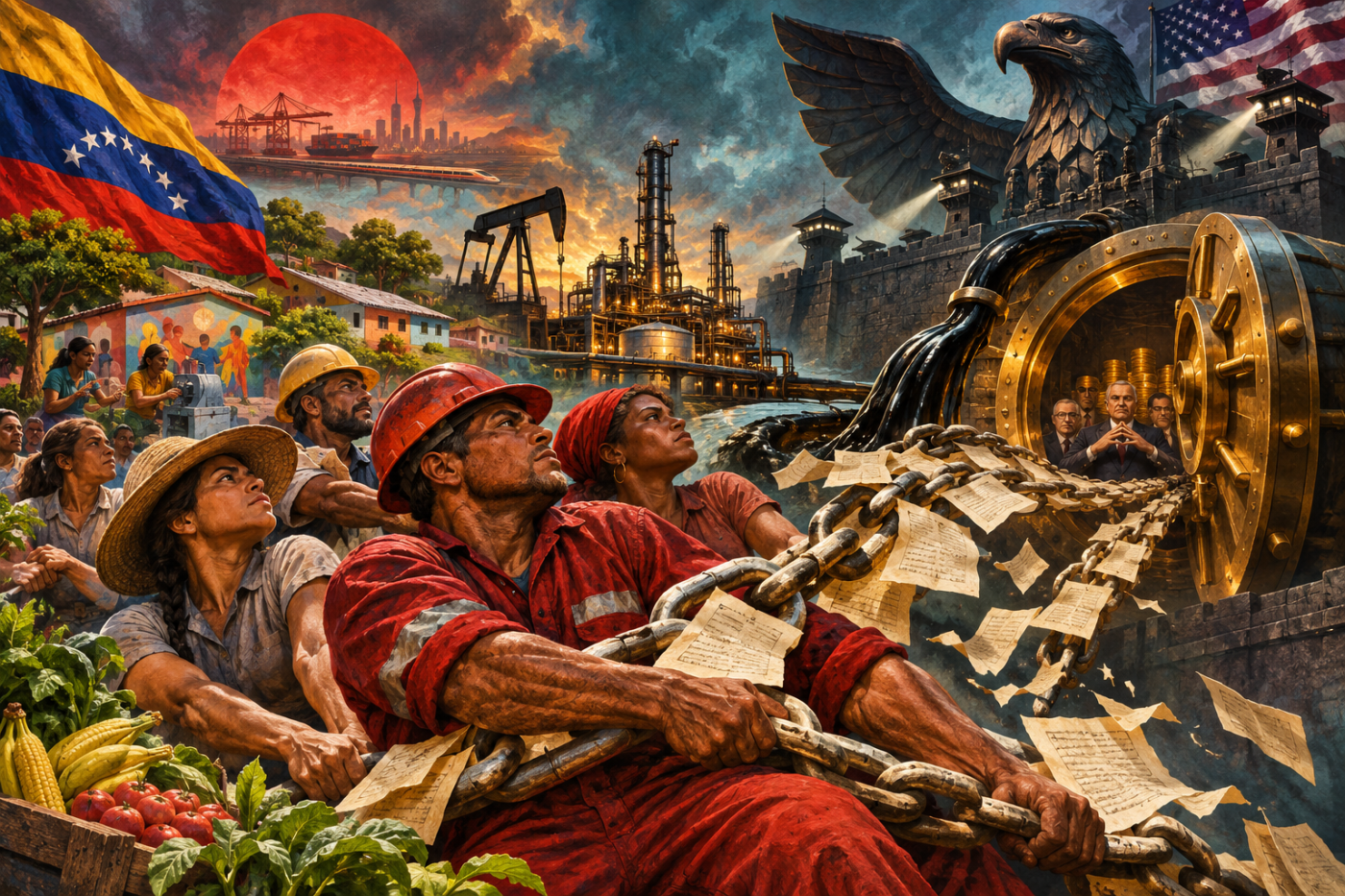
While Reuters celebrates the renewed confidence of international bondholders, the historical relationship between Venezuela’s indebtedness and Washington’s economic siege goes largely unexplored. From financial sanctions and distressed-debt speculation to petroleum concessions and geopolitical restrictions on debt restructuring, the imperial state is assembling mechanisms through which the coercion of yesterday can become the financial command of tomorrow. Venezuela’s prospective reconstruction represents a strategic front in the construction of the American Pole and the New Cold War against China and sovereign-development multipolarity. But Venezuela’s workers and communards are fighting for an altogether different future, one in which the wealth they produce becomes the material foundation of communal socialism rather than the collateral of a declining empire.
Prince Kapone | Weaponized Information
November 24, 2026
The Bondholders’ Good News
There’s something beautifully obscene about the way capitalism keeps its books. On November 24, 2026, Reuters journalists Mayela Armas, Libby George and Rodrigo Campos reported in U.S. News & World Report that Venezuela’s public debt amounted to a “whopping” $237.5 billion, equivalent to 242 percent of its gross domestic product at the end of 2025. International investors apparently found something to smile about. Venezuelan sovereign bonds and securities issued by the state petroleum company, PDVSA, jumped more than four cents on the dollar. The prospect of collecting on an indebted nation’s obligations is good news for those who own them. Whether it’s equally good news for those who’ll have to pay them is another matter altogether.
Pay close attention to the historical sequence Reuters constructs. Venezuela had been largely shut off from international finance since Washington imposed financial sanctions in 2017, but the country re-engaged following what the journalists call the “shock January seizure” of Nicolás Maduro by U.S. forces. Both the sanctions and the military intervention make it into the story, yet the kidnapping of a Venezuelan president serves principally as a chronological marker on the road toward financial rehabilitation. Washington sends in the troops, international financial engagement resumes, and before long we’re discussing economic recovery. Apparently, even imperial aggression can acquire an air of respectability once somebody puts a damn spreadsheet in front of it.
The Venezuelan government’s commitment to a “clear and credible” restructuring plan is immediately interpreted through the anxieties of investors who fear suffering greater losses under fragmented negotiations. Reuters even sought comment from the Venezuela Creditor Committee, yet the perspectives of Venezuelan workers, pensioners and communal producers are entirely absent from the report. The devastating June earthquakes enter the story because they complicated efforts to assess the economy. The people digging themselves out of the rubble remain nameless, while the financial interests awaiting repayment have an organized voice.
Buried near the bottom of the dispatch is a rather revealing figure: of Venezuela’s $110.1 billion in Eurobond obligations, $45.9 billion consists of past-due interest. More than forty percent of those obligations demands a historical explanation that Reuters never supplies. Meanwhile, projections of rising petroleum production and a more than doubling dollar-denominated economy tell us how much Venezuela expects to produce without telling us a damn thing about who’ll appropriate the additional wealth or how it’ll be distributed.
The report reproduces the Venezuelan government’s explicit identification of financial sanctions among the causes of its unsustainable debt. That admission raises a rather uncomfortable question for the reassuring narrative of financial normalization: what relationship exists between the restrictions that helped deepen Venezuela’s indebtedness and the financial claims whose prospective settlement is now exciting international investors? Before we shed any tears over the possible losses of the bondholders, we’d better investigate how they came to possess such enormous claims upon Venezuelan wealth in the first bloody place.
How the Siege Became a Balance Sheet
Venezuelans have been down this road before. When rising U.S. interest rates and mounting foreign debts plunged the country into financial crisis in the 1980s, creditors demanded payment from an economy dependent upon petroleum exports. Debt restructuring and economic adjustment consumed resources needed for national development. By February 1989, the population had absorbed about as much of this economic wisdom as it could stomach. The popular uprising known as the Caracazo shook the political establishment and helped prepare the ground for the Bolivarian Revolution. Chávez redirected petroleum wealth toward healthcare, education and popular development, although overcoming the inherited structure of petroleum dependency proved a considerably longer historical undertaking.
Washington knew where to apply pressure. Venezuela was already experiencing economic contraction and declining petroleum revenues when international banks began restricting its financial transactions. Venezuelan economist Pasqualina Curcio documented how banking and payment restrictions complicated the country’s efforts to honor and refinance its obligations. Trump’s August 2017 Executive Order 13808 restricted new government and PDVSA borrowing just months before Caracas attempted to restructure its debts. Default followed, and subsequent sanctions against the petroleum industry further impaired Venezuela’s capacity to earn the foreign exchange necessary to pay its creditors.
The government’s Venezuela Renace economic framework records the accumulated consequences of several distinct historical processes. Approximately $64.2 billion in Eurobond principal carries another $45.9 billion in past-due interest. The wider inventory includes $16.9 billion owed to China Development Bank, $26.3 billion in arbitration liabilities and roughly $35 billion in specified internal PDVSA obligations, including employee pension liabilities. Caracas reserves the right to contest individual claims. Some obligations originated in borrowing, others accumulated during default, and still others arose from struggles over productive property. In December 2025, a Delaware judge authorized the sale of CITGO’s parent-company shares to an Elliott Management affiliate. Corporate disputes arising partly from Venezuelan nationalizations had become financial claims enforceable against other Venezuelan assets.
On October 18, 2023, the U.S. Treasury authorized secondary-market transactions in specified Venezuelan securities while maintaining restrictions on primary-market financing. Investors could purchase outstanding bonds without a penny of that money reaching Venezuela. Securities that had traded at exceptionally depressed prices appreciated following January’s aggression. Then came General License 58, issued May 5, 2026. Treasury authorized preparatory financial and legal services but excluded actual restructuring, settlements and direct creditor negotiations from that authorization. Paragraph (b)(4) also excluded transactions by persons located in China, Russia, Cuba, Iran and North Korea, alongside their specified corporate affiliates and joint ventures. Even the permission to prepare a damn debt settlement came with Washington’s geopolitical restrictions attached.
Meanwhile, January’s Hydrocarbons Law reform preserved public ownership of petroleum deposits while expanding private operational and commercialization rights. Article 26 allows contractual adjustments to restore agreed economic conditions when subsequent regulatory or fiscal changes materially undermine them. The January 9 executive order governing petroleum revenues recognizes designated funds as Venezuelan sovereign property, protects them from creditor attachment and places their disposition under the authority of the U.S. Secretary of State. Subsequent licenses directed specified royalties and petroleum taxes into U.S.-controlled accounts. The money belongs to Venezuela; Washington decides when it can be released.
Long before the intensified siege, Caracas had developed alternative financing relationships with China through development funds and petroleum-linked repayment agreements. Chinese enterprises also helped rehabilitate productive infrastructure, including a Lake Maracaibo drilling project in 2025. These relationships became increasingly important under sanctions. Following January’s intervention, Chinese petroleum shipments encountered disruptions while Washington’s petroleum licenses expanded Western corporate access and excluded specified transactions involving several of Venezuela’s longstanding international partners.
By September, Venezuelan businessman Alejandro Betancourt’s North American Blue Energy Partners had secured an announced arrangement covering 17 oilfields. Under its proposed terms, the Pentagon’s Office of Strategic Capital would acquire a 35 percent equity stake through nominal-cost warrants, alongside Washington’s authority over corporate governance. The United States would obtain purchasing rights over one-fifth of production at cost and first refusal over the remainder. The White House’s own announcement connects these arrangements to strategic reserves, military supply, emergency energy access and the displacement of Chinese and Russian operators. Venezuela’s National Assembly, confronting urgent domestic needs, defended the agreement as a means of financing public services and workers’ incomes.
The November framework projects $160 billion in petroleum investment through 2036, with Productive Participation Contracts expected to account for more than half of output. Its fiscal program combines reduced petroleum subsidies and increased consumption-tax revenues with projected improvements in public investment and pensions. Renewed multilateral financing remains anticipated rather than secured through a binding IMF program. Meanwhile, earthquake reconstruction demands substantial resources, and Venezuelan workers have their own bloody priorities. On November 16, education and healthcare workers stopped work, rejecting a $150 year-end bonus and demanding $960. Unions are also fighting to incorporate bonuses into legally recognized wages and restore collective bargaining. October’s food basket for five people cost $744.55; an individual public-sector worker’s monthly income floor, including bonuses, stands at $240.
In Caracas, the 5 de Marzo Comandante Eterno Commune operates Somos Karive, a socially owned enterprise processing meat, distributing groceries and treating water. Its administrators answer to the commune, and its social reinvestment fund supports community activities. Yet communard economist Andy Hernández describes persistent difficulties financing reinvestment, supporting producers and competing against private businesses. Nationwide popular consultations allow communities to determine local investment priorities, but the resources available fall far short of their needs. The communards are fighting for greater authority over national petroleum wealth so they can expand their own productive capacities. The resources they require to build that future are precisely the resources over which international creditors, petroleum corporations and Washington are negotiating their own claims.
Mortgaging the Revolution’s Future
Capital has a remarkable capacity to make money out of the destruction of wealth. While Venezuelan workers struggled to keep machinery running, hospitals functioning and food on the table, financial claims against their country accumulated. A bond entitles its owner to anticipated income, and its market price reflects what investors expect to collect and how likely they think they’ll be to collect it. Marx called this fictitious capital. The property claim is real enough, but its appreciation doesn’t represent the creation of additional productive wealth. Washington can change the political conditions governing repayment and send bond prices soaring before Venezuelan workers have produced another barrel of oil.
Imagine the generosity of a financier who purchases distressed Venezuelan debt for pennies on the dollar and subsequently agrees to accept considerably less than its original face value. The newspapers may applaud his willingness to take a loss, even though he stands to collect several times his original investment. Venezuela could obtain genuine debt relief while the financier makes a killing. For mature monopoly capitalism, which generates enormous concentrations of surplus capital without a corresponding expansion of sufficiently profitable productive investment opportunities, financial speculation offers an attractive outlet. The economic catastrophe of an entire country becomes somebody else’s investment opportunity.
Washington’s siege helped manufacture the conditions for precisely this kind of accumulation. Treasury officials restricted Venezuela’s capacity to refinance its obligations while subsequently restoring opportunities for investors to acquire them. Military intervention changed the prospects for repayment. Restructuring could now consolidate the results of that coercion in a new generation of financial obligations, while petroleum contracts protecting agreed economic conditions could make subsequent changes in national development policy costly. Future Venezuelan governments would confront the consequences of decisions extracted under duress through the routine administration of contracts and public budgets. This is what Weaponized Information means by sanctions-to-structure conversion. The imperialists can relax the siege once they’ve mortgaged the recovery.
But Washington’s ambitions extend considerably beyond enriching bondholders. Petroleum companies require substantial investment to rehabilitate production, whereas creditors want income extracted from the economy. Allow every capitalist to descend upon Venezuela’s assets according to his immediate private interests and they could undermine the productive foundations upon which their collective fortunes depend. By protecting designated petroleum revenues from individual creditor seizures while retaining authority over their disposition, Washington can discipline particular capitalists in the interests of a broader accumulation project. The Pentagon’s proposed participation in NABEP takes this relationship further, combining corporate ownership, managerial authority and preferential access to petroleum. The imperial state can organize a profitable investment field while securing strategic energy supplies for purposes extending beyond the commercial interests of the enterprise itself.
Here we encounter the political economy of Fortress America. U.S. monopoly-finance capital confronts a world in which its enormous accumulated wealth and coercive capacities no longer guarantee cheap and dependable imperial command. Washington’s response is imperial concentration, securing tighter authority over the resources and economic relationships indispensable to its continued power. The American Pole is the emerging bloc-form of this recalibration; Fortress America is the architecture through which it’s being constructed. Venezuela’s particular form of incorporation joins external command over present petroleum circulation to prospective financial claims upon future production. The imperialists are attempting to fortify their position geographically while extending the economic consequences of their intervention across generations.
They require functioning Venezuelan institutions to accomplish this. Somebody has to administer the oilfields, collect the taxes and negotiate the contracts. Yet those institutions are themselves products of Venezuelan history and revolutionary struggle. They retain capacities for defending public property, bargaining with foreign capital and sustaining popular development, even as the government negotiates arrangements that strengthen capitalist economic authority. That’s the contradiction of the surviving Bolivarian state. Washington seeks political command over institutions whose historical purposes stand in the way of its imperial project. Whether those institutions become instruments of externally conditioned accumulation or vehicles of renewed sovereign development remains a question of class struggle.
The New Cold War against China enters this struggle through the financial machinery itself. Venezuela’s relationships with China furnished alternative sources of credit, productive equipment and markets, enlarging the country’s capacity to pursue independently determined development. Treasury’s geopolitical exclusions now reach into the preparation of debt restructuring as well as petroleum production. Washington needn’t extinguish every Chinese financial claim or prohibit every barrel of oil sold to China. Even if Caracas honors its existing bilateral obligations, the institutions through which it obtains future development finance could be reorganized around Western financial command. There’s a world of political difference between negotiating an agreement with another sovereign country and requiring the permission of a third country to carry it out. The struggle against multipolarity is a struggle to deprive nations of that freedom.
And Venezuela could grow considerably within the structure Washington seeks to consolidate. External obligations require foreign exchange, which gives petroleum exports renewed priority in the allocation of investment. The more national development depends upon expanding those exports, the more vulnerable the country remains to the financial and commercial institutions governing their circulation. Meanwhile, resources needed to develop agriculture, domestic industry and communal production must compete with external financial claims. This is how recovery can reproduce dependency. Caracas may genuinely improve wages, pensions and public infrastructure while simultaneously strengthening the economic relationships that constrain its future development. The fight over who’ll absorb the costs of adjustment will be fought through taxation, subsidies, collective bargaining and the purchasing power of Venezuelan workers.
The communards are struggling to break that vicious circle by organizing accumulation on different foundations. When a collectively administered enterprise produces food and reinvests its earnings in productive equipment, community infrastructure and the development of other producers, the surplus expands the material capacities of the community itself. Every successful expansion can strengthen collective economic authority. But these enterprises must reproduce themselves within an economy where private capital still commands considerable resources and where access to national petroleum wealth remains limited. Their struggle for greater control over that wealth concerns the ability to expand socialist relations of production beyond the confines of individual communes. What good is national ownership of petroleum if the organized producers of society lack the power to determine its economic employment?
Herein lies the revolutionary significance of sovereign-development multipolarity. The emergence of alternative international relationships creates material possibilities for national liberation, but organized popular power must determine the social content of the development those relationships make possible. Venezuela’s workers and communards confront a struggle on both fronts: recovering sovereign authority over their country’s international economic relations and expanding collective command over its productive wealth. The architects of Fortress America seek to reconstruct Venezuela as a profitable resource base for the American Pole. The revolutionary forces within Venezuela seek to employ that same wealth to reproduce and expand the institutions of communal socialism. The struggle over debt is ultimately a struggle over which of these social orders the labor of subsequent generations will be made to sustain. And no damn financial institution has the right to settle that question for them.
Put the Wealth Back in the People’s Hands
Those of us living inside the imperial command center have responsibilities of our own. It’s easy enough to sit comfortably in the United States and lecture Venezuelans about the concessions their government should or shouldn’t make under military and economic coercion. It’s considerably harder to organize against the ruling class imposing those conditions. But that’s where our immediate political responsibility lies. The same ruling class that mobilizes public resources to secure petroleum concessions and investment opportunities abroad tells American workers there’s insufficient money for healthcare, housing and education. We’ve got no damn interest in helping these people build their fortress.
The SanctionsKill campaign to recover Venezuela’s stolen wealth provides a concrete starting point. Bring its demands into trade unions, community organizations and antiwar coalitions through the Venezuela Solidarity Network. Organize public meetings, demonstrations and congressional advocacy demanding the termination of Treasury’s coercive licensing restrictions, the release of frozen Venezuelan assets and the restoration of autonomous Venezuelan control over petroleum revenues held under U.S. custody. Demand public disclosure and congressional scrutiny of the arrangements through which Washington controls those funds. Venezuela’s freedom to trade, borrow and cooperate with other nations shouldn’t depend upon the political preferences of officials sitting in Washington.
International solidarity must also support the struggle to establish who legitimately owes what to whom. The citizen-led debt audit advocated by CADTM provides a basis for political education and public scrutiny of original borrowing conditions, creditor ownership, previous repayments, accumulated interest and arbitration claims. Such an accounting must also examine the Venezuelan assets immobilized abroad and the financial consequences of the sanctions themselves. The creditors have organized committees, lawyers and financial advisers to defend their property claims. Venezuelan workers have every damn right to organize their own scrutiny of the obligations their labor will be expected to service. The authority to determine which debts are legitimate and what settlement serves national development belongs to Venezuelans themselves.
Above all, internationalists should cultivate relationships with the organized forces carrying forward the socialist content of the Bolivarian Revolution. Study the program of Unión Comunera in our unions and political organizations, translate and circulate its materials, and develop direct relationships with communal producers on their own terms. The experiences documented by the International Peace Brigade demonstrate how international solidarity can become a process of mutual political education. Venezuelan communards are confronting practical questions of socialist production, collective administration and economic democracy from which working people everywhere can learn.
The struggle against Fortress America demands solidarity with nations fighting to determine their own development and with the workers fighting to give that development socialist content. Venezuela’s petroleum wealth must furnish the material foundations for rebuilding its communities and expanding the productive power of its communes. The people repairing the infrastructure, working the oilfields, cultivating the land and rebuilding the schools will produce the wealth upon which Venezuela’s recovery depends. That gives them a claim far more fundamental than anything recorded in a bondholder’s ledger. Their future isn’t Washington’s property to mortgage, and it sure as hell isn’t Wall Street’s to collect.


Leave a Reply