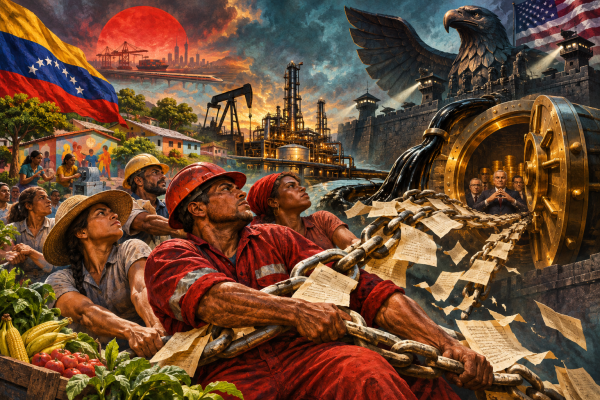
While Reuters celebrates the renewed confidence of international bondholders, the historical relationship between Venezuela's indebtedness and Washington's economic siege goes largely unexplored. From financial sanctions and distressed-debt speculation to petroleum concessions and geopolitical restrictions on debt restructuring, the imperial state is assembling mechanisms through which the coercion of yesterday can become the financial command of... Continue Reading →
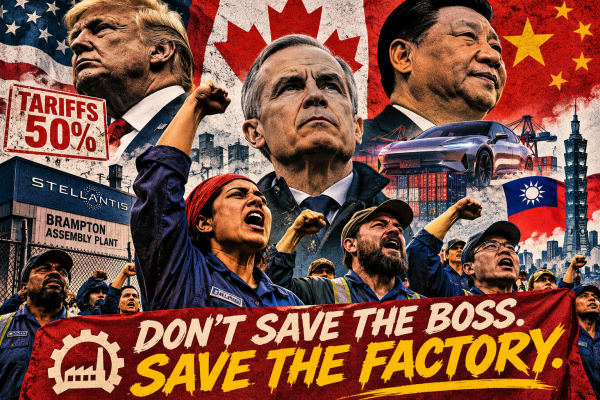
Beware Beijing’s Leash, Sign Washington’s Contract: Taiwan, Canada, and the Price of Economic Independence
The Associated Press gives Taiwan's deputy foreign minister a platform to warn Canada about Chinese economic coercion while Washington's ongoing economic assault on Canadian industry fades conveniently into the background. Behind that warning lies an automotive industry battered by decades of continental integration, corporate abandonment, and trade arrangements that left Canadian workers defending factories they... Continue Reading →
The Deed Stays in Caracas: How Washington Commands Oil It Doesn’t Own
Delcy Rodríguez's shocking pivot from anti-imperialist rhetoric to endorsing U.S. oil agreements is less a political betrayal and more an unveiling of Venezuela's fractured sovereignty. The narrative is explosive: as Washington tightens its grip, national ownership of oil assets becomes a hollow claim, with real power shifting to private capital and American influence. The illusion of control is shattered—Venezuelans are left to wrestle with a new reality where contracts dictate who profits from their resources. The stakes are high, as demands for transparency and public scrutiny grow louder; will the oil wealth truly benefit the people, or simply reinforce the power structures in play?
The Worker Becomes Optional: The Wage Still Demands Your Life
Bill Gates has finally acknowledged a truth that capitalists prefer to ignore: as AI and automation advance, corporations can reduce their reliance on human workers, yet those workers still need jobs to survive. This dystopian paradox manifests as corporations accumulate vast fixed capital while employing fewer people, leading to increasing labor insecurities. The state, ostensibly aiding automation's growth, is simultaneously crafting systems to manage this emerging class of excess workers. Gates proposes measures to protect jobs, but under capitalism, preserving employment becomes essential simply for survival, distorting the very essence of technological progress into a means of perpetuating exploitation rather than liberating humanity from labor.