James Traub's exploration of America's dual origins through the Mayflower and the White Lion is dangerously simplistic. He perpetuates a narrative of moral dichotomy, ignoring the harsh reality that both journeys fueled a settler-capitalist machine built on land theft and enslavement. The framing minimizes Indigenous dispossession and reduces oppressed voices to mere historical subjects. This liberal attempt at reconciliation fails to confront the brutal interdependence between North and South, leaving unchallenged the systemic inequities rooted in conquest and exploitation. Rather than embracing a flawed myth of unity, America must confront its history to dismantle the ongoing consequences of its oppressive foundations.
No Freedom Without Power: Machiavelli, Rome, and the Republic Built on Ruins
Machiavelli’s The Discourses is not a genteel treatise on republican ideals but a gritty how-to on wielding power from the depths of defeat. This work confronts the myth of liberal innocence, asserting that liberty arises not from consensus but through chaos, violence, and organized resistance against domination. Machiavelli's insights expose the harsh realities of historical conflict and the necessity of institutional discipline, emphasizing that true power is built on struggle, not sentiment. Yet, amidst its rich lessons, The Discourses reveals a troubling contradiction: the same republic that fosters internal liberty thrives through imperial conquest and exclusion. This duality beckons revolutionaries to seize its pragmatic lessons while rejecting its imperial legacy.
The Throne Was Always Cracked: Radhika Desai and the Myth of American Hegemony
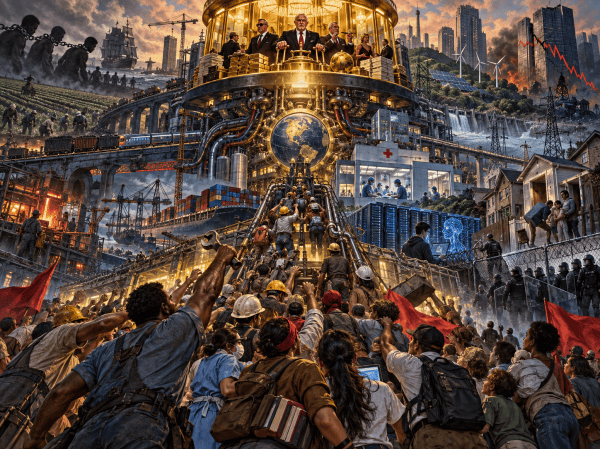
Radhika Desai’s Geopolitical Economy obliterates the illusion of a stable, American-led world, revealing that capitalism thrives on conflict, not unity. The book exposes capitalism’s instability, punctuated by crises that merely reshift the burdens onto workers and debtor nations. Desai argues for a multipolar world not as a peaceful transition to a new hegemon, but as a rupture from monopolistic control, fostering opportunities for sovereign development and socialist planning. However, liberation demands that working people reclaim the means of production and governance. The narrative warns against complacency; the emerging multipolarity is ripe for struggle, shaping the future based on who wields power over resources and development.
Capitalism After the Robbery: Adam Smith, the Wealth of Nations, and the Clean Alibi of Bourgeois Political Economy
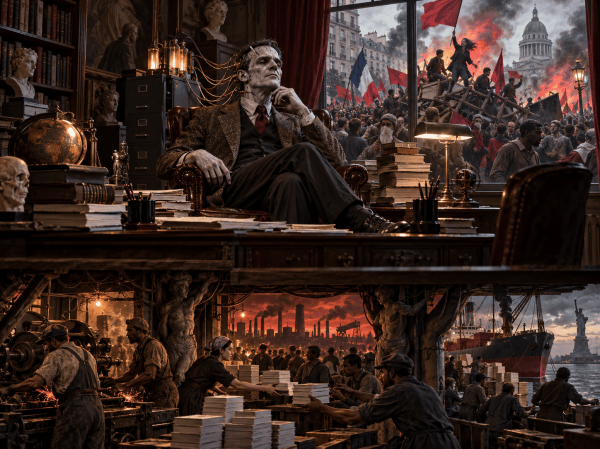
Adam Smith’s The Wealth of Nations is a twisted tale masquerading as a free-market manifesto, one that defies the naive faith bestowed upon it by neoliberals. It exposes capitalism's fundamental contradictions, revealing how labor produces wealth while class divides it unjustly. Smith acknowledges the state's crucial role in maintaining this order, contradicting the myth of an autonomous market. He scrutinizes colonialism and monopoly yet ultimately upholds capitalist structures. Historical materialism challenges his framework, demanding accountability from the beneficiaries of this exploitation. As we dissect Smith's insights, we unearth his omissions, seeking a world where labor governs—transforming capitalism's alibi into an indictment of its foundation.
The World Was Not Discovered: Genocide, Slavery, and the Birth of Capitalist Empire
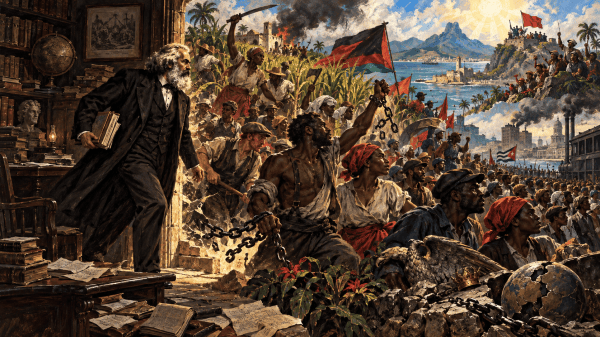
History is often told from the perspective of conquerors, romanticizing imperialism as a noble endeavor of “discovery.” However, this narrative ignores the vibrant, complex societies that existed long before European arrival; civilizations rich in culture and knowledge prepared to resist. The so-called “Age of Discovery” merely facilitated violent conquest, genocide, and exploitation. Colonialism and capitalism are intertwined, with wealth extracted through enslavement and land theft, while underdevelopment in colonized regions resulted from this systematic violence. Today, the consequences of colonialism persist, as neo-colonial strategies manipulate economies and suppress sovereignty. To reclaim the future, societies must confront this history, recognize the pain of oppression, and organize for a just world, free from the chains of empire.
The Devil’s Republic: Illuminati Panic and the Hidden Architecture of American Repression
The American ruling elite has a long history of morphing political dissent into a narrative of demonic threat, consolidating their power through fear tactics akin to those seen during the Illuminati panic of the 18th century. This episode illuminated how conspiracy theories, fueled by elite anxieties, have criminalized immigrants and suppressed dissent. The manipulation of societal fears allows the state to transform opposition into an existential threat, justifying repression and surveillance. Today's conspiracism, though often dismissed as irrational, reveals a deeper urgency: a misdirected anger at real systemic injustices commodified into scapegoating narratives, obscuring the true architecture of capitalist power while paralyzing collective political action.
The World System Before European Hegemony: How the West Hijacked a System It Did Not Build
Janet Abu-Lughod's "Before European Hegemony" ruthlessly dismantles the myth that Europe rose to global prominence due to inherent superiority or brilliance. Instead, it reveals a pre-existing world economy crafted by diverse, thriving civilizations from which Europe, late to the game, benefited through exploitation and rupture. By tracing this narrative, Abu-Lughod forces us to confront uncomfortable truths: Europe did not create history; it emerged through the erosion of powerful systems created by others. History wasn’t predestined; it was violently reshaped.
Africa Against the World Market: Hosea Jaffe, Imperialism, and the Long Struggle for Liberation
A Weaponized Intellects review of A History of Africa that excavates Hosea Jaffe’s uncompromising analysis of colonialism, class formation, and imperial domination—situating his intervention within the liberation struggles of his time and assessing its enduring relevance for understanding Africa, the world system, and the unfinished project of revolutionary transformation today. By Prince Kapone | Weaponized... Continue Reading →
The War Over Totality: Engels, Science, and the Limits of Western Marxism
An uncompromising review of Sven-Eric Liedman’s The Game of Contradictions, tracing his reconstruction of Engels’s engagement with Hegel, science, and ideology while testing whether his critique clarifies the contradictions of dialectical materialism or disarms the communist struggle for totality. By Prince Kapone | Weaponized Information | Weaponized Intellects Book Review | April 12, 2026 Against... Continue Reading →
The Fool Who Moved the Mountains Still Walks Among Us: China’s Long March to Socialism and the Emergence of the Multipolar World Order
From Mao’s seizure of sovereignty to Xi’s effort to discipline capital, China’s modern history is neither a fall from revolutionary purity nor a smooth ascent into capitalism, but a protracted socialist struggle through contradiction. Each phase of development generated new class forces, new dangers, and new strategic adjustments, as the Party-state sought to preserve political... Continue Reading →