USAID did not simply deliver humanitarian aid—it institutionalized a model of empire that fused relief, civil society, media, governance, and development into the machinery of U.S. foreign policy. Excavating an NPR interview with former USAID Administrator Samantha Power, this essay exposes how liberal narratives of compassion obscure the agency's role inside the broader NGO-industrial complex. Drawing on anti-imperialist scholarship and Global South perspectives, it argues that the real choice is not between aid and no aid, but between imperial dependency and sovereign development. The struggle ahead is to defend the people harmed by aid cuts while dismantling the donor architecture that transforms solidarity into supervision.
The Empire’s Cheapest Deputies: How Liberal Media Turns White-Worker Disillusionment Into Political Defeat
The Guardian correctly rejects the liberal fantasy that MAGA is merely “economic anxiety,” but it turns a crack in the settler bargain into a locked door. Trump 2.0 is not the grassroots program of white workers but the ruling-class recalibration of labor discipline, border terror, tariff nationalism, and imperial decline. The racial wage remains real,... Continue Reading →
NATO 3.0: The Empire Rebrands Its Launchpads
NBC’s coverage of Pete Hegseth's outburst in Brussels starkly reveals a deeper imperial narrative: NATO is a glorified framework for U.S. militarism, demanding European complicity. Instead of a cooperative alliance, it illustrates a machinery of war where access to land and resources is treated as a given entitlement. The jargon of "burden-sharing" and "NATO 3.0" drapes the insistence on militarized obedience in a veneer of unity. The article neglects dissenting voices, such as the European populations and their rights, instead framing hesitation as irresponsibility. This is not a mere operational adjustment; it’s a clarion call to recognize and resist the underlying realities of imperialism masquerading as alliance-building.
Berlin’s Boardrooms, NATO’s Generals, and Beijing’s Factories: Germany’s Trade Deficit and the Crisis of Imperial Supremacy
A romance metaphor conceals structural strain. The trade ledger exposes export contraction and rising militarization. Industrial rivalry is recoded as security doctrine. Workers and colonized nations confront the costs—and the opening.By Prince Kapone | Weaponized Information | February 19, 2026When the Empire Calls It Heartbreak Our excavation begins with a February 19, 2026 piece from... Continue Reading →
Carney, NATO, and the War Contractors: How Canada’s “Sovereignty” Pivot Deepens the Military Bloc
The New York Times sells a procurement shift as national independence. The numbers reveal a structural escalation anchored in NATO and continental integration. The pivot redistributes contracts while entrenching a war-oriented political economy. Workers and movements face a choice: defend the arms budget or reorganize production itself.By Prince Kapone | Weaponized Information | February 16,... Continue Reading →
The K They Drew, The System They Hid: Confidence, Concentration, and the Architecture of a Split Economy
Wall Street calls it sentiment. Corporate media calls it divergence. But beneath the alphabet metaphors lies a decades-long transfer of wealth, power, and sovereignty from labor to capital. The numbers do not describe a mood swing. They describe a system working exactly as designed. By Prince Kapone | Weaponized Information | February 11, 2026 When... Continue Reading →
Trump, ABC, and the Monopoly Class: Tariffs, Tax Cuts, and the Crisis of Imperial Political Economy
Corporate media frames tariffs as a consumer morality tale while shielding monopoly power. The data reveals regressive burdens, profit expansion, and geopolitical escalation beneath the headline numbers. Trade warfare emerges as imperial recalibration in a fading unipolar order. Labor, colonized nations, and multipolar movements must organize where the contradictions already burn.By Prince Kapone | Weaponized... Continue Reading →
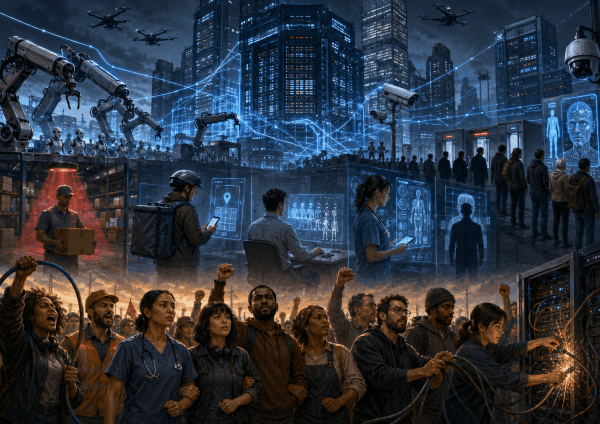
The Pole and the Cage: Fortress America, Technofascism, and the Labor Regime of Imperial Decline
The U.S. economy is generating profits without integrating people into stable life. Domestic labor is being recalibrated through precarity, surveillance, and managed migration. Fortress America turns the hemisphere into a disciplined rear-base of corridors, minerals, and compliant labor. The American Pole and technofascism are one system—an empire tightening the enclosure at home and abroad.By: Prince... Continue Reading →
Taking the Sign Out of the Window: Mark Carney, Middle Powers, and the Managed Truth of a Fortifying World
At Davos 2026, Canada’s prime minister declares the rules-based order dead and urges “honesty” about power. But beneath the rhetoric of truth lies a disciplined strategy for stabilizing imperial hierarchy, fortifying the middle powers, and managing decline without rupture. By Prince Kapone | Weaponized Information | January 24, 2026When the Lie Stops Paying the Rent... Continue Reading →
Lutnick, Carney, and the Politics of Permission: How USMCA Discipline Turns Trade Into Obedience
A U.S. trade official scolds Canada for stepping outside its assigned lane, revealing how power speaks through “commentary.” The facts show a bounded policy shift unfolding inside an unstable trade and industrial landscape the story refuses to name. Placed in historical and imperial context, the outrage reads less as economics than as enforcement of hierarchy... Continue Reading →