The Corpse Got Tenure: French Theory’s American Afterlife
Requiem for French Theory asks a question academia prefers to leave buried: how did a heterogeneous group of French thinkers become a unified radical canon in the United States? Monville and Rockhill trace the foundations, universities, publishers and Cold War institutions that helped make French Theory travel, but the deeper story is more dialectical than conspiracy. Foucault, Derrida, Deleuze and others confronted real contradictions and produced genuine insights even as their work was selectively reproduced, professionalized and detached from mass struggle. The lesson reaches Marxism itself: revolutionary theory needs more than correct ideas. It needs its own means of intellectual production.

Lenin’s Imperialism: The World Is Socialized, the Loot Stays Private

Lenin's "Imperialism, the Highest Stage of Capitalism" exposes the dark underbelly of capitalism, where economic forces and political power dance in a shadowy masquerade. He reveals how imperialism is not a mere side-effect of states' ambitions but a complex product of capital's relentless quest for profit, driving nations to export capital rather than just goods. The document reflects the sinister dynamics that create monopolies, establish financial oligarchies, and differentiate classes within the proletariat, suggesting that even workers can become complicit in their subjugation. This analysis remains crucial today, as it compels us to question ownership and control within our increasingly interconnected world.

The Wall Produces the Ladder: How America’s China Scare Turns Exchange Into Evidence of Threat

China’s Young Envoys program is openly political public diplomacy, but that is not the same thing as communist indoctrination, infiltration, or espionage. This essay excavates how KOMO and Defending Education turn educational exchange into a national-security threat by collapsing contact, influence, ideology, and subversion into one Red Scare narrative. Beneath the panic lies a deeper contradiction: U.S. efforts to isolate China generate the very Chinese counter-communication then cited as proof that greater isolation is necessary. The result is a narrow imperial provincialism that treats direct encounter with another civilization, its ideas, and its socialist project as something Americans must be protected from.

Sovereign Enough to Steal From: How American Law Turns Conquest Into Governance

Ward Churchill’s Perversions of Justice exposes the legal machinery through which Indigenous sovereignty is recognized just enough to legitimize treaties, land cessions, resource extraction and colonial administration—then restricted whenever it threatens settler possession or state power. Following that contradiction from conquest and property into uranium mining, blood quantum, AIM repression and U.S. imperial expansion, this review tests both Churchill’s strongest insights and his strategic limits. His final wager—that the colonizer’s own law can be weaponized to fracture legitimacy and withdraw consent—remains powerful. But the deeper revolutionary question is what turns that rupture into organized material counter-power.

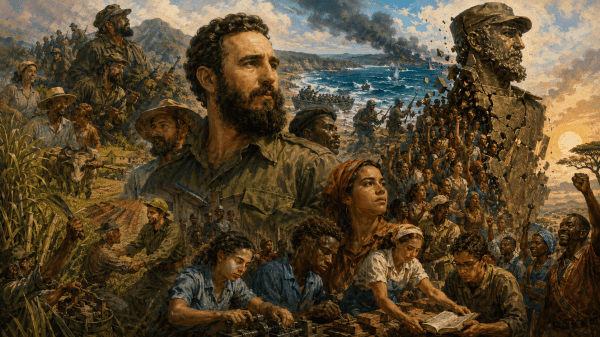
The Revolution Must Keep Making Revolutionaries: Fidel Castro and the Fight Against Becoming a Monument

On the centenary of Fidel Castro's birth, his autobiography, My Life, acts as a provocative lens into the complexities of revolution. It dismantles the myth of the born revolutionary, showcasing instead how context, struggle, and learning forge warriors for change. Despite Cuba's successes, deep-rooted issues like racism and inequality persist, with Fidel warning that Cuba's most significant threat may not come from external forces but from within—its own inability to correct mistakes. As the Revolution ages, the pressing query remains: can it continually foster revolutionary consciousness amidst evolving contradictions or will it succumb to the complacency that often follows victory?

Website Powered by WordPress.com.

Up ↑