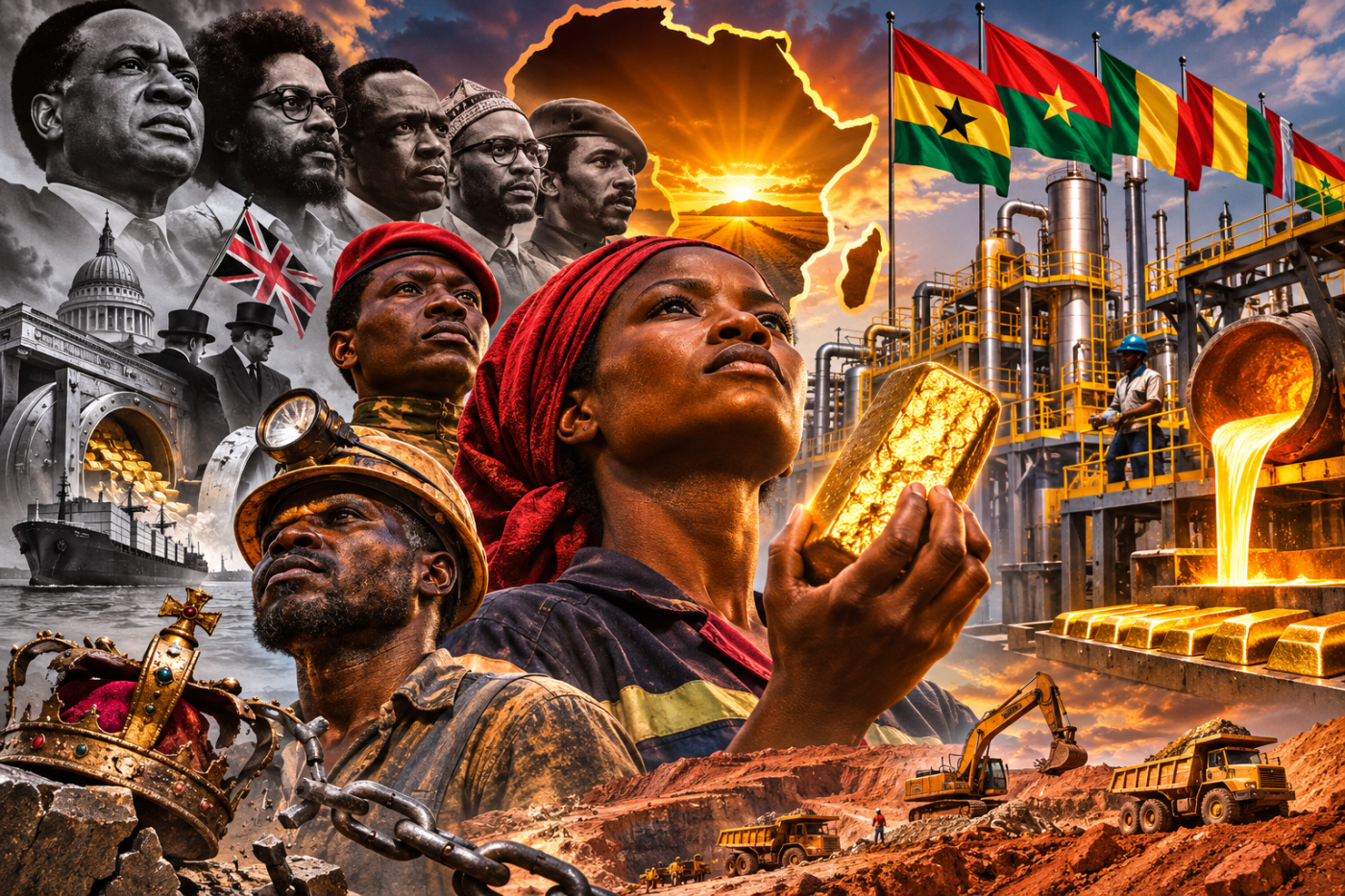
Reuters warns that West Africa’s struggle to refine its own gold could produce excessive industrial capacity, but the economic conditions against which it measures African development are themselves products of colonial plunder and neocolonial extraction. From Burkina Faso’s refinery and Mali’s public mining enterprises to Ghana’s reorganization of gold commerce and Guinea’s struggle to retain export earnings, African governments are reclaiming successive links in a chain of accumulation historically directed toward enriching other societies. The genuine contradictions emerging from these national industrial programs vindicate Kwame Nkrumah’s revolutionary analysis of African economic fragmentation and the material necessity of continental integration. The unfinished struggle for African liberation demands an integrated economy in which the people whose labor produces the continent’s wealth possess the power to determine its destiny.
Prince Kapone | Weaponized Information | November 24, 2026
I. When Africa Builds Too Much
In a November 24 dispatch for Reuters, Maxwell Akalaare Adombila delivers some apparently troubling news from West Africa. With gold prices rising, the region’s governments are building refineries to retain more of their mineral wealth and reduce their dependence on overseas processing. Reuters puts their combined refining ambitions at more than 1,000 metric tonnes annually against an estimated regional production of 585 tonnes. Whether these investments make economic sense is a perfectly legitimate question. But whose economics are we talking about, and whose interests determine what makes sense?
The headline already has its answer half prepared. African governments are in a “rush,” unleashing a “flood” of refining capacity. Here are countries sitting on enormous mineral wealth, developing the industrial means to process it themselves, and the international business press reaches for the language of natural disasters. Apparently, one of the great dangers confronting Africa today is that Africans might build too many damn factories.
Then comes the arithmetic. Under the subheading “More Refineries Than Gold,” Reuters aggregates projects at different stages of development without providing a facility-by-facility accounting of their capacities, commissioning schedules or anticipated sources of supply. Yet Dean Subramanian, chief executive of Rand Refinery, raises a considerably more interesting question: competition for commercially accessible, responsibly sourced gold. The distinction between gold that exists and gold that a refinery can actually acquire deserves an investigation of its own. Reuters leaves that economic relationship largely unexplored.
Mining executives explain that, unlike bauxite or iron ore, gold realizes much of its commercial value before refining. Fair enough. But what warrants treating the limited income generated by one processing operation as the overriding measure of its wider economic significance? Reuters relies heavily upon refinery executives, bullion traders, mining companies and investment capital to frame that question. Guinea’s mines minister gets his say, too. The people whose labor produces the gold, however, don’t get a single damn word.
What’s particularly revealing is that Reuters contains much of the material necessary to challenge its own framing. It acknowledges governmental efforts to formalize artisanal mining, retain mineral revenues and accumulate monetary reserves. Guinea’s mines minister even describes the ambition to build an entire gold commercial ecosystem capable of competing with Dubai. Yet these objectives receive considerably less economic scrutiny than investor returns, while London’s accreditation system enters the story as an established commercial necessity whose authority scarcely requires historical explanation.
And that’s where Reuters’ chronology performs its most consequential ideological work. The story begins in 2024, when African governments accelerated their refinery programs. How the countries producing the gold came to lack the capital, infrastructure and technical expertise to process it barely enters the explanation. Nor does the history through which other commercial centers acquired command over African mineral wealth. Before we start counting Africa’s allegedly surplus refineries, we’d better account for the historical economy that made those refineries necessary in the first damn place.
II. Who Owns the Road from the Mine to the Vault?
Africa’s shortage of industrial capacity has a history. Colonial mining companies organized extraction, transportation and commerce around the requirements of industries overseas. African liberation movements inherited these externally oriented economies and struggled to develop national industries, public enterprises and independent financial institutions. The debt crisis of the 1980s provided international capital with an opportunity to reverse many of those advances. As Ghanaian political economist Gyekye Tanoh explains in his study of African resource sovereignty, structural adjustment pushed governments toward raw material exports whose earnings serviced external debts instead of financing domestic industrialization. The World Bank’s 1992 mining strategy explicitly prioritized tax revenues over resource control and employment, discouraging mandatory downstream processing wherever it failed conventional commercial criteria. Foreign corporations would organize the exploitation of Africa’s minerals, and African treasuries could collect their little commission. The African Union’s 2009 African Mining Vision challenged that arrangement by integrating mineral production with industrialization, employment, technological development and regional economic planning.
That struggle has now acquired some machinery. On September 28, Burkina Faso inaugurated Raffinor-BF, equipped with an analytical laboratory, secure storage and jewelry-production facilities, with an initial annual refining capacity of 164 tonnes and provision for expansion to 515 tonnes. In neighboring Mali, the government secured 62% state participation in SOROMA-SA. As we’ve previously documented at Weaponized Information, the Malian refinery’s planned initial capacity of 100 tonnes could eventually expand to 200. Its Russian technical partner, Yadran, will assist with training and industrial expertise, while the Malian government envisages processing gold from neighboring countries.
Guinea inaugurated Nimba Gold Refinery on November 1 with a 733-tonne design capacity, more than ten times the country’s recorded 2025 gold exports. Its government has enlisted an unnamed UAE-based refinery operator to help establish a commercial ecosystem capable of competing with Dubai. The transition has encountered real commercial difficulties, with mining companies accumulating inventories while processing and settlement arrangements were being established. Meanwhile, Ghana’s proposed 600-tonne refinery, targeted for 2027, anticipates acquiring gold from Burkina Faso and Togo. Several governments are developing industrial programs that could compete for supplies originating in the same mines. That’s a genuine economic problem, even though much of the anticipated capacity hasn’t entered operation.
But Ghana’s existing Gold Coast Refinery exposes something that simple capacity arithmetic can’t explain. Commissioned in 2016, it remained substantially underutilized despite Ghana’s enormous gold production. The establishment of GoldBod began reorganizing the commercial relationships governing that production. The agency reserved domestic trading licenses for Ghanaian citizens and wholly Ghanaian-owned companies, established regulated financing arrangements connecting international buyers with domestic aggregators, and brought assaying and export authorization under greater national supervision. In January 2026, Ghana secured a 15% free-carried equity stake in Gold Coast Refinery alongside an agreement to supply it with gold. Technical improvements and renegotiated commercial arrangements followed. By October 20, GoldBod reported that Gold Coast and Royal Ghana Gold Refinery had collectively processed 94.6% of its purchases of small-scale gold that month. Ghana had the gold and the machinery all along. Bringing the two together required changing the institutions governing their operation.
The signed refining contract, amended in March, establishes a processing fee of 0.3% of the fine gold value. That’s gross processing income before operating costs, and GoldBod or its partners retain ownership of the underlying gold. Here’s another detail Reuters neglected to mention: Rand Refinery, whose chief executive warns about excessive African capacity, is itself a technical and commercial partner in Ghana’s program. The partnership helps Ghana navigate international bullion accreditation requirements involving established production, operating experience and financial capacity. Dubai, meanwhile, built its enormous gold trading ecosystem without possessing significant gold deposits of its own. As we’ve demonstrated in our earlier investigation of the international gold chain, there’s considerable economic power in organizing the movement of other people’s minerals.
Consider Guinea. In March 2026, its central bank governor reported to legislators that authorized artisanal gold exporters had declared approximately $5 billion in exports during 2025. They were legally required to repatriate $3 billion in foreign exchange. Only $1.587 billion came back. That’s a shortfall exceeding $1.4 billion against the legal requirement in one damn year. Guinea’s subsequent mandatory refining decree integrates domestic processing with export documentation, assaying and banking supervision. The government is attempting to acquire greater authority over the commercial transactions determining how much of the country’s exported wealth actually returns.
Ghana’s reserve accumulation policy establishes two distinct mechanisms. Gold acquired from large-scale mines will help build physical monetary reserves, with additional processing through internationally accredited facilities where necessary. Small-scale gold purchases primarily generate foreign exchange through commercial sales. Ghana’s 2027 industrial program measures mineral development through domestic value retention, skilled employment, local procurement and technology transfer. Mali, meanwhile, reports mining-sector contributions exceeding 18.4 billion CFA francs to local development in 2025 and 109.14 billion to energy, water and transportation financing between January 2025 and June 2026. The AES has also established its own regional development bank, creating an institutional foundation for coordinating investment beyond national boundaries.
And what about the people digging this wealth out of the earth? Small-scale production accounted for over half of Ghana’s gold in 2025. Yet research by Third World Network-Africa reveals a sector comprising wage workers, independent producers, mining proprietors, financiers and equipment owners. Ghana’s proposed 3% purchasing discount raises the question of which of these groups will ultimately absorb the costs of reserve accumulation. Earlier this year, organized opposition from the Ghana Mineworkers’ Union secured a temporary government suspension of the deadline for implementing a localization policy that the union argued threatened wages, benefits and employment security. African governments are recovering greater economic authority, and African workers are already fighting over the concrete forms that authority takes. The struggle over who gets to handle Africa’s gold has opened up a much bigger struggle over who gets to determine Africa’s economic future.
III. The Gold Is African. The Economy Must Become African.
Walter Rodney spent much of his intellectual life explaining a relationship that the international business press has made a profitable business out of obscuring: European development and African underdevelopment were two sides of the same historical process. Colonialism organized African production around the accumulation of capital elsewhere. The wealth African workers produced helped build industrial economies equipped with laboratories, universities, banks and sophisticated machinery, while the economies in which those workers lived were developed principally as suppliers of raw materials. Now the descendants of those workers are informed that they lack the capital and technical expertise to process their own damn gold. Capitalism has a peculiar talent for converting the consequences of its historical crimes into arguments for their continuation.
Political independence opened up the possibility of transforming these economic relationships, but African governments inherited the very institutions through which their economies had been subordinated to external accumulation. That’s the historical contradiction Nkrumah identified as neocolonialism, and it’s still at work in the construction of these refineries. African governments must mobilize capital within financial arrangements they’re struggling to transform, acquire technology from industries whose historical advantages they’re struggling to overcome, and commercialize their products through institutions whose authority they’re struggling to diminish. Every advance changes the conditions under which the next battle can be fought. Greater command over mineral revenues can finance industrial construction, while industrial construction can create new opportunities to retain wealth and develop technical expertise. Economic sovereignty develops through the cumulative transformation of these relationships.
But between the mine and the refinery stands an entire class of people making money from the circulation of gold. Fanon understood the immense power concentrated in the intermediary sector of the colonial economy. Whoever commands the commercial relationships connecting producers to markets can exercise considerable authority over production itself. Ghana’s experience illustrates the point beautifully. The machinery existed, the gold existed, and yet the commercial organization of the industry hadn’t effectively brought the two together. By reorganizing purchasing, licensing, trade finance and export authorization, GoldBod began changing the conditions under which domestic refining could operate. The state acquired greater authority over private commerce, including the activities of foreign buyers, without having to nationalize every enterprise participating in the gold economy.
Guinea’s experience illuminates the other end of that commercial relationship. The country exported billions of dollars’ worth of gold while a substantial portion of the foreign exchange legally owed to its economy remained abroad. What good’s an impressive export ledger when the money necessary to develop the country’s productive forces doesn’t come home? Refining fees, commercial margins, mineral rents and repatriated export proceeds represent distinct economic quantities. Domestic refining won’t magically recover Guinea’s missing billions, but its integration with assaying, commercial regulation and banking supervision can give the state greater command over the transactions through which that wealth moves. The economic struggle concerns the appropriation and employment of the surplus generated throughout the gold chain. Reducing that struggle to the processing fee charged by a refinery is rather like assessing the economic importance of a railway by counting the money collected at a single ticket booth.
Here lies the substance of Samir Amin’s critique of extraverted development. An economy can expand its exports, attract investment and accumulate wealth for its proprietors while reproducing the conditions of its own underdevelopment. The decisive question concerns what that accumulation serves. Ghana’s gold purchases can strengthen its foreign-exchange position, while physical gold accumulation enlarges the central bank’s reserve assets. But if greater financial capacity merely enables the country to import the same manufactured goods and service the same external obligations, the underlying productive dependency remains. Its transformative potential emerges when that financial room for maneuver supports industrial diversification, agricultural development and the acquisition of technical knowledge. In turn, developing those productive forces can reduce the economy’s dependence upon external finance and imported machinery. The gold in the vault must ultimately serve the development of the economy outside it.
And that development demands discipline. A refinery sitting idle consumes capital that could’ve built something else. Guinea’s enormous design capacity requires a credible sourcing strategy, and Ghana must establish what another gigantic refinery would accomplish that its existing facilities couldn’t. Thomas Sankara understood that revolutionary economic construction demanded rigorous discipline precisely because an underdeveloped society’s resources were so damn precious. The refinery’s balance sheet forms part of the calculation, alongside technological development, employment, commercial authority and wider industrial linkages. Governments may need to phase construction, reconsider investments or pool resources. The distinction between capitalist and revolutionary economic discipline lies in whose interests determine these decisions. Private capital demands an adequate return for its owners; African developmental planning must secure the most effective employment of society’s resources for society’s advancement.
And here we arrive at the great historical contradiction Nkrumah confronted in Africa Must Unite. Colonialism fragmented Africa into separately administered territories whose commercial, financial and productive relationships were disproportionately organized around external centers of accumulation. Independence left African governments negotiating individually with corporations capable of mobilizing capital internationally. Fragmented markets restricted the scale of industrial investment, while fragmented financial resources restricted the means of financing it. African countries producing similar commodities could be maneuvered into competing against one another for foreign investment and access to markets. The economic weakness of each separately organized African state became a source of bargaining power for international capital. Colonial partition remained economically productive for imperialism long after the colonial administrators packed their bags.
Today, the struggle to overcome that inheritance is generating new contradictions. Ghana wants gold from Burkina Faso, Burkina Faso wants to process its own gold, and Mali and Guinea envisage regional refining industries. Each government has intelligible national developmental reasons for constructing these facilities, yet their combined investments may produce collectively inefficient results. The development of Africa’s productive forces is pressing against the fragmented economic geography inherited from colonialism. Nkrumah would’ve recognized the problem immediately. Pool investment, coordinate industrial specialization, organize regional purchasing and marketing, and develop common technical and financial institutions. Africa’s newly established developmental institutions provide foundations upon which such arrangements could be constructed. Continental integration acquires its historical necessity through the national liberation struggle itself: the productive capacities reclaimed through national sovereignty increasingly require a wider economic organization to consolidate and extend their development.
But who’ll command that increasingly integrated economy? Ghana’s mineworkers have already demonstrated that organized labor can change the direction of national industrial policy. Their intervention exposes the class struggle operating within resource reclamation itself. A reduction in gold purchasing prices might come out of a trader’s commercial margin, a proprietor’s earnings or a worker’s wages. The outcome depends upon the relative strength of the classes involved. Likewise, regional industrial planning could coordinate the accumulation of African capitalists or become an instrument for the collective development of African working people. Fanon’s warning about the national bourgeoisie and Cabral’s insistence upon transforming the material conditions of the masses converge here. Reclaiming Africa’s wealth expands the terrain upon which its people can fight for command over their own labor and its fruits. The historical task is to turn that expanding national and continental economic power into people’s power. Africa’s gold can build African industry, agriculture, schools, hospitals and infrastructure. There’s a whole damn continent to build, and the people whose labor produces its wealth must increasingly determine how it’s built.
IV. From National Gold to People’s Power
The struggle over Africa’s gold has already moved into workplaces, collective bargaining negotiations and the institutions governing mineral development. African working people possess organized forces capable of intervening in these battles. Their task is to consolidate the advances made against neocolonial extraction while fighting to determine the social character of the economy emerging from those advances.
The Ghana Mineworkers’ Union demonstrated the effectiveness of organized labor when its opposition to compulsory contract mining secured a temporary government suspension of the implementation deadline. The resulting policy review provides a concrete opportunity to fight for enforceable wage protections, employment security, collective bargaining rights and technical training within Ghana’s industrial localization program. African workers must demand that these protections become binding conditions of mining contracts and beneficiation agreements. After all, what the hell is the point of replacing a foreign mining contractor with a Ghanaian one if the Ghanaian worker ends up earning less money for doing the same dangerous work?
Meanwhile, the Ghana National Association of Small-Scale Miners, representing registered mining operators, has already submitted pricing and licensing proposals to GoldBod. The agency’s ongoing formalization consultations provide an immediate opportunity to fight for transparent purchasing formulas, reliable payments and affordable productive credit. But artisanal wage workers also need independent representation in these negotiations. Their employers can protect their commercial margins by squeezing wages and cutting production costs. Building national monetary reserves must go hand in hand with protecting workers’ incomes, improving mining safety and rehabilitating the land and water upon which entire communities depend.
The African Federation of Miners and Mineral Wealth provides an organizational foundation for carrying these struggles across national borders. Its March 2026 executive council meeting in Accra advanced continental trade-union coordination, mineral beneficiation and African industrialization. Building upon that work, African mining unions could develop common labor standards and collectively intervene in decisions concerning refinery investment, regional sourcing, industrial training and development financing. Let African governments pool their resources without allowing African capitalists to pit one country’s workers against another. Continental economic planning needs an organized continental working class capable of fighting over its direction. That’s how we give Nkrumah’s revolutionary program living political substance.
Those of us engaged in revolutionary journalism and political education have our own responsibilities: circulate African workers’ demands, expose the commercial interests masquerading as universal economic wisdom and recover the revolutionary intellectual traditions that illuminate these struggles. Africa’s workers have spent generations producing the wealth upon which other societies built their industries, cities and financial empires. They’ve paid for that development with their labor, their land and their lives. It’s about damn time their accumulated wealth became the foundation of their own liberation. Let the gold that comes out of African soil build an Africa worthy of the people who bring it to the surface.


Leave a Reply