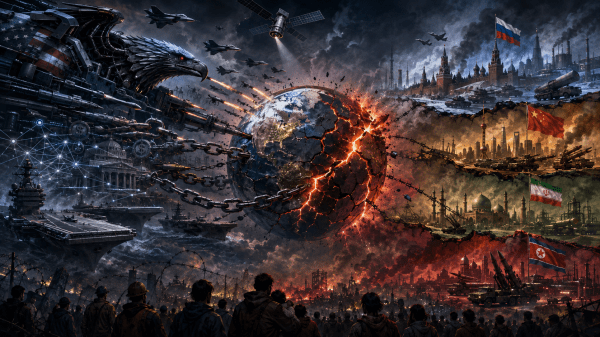
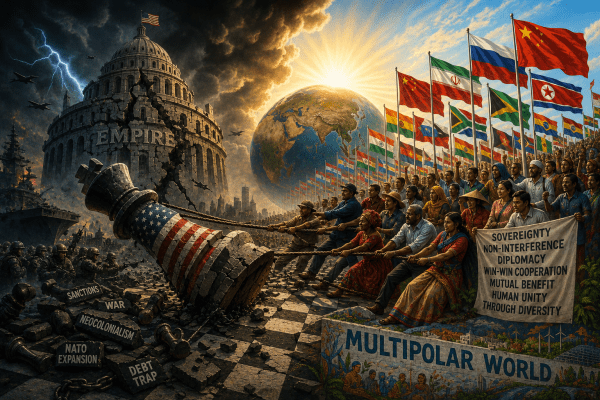
Great Satan at the Strait: Iran, International Law, and the Collapse of the “Rules-Based Order”

In a tale of diplomacy that sounds more like a sitcom plot, the Associated Press managed to frame U.S.-Israeli power plays as polite conversation while depicting Iran’s resistance as a chaotic tantrum. Imagine a landlord demanding rent while simultaneously hammering a "peace" sign into the wall—classic! The article promotes a narrative where blocking a nation is just “maritime security,” leaving readers to wonder if the actual level of aggression got lost in translation. Amid drones and oil price panic, the main issue lurking around like an unwelcome relative is whether nations can truly be sovereign or if they must politely obey the empire’s whims. It's a comedy of imperial contradictions, where legality bends more than a yoga instructor under pressure!

The Corridors of Defiance: How the War on Iran Accelerated the Multipolar Reorganization of Western Asia

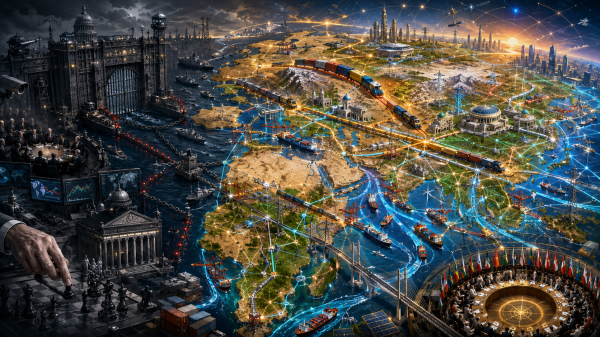
The 2026 U.S.-Israeli assault on Iran was a strategic miscalculation, intended to reassert imperial dominance in Western Asia but instead revealing the fragility of Atlantic hegemony. As the old security architecture eroded, alternative infrastructures and regional alliances emerged, facilitating trade and cooperation beyond Western control. The ongoing crises connected Gaza, Yemen, and the vital sea lanes, illustrating that military aggression has backfired, prompting regional states to recalibrate and seek resilience against imperialism. This war exposed a transformative geopolitical landscape, where logistics and diplomatic maneuvers are increasingly driven by necessity, carving out a multipolar future and undermining the sheer authority once held by the empire.

Technofascism: The Digital Leviathan and the War on Humanity

The United States isn’t gracefully unraveling; it’s morphing into a technofascist apparatus of control that leverages financial dominance, digital surveillance, and labor discipline. While the elite tout "innovation," they're repackaging colonial exploitation under the guise of progress, tightening their hold domestically and globally. Liberal analyses miss the subtleties of this shift, mistaking procedural forms for genuine democracy, while real power redistributes into unaccountable systems. As public trust wanes and crises mount, this infrastructure of power rapidly transforms governance into an invisible web of control, inching toward collective consciousness and organized resistance that could eventually dismantle the machinery of oppression.

The Independent’s Imperial Blindness: How North Korea and Belarus Refuse Isolation and Build Under Siege

The Independent recasts the DPRK–Belarus treaty as suspicious alignment while obscuring sanctions, war, and coercion shaping both states. The actual record shows concrete agreements across food, healthcare, industry, and education built through ongoing diplomatic coordination. These developments emerge from Korea’s imposed partition, Belarus’s post-Soviet Western pressure, and their shared positioning alongside Russia in the Ukraine... Continue Reading →

After the Empire — Before the Collapse

When Emmanuel Todd wrote After the Empire, Washington still believed it ruled a permanent unipolar world. Todd saw something different: an empire sustained less by production than by financial tribute and military spectacle. Two decades later the contradictions he described—economic dependency, micromilitarism, and ideological decay—have matured into the turbulent transition now reshaping global power.By Prince... Continue Reading →

The BBC, Zelensky and the Price of Primacy: When Hegemony Calls Itself Defense

This essay excavates the BBC’s framing of the Ukraine war to reveal how catastrophe rhetoric and moral personalization manufacture consent. It reconstructs the documented record—NATO expansion, U.S. strategic doctrine, Minsk diplomacy, sanctions, and militarization—to widen the frame beyond headline urgency. It then situates the conflict within the deeper contradiction between imperial hegemony and national sovereignty,... Continue Reading →

Iran Under Hybrid War: Sanctions, Sabotage, Terror Proxies, and the Long Siege Against Sovereignty

A forensic reconstruction of how sanctions, sabotage, terror proxies, narrative warfare, and regional forward bases have converged into a full-spectrum hybrid war against Iran — and why the January 2026 unrest is not a spontaneous crisis, but the latest front in a decades-long campaign to break an independent state.By Prince Kapone | Weaponized Information |... Continue Reading →

Who Owns Venezuela?

Trump’s claim that Venezuela “stole” U.S. oil is not a gaffe or exaggeration—it is an imperial verdict. This essay dismantles that claim by tracing the conflict over Venezuela’s resources through international law, the neoliberal wreckage of the pre-Chávez era, the Bolivarian rupture, Maduro’s Plan de la Patria, and María Corina Machado’s restoration blueprint. What emerges... Continue Reading →

Website Powered by WordPress.com.

Up ↑