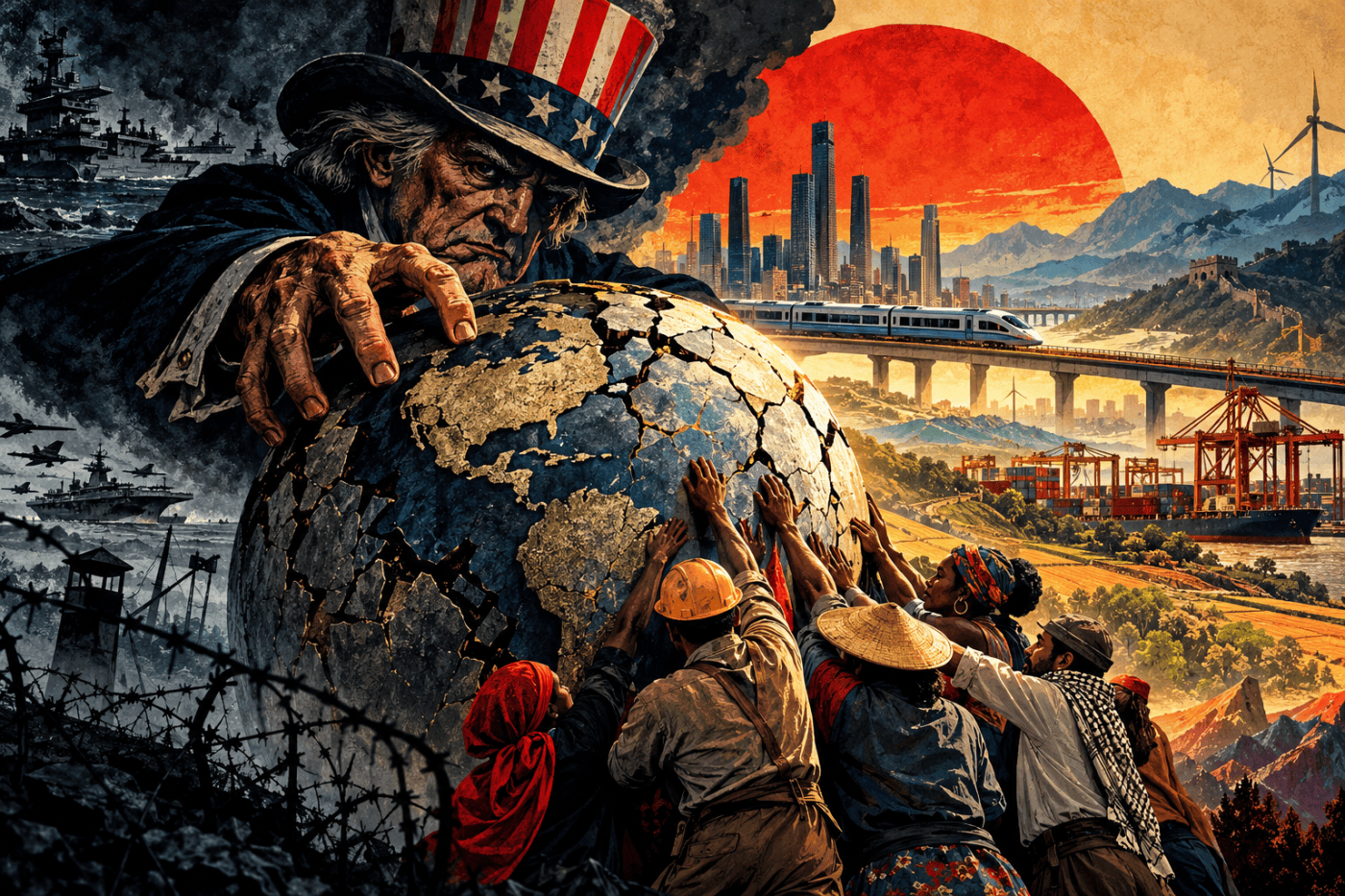
The world the imperial powers built to keep the colonized dependent is beginning to crack, and China’s socialist construction has helped put the hammer in the hands of nations once condemned to serve as suppliers of cheap labor and raw materials. From BRICS development finance to Washington’s desperate efforts to fortify its hemispheric empire, the struggle over who controls production, credit, technology, and territory is reshaping the international order. But breaking the monopoly of Western imperialism doesn’t automatically break the power of domestic capitalists, as the contradictions of nationalization, private investment, industrial labor, and Indigenous sovereignty make painfully clear. Multipolarity is opening doors that imperialism spent centuries keeping locked; the struggle for socialism will determine whether the workers and peasants who built the world finally take possession of the goddamn house.
Prince Kapone | Weaponized Information | October 30, 2026
I. The World Is Changing. Who Will Own What Comes Next?
A country can raise its own flag and still need a foreign creditor’s permission to build a power plant. It can elect a president, write a constitution, send ambassadors around the world, and discover that its sovereignty ends precisely where the interests of foreign capital begin. The colonial governor has gone home, but his bank remains open for business. The plantation has acquired a corporate logo, the overseer has become a development consultant, and the old imperial powers now congratulate their former subjects on achieving independence while presenting them with the bill for exercising it. Apparently, freedom is a wonderful thing, provided nobody mistakes it for the right to control their own land, labor, resources, or future.
That arrangement is coming under increasing pressure. China’s socialist construction has transformed the international conditions under which formerly colonized countries struggle to develop. Nations long condemned to export raw materials, import finished goods, service foreign debts, and call the whole miserable arrangement economic development now possess additional sources of machinery, infrastructure, technology, and finance. BRICS cooperation gives institutional expression to some of these possibilities, bringing together societies with different class structures and political purposes. None of this arrived as a charitable donation from the powers that benefited from its absence.
It’s precisely this problem that gives Tricontinental’s Beyond Polarity: For a Marxist Theory of the World Order its importance. Is the world unipolar, bipolar, or multipolar? Has China displaced the United States? These questions matter, but a map of competing states can’t explain the social relations beneath their power. Capitalism has never objected to having several national flags flying above its factories, provided the workers beneath them continue producing profits for somebody else. Counting poles tells us something about the distribution of international power. It tells us considerably less about who owns production and what purposes it serves.
The problem has a longer history than the vocabulary of today’s summit communiqués. In Neo-Colonialism, Kwame Nkrumah located domination within the gap between formal independence and effective command over economic life. The question wasn’t whether foreign investment existed, but whether financial power subordinated national development to outside interests. Today’s alternatives matter because they can loosen that command. Their social direction must still be fought over.
The United States confronts these changes with an immense apparatus built to preserve its privileges. Relative decline hasn’t emptied its military bases or persuaded its corporations to surrender their claims. Here we encounter the process Weaponized Information identifies through its American Pole/Fortress America thesis: an attempt to consolidate the hemispheric foundations of U.S. power while tightening the alliances, strategic access, and economic relationships through which that power reaches outward. This is imperialist recalibration, not imperial retirement. The empire that spent decades preaching unrestricted markets now discovers that economic sovereignty is a wonderful principle when practiced by itself and a dangerous offense when practiced by its competitors.
The argument of this essay is that the emerging world order is shaped by the struggle between the reproduction of U.S.-led imperial command and the uneven expansion of capacities through which states and peoples can resist subordination. China’s socialist construction is a central material force in that transformation. BRICS cooperation enlarges developmental possibilities across different social formations; struggle over property, production, and state power determines who commands those possibilities. National sovereignty can open the way toward deeper emancipation without delivering it automatically.
To understand this struggle, we must begin with the historical construction of imperial command, then examine the revolutionary changes that made alternative paths possible. From there, we can follow those possibilities into development banks and industrial projects, confront the empire’s response, and enter the workplaces and communities where their social meaning is decided. The people who mine the minerals, cultivate the fields, and operate the factories have more immediate concerns than the seating arrangements of presidents and bankers. They want to know whether their labor will build societies they control or enrich another generation of masters. Who will own the world that the people are building?
II. The Empire Seized the Wealth and Kept the Keys
The world economy wasn’t born from a friendly gathering of nations, each arriving with something to trade and an equal opportunity to prosper. Some arrived with warships. Others were dragged aboard slave ships. The Europeans seized land, enslaved labor, dictated what could be grown, determined what could be manufactured, and organized entire continents around the accumulation of wealth somewhere else. By the time the colonial powers began lecturing the rest of humanity about the virtues of free trade, they had already spent centuries making certain that trade would never be conducted between equals. They had seized the land, appropriated the wealth produced by others, and written the commercial rules. Then they turned to the people they had dispossessed and asked why they were so poor. It was quite an intellectual achievement: first manufacture underdevelopment, then invent an economic science to explain it as the natural condition of the underdeveloped.
Walter Rodney demolished this fraud in How Europe Underdeveloped Africa. Development and underdevelopment weren’t separate journeys undertaken by societies possessing different degrees of ambition or intelligence. They were connected outcomes of a history of extraction. Colonial rule reorganized economies around European accumulation, directing transport toward export outlets rather than the needs of African communities. The railway was an engineering marvel, certainly. It was also a remarkably efficient means of transporting a country’s wealth away from the people who produced it. Colonial infrastructure wasn’t simply inadequate development. It was development organized for a different class and a different country.
The United States didn’t stand outside this process. American capitalism developed upon territory seized from Indigenous nations and through wealth produced by enslaved African labor. Plantations, farms, railways, and mines expanded through the destruction or subordination of Indigenous societies and the conversion of conquered land into alienable property. Enslaved Africans produced commodities that enriched merchants, financiers, manufacturers, and landowners. The republic announced itself as the land of liberty while organizing an economy in which one population could be bought and sold and another expelled from its ancestral homeland. Their liberty was built upon other people’s unfreedom.
The state didn’t arrive afterward to regulate an economy that private enterprise had somehow constructed independently. It enforced ownership, subsidized infrastructure, and defended accumulation. The Pacific Railway Act of 1862 provided land grants and federal bond support for railroad construction. It also directed the government to extinguish Indigenous title to lands required for the route and grants. Dispossession, public finance, and corporate expansion occupied the same statute. The corporation could congratulate itself on its entrepreneurial brilliance because state power had secured the land and helped finance the railway. The celebrated independence of private enterprise required a rather extensive public commitment to making somebody else’s property available for private acquisition.
As American industrial and financial power expanded, this relationship reached beyond the continent. Military interventions, financial influence, and political interference helped secure markets, resources, and investment opportunities. The colonial administrator could issue orders directly. The imperial financier could exercise power by deciding whether a government received the credit necessary to carry out its plans. One arrived wearing a uniform, the other carrying a contract. Both understood that control over the conditions of production could accomplish what formal political sovereignty appeared to prohibit.
The great anticolonial revolutions and national liberation struggles of the twentieth century broke open this arrangement. From Asia to Africa and the Caribbean, colonized peoples fought to remove foreign rulers, recover national sovereignty, and redirect their countries’ resources toward their own development. These weren’t ceremonial achievements. Independence transferred political authority into institutions that could, at least in principle, undertake land reform, construct public industries, expand education, and organize national economic life around domestic needs. But the departure of colonial administrators didn’t automatically dismantle the economies they had constructed. Newly independent governments inherited export sectors dependent upon foreign buyers, transportation systems designed around extraction, industries concentrated in a narrow range of activities, and financial relationships that remained largely beyond national control. The flag could be raised in a single afternoon. Building the productive capacity necessary to make that flag sovereign required decades of struggle.
Consider the practical problem facing a government determined to electrify its countryside. It needs engineers, turbines, transmission equipment, trained workers, and the financial resources to obtain what it can’t yet produce. Much of that equipment must be purchased internationally, requiring foreign currency earned through exports or obtained through borrowing. If the country’s principal export is copper, coffee, or cocoa, its development plans become vulnerable to prices determined in markets it doesn’t control. When prices fall, the foreign exchange needed to purchase machinery disappears. Borrowing may keep the project alive, but the debt creates claims upon future national revenues. Interest payments compete with public investment, while creditors acquire influence over budgets, exchange rates, and economic policy. A government can possess the legal right to build a power station and still discover that the actual decision rests with institutions located thousands of miles away. The minister has the blueprint. The creditor holds the keys to the machinery.
Tricontinental’s study of de-dollarisation and financialisation places these problems within the international monetary system. Countries need internationally accepted money to purchase imports, service debts, and maintain financial stability. The state whose currency occupies the central position enjoys advantages unavailable to countries that must continually earn or borrow it. U.S. monetary policy, financial institutions, and sanctions consequently influence decisions far beyond American territory. A government may enjoy one vote in the United Nations while confronting a financial order shaped by institutions it neither owns nor controls. Political equality receives a microphone. Economic inequality keeps the ledger.
Debt and monetary dependence don’t operate independently of domestic class relations. The national bourgeoisie, landowning classes, commercial intermediaries, and financial elites often occupy positions within the inherited economy that make continued dependence profitable. An importer may benefit from a market flooded with foreign manufactures. A plantation owner may prefer export earnings to agricultural production organized around feeding the population. A banker handling international capital may regard national industrial planning as a threat to established business relationships. When a government attempts to redirect investment, protect domestic industry, or bring strategic resources under public control, it may encounter opposition from these classes alongside pressure from foreign creditors and corporations. The empire doesn’t always need to send an ambassador to dictate economic policy. Sometimes the people defending its interests already occupy the finance ministry, own the newspapers, and sit on the boards of the country’s largest companies.
This is the relationship Nkrumah analyzed in 1965: nominal sovereignty constrained through monetary institutions, foreign exchange, investment, and external direction. His argument didn’t require rejecting all foreign capital. It required making investment answer to a national developmental purpose. A country can enter commercial relationships without surrendering command over its future; the struggle concerns the institutions and class forces capable of maintaining that authority. This distinction becomes crucial when new partners enter an economy still organized around the old dependence.
The international reorganization of production made that struggle more complex. Factories could spread across borders while lead firms retained command over technology, purchasing, and markets. Intan Suwandi’s research on labor-value commodity chains, including Indonesian supplier firms, shows how decentralized production can coexist with concentrated power. Subcontracting transfers work and costs without necessarily transferring authority. A worker makes the commodity; a distant buyer dictates requirements and squeezes the supplier, which passes pressure down to the shop floor. A factory appearing on a country’s trade chart therefore proves production, not sovereignty over the chain in which production occurs.
This process didn’t render the nation-state obsolete. Capital crosses borders, but it continues to require governments to enforce contracts, defend property, construct infrastructure, regulate labor, and maintain the political conditions necessary for accumulation. Corporations depend upon public institutions even while demanding freedom from public interference. Their international operations generate relationships with domestic capitalist classes, state agencies, and political elites whose interests may overlap without becoming identical. Some governments bargain for technology transfers, industrial investment, or greater domestic participation. Others compete to offer cheaper labor, weaker protections, and more generous concessions in a race to the bottom. International capital hasn’t escaped politics. It has multiplied the places where political power must be exercised on its behalf.
These relationships explain why the relative decline of American industrial predominance can’t be mistaken for the disappearance of imperial power. Manufacturing can shift while financial command, military access, and control of critical technologies remain concentrated elsewhere. Tricontinental’s Hyper-Imperialism examines the continuing organization of Western military and political power. Weakening in one sphere can coexist with strength in another. An empire doesn’t cease to be dangerous because its factories face competition; defending privileges no longer secured through productive predominance can sharpen its coercion.
The historical challenge, then, exceeds acquiring more factories. It requires the capacity to direct investment, develop technology, and decide what production is for. That brings us to China. Its transformation began with a struggle over the domestic property relations and state power through which development itself could be commanded.
III. China Took Back the Keys: Revolution and the Power to Develop
Before China became the workshop of the world, its people had to fight to become the masters of their own country. The factories, railways, power stations, and industrial cities that today provoke such anxiety in Washington didn’t emerge from a nation peacefully discovering the blessings of international commerce. They arose from a society that had endured foreign invasion, unequal treaties, imperial encroachment, landlord exploitation, and decades of devastating warfare. China had known what it meant to possess land without controlling its resources, to produce wealth without determining its destination, and to have foreign powers dictate the conditions of its national existence. The Chinese Revolution confronted this entire arrangement. Its objective wasn’t simply to replace one government with another, but to transform the social relations through which the country was governed, its wealth produced, and its future determined. The question was whether hundreds of millions of workers and peasants could acquire the organized power to reconstruct a society that imperialism and domestic exploitation had kept subordinate.
The victory of 1949 changed the terms of that struggle. Under the leadership of the Communist Party of China, the revolution established a sovereign state capable of directing national reconstruction, dismantling the old landlord order, and beginning the transformation that would bring commanding sectors of economic life under public authority. Land reform transformed rural property relations. Industrialization became a national undertaking rather than an activity dependent upon the commercial priorities of foreign capital. Public institutions mobilized resources for infrastructure, education, health, and the expansion of productive capacity. These changes didn’t instantly abolish poverty or deliver an industrial economy ready to compete with the imperial powers. They created something more fundamental: the political and institutional means through which the Chinese people could undertake that transformation themselves. A steel mill requires iron, machinery, electricity, engineers, and workers. But it also requires somebody with the authority to decide that the steel mill should exist, that national resources should be committed to building it, and that its output should serve a larger developmental purpose. The revolution transformed who could exercise that authority.
This is the historical foundation that Walking on Two Legs: The Socialism of Chinese Modernisation brings into focus. China’s subsequent development can’t be separated from the revolutionary construction that preceded reform and opening. The industrial base, technical institutions, public infrastructure, and capacities for national coordination developed during the socialist period formed part of the material inheritance upon which later transformations proceeded. The familiar Western account, which begins China’s economic history in 1978, performs a convenient little disappearing act. The revolution vanishes, the workers disappear, the peasants are ushered offstage, and foreign capital arrives to receive applause for a transformation whose foundations were laid long before its entrance. Apparently, history began when the investor discovered the country. The people who fought a revolution, reorganized agriculture, built factories, expanded education, and established national sovereignty were merely preparing the scenery.
That inheritance included living people with capacities foreign capital hadn’t created. A 2015 provincial study by Kimberly Singer Babiarz and colleagues used Chinese health archives, provincial records, and retrospective mortality data to investigate the improvements of 1950–80. Its exploratory results associated expanded schooling and public-health campaigns with substantial reductions in infant and child mortality. That’s evidence of a mechanism, not proof that every campaign succeeded or a license to erase the period’s disasters. The 2022 joint study by China’s Development Research Center and the World Bank likewise identifies relatively strong health and educational foundations before 1978. Reform inherited a population whose capacity to learn, work, and survive had already been transformed.
The institutional distinction remains visible in China’s Constitution. Public ownership is the mainstay of its socialist economic system, and the state-owned sector has a leading role. Urban land belongs to the state; rural and suburban land is generally collectively owned, subject to constitutional exceptions. These provisions establish powers over strategic resources that aren’t simply available for purchase by whoever accumulates the largest fortune. But a constitution doesn’t operate a factory or prevent every abuse. The legal framework matters through the institutions that turn public ownership into decisions about credit, land, industry, and social provision.
In China 2013, Samir Amin placed the non-commodity status of agricultural land at the center of his analysis. Collective ownership and household production were distinct questions: changing the organization of cultivation didn’t automatically establish private ownership of the land itself. He also treated China’s future direction as a struggle, identifying tendencies capable of strengthening either capitalist development or a socialist path. This is a historically situated Marxist interpretation, not a timeless certificate issued to every Chinese policy. Its method is essential: examine which property relations persist, which change, and what powers follow from them.
Nor did revolution abolish scarcity. Industrializing a predominantly rural society required machinery, agricultural productivity, technical knowledge, and resources to meet immediate needs. Socialist construction achieved major transformations but also suffered severe policy failures and human losses. Political commitment could mobilize extraordinary effort; it couldn’t substitute indefinitely for the material requirements of reconstruction. A hospital still needed medicine. A family still needed food and the means to live beyond the next harvest.
It was within these historical conditions that reform and opening emerged. As the Wenhua Zongheng discussion of socialism as a historical process explains, China’s developmental strategy confronted the need to expand production, acquire technology, improve living standards, and overcome persistent economic limitations. Markets, foreign investment, private enterprise, and international trade became instruments within that effort. The decision introduced new contradictions, but it can’t be understood by pretending that the country faced a choice between an already prosperous socialism and an unnecessary accommodation with capitalism. The people had made a revolution to transform their lives, not to preserve poverty as evidence of ideological purity. A socialist government that can’t improve the material conditions of its population has a problem that no quantity of revolutionary quotations will solve. Workers can’t eat slogans, peasants can’t irrigate fields with declarations, and children can’t study beneath the magnificent illumination of a correctly formulated political line.
Yet market expansion also strengthened capitalist relations. Private accumulation created concentrations of wealth and interests committed to defending it. Regional development proceeded unevenly; employment and bargaining relations changed. Mechanisms used to expand productive capacity could strengthen social forces resistant to socialist direction. Recognizing this contradiction requires investigating how it’s governed. It doesn’t require declaring the revolutionary project defeated whenever the struggle produces another problem.
Here the character of state power becomes decisive. Capitalist enterprises may exist within different social formations, but their presence alone doesn’t establish the total character or historical direction of those formations. What matters is the relationship between private accumulation, public ownership, political authority, and the capacity to direct development. Can strategic investment be organized around national priorities rather than the immediate preferences of private investors? Can public institutions discipline concentrations of capital that threaten broader social objectives? Can the state mobilize resources for infrastructure, poverty alleviation, technological development, and public services where private profitability provides insufficient incentive? These aren’t abstract questions about whether markets are good or bad. They concern which social forces possess the authority to determine the purposes for which markets and enterprises operate. The bourgeoisie would naturally prefer that the existence of a wealthy capitalist settle the matter in its favor. Fortunately, the ownership of a large bank account doesn’t automatically establish ownership of the state.
China’s targeted poverty campaign gives that distinction concrete institutional content. The joint Development Research Center–World Bank report describes a shift toward household targeting, the combination of development measures and social protection, and responsibilities assigned through Party and government institutions down to village level. Infrastructure, employment, education, and public support were organized around identified needs. This was more than waiting for an investor to discover that a poor village had become profitable enough to deserve a road. The village didn’t need to impress shareholders before its children could attend school.
But the deeper socialist question extends beyond the achievement of campaign targets. A road must remain usable after the officials have departed. A clinic needs medical personnel, supplies, and financing long after its opening ceremony. A village requires durable economic opportunities if its young people are to build lives without being compelled to abandon their communities simply to survive. And the people whose labor sustains these achievements must possess meaningful ways to influence the decisions affecting their livelihoods. Concentrated mobilization can overcome extraordinary obstacles, but socialism can’t be reduced to the administrative completion of a development program. Its historical purpose is to enlarge the material and political capacity of the people to govern their collective lives. The official may regard a completed report as proof of success. The family waiting for clean water has a more demanding standard.
The international significance of this development is enormous. China’s transformation has created productive capacities that alter the choices available to countries still confronting the structures of colonial dependency. A government that can obtain equipment from more than one source, negotiate among financial institutions, or cooperate in building domestic industry possesses possibilities previously restricted. But other countries can’t purchase China’s revolutionary history along with its locomotives, power stations, or machinery. The institutions through which China directs development emerged from struggles over land, class power, national sovereignty, and production. A country can import machinery; it can’t import the political authority necessary to ensure that machinery serves its people. That authority must be built through its own struggles. China can enlarge the available possibilities. It can’t substitute for the organization through which another people determines what to do with them. We must now follow those possibilities into the institutions through which equipment is financed and projects are built.
IV. The Empire No Longer Holds Every Key: BRICS and the Struggle to Finance Development
A country can’t build a railway with a summit declaration. It needs steel, machinery, engineers, workers, and somebody willing to finance the whole undertaking before the first train carries a single passenger. The speeches may be magnificent. The flags may look splendid. The presidents may congratulate one another until their hands ache. But when the ceremony ends, somebody still has to pay for the damn railway. And for much of the formerly colonized world, that seemingly ordinary question has been one of the principal instruments through which imperialism exercises its power. A government might possess the land, the workers, the need, and even the political determination to build, yet remain dependent upon financial institutions whose priorities were established thousands of miles away. The power to approve a loan becomes the power to influence what gets built, whose resources are committed, and what obligations the country must accept in return. Political independence means considerably less when the creditor still gets to decide whether the lights come on.
This is why the emergence of alternative development institutions matters. The New Development Bank wasn’t established merely to provide BRICS leaders with another impressive building in which to hold meetings. Its creation gave the founding members a financial institution through which they could collectively exercise authority over development lending. That authority has been written into the bank’s governing structure. Under the founding agreement, changes in share subscriptions can’t reduce the founding members’ combined voting power below 55 percent. Non-borrowing members can’t collectively hold more than 20 percent, while an individual non-founding member can’t exceed 7 percent. These provisions matter because they place limits on the ability of outside shareholders to acquire control as the institution expands. Countries long accustomed to approaching financial institutions governed by others have established one in which their collective authority receives explicit protection. The old creditors haven’t disappeared, but they no longer possess quite the same exclusive claim to the lending desk.
The arrangement also distributes that authority unequally. Later members don’t enter with the founders’ protected collective position. Expansion can increase geographical reach without an equivalent redistribution of control. This isn’t a reason to dismiss the bank; it identifies a conflict inside its institutional design. A country may have a seat at the table while somebody else still possesses enough votes to determine the menu.
By 2026, the bank’s operations had moved well beyond the ceremonial stage. In an August address, NDB vice-president Roman Serov reported that, as of June 30, the institution had approved approximately $44 billion across 141 projects and disbursed $25 billion, with local-currency operations approaching 30 percent. Those figures establish a substantial body of financing activity. They also demand careful interpretation. An approved project represents a financial commitment; a disbursement represents money actually delivered. Neither figure tells us whether the electricity reached the villages, whether the railway serves the people who need it, or whether construction left workers and communities better off. Banks have always been exceptionally talented at counting the money they intend to spend. The people living beside their projects have the considerably less glamorous responsibility of discovering what the money actually accomplished.
The Serra da Palmeira wind project in Brazil makes the relationship concrete. The NDB disclosure records approved financing of RMB 1.4 billion for CTG Brasil, with construction organized through subsidiary project companies. It describes planned capacity of 648 megawatts and turbines from China’s Goldwind. Chinese industrial capacity supplies equipment for Brazilian electricity generation through financing from a BRICS-created institution. This is a specific connection between production and finance outside exclusive Western provision, rather than merely another declaration that a new world has arrived.
The currency arrangement adds another dimension. Financing denominated in renminbi can connect the financial obligation more closely to the currency of an equipment supplier, potentially changing how procurement and payment are organized. But the renminbi isn’t Brazil’s national currency, and a loan denominated in it doesn’t automatically eliminate exchange-rate exposure. The project disclosure doesn’t establish the complete hedging arrangements or reveal who ultimately bears every associated currency risk. Those questions matter because replacing a dollar obligation with a renminbi obligation changes the structure of the financial relationship without magically abolishing the possibility of dependence. The objective of de-dollarization isn’t to exchange one sacred banknote for another and declare the international monetary question solved. Money is a social relation, not a lucky charm. Changing the denomination of a loan can create useful alternatives, but the underlying obligations, repayment conditions, and distribution of financial risk still have to be examined.
The same disclosure identifies potential relocation, economic displacement, and environmental impacts requiring mitigation. These are assessed risks, not proof that every anticipated harm occurred. They identify obligations against which implementation must be judged. A turbine can expand electricity generation while its construction changes access to land. Socialism doesn’t mean admiring machinery so enthusiastically that we forget who has to live beside it.
The NDB’s 2022 announcement placing new transactions in Russia on hold, citing uncertainties, restrictions, and compliance requirements, exposes another limit. Russia is a founder, yet the bank suspended new transactions there amid external pressures. That announcement doesn’t settle the present status of every Russian operation or identify every causal channel behind the decision. It does show that independent governance alone didn’t insulate the institution from the wider financial environment. The empire doesn’t have to own every bank to make its influence felt inside them.
Some of that power operates through mechanisms so ordinary that their political significance is easily concealed. Bank of Russia guidance concerning cross-border transfers explains that foreign correspondent banks may refuse transactions or block funds because of sanctions requirements, even where Russian law permits the payment. The transaction can be lawful at its destination and still be obstructed along the financial route it must travel. This is how monetary hierarchy becomes political authority. A government may approve a purchase, a company may possess the funds, and a supplier may be prepared to deliver the equipment, yet an intermediary institution can prevent the payment from arriving. The border guard no longer needs to stand beside a road carrying a rifle. He can sit behind a bank terminal and prevent the machinery from leaving the warehouse. The paperwork looks respectable. The coercion remains perfectly real.
That mechanism helps explain why de-dollarization involves several related but distinct struggles. Lending in national currencies can reduce particular forms of dependence upon the dollar. Developing alternative payment arrangements can create additional routes through which transactions are settled. Building reliable sources of finance can reduce the ability of established creditors to dictate borrowing conditions. Creating mechanisms for liquidity during financial crises can help countries withstand pressures that would otherwise force them back toward institutions dominated by the imperial centers. These are connected problems, but progress in one doesn’t automatically solve the others. A country may conduct trade in national currencies while remaining dependent upon foreign financial markets for long-term investment. A bank may issue loans outside the dollar while still encountering restrictions in international payment networks. A new financial corridor is useful, but nobody should mistake the first completed bridge for an entire transportation system. The point is to build the connections, understand their limits, and develop the capacities necessary to make them more resilient.
The September 2026 BRICS declaration treats payment interoperability as an area for further study and cooperation, alongside reform of existing institutions including the IMF. These commitments shouldn’t be inflated into a functioning, sanction-proof monetary alternative. Former NDB vice-president Paulo Nogueira Batista Jr. examines the political and institutional obstacles to de-dollarization among countries with different interests and capacities. A common objection to dollar dependence doesn’t supply common monetary policy, technical infrastructure, or agreement about who bears the costs of transition. The dollar system wasn’t built by wishing, and it won’t be displaced by wishing either.
What has changed is the range of instruments available for building alternatives. Founding countries possess a bank they govern; borrowers can pursue some projects through additional combinations of technology and finance. The limits just examined show where further capacities must be built. For Washington, however, even incomplete alternatives pose a problem: dependence becomes harder to turn into obedience when countries acquire other means to develop. The next question is how the imperial state responds when the lending desk no longer supplies all the discipline it once did.
V. Fortress America: The Empire Wants the Keys Back
Washington has never been particularly enthusiastic about sovereignty when somebody else tries exercising it. A government finds another creditor or refuses to surrender a strategic resource, and the guardians of the rules-based order discover an urgent threat to regional security. Beneath the diplomatic tantrums lies a serious problem: how does an empire reorganize its command when countries it once disciplined acquire a greater capacity to tell it to fuck off?
Weaponized Information’s American Pole/Fortress America thesis addresses that reorganization. The United States isn’t simply retreating from a world it can no longer dominate on the old terms. It’s attempting to consolidate a more secure material foundation from which to preserve and exercise imperial power. The Western Hemisphere occupies a central place in that project because it contains resources, energy supplies, agricultural production, industrial capacity, transportation corridors, financial relationships, and military geography essential to American accumulation. Control over strategic access points, commercial infrastructure, and regional security arrangements can help secure those advantages against competing economic relationships, particularly the growing presence of China. Beyond the hemisphere, Washington seeks to bind its allies more tightly into the military, technological, and economic arrangements that sustain American power. Fortress America is no little cabin in the woods where the empire intends to spend its retirement. It has overseas military installations, multinational corporations, intelligence networks, investment portfolios, and a formidable military arsenal. Its purpose is to secure the foundations of imperial command while preserving the capacity to project that command outward.
Ben Norton’s examination of the so-called Donroe Doctrine identifies Washington’s hemispheric ambitions, including efforts to secure resources and constrain China’s relationships with Latin America. The strategy seeks authority over which partners other countries may choose and what infrastructure they may develop. But ambition and accomplishment aren’t identical. Popular organizations, governments, courts, and legislatures mediate what Washington can actually obtain. The thesis must explain those encounters, rather than convert every imperial demand into a victory before anybody has resisted it.
Ecuador provides a particularly revealing example. In 2025, the government sought to remove the constitutional prohibition on foreign military bases and installations, including arrangements transferring national bases to foreign armed or security forces. The proposed amendment would have opened a significant institutional route for expanding foreign military presence. But Ecuadorian voters rejected it. According to the National Electoral Council’s final results, 60.82 percent voted against the proposal. The electoral authority’s published question establishes precisely what voters were being asked to surrender. The government wanted the constitutional prohibition removed. The people told it no. That’s a real political defeat for a particular avenue of military expansion, and it deserves to be recognized as such. Ecuadorians didn’t need a lecture about the strategic requirements of the American hemisphere. They had a constitutional protection, they were asked to give it up, and a decisive majority refused.
But Washington’s security relationships with Ecuador didn’t begin with that referendum, and the defeat of the proposed amendment didn’t dissolve the machinery already in place. Ecuadorian reporting in March 2026 documented publicly announced joint operations and traced their legal framework to bilateral agreements concluded under the previous government. The reporting distinguished intelligence, logistical support, and operational planning from claims about direct American participation on the ground. Those distinctions matter because the actual forms of military involvement have to be established through evidence, not inflated to satisfy a political argument. What the evidence already shows is revealing enough: the popular rejection of foreign bases blocked one institutional route while other arrangements for military cooperation remained available. The front gate had been locked, but the security apparatus still possessed access agreements. Imperialism is perfectly capable of reading the fine print when the voters refuse to cooperate.
The legal history exposes how that arrangement developed. In its January 2024 judgment concerning maritime cooperation with the United States, Ecuador’s Constitutional Court ruled that legislative approval wasn’t required for the agreement under examination. Three judges dissented, arguing that provisions affecting foreign military operations and territorial sovereignty demanded parliamentary scrutiny. This was a struggle over the institutions empowered to authorize foreign military activity, not some tedious dispute about administrative procedure. Parliamentary approval can determine whether an executive agreement faces public deliberation and organized political opposition. Removing that requirement can narrow the opportunities through which the population’s representatives challenge an arrangement before it acquires legal force. The ruling concerned a specific agreement and didn’t provide unlimited authorization for every subsequent operation. But it illustrates how the legal machinery of military cooperation can develop through institutional decisions that receive far less public attention than a national referendum. The imperial project doesn’t always arrive with a general announcing an occupation. Sometimes it comes with a lawyer explaining why nobody else needs to vote.
Greenland reveals another dimension of the same imperial recalibration, this time in the Arctic. Its strategic importance arises from geography, military access, and the wider contest over northern transportation routes, resources, and security infrastructure. Washington’s ambitions therefore concern more than a spectacular territorial acquisition. Formal ownership would provide one means of securing strategic authority, but access agreements and defense commitments can also shape how territory is used. In January 2026, Greenland’s government rejected American ownership, governance, and incorporation, asserting its political position against the prospect of being absorbed by the United States. That refusal was significant. Greenland wasn’t an unoccupied parcel awaiting a purchaser, whatever fantasies might circulate among American politicians. Its people possess political institutions, historical claims, and the right to determine their own future. Yet the government’s immediate response also looked toward Denmark, Europe, and NATO for protection, demonstrating that resistance to American annexation could coexist with continued participation in the Western security architecture.
The subsequent September 2026 agreement involving Greenland, Denmark, and the United States placed those competing relationships into institutional form. Greenland’s government presented the arrangement as recognizing self-determination while strengthening common security, and specified that its entry into force depended upon the necessary parliamentary procedures. The signed agreement provides for expanded American activities at Pituffik and additional defense areas at Narsarsuaq and Mestersvig, subject to agreed arrangements. It also establishes continued NATO alignment and defense obligations in the event of Greenlandic independence. These provisions deserve close attention because they show how recognition of political sovereignty can coexist with commitments affecting the military use of territory and the strategic options available to future governments. A signature records an agreement reached by its parties; it doesn’t prove that every provision has entered into force or been implemented. But the obligations written into the agreement identify the direction of the proposed relationship.
The United States doesn’t need to paint Greenland red, white, and blue on every map to obtain military advantages from its geography. Access to installations and airfields can serve its planning without transferring ownership of the island. Washington would undoubtedly prefer the whole damn thing if it could get it, but a military agreement can be useful even when the real estate transaction falls through.
There’s also a people whose existence imperial strategy has a remarkable habit of overlooking. Greenland isn’t empty Arctic scenery waiting to accommodate military planners. It’s the homeland of Inuit communities whose collective life, political authority, and relationship to the land precede the strategic calculations of Washington and Copenhagen. An Alaskan Inuit statement reproduced by the International Indian Treaty Council affirms Inuit self-determination and the right to govern their own affairs. That claim reaches across the state borders through which the Arctic has been divided. It also exposes the inadequacy of treating sovereignty as a bargain concluded exclusively between national governments. An agreement may recognize the formal political status of a territory while leaving questions about Indigenous authority, community consent, land use, and military impacts unresolved. The Inuit aren’t decorative participants in somebody else’s geopolitical drama. Their rights and political struggles belong at the center of any serious account of Arctic sovereignty.
The American state’s own settler-colonial formation makes its treatment of another Indigenous homeland as a strategic asset especially revealing. The cavalry has acquired satellites; the frontier has acquired defense agreements. This historical connection doesn’t make Greenland’s institutions or future identical to the nineteenth-century American frontier. It identifies a recurring relation requiring investigation: inhabited land is valued for an outside power’s purposes while its people’s authority becomes an obstacle to be managed. Resistance to incorporation contests that relation. The struggle over military access concerns how far the refusal reaches.
The two cases delimit the Fortress America thesis. Ecuador’s vote blocked a constitutional change while earlier cooperation continued. Greenland’s rejection of incorporation coexisted with proposed expanded access. These outcomes support an interpretation of imperial power adapting through contested legal and strategic arrangements; they don’t establish a completed hemispheric fortress. Courts, parliamentary procedures, and popular resistance can change the result. The Pentagon may have a very expensive map of the world. That doesn’t mean everybody living on it has agreed to the itinerary.
Yet greater freedom from foreign command leaves another question open. Who exercises the enlarged authority within the country? A state can resist an American military demand while organizing economic life around its own landowners, financiers, and corporations. To determine the social direction of sovereignty, we must leave the diplomatic table and examine ownership, investment, and the workplace.
VI. The Flag Changed Hands. Who Owns the Factory?
A country can throw off an imperial creditor, find new markets for its exports, and acquire the machinery to build industries its former masters never wanted it to possess. These are real victories. They enlarge the room in which a people can determine its future. But walk through the factory gates, into the fields, or down the corridors of the finance ministry, and another question comes into view. Who owns what the workers produce? Who decides where the profits go? Who gets the new hospital, and who gets another mansion overlooking the sea? A government may gain greater freedom from Washington while the people beneath it remain chained to the same landlords, employers, and financiers. National sovereignty changes the conditions of class struggle. It doesn’t abolish the classes doing the struggling. The empire may lose its privileged seat at the table while the local bourgeoisie continues eating the workers’ dinner.
Consider a government taking ownership of a major enterprise. Nationalization can place productive assets under institutions directing them toward collective development. It can also precede a transfer to another private owner. The meaning emerges from who ultimately commands the assets and where the surplus goes. The state may seize the keys from one capitalist only to hand them to another. The ceremony looks revolutionary until somebody checks the fucking ownership register.
Russia offers a concrete example. Following judicial proceedings that brought assets associated with the gold producer Yuzhuralzoloto into state ownership, those assets were subsequently offered for sale. Russian financial reporting in June 2026 identified BTS-Most Holding as the winning bidder for a package that included a controlling stake in the company. The following month, Interfax reported the completed transfer of approximately 67.25 percent of its shares, citing the company’s disclosure. The acquiring company was controlled by businessman Ruslan Baisarov. The sequence matters. State intervention removed assets from one ownership arrangement, but the eventual disposition placed the controlling stake back in private hands. Public ownership became an intermediate stage in the redistribution of capitalist property rather than the enduring socialization of the enterprise.
Sergei Obukhov’s criticism, published by the Communist Party of the Russian Federation, raises the question of whether recovering strategic wealth serves public purposes or rearranges ownership among wealthy groups. The transaction establishes a private transfer; it doesn’t establish the subsequent wages, safety conditions, or bargaining power of the workforce. Those require separate evidence. What it certainly doesn’t establish is workers’ control. The capitalist acquiring the enterprise has every reason to appreciate the state’s assistance.
Russia’s confrontation with Western power doesn’t dissolve this domestic class relation. A capitalist state can resist external coercion while defending its own bourgeoisie’s accumulation. Its resistance can have international significance without making private appropriation disappear at home. To acknowledge Russia’s opposition to Western domination doesn’t require pretending that its oligarchs have become proletarians. The enemy of an imperial creditor may still have a very healthy appetite for other people’s work.
India presents a different relationship between public authority and private accumulation. Rather than temporarily acquiring an existing enterprise before transferring it to another owner, the state participates in institutions designed to mobilize investment through private financial markets. The New Development Bank’s disclosure concerning the National Investment and Infrastructure Fund’s Private Markets Fund II describes a government-sponsored arrangement intended to expand private-equity investment in priority sectors. India’s government committed up to 49 percent of the fund’s total commitments. The structure provides for investment through underlying funds and direct co-investment, while the NDB receives representation on its advisory board. Here public institutions help organize the capital, establish the investment framework, and encourage the expansion of private financial activity. The state isn’t absent from accumulation. It’s actively helping assemble the machinery through which accumulation proceeds.
This arrangement can support productive development while expanding private-equity and venture-capital markets. The questions concern who selects investments, how returns are generated, what essential services cost, and what happens when investors exit. India’s June 2026 announcement on NIIF reports investor returns through portfolio exits and relationships with domestic institutions, development banks, sovereign wealth funds, and overseas pension investors. Those results concern the wider NIIF platform, not Private Markets Fund II specifically. They illustrate development policy operating through international financial accumulation.
Government participation alone proves neither public control over all benefits nor protection of private investors against every loss. The documents don’t justify inventing guarantees. They do establish a structure in which public institutions help assemble capital for privately managed investment. Calling the fund national doesn’t distribute its ownership among the nation’s workers and peasants. The social question is who sets the terms when investor returns collide with public need.
That struggle becomes impossible to ignore when we move from investment portfolios to the people doing the actual work. A factory celebrated as a triumph of industrial cooperation must first be built by workers who need food, wages, safe housing, medical care, and the freedom to leave their employers. The cranes, machines, and production lines that appear in government announcements don’t assemble themselves. Behind every photograph of a new industrial complex stand thousands of hours of human labor, and the conditions under which that labor is performed reveal relations that a ribbon-cutting ceremony has every incentive to conceal. The factory may symbolize national development, but the worker who constructed it has to live with the contract, the supervisor, the accommodation, and the paycheck. Industrial progress looks rather different from the top of a corporate headquarters than it does from the floor of a crowded workers’ dormitory.
Brazil’s experience with construction of BYD’s Camaçari plant brings those relations into sharp focus. The project represents a significant industrial undertaking associated with Chinese investment and the expansion of electric-vehicle production. But Brazilian labor prosecutors’ filing assembled allegations and inspection evidence concerning degrading conditions and exploitation of Chinese migrant workers employed through contractors during construction. The proceedings placed recruitment practices, subcontracting, employment conditions, and workers’ freedom at the center of an industrial project otherwise presented through investment figures and manufacturing capacity. These allegations must be distinguished from final judicial findings. Their political significance, however, lies in the employment relations brought under investigation. A worker can cross an ocean to help build a factory and discover that the arrangements surrounding his recruitment, documents, accommodation, and wages have made his freedom far more limited than the employment contract suggests.
Brazilian institutions intervened in the dispute. Reporting on the December 2025 settlement states that the contractors agreed to pay R$40 million, with BYD guaranteeing payment if the contractors failed to comply. The agreement included compensation and protective obligations, without constituting an admission of guilt. Its existence demonstrates an institutional response to the conditions raised in the proceedings. But an agreement recorded on paper isn’t the same as compensation delivered into workers’ hands or working conditions transformed in practice. The decisive question concerns implementation: whether the people affected received the remedies owed to them and whether the employment arrangements that gave rise to the dispute were corrected. A corporation may consider a settlement completed when the lawyers finish signing. The worker has a rather more material definition of completion.
Workers also intervened through their own organization. Bahia’s construction union, SINDTICCC, reported a September 2026 assembly at the BYD factory project and an agreement with the companies before the regional labor authority concerning full payment of the PPR participation bonus. This was a separate dispute from the earlier migrant-worker proceedings, and its outcome shouldn’t be presented as proof that the previous compensation obligations had been fulfilled. The agreement also doesn’t itself establish that payment was delivered. Its significance lies elsewhere. Organized workers intervened directly in the distribution of the gains associated with the project. They assembled, advanced their demands, and secured an agreement concerning compensation. The people whose labor made the industrial investment possible weren’t merely waiting for development to trickle down from the boardroom. They organized to claim a share of what they had helped produce.
The nationality of investment settles neither the conduct of every contractor nor the social formation of the country supplying it. A Chinese company’s involvement doesn’t make every subcontractor socialist; a contractor’s misconduct doesn’t erase China’s revolution. Defending socialist construction requires confronting abuse through the actual employment relations and responsible institutions. Socialism was never supposed to mean that the proletariat must keep quiet whenever the boss happens to come from a friendly country.
Popular sovereignty also concerns authority over land, communities, and bodies. Greenland’s resistance to incorporation raises the question of who may command its territory. The struggle of Kalaallit Inuit women subjected to involuntary contraceptive practices raises an inseparable question: who may command the reproduction of its people? Constitutional recognition can’t substitute for control over whether and when to have children.
An independent report by Dalee Sambo Dorough and Miriam Cullen found reasonable grounds to believe that involuntary contraceptive practices violated the rights of Kalaallit Inuit women. The report examined discriminatory institutional arrangements and the continuing consequences for women, families, and collective life. These are expert findings rather than a judicial determination of liability in every individual case. The authors also explicitly cautioned against using their investigation as political ammunition for or against Greenland’s constitutional position. That warning matters. The women whose rights were violated aren’t convenient exhibits for Washington’s territorial ambitions, nor should their experiences be buried because exposing them might embarrass another government. Their struggle concerns justice, accountability, and the authority to make decisions over their own lives. It belongs to the people who suffered the harm, not to whichever imperial power finds their suffering useful in a diplomatic argument.
The institutional history also shows why changing formal responsibility doesn’t automatically end inherited practices or repair their consequences. Greenland assumed responsibility for healthcare in 1992, but the problem of involuntary contraception and the demand for remedies extended beyond that administrative transfer. Greenlandic broadcaster KNR reported in September 2026 that 109 applications concerning later experiences remained under substantive consideration, with difficulties obtaining medical records contributing to delays. Pending applications aren’t findings that every individual claim has been established. They demonstrate that people continue to seek remedies from institutions responsible for investigating and addressing the harm. The transfer of authority may alter which government administers a service, but the people affected still need records, accountability, and effective compensation. An official declaration of responsibility means precious little to a woman who has spent years trying to establish what was done to her body and obtain justice for it.
These cases bring us beyond a contest over national flags. State intervention can redistribute capitalist property; public finance can deepen private investment markets; new industry can become an arena of organized labor struggle; self-government can inherit institutions its people must still transform. None of these relations makes national independence expendable. They identify the forces that must organize within it if the power recovered from imperial command is to become the power of the people.
VII. The World Is Opening. The Workers Must Take Possession.
The opening created by multipolarity is real, but it has no automatic socialist destination. A new lender can weaken a creditor’s monopoly without transferring a factory to its workers. Industrial cooperation can enlarge productive capacity without settling its social purpose. The political task is to defend these openings against imperial strangulation and organize the forces capable of carrying them further.
There’s a peculiar habit among sections of the Western left of measuring every advance against domination by a standard no historical struggle could satisfy. A bank is dismissed because it still operates within financial markets; a government resisting coercion because its economy remains capitalist; a socialist country because its construction continues to produce contradictions. The formerly colonized world must apparently abolish every consequence of imperialism before any effort to weaken it deserves recognition. The prisoner is informed that his escape doesn’t count because he hasn’t yet demolished the prison system. One wonders whether the jailer could have devised a more accommodating political philosophy.
Revolutionary politics has no business accepting that bullshit. We uphold socialist construction through its achievements, errors, corrective struggles, and defeats. Learning from failure isn’t renouncing the path. Nor does defending a revolution require declaring every decision correct. Its accumulated capacities belong to a history made by working people, and its unresolved contradictions demand their continuing political intervention. A revolution that survives long enough to confront new problems has accomplished more than a tendency preserving spotless principles by never assuming responsibility for governing anything.
The same commitment makes the social purpose of development non-negotiable. Will increased productivity shorten exhausting work, improve housing and healthcare, and enlarge collective authority? Or will machinery become more efficient at transferring wealth from the people operating it to the people owning it? The bourgeoisie has spent centuries insisting that its enrichment is the necessary preliminary to everybody else’s prosperity. The preliminary has become rather fucking permanent. Socialist development begins from another purpose: enabling the people who create society’s wealth to govern its use and enjoy its benefits.
There’s no contradiction in defending a country’s right to pursue development free from imperial coercion while supporting the workers and peasants struggling over the social direction of that development. The contradiction lies in demanding that they surrender one struggle to participate in the other. The working class has no reason to celebrate sanctions that impoverish its country or military interventions that destroy its productive capacities. Neither does it have any reason to accept exploitation from a domestic capitalist simply because that capitalist occasionally quarrels with Washington. Revolutionary internationalism requires a politics capable of recognizing the different relationships through which domination operates. Imperialism must be confronted as a world system that subordinates nations and restricts their developmental possibilities. Capitalist exploitation must be confronted through the property relations and institutions that allow one class to appropriate the labor of another. These struggles meet in the concrete lives of workers and peasants, who experience both the external constraints imposed upon their societies and the internal relations governing their work.
That organization can’t be imported with machinery. Unions must contest conditions and the distribution of gains; peasants and Indigenous peoples must exercise authority over land and collective life; socialist institutions must make investment and production answer to social need. International cooperation can furnish resources and room to maneuver. The people must turn those conditions into durable power. Opportunities don’t organize themselves.
Fortress America seeks to close that room by consolidating the means of imperial command. Its defeats and adaptations show both the danger and the possibility of resistance. Multipolarity can weaken the empire’s ability to dictate the future. Socialism concerns the people acquiring the power to make that future their own. The people who built the factories, cultivated the fields, extracted the minerals, and laid the railways have spent long enough standing outside while the owners discuss what should happen next. The doors are opening. It’s time the workers and peasants stopped asking for an invitation and took possession of the goddamn house.


Leave a Reply