Prince Kapone | Weaponized Information | October 29, 2026
Africa Attends. Putin Gets the Agency.
Forty-eight African delegations arrive in Moscow, and Reuters turns them into furniture in Putin’s reception room. Its October 28 dispatch, “Putin woos African leaders,” written by Andrew Osborn and edited by Sharon Singleton, reports proposals involving trade, education, agriculture, and local production. But the headline has already assigned the roles: Putin does the courting; African leaders receive his attention. Twenty-two leaders attend. None gets a substantive quotation explaining what they came to demand.
“Woos” makes African participation sound like the reward for a convincing sales pitch. “Showcase summit” adds a whiff of stage paint. Before readers encounter the proposals, they’re invited to inspect the performance. African governments might have purposes of their own, but Reuters leaves those purposes outside with the coats.
Western critics, meanwhile, enjoy excellent access to the microphone. When Putin condemns colonial enrichment, Reuters inserts their accusation that he exploits Africa’s colonial past. When he promises local processing, Western governments supply allegations about Russian forces supporting military juntas. Those allegations require evidence and examination. Reuters gives us neither the particulars nor African assessments. It gives the accusation a place beside the economic proposal, where suspicion can do the work investigation hasn’t.
The story then sweeps Russian companies, cultural institutions, state media, and armed personnel into one expanding “footprint.” Different activities disappear beneath the same boot. The reader learns what Moscow supposedly gains from every relationship before learning what any African participant expects to gain. Apparently, African governments can sign agreements, but explaining their own decisions would exceed their allotted duties.
The economic questions remain unopened. Debt appears without named creditors or loan conditions. Local processing appears without a factory, ownership agreement, or obligation anyone could enforce. Education becomes a head count. Reuters reports enough to show that material proposals exist, then leaves the machinery under the bonnet while discussing the salesman’s motives.
Russia’s pursuit of interests is real enough. So are the Western accusations as accusations. The ideological work lies in making those two voices contain the entire argument. Colonial domination becomes something Putin invokes. African development becomes something he offers. Africans themselves become the audience watching outsiders quarrel over who deserves their business.
That arrangement protects a powerful assumption: African relationships become intelligible through the ambitions of larger powers. Before judging how effectively Putin has worked the room, we need to hear what Africans intend to change—and whose interests those changes would serve.
The Terms Africa Is Trying to Change
The African Union’s account lets Africans explain themselves. At the summit’s agricultural forum, AU Commission chair Mahmoud Ali Youssouf called for irrigation, domestic production, agricultural research, technical training, and technology transfer. He wanted cooperation with Russia to help reduce food-import dependence. There’s a difference between buying the next shipment and acquiring the means to produce more food yourself. Reuters gives us the supplier’s offer. The AU gives us the buyer’s ambition to need fewer deliveries.
That ambition didn’t arrive in Putin’s luggage. The AU adopted its Commodity Strategy in 2022 to move African economies beyond supplying raw materials through processing, diversification, and industrialization. Regional implementation consultations followed. African institutions had already identified the problem: resources leave, while too much of the production that turns them into higher-value goods happens elsewhere. They’re trying to change their place in that chain.
The Russian relationship also extends beyond a presidential sales pitch. In July’s joint consultations, the AU Commission and Russia reviewed existing agreements and connected future cooperation to African industrialization and continental integration. On October 28, they signed an action plan covering nineteen areas, including agriculture, transport, energy, and education. The AU states that it creates no international legal obligations. That distinction matters: a framework identifies work to undertake. It doesn’t pour concrete, train an engineer, or compel a company to deliver.
Financing that work means confronting creditors already standing at the pay window. Afreximbank’s debt study identifies high borrowing costs, growing private-creditor exposure, refinancing risks, and inadequate reserves. Its 2025 assessment places twenty-five African countries above a debt-service-to-revenue benchmark of twenty percent. The development budget has demands on it before a government buys a single machine. Creditors expect payment while schools, hospitals, irrigation, and industry compete for what remains.
Structural adjustment gave those creditors power over more than repayment schedules. Tricontinental’s history of the debt crisis traces financing conditions requiring privatization, spending restrictions, trade liberalization, and the removal of protections. Governments seeking money surrendered authority over policies needed to build public services and productive capacity. The Western bourgeoisie preached the sanctity of national choice while arriving at the finance ministry with a list of assets to sell. Apparently, sovereignty was perfectly respectable until it interfered with collecting.
Mali’s refinery project puts ownership and production into the discussion. In June 2025, its transitional legislature approved participation in SOROMA, with 62 percent state ownership. The finance minister connected the venture to domestic-refining requirements and access to technical expertise, certification, and international marketing. A public majority gives Mali a defined ownership position in the proposed enterprise. The arrangement concerns who holds shares and where processing is intended to happen.
The Russian partner’s account supplies necessary particulars. Yadran described an initial 100-tonne annual capacity, expandable to 200 tonnes. Its minority stake included strategic partners whose identities remained confidential. Certification would depend on outside organizations. These details identify powers still requiring scrutiny: technical capability, corporate participation, and market access. They also describe a project under development. A foundation stone doesn’t become a working refinery because somebody delivers a magnificent speech beside it.
Popular demands for different relationships also preceded the latest summit. In Niger, M62 formed in 2022, bringing together social and political organizations demanding French military withdrawal before the following year’s coup. Those organizers had an agenda before Russian partnership became the preferred explanation for events. Treating them as scenery erases people who helped force the question of foreign military presence into national politics.
At the November 2024 Niamey solidarity conference, reporting records conditional support for government alongside debate about development. Students, trade unions, women’s organizations, and community groups participated. Support carried expectations; it wasn’t a blank cheque. Their presence establishes organized people pressing claims on the sovereign project. Governments can negotiate new partners and public stakes. The struggle over who directs those gains continues among the people whose labor and lives are supposed to benefit.
Africa’s Freedom Is the Threat
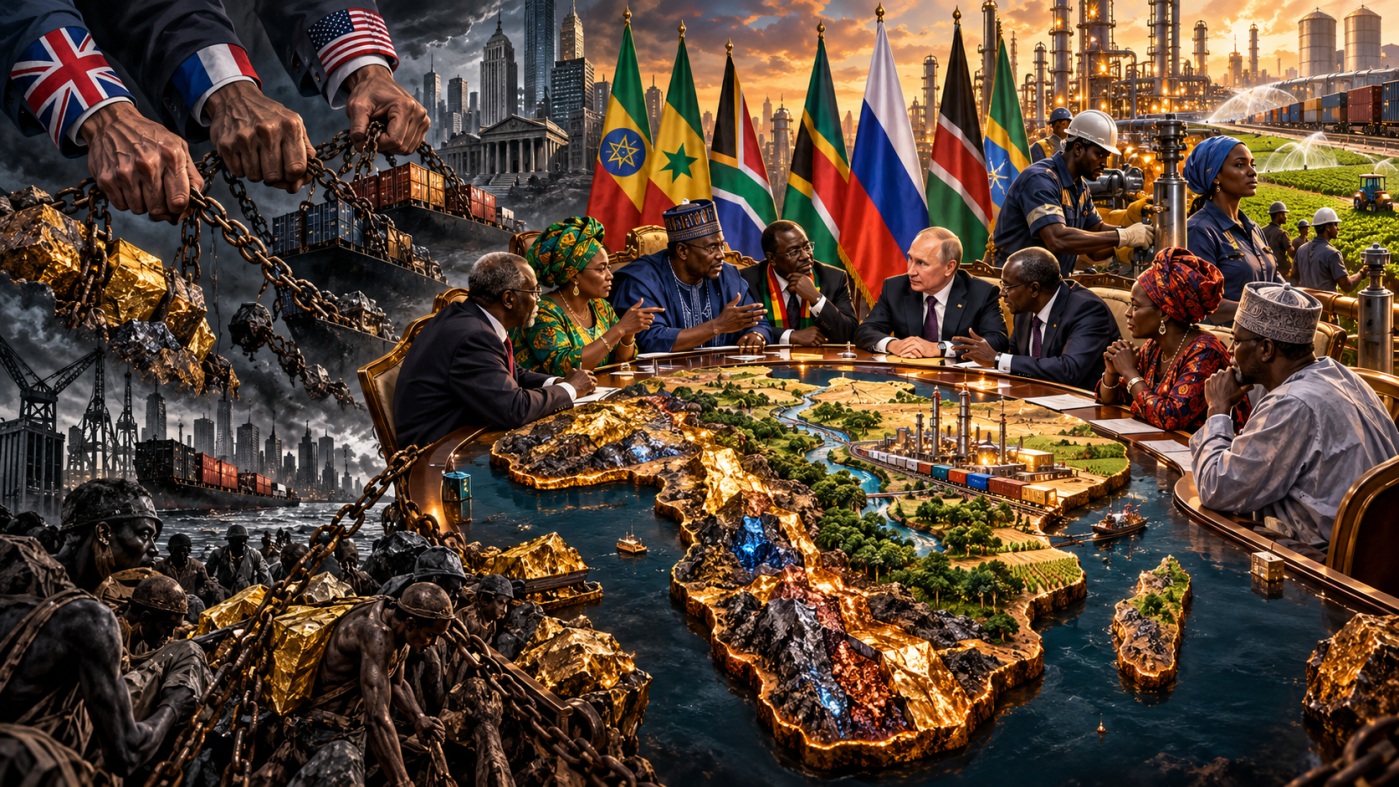
Britain, France, and the United States aren’t innocent spectators watching Russia muscle into Africa. They’re imperial powers defending an order that has fed on African wealth. European colonialists stole land, exploited labor, and hauled resources away to enrich their own countries. Neocolonialism kept the extraction running through corporate ownership, debt, and financial coercion. The colonial governor left; the mining company and the bill collector stayed. Reuters picks up the story when Africans start looking for another door.
That history gives the summit its driving contradiction. African countries need machinery, knowledge, finance, and productive capacity to overcome underdevelopment. But access to those necessities passes through institutions that have helped keep them dependent. They export resources to obtain foreign exchange, then spend it importing goods their economies lack the capacity to produce. They borrow to close the gap, and repayment claims resources needed to change the arrangement. The country keeps digging while the hole gets deeper.
Structural adjustment put a creditor’s boot behind this cycle. Governments needing financing faced demands to sell public assets, restrict spending, and remove protections. The shortage of money became an opportunity to seize authority over development. Workers and peasants paid through weakened services and constrained investment, while capital acquired assets and opportunities. Then came the lecture about poor countries lacking capacity. Break a worker’s tools, charge interest on replacements, and blame the lazy bastard for falling behind. That’s a hell of a business model.
The debt trap therefore reaches beyond interest payments. It gives creditors leverage over the means by which a country might escape their grip. Public institutions, investment decisions, and development priorities become bargaining chips at the lender’s desk. The government signs, but necessity holds the pen. Western financial power calls this an agreement between consenting parties. Any worker who’s accepted rotten conditions because the rent was due knows how much freedom that word can conceal.
Another usable source of finance or technology changes that confrontation. A government can reject a demand more credibly when refusal won’t immediately shut down something essential. Domestic processing becomes enforceable when the capacity to process actually exists. Technical knowledge gives a country more control over work it previously depended on outsiders to perform. These gains reduce the price of saying no. Sovereignty grows teeth when a people can refuse an ultimatum and keep functioning the following morning.
That’s where Russian cooperation acquires its anti-imperialist significance. It can help African countries obtain capacities with which to confront inherited domination. The relationship matters because of what it makes possible within an unequal world. The powers defending privileged access and a partner helping widen African options occupy different positions in that struggle. Throwing them into one bucket marked “foreign influence” produces the appearance of sophistication by draining the history out. The thief and the person offering another set of tools become two equally suspicious visitors.
Reuters performs the same trick through its allocation of agency. Moscow pursues influence; African governments receive attention. The Western relationships they’re trying to change remain scenery. An effort to loosen dependence becomes Russian encroachment. Imagine reporting a worker leaving an abusive employer entirely through the recruitment ambitions of the next company. The wage theft, the broken equipment, the boss holding dismissal over everybody’s head—all disappear. Apparently, the real story is that somebody else is hiring.
A sovereign development project has to disturb the arrangements that make dependence profitable. Local processing challenges where productive work happens. Public ownership changes claims on revenue and decision-making. Training can weaken dependence on expertise held elsewhere. Connected together, those capacities can reinforce one another: stronger production improves bargaining, better terms retain more resources, and retained resources can finance further development. That’s how a country starts making the machinery of extraction serve purposes its former masters never intended.
Capital will fight over the direction of that machinery. A company wants returns. A society needs food, education, healthcare, infrastructure, and the capacity to reproduce life on better terms. Public authority must compel investment to answer to those needs. Otherwise, the country can acquire a new facility while remaining chained to somebody else’s priorities. A factory gate inside the border doesn’t settle who gives the orders or where the wealth goes.
Workers and peasants stand at the center because their labor sustains the whole damn operation. External domination restricts what they can win by placing essential decisions beyond their reach. Breaking that domination enlarges the ground on which they can struggle. Greater national authority brings more responsibility home. The government can’t celebrate reclaiming power and then shrug when people demand to know what it’s doing with it. Sovereignty carries a bill, too—and this time working people have every right to collect.
Popular organization makes that claim a force governments must reckon with. The people who helped put foreign domination on the political agenda bring expectations that exceed a change of personnel. Their conditional support keeps the struggle alive inside the sovereign project. Without that independent pressure, officials can inherit the microphone while the masses inherit another waiting period. “Development is coming” becomes the same old bullshit, printed on patriotic stationery.
The direction is clear: break the external veto, build productive capacity, and strengthen the people’s power over its use. Western imperialists have no right to police African partnerships to preserve the returns from centuries of plunder. African peoples owe them neither exclusive access nor gratitude for financing another turn of the screw. Reuters sees Putin acquiring influence. Beneath its account, people are fighting to get the boot off their necks—and put their own hands on the machinery their labor keeps running.
Put Solidarity Where Decisions Are Made
The struggle belongs wherever imperial power becomes a loan condition, a military agreement, or a claim on African wealth. Solidarity has to reach those decisions. Otherwise, we leave the creditors holding the contracts while we congratulate ourselves for having the correct opinions. The bastards can survive our disapproval. Organized pressure against their power presents a different problem.
Begin with the people whose purposes Reuters buried. The International Peoples’ Assembly’s Voices from the Sahel brings together interviews, movement testimony, and political education concerning sovereignty struggles in Mali, Burkina Faso, and Niger. Use those materials in union meetings, study groups, and community forums. Build relationships through existing solidarity channels so African organizers can explain their demands directly. A meeting earns its keep when it develops people capable of organizing together, carrying those demands into their institutions, and challenging attempts to dictate Africa’s partners from abroad.
Follow the financing, too. A government’s announcement can promise development while the agreement beneath it assigns repayment obligations the public hasn’t examined. AFRODAD’s African Borrowing Charter provides a practical instrument for scrutinizing borrowing, public guarantees, and debt-financed projects. Its documented parliamentary oversight partnership identifies an institutional pressure point. Support demands to disclose who lends, who guarantees, what repayment requires, and what the project must deliver. Put those questions before public commitments harden into obligations that workers inherit. The banker shouldn’t be the only person who reads the mortgage before the country signs it.
Inside France, Survie’s organizing network provides an existing channel for confronting Françafrique through investigation, public campaigning, and local groups. Its participation routes include translation, research assistance, public events, and campaigning. Readers there can join that work against the institutions through which their own state maintains domination. Investigative and translation work can put agreements before a wider public; organized campaigning can make officials answer for them. Bring the paperwork out of the ministry and into the meeting hall.
These efforts meet in one political task: help African peoples defend the room to choose, expose the terms being negotiated, and strengthen popular authority over what follows. Solidarity must serve the workers and peasants whose labor makes development possible. Their victory requires the power to compel delivery, direct resources, and hold governments to their promises. The people who keep the whole machine running have earned more than another invitation to applaud.


Leave a Reply