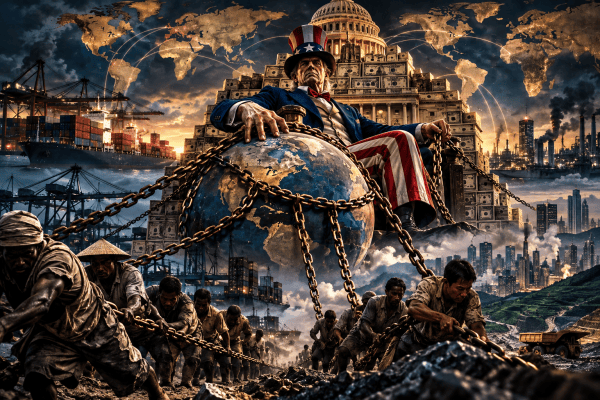
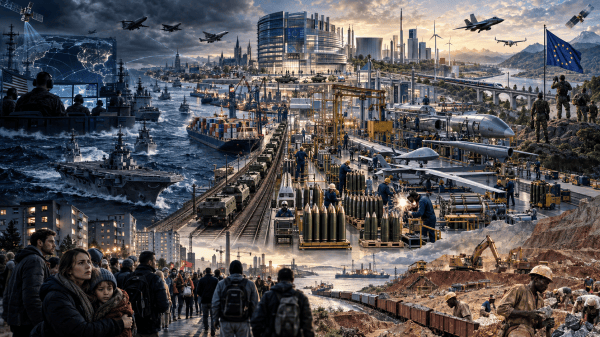
What if the façade of Asian firms acquiring American assets is merely a veneer masking a broader crisis of imperial power? The Asia Times' portrayal presents a triumphant narrative of capital flows, yet ignores the brutal realities behind ownership transitions. As firms like Sun Pharma and Mitsubishi grasp at American infrastructure, the underlying forces of deindustrialization, labor exploitation, and geopolitical tensions are left unexamined. This isn't progress—it's a manipulation of perception. The real question remains: who controls these vital resources? Without a radical reimagining of ownership, the future remains shackled to elite interests, while workers are forced to celebrate their own dispossession.
Great Satan at the Strait: Iran, International Law, and the Collapse of the “Rules-Based Order”
In a tale of diplomacy that sounds more like a sitcom plot, the Associated Press managed to frame U.S.-Israeli power plays as polite conversation while depicting Iran’s resistance as a chaotic tantrum. Imagine a landlord demanding rent while simultaneously hammering a "peace" sign into the wall—classic! The article promotes a narrative where blocking a nation is just “maritime security,” leaving readers to wonder if the actual level of aggression got lost in translation. Amid drones and oil price panic, the main issue lurking around like an unwelcome relative is whether nations can truly be sovereign or if they must politely obey the empire’s whims. It's a comedy of imperial contradictions, where legality bends more than a yoga instructor under pressure!
Failure According to Whom?: Rewriting the Metrics of Socialism
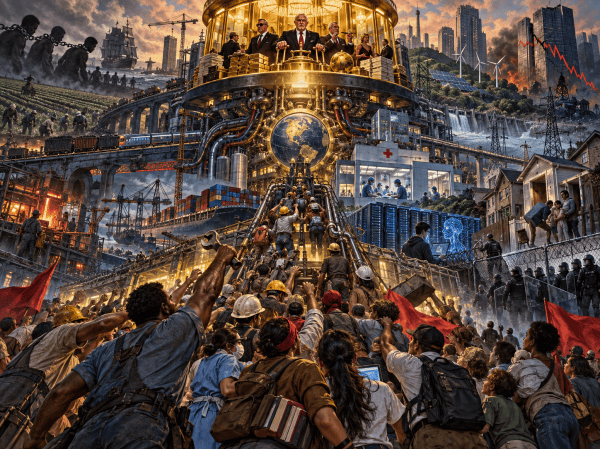
The pervasive claim that socialism has "failed" is an ideological construct rather than a factual statement. A closer analysis reveals that socialist systems, from the Soviet Union to China, achieved measurable gains in education, health, and economic development under dire conditions. This narrative of failure is not supported by historical evidence but rather is a product of a century-long ideological war against socialism. Capitalism, meanwhile, perpetuates crises, inequality, and social fragmentation, failing to meet human needs. The real question is not why socialism fails, but how it has transformed societies when confronted with immense challenges, challenging the ruling narrative that defines success so narrowly.
Technofascism: The Digital Leviathan and the War on Humanity
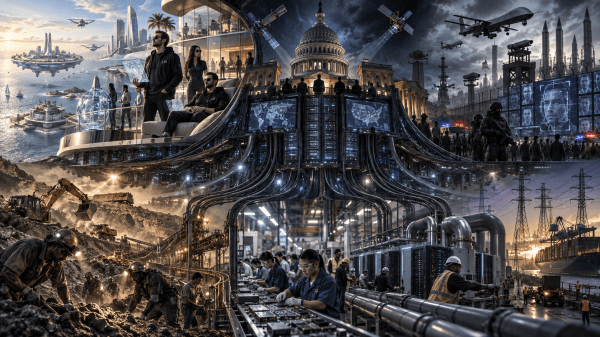
The United States isn’t gracefully unraveling; it’s morphing into a technofascist apparatus of control that leverages financial dominance, digital surveillance, and labor discipline. While the elite tout "innovation," they're repackaging colonial exploitation under the guise of progress, tightening their hold domestically and globally. Liberal analyses miss the subtleties of this shift, mistaking procedural forms for genuine democracy, while real power redistributes into unaccountable systems. As public trust wanes and crises mount, this infrastructure of power rapidly transforms governance into an invisible web of control, inching toward collective consciousness and organized resistance that could eventually dismantle the machinery of oppression.
Gold, Lithium, and the Chains of Empire: Zimbabwe, China, and the Battle to Break the Colonial Economy
The imperial press calls Zimbabwe’s recovery “bizarre,” revealing more about empire’s ideology than Africa’s reality. Beneath the headlines lies a material transformation driven by gold, lithium, labor, and survival within a system built to constrain it. As Zimbabwe pushes toward beneficiation and partners with China, it enters a global struggle over who controls resources, industry,... Continue Reading →
Settlers in the Wreckage: J. Sakai, Technofascism, and the War for the Future
J. Sakai’s interviews force the U.S. left to confront the settler-colonial foundations it has spent generations avoiding. His analysis exposes the myth of the revolutionary white proletariat, the collapse of liberal illusions, and the expansion of war into every domain of life. But Weaponized Information pushes further, grounding his insights in monopoly finance capital, technofascism,... Continue Reading →
Inside the House of Cards: How Empire Manages Crisis Through Memory, Civility, and Myth
Four former presidents gather under corporate media lights to present democracy as a shared moral inheritance, grounded in unity, civility, and participation. Beneath that performance lies a material history of deregulation, war, surveillance, and repression that produced the very crisis now being discussed. The interview reveals not reflection, but a ruling-class effort to manage legitimacy... Continue Reading →
The Return of the State: How Industrial Policy Became a Weapon of Global Power
An emerging “consensus” around industrial policy masks a deeper ideological project disciplining development within the boundaries of global capital. The material reality reveals a world defined by subsidy wars, coercion, and uneven development, where state intervention is already reshaping the global economy. China stands at the center of this contradiction as a socialist-led state navigating... Continue Reading →
Reopening the Cage: Bretton Woods Returns to a Country That Refused to Kneel
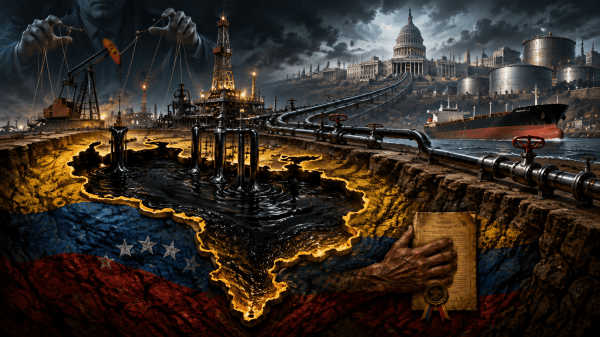
The article presents IMF and World Bank re-engagement as routine normalization, masking a political event shaped by years of institutional blockade and external pressure. Beneath that surface lies a struggle over sovereignty, where constitutional legitimacy, sanctions, and anti-neoliberal memory redefine what “recognition” actually means. The return of global finance collides with a still-living project of... Continue Reading →
The Fool Who Moved the Mountains Still Walks Among Us: China’s Long March to Socialism and the Emergence of the Multipolar World Order
From Mao’s seizure of sovereignty to Xi’s effort to discipline capital, China’s modern history is neither a fall from revolutionary purity nor a smooth ascent into capitalism, but a protracted socialist struggle through contradiction. Each phase of development generated new class forces, new dangers, and new strategic adjustments, as the Party-state sought to preserve political... Continue Reading →