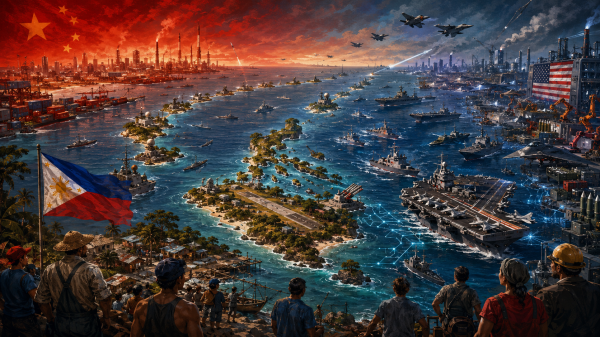
The Status Quo Has to Be Manufactured: America’s Pacific Primacy and the Rising Cost of Keeping It Alive

Elbridge Colby's assertion that America is the "apex predator" in military readiness disguises the troubling reality of dwindling U.S. military supremacy against a rising China. The narrative expertly choreographs U.S. responses to China's actions, framing Washington as a stabilizing force while ignoring the material consequences of its expansive military infrastructure and the burdens it places on allies like the Philippines. This contrived status quo sustains American dominance at an ever-increasing cost, presenting imperial ambitions as mere defense. The real struggle lies not in choosing a stronger predator, but in dismantling the systems that perpetuate this militarized hierarchy, exposing the true stakes of U.S. imperialism.

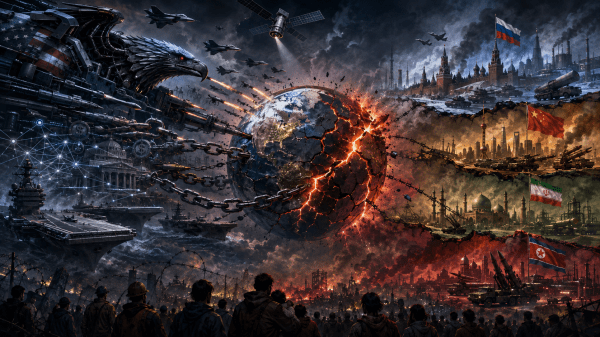
The Axis Washington Built: How the War Against Multipolarity Is Pushing the World Toward World War III

The rhetoric around a so-called "authoritarian axis" of Russia, China, Iran, and North Korea is dangerously misleading. This narrative stems from a long history of U.S. military expansion and interventionism that has fostered the very hostilities it claims to combat. Instead of viewing these nations as a monolithic threat, we must recognize that their alliances are responses to decades of American aggression and coercion. Bosco's portrayal of these entities as simple villains obscures the deeper dynamics at play, namely that U.S. actions have directly contributed to their convergence. To prevent a World War III scenario, we must dismantle the war machinery perpetuating this cycle of escalation and educate the public on these historical nuances.

Public Money, Private Command: The State Returns to Rescue Capital

Washington's recent equity stakes in key corporations like Intel signal capitalism's failure rather than a shift towards socialism. While the government assumes control over critical industries, it simultaneously excludes workers from labor and decision-making roles. The stated objective is national security, but this forms part of a broader imperial strategy that intertwines military needs with corporate interests. The public funds the industrial system while remaining marginalized, illustrating a profound contradiction: social production is maintained under corporate control. As America grapples with its economic decline, the push for a more equitable structure is vital. It's time for public investment to translate into worker empowerment and community authority.

The Development Racket: How the World Bank Repackages Empire in Burkina Faso

The World Bank's report on Burkina Faso masquerades as a beacon of growth while burying the sinister realities of imperialism and neoliberal domination. Beneath the polished metrics of economic success lies a nation striving for food and resource sovereignty, grappling with the vestiges of colonial exploitation. This report, cloaked in the language of reform, manipulates narratives to maintain control, ignoring the voices of those truly affected. Burkina Faso’s fight against the systems that dictate their development is not a mere economic story; it's a battleground for sovereignty, pitting genuine progress against imperial interests that aim to manage rather than liberate.

Same Boss, New Contract: USMCA and the Empire’s Grip on Mexico and Canada

NBC's portrayal of Trump's refusal to renew the USMCA is more than a mere disruption in trade; it’s a calculated move to establish an iron grip over North America. The article frames this as instability, ignoring the deeper narrative of imperial ambition where trade agreements become tools for coercion. The U.S. isn't retreating; it's reconfiguring the continent, tightening control over Mexico and Canada while excluding China from the fold. Workers from all sides suffer under this new order while corporate interests thrive unchallenged. Ultimately, this is not a story of chaos but of empire reshaping subjugation—inviting you to witness the birth of Fortress America instead of its decay.

Françafrique 2.0: Macron, Multipolarity, and the Quiet Reassembly of Empire

French President Emmanuel Macron's interruption at a Nairobi summit starkly reveals the hypocrisy behind France's so-called partnership with Africa. Masked in the rhetoric of mutual respect and development lies an insidious struggle for neocolonial influence amid a backdrop of declining French authority. As African nations increasingly assert sovereignty, aiming to break free from debt and military dependency, Macron's actions embody centuries of colonial entitlement. While Paris attempts to rebrand its influence through climate and technological initiatives, a new wave of Pan-African movements challenges these narratives, demanding genuine autonomy over the façade of partnership. The true legacy of imperialism endures, evolving but never vanishing.

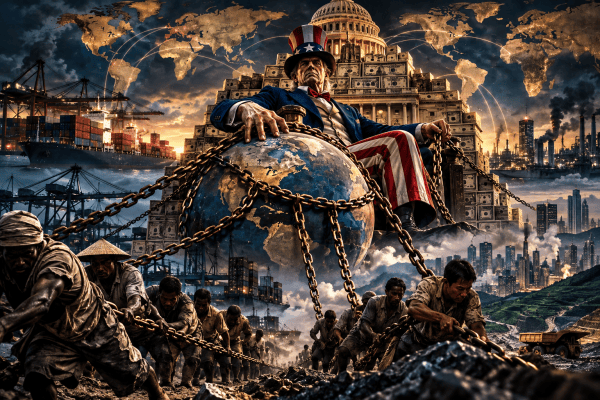
Apples to Apples: Superexploitation from Orchards to iPhones

What appears to be a comparison between two unrelated commodities—apples picked in U.S. orchards and Apple devices assembled across the Global South—is in fact a comparison between two forms of the same capitalist-imperialist labor regime. In U.S. agriculture, superexploitation is organized through settler-colonial land relations, racialized migrant labor, H-2A dependency, deportability, and the broader coercive... Continue Reading →

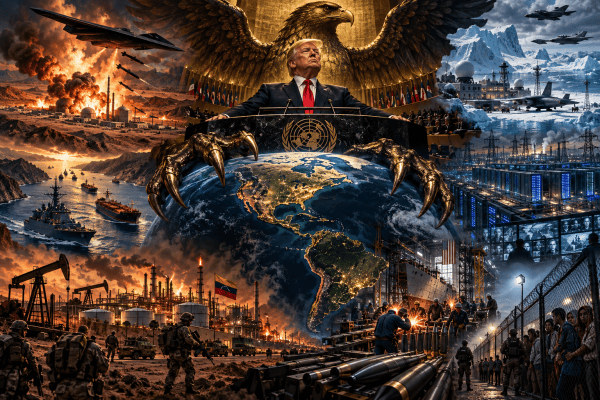
Cuba Will Not Kneel: Trump, The New York Times, and the Contradictions of the American Pole

The New York Times launders U.S. regime-change demands into the language of negotiation, masking domination as diplomacy. Beneath the narrative, a coordinated campaign of economic strangulation—especially through energy chokepoints—reveals deliberate coercion, not Cuban failure. This pressure is part of a broader imperial recalibration: the consolidation of Fortress America as a hemispheric bloc under U.S. control.... Continue Reading →

Fortress America: From “Operation Total Extermination” to the Consolidation of the American Pole

The Intercept’s reporting reveals a widening U.S.-aligned war across Latin America, exposing a moment where imperial language begins to outpace its own ideological cover. The documented facts—cross-border strikes, coalition warfare, regime change operations, and indefinite escalation—align directly with official doctrine and emerging hemispheric war architecture. When situated within the crisis of imperialism and the rise... Continue Reading →

Cathedrals and Carriers: Marco Rubio’s Civilizational Manifesto for a New Western Century

In Munich, the language of heritage, sovereignty, and renewal cloaks a program of bloc consolidation, industrial recalibration, hardened borders, and unilateral force. Beneath the hymn to Western civilization lies a disciplined strategy to reassert Atlantic primacy in a multipolar world. The question is not whether the West will act — but who benefits from how... Continue Reading →

Website Powered by WordPress.com.

Up ↑