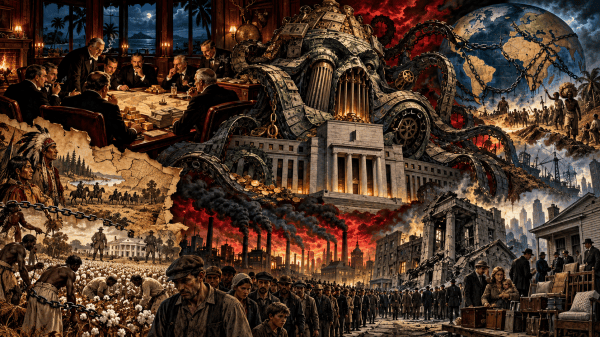
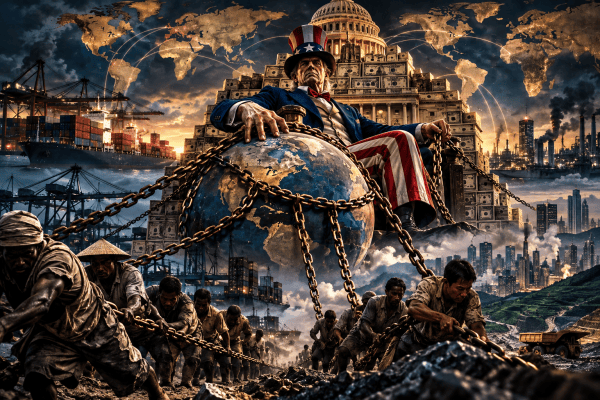
Malcolm X reshaped my understanding of America’s racial dynamics, revealing it not as a flawed democracy but as a colonial project steeped in oppression. His teachings led me beyond the shallow understanding of leftist politics to a deeper comprehension of the intertwined struggles against imperialism and capitalism. Each encounter with his work pushed me toward recognizing humanity in the oppressed and the global context of their struggles. Through Malcolm, I learned that true liberation requires a conscious break from inherited identities tied to empire. His evolution mirrors a broader human struggle, challenging us to embrace revolutionary love as an act of transformation, not mere rhetoric.
Crouching Tiger, Hidden Shareholder: The Empire Goes on the Auction Block
What if the façade of Asian firms acquiring American assets is merely a veneer masking a broader crisis of imperial power? The Asia Times' portrayal presents a triumphant narrative of capital flows, yet ignores the brutal realities behind ownership transitions. As firms like Sun Pharma and Mitsubishi grasp at American infrastructure, the underlying forces of deindustrialization, labor exploitation, and geopolitical tensions are left unexamined. This isn't progress—it's a manipulation of perception. The real question remains: who controls these vital resources? Without a radical reimagining of ownership, the future remains shackled to elite interests, while workers are forced to celebrate their own dispossession.
Empire in Denial: The Telegraph, the New Cold War Against China, and the Crisis of Unipolar Power
The Telegraph's portrayal of China as a weakening power is nothing more than imperial propaganda, designed to comfort an anxious Western audience. Underneath such narratives lies a complex reality where the U.S. struggles to maintain its grip on a transforming world order fraught with geopolitical tensions. China’s economic performance, rather than signalling decline, reveals strategic resilience amidst U.S. encirclement. The article strategically omits critical historical context and nuances of international relations, twisting narratives to fit a moral superiority that inaccurately paints adversaries as threats. What emerges is not China's downfall but an empire grappling with its loss of unchallenged authority in a rapidly evolving global landscape.
The Red Menace Strikes Back: Vietnam, the DPRK, and the Collapse of Imperial Isolation
In May 2026, Vietnam's Foreign Minister met with North Korean officials, a significant yet underreported event that challenges the Western narrative of the DPRK as isolated and irrational. This meeting signifies the resurgence of socialist internationalism and the resilience of anti-imperialist relations against a U.S.-dominated order. Vietnam asserts its independence by maintaining ties with a historically aligned state despite pressures to conform to U.S. interests, illustrating a defiance of binary political expectations dictated by Western powers. As these two nations deepen cooperation, they expose cracks in imperial control, revealing that sovereignty endures in the face of sanctions and coercion.
Empire at the Table: Trump, Xi, and the Crisis of Unipolar Power
The Beijing summit is not merely a high-stakes poker game between Trump and Xi; it’s a façade hiding an imperial crisis where U.S. dominance falters amid technological decay and geopolitical strife. France 24’s framing turns complex geopolitical tensions into trivial personal confrontations, ignoring the deeper struggles over resources and sovereignty that threaten global order. As globalization erodes, emerging anti-imperialist movements ripple through nations, rejecting the casino logic of empire. The real question isn’t who holds the cards, but whether an imperial system so reliant on exploitation and coercion can adapt to a world increasingly seeking self-determination and resistance.
From Alliance to Containment: How Anglo-American Power Engineered the Cold War
The essay provocatively dismantles the myth that the Cold War was merely a reaction to "Soviet aggression." Instead, it reveals it as America's calculated strategy to reinforce a capitalist world order post-World War II, driven by anxieties over rising leftist movements and anti-colonial uprisings. It highlights how the U.S. initiated a campaign of political warfare and economic reconstruction through the Marshall Plan, effectively shaping Europe and other regions under its imperial influence. To Washington, the real danger was not communism but the threat of genuine independence that challenged capitalist dominance. The Cold War was less about ideological battles and more about inter-imperialist struggles to determine global economic control.
Workers of the New World: BRICS+, Platform Capital, and the Class Struggle Inside Multipolarity
The Atlantic neoliberal order is disintegrating, revealing the ravages inflicted on workers and the environment by a relentless pursuit of profit. As BRICS+ nations seek to reclaim industrial sovereignty and labor rights, they face a chaotic multipolar reality where exploitation continues under different guises. Amid profound instability, the laboring class must transition from mere instruments of production to conscious political actors capable of reshaping development. This moment offers a critical opportunity: to reclaim the narrative and construct a world centered on human dignity and ecological balance. The question now is whether history will be rewritten by workers or remain dominated by elites.
Françafrique Forward: Macron, Ruto, and the Nairobi Trap of Imperial Recalibration
The Africa Forward Summit in Nairobi is nothing more than a polished façade for France's enduring imperial ambitions in Africa, cleverly cloaked in the language of innovation and partnership. While hailed as a diplomatic reset as it moves outside Francophone Africa for the first time, the summit simply signals France’s desperation to regain footholds after being ousted from the Sahel. As Kenya grapples with its own debt crisis, the summit reflects a deeper reality: a struggle for sovereignty masked by corporate rhetoric. Opposing forces are mobilizing against this repackaging of imperialism, unearthing the true narrative of resistance against old empires in new guises.
The Devil’s Republic: Illuminati Panic and the Hidden Architecture of American Repression
The American ruling elite has a long history of morphing political dissent into a narrative of demonic threat, consolidating their power through fear tactics akin to those seen during the Illuminati panic of the 18th century. This episode illuminated how conspiracy theories, fueled by elite anxieties, have criminalized immigrants and suppressed dissent. The manipulation of societal fears allows the state to transform opposition into an existential threat, justifying repression and surveillance. Today's conspiracism, though often dismissed as irrational, reveals a deeper urgency: a misdirected anger at real systemic injustices commodified into scapegoating narratives, obscuring the true architecture of capitalist power while paralyzing collective political action.
Failure According to Whom?: Rewriting the Metrics of Socialism
The pervasive claim that socialism has "failed" is an ideological construct rather than a factual statement. A closer analysis reveals that socialist systems, from the Soviet Union to China, achieved measurable gains in education, health, and economic development under dire conditions. This narrative of failure is not supported by historical evidence but rather is a product of a century-long ideological war against socialism. Capitalism, meanwhile, perpetuates crises, inequality, and social fragmentation, failing to meet human needs. The real question is not why socialism fails, but how it has transformed societies when confronted with immense challenges, challenging the ruling narrative that defines success so narrowly.