The New York Times frames China’s ethnic unity law as a blatant act of repression against minorities, echoing a Cold War moral narrative. Yet, this interpretation overlooks the historical and political complexities faced by a socialist state trying to maintain unity amidst the legacies of imperialism and foreign interference. The law seeks to counteract separatism and assert national sovereignty, but critics argue it risks bureaucratic assimilation of diverse ethnic identities. Ultimately, the struggle over the national question lies not in simplistic moral judgments, but in addressing imperialism's manipulative strategies while safeguarding genuine autonomy and cultural integrity within China's socialist framework.
The Development Racket: How the World Bank Repackages Empire in Burkina Faso
The World Bank's report on Burkina Faso masquerades as a beacon of growth while burying the sinister realities of imperialism and neoliberal domination. Beneath the polished metrics of economic success lies a nation striving for food and resource sovereignty, grappling with the vestiges of colonial exploitation. This report, cloaked in the language of reform, manipulates narratives to maintain control, ignoring the voices of those truly affected. Burkina Faso’s fight against the systems that dictate their development is not a mere economic story; it's a battleground for sovereignty, pitting genuine progress against imperial interests that aim to manage rather than liberate.
Same Boss, New Contract: USMCA and the Empire’s Grip on Mexico and Canada
NBC's portrayal of Trump's refusal to renew the USMCA is more than a mere disruption in trade; it’s a calculated move to establish an iron grip over North America. The article frames this as instability, ignoring the deeper narrative of imperial ambition where trade agreements become tools for coercion. The U.S. isn't retreating; it's reconfiguring the continent, tightening control over Mexico and Canada while excluding China from the fold. Workers from all sides suffer under this new order while corporate interests thrive unchallenged. Ultimately, this is not a story of chaos but of empire reshaping subjugation—inviting you to witness the birth of Fortress America instead of its decay.
Socialism Without Revolution: Jacobin’s Market Fantasy Against the Socialist World
Bhaskar Sunkara’s market socialism is a bold yet flawed vision that naively overlooks the burdens of imperialism. He critiques past socialist models while proposing that worker-run firms can flourish within a system still embedded in capitalist exploitation. However, the reality is that these worker enterprises would still rely on the global hierarchy that upholds imperial advantages. A true socialist awakening must reject these inherited structures and demands an anti-imperialist framework instead. Without confronting the realities of colonial legacies and ensuring reparative relations, Sunkara’s proposal risks socializing the benefits of imperialism while maintaining its oppressive mechanisms intact.
From Yan’an to Shenzhen: How China Forged Socialism Through Concrete Contradiction
China’s revolutionary saga obliterates the Cold War illusion of socialist states as mere Soviet puppets. Through peasant uprisings and intricate political maneuvers, China redefined socialism amidst imperial oppression, transforming from a colonial victim to a technological titan without abandoning Communist rule. The narrative that constraints socialism to a Soviet mold collapses under China’s rich history of adaptation to its unique tumultuous reality. China’s evolution showcases socialism as a living pursuit aimed at sovereignty and rejuvenation, not dogmatic adherence. The experiences of struggle, experimentation, and resilience reflect a deep understanding: socialism thrives on continuous reimagining, not imitation.
The Red Scare Has a Filing Cabinet: CNN, Communism, and the Policing of American Thought
CNN turns deleted tweets into an anti-communist dossier while burying the housing, healthcare, immigration, education, and antiwar demands that made Darializa Avila Chevalier’s campaign matter. The article inherits a long U.S. tradition where communism is treated not as a political position but as contamination. The real story is capitalism’s fear that workers might learn the... Continue Reading →
The Robber at the Gate: Venezuela, China, and the American Pole’s Oil Ledger
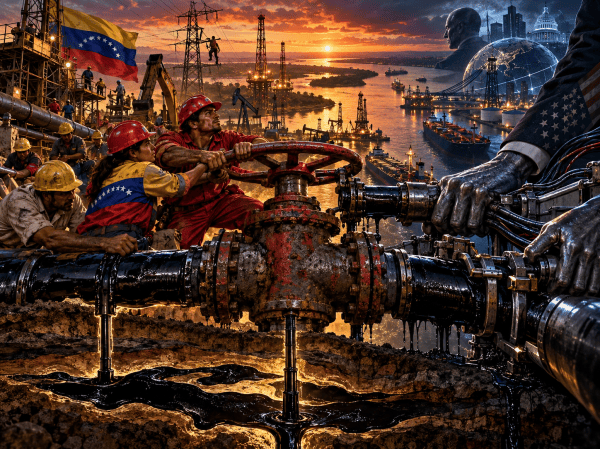
Washington masquerades as a “gatekeeper,” but it’s merely an imperial force exploiting Venezuela’s oil through a facade of debt management. The South China Morning Post article dismisses the severe issue of sovereignty, framing the US’s dominance as mere financial oversight. This is financial piracy, where the empire suffocates a nation but presents itself as a recovery manager. As China seeks to protect its investments in Venezuela, the true battle is not about debt but about reclaiming sovereignty from imperial grasp. The struggle is clear: Venezuela’s resources belong to its people, not to the US, which must be confronted directly to dismantle this neocolonial command.
Immunity for the Occupiers: Gaza and the Peace Board of Empire
The Guardian's exposure of a leaked immunity draft serves as just the tip of a colossal iceberg: the Board of Peace governing Gaza masquerades as a humanitarian initiative but is an elaborate facade for hyper-imperialism. Rather than delivering justice or sovereignty to the Palestinian people, this foreign administration seeks legal immunity, converting public facilities into operational bases and redefining colonial rule as a technocratic management process. The real scandal lies not just in their legal shield but in the fact that Gaza is being stripped of autonomy and treated as a problem to be managed. Resistance isn’t merely an option; it’s a necessity against this colonial resurrection disguised as peace.
No Freedom Without Power: Machiavelli, Rome, and the Republic Built on Ruins
Machiavelli’s The Discourses is not a genteel treatise on republican ideals but a gritty how-to on wielding power from the depths of defeat. This work confronts the myth of liberal innocence, asserting that liberty arises not from consensus but through chaos, violence, and organized resistance against domination. Machiavelli's insights expose the harsh realities of historical conflict and the necessity of institutional discipline, emphasizing that true power is built on struggle, not sentiment. Yet, amidst its rich lessons, The Discourses reveals a troubling contradiction: the same republic that fosters internal liberty thrives through imperial conquest and exclusion. This duality beckons revolutionaries to seize its pragmatic lessons while rejecting its imperial legacy.
Cop City Is the Counterinsurgency Campus: How “Antifa” Became the New Name for the Old Domestic Enemy
The Guardian's coverage of Trump's "antifa" prosecutions highlights a covert escalation of systemic repression rather than the emergence of a new threat. While it depicts the federal indictment against Cop City protesters as a shocking maneuver, this is merely the latest play in a long history of state-sponsored violence rooted in colonialism, slavery, and counterinsurgency tactics. The narrative frames Trump as the villain while obscuring the entrenched architecture of oppression that transcends his administration. The real battle lies in organizing effective resistance, connecting various social justice movements, and building robust defense mechanisms amidst a climate poised for increasing militarization and legislative warfare against dissent.