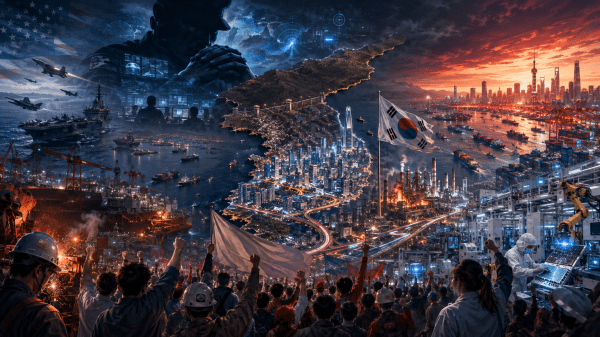
South Korea’s “miracle” didn’t fall from the fucking sky. It was built through war, U.S. occupation, anti-communist repression, Japanese capital, state-directed development, disciplined labor and a regional imperial order designed to make capitalism look victorious against socialism. But the contradiction is vicious: the same system built Korean industry strong enough to become indispensable, produced workers powerful enough to break dictatorship, and tied Korean accumulation into an Asian economy increasingly centered on China. Now Washington wants the miracle to keep taking orders—more weapons, more shipyards, more investment, more war preparation. The problem is South Korea ain’t the weak frontier state it used to be.
Sovereign Enough to Steal From: How American Law Turns Conquest Into Governance
Ward Churchill’s Perversions of Justice exposes the legal machinery through which Indigenous sovereignty is recognized just enough to legitimize treaties, land cessions, resource extraction and colonial administration—then restricted whenever it threatens settler possession or state power. Following that contradiction from conquest and property into uranium mining, blood quantum, AIM repression and U.S. imperial expansion, this review tests both Churchill’s strongest insights and his strategic limits. His final wager—that the colonizer’s own law can be weaponized to fracture legitimacy and withdraw consent—remains powerful. But the deeper revolutionary question is what turns that rupture into organized material counter-power.
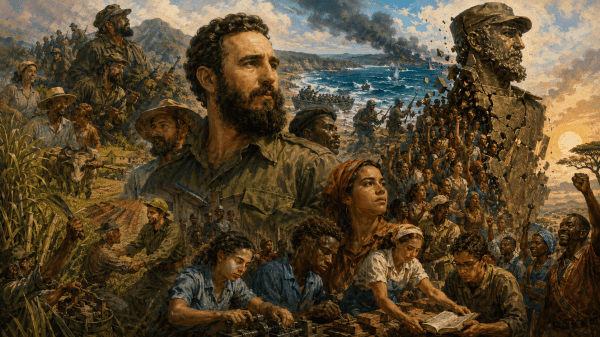
The Revolution Must Keep Making Revolutionaries: Fidel Castro and the Fight Against Becoming a Monument
On the centenary of Fidel Castro's birth, his autobiography, My Life, acts as a provocative lens into the complexities of revolution. It dismantles the myth of the born revolutionary, showcasing instead how context, struggle, and learning forge warriors for change. Despite Cuba's successes, deep-rooted issues like racism and inequality persist, with Fidel warning that Cuba's most significant threat may not come from external forces but from within—its own inability to correct mistakes. As the Revolution ages, the pressing query remains: can it continually foster revolutionary consciousness amidst evolving contradictions or will it succumb to the complacency that often follows victory?
Beyond Hegemony, Beyond Illusion: Samir Amin, Multipolarity, and the Unfinished Road to Socialism
What happens when one of the twentieth century's greatest Marxist theorists is tested against the world that emerged after unipolarity began to fracture? This Weaponized Intellects review excavates Samir Amin's Beyond US Hegemony? as both a product of its historical moment and a living revolutionary framework, measuring its arguments against China's socialist transition, Russia's anti-hegemonic resurgence, the rise of BRICS, and Amin's own later theoretical development. The result is neither celebration nor dismissal, but a critical reconstruction that distinguishes multipolarity from socialism and argues that only organized popular power can transform the decline of empire into genuine human emancipation.
From Alliance to Containment: How Anglo-American Power Engineered the Cold War
The essay provocatively dismantles the myth that the Cold War was merely a reaction to "Soviet aggression." Instead, it reveals it as America's calculated strategy to reinforce a capitalist world order post-World War II, driven by anxieties over rising leftist movements and anti-colonial uprisings. It highlights how the U.S. initiated a campaign of political warfare and economic reconstruction through the Marshall Plan, effectively shaping Europe and other regions under its imperial influence. To Washington, the real danger was not communism but the threat of genuine independence that challenged capitalist dominance. The Cold War was less about ideological battles and more about inter-imperialist struggles to determine global economic control.
Cedric J. Robinson, Black Marxism and the Colonial Blindspot Inside Western Marxism
Black Marxism and the Colonial Blindspot Inside Western Marxism Cedric J. Robinson did not write Black Marxism to abandon Marxism, but to indict the version of it that emerged safely inside empire. By tracing capitalism’s formation through slavery, racial domination, and colonial war, Robinson forces historical materialism to confront what Western Marxism systematically erased. The... Continue Reading →
Malcolm X and the Making of a Revolutionary Internationalist
From colonial violence in the American Midwest to the global battlefields of Africa and Asia, Malcolm’s life traces the sharpening of Black consciousness under empire. His final years mark not moderation but expansion — from religious nationalism to human rights insurgency and anti-imperialist alignment. This essay follows the dialectical arc of his transformation and the... Continue Reading →
“We Don’t Please East or West”: African Sovereignty Speaks While the Rules-Based Order Breaks
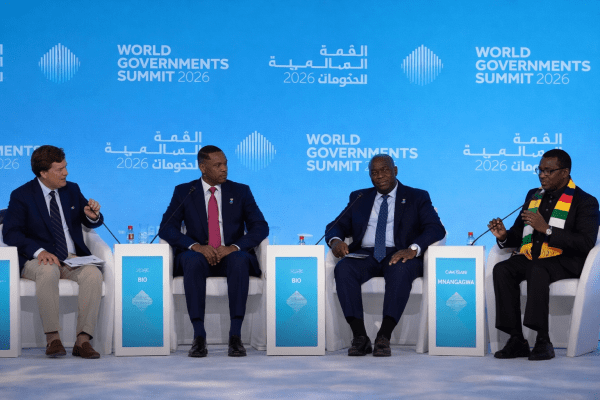
At a summit built to “shape future governments,” African heads of state confront old imperial binaries inside a new architecture of power. Tucker Carlson presses the familiar frames—China versus the West, democracy as sermon, race as property—while sanctions, AI infrastructure, and development finance reveal the harder machinery beneath the talk. Zimbabwe’s discipline, Sierra Leone’s education... Continue Reading →
Precolonial Black Africa: Cheikh Anta Diop and the Destruction of Eurocentric History
Cheikh Anta Diop’s Precolonial Black Africa shows—through hard historical evidence—that Africa followed its own material pathway to complex civilization, disproving Europe as the universal model and exposing Western Marxism’s blind spots. For today’s revolutionaries, Diop arms us with the historical clarity needed to dismantle colonial ideology and rebuild a truly internationalist, anti-imperialist science of liberation.... Continue Reading →
From “Stay Woke” To American Dreaming: The Liberal Capture of Identity Politics, the Rise of DEI, and the Soft Counterinsurgency That Replaced Revolution With Representation
How a radical method of seeing the empire became a tool for managing it, and why reclaiming “woke” requires breaking with the settler state and realigning with global anti-imperialist struggleBy Prince Kapone | Weaponized Information | December 6, 2025When “Woke” Left Home and Got Jumped by the EmpireOnce upon a time, before cable news discovered... Continue Reading →