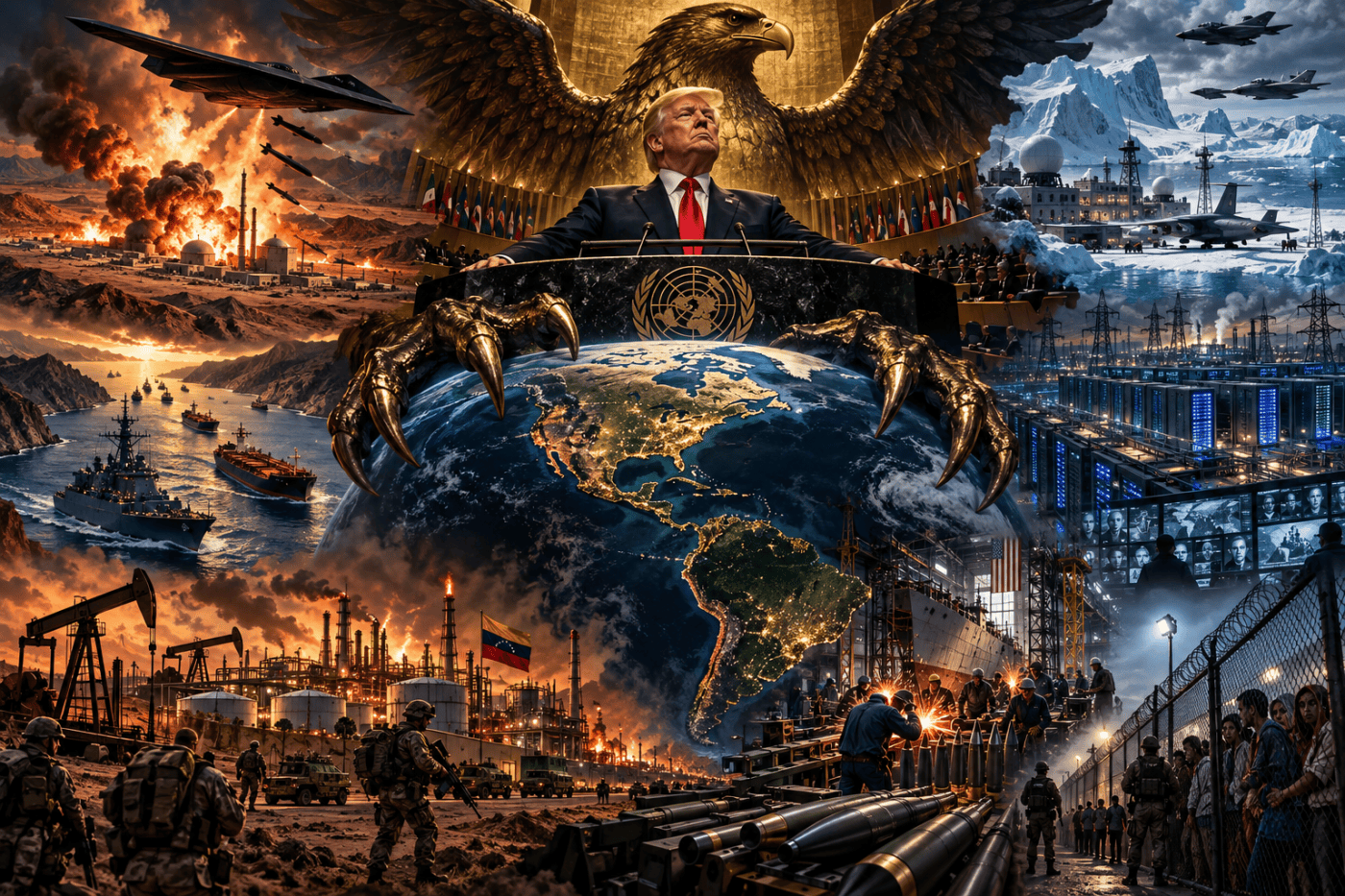
Trump came to the United Nations declaring that America was back, only to spend the rest of his speech describing how much bombing, economic punishment, military buildup and political pressure it now takes to keep Washington on top. From Iran and Venezuela to Greenland and Cuba, the spectacle of restored supremacy reveals an empire tightening its grip as uncontested command becomes harder to reproduce. Abroad, that pressure is hardening into an American Pole built around strategic enclosure; at home, it runs through rearmament, immigration enforcement, AI infrastructure and the growing fusion of monopoly capital with coercive state power. The United States remains enormously powerful, but Trump’s own boasts expose the contradiction beneath the gold plating: maintaining imperial command now requires more force, more enclosure and more naked domination than the mythology of effortless primacy can admit.
Prince Kapone | Weaponized Information | September 23, 2026
I. America Is Back
Donald Trump opens his address by announcing a restoration. “America is back,” he tells the General Assembly, then piles one declaration on top of another: the economy is the envy of the world, the military is unmatched, American technology leads, American energy fuels the planet, American power is expanding. This is more than the usual presidential chest-beating. It establishes the premise on which the whole speech depends. The United States passed through weakness, recovered its strength and once again possesses the power and political will to command events rather than endure them.
The story works because Trump isn’t building it entirely out of smoke. Census data showed real median household income reaching a record in its series in 2025 while the official poverty rate fell. National violent crime also declined sharply. The propaganda doesn’t require every number to be false. Its trick is to gather different facts, different time periods and different social relations into one glowing picture of national ascent. Household income, corporate investment, stock prices, border enforcement, policing, military spending and technological competition all become proof that the same thing is happening everywhere: America is rising because America is strong again.
The class relation disappears inside the pronoun our. “Our economy.” “Our military.” “Our technology.” “Our energy.” A worker selling labor by the hour, a defense contractor receiving federal billions, an oil company securing access to new reserves and a technology monopoly building enormous data centers are folded into the same national body. Trump never has to prove that their interests coincide. The grammar does the work for him. Corporate accumulation becomes national prosperity. Military capacity becomes popular strength. Higher markets become evidence that the country itself is doing well.
His treatment of investment makes the maneuver especially clear. Trump moves from wages and poverty to deregulation, tax cuts and enormous capital commitments as if the causal chain were self-evident: free capital from restraint, capital invests, the nation prospers. But the record already established in this essay is more uneven. Household income rose in 2025, while by August 2026 real hourly earnings were slightly lower than a year earlier and corporate profits had risen sharply. Those facts don’t cancel one another. They show why “the economy” can’t be treated as a single subject with one interest. Wages, profits, prices, employment and asset values can move in different directions because workers and owners occupy different places inside the same capitalist economy.
Trump gets around that contradiction by shifting from distribution to magnitude. More investment. Higher markets. More energy. More weapons. More production. Success becomes a question of how much national capacity exists, while ownership disappears from view. A booming stock market is treated as popular prosperity even though stock ownership is heavily concentrated. A larger military budget becomes evidence of national strength before anyone asks which corporations receive the contracts, which workers build the weapons, what public needs compete for the same money, or why so much military production has become necessary in the first place. The national ledger gets fatter; Trump invites everyone to admire the total without asking who owns the account.
The border enters the same story. Trump describes the pre-2025 border as catastrophe and the present one as historically secure. Migration appears almost entirely as unauthorized entry defeated by a state that finally recovered the will to act. Yet migrants don’t meet the U.S. economy only at the border fence. They meet it in fields, kitchens, construction crews, warehouses and factories. The same enforcement regime celebrated as proof of national recovery also changes who is available to work inside the industries Trump wants expanded. Sovereignty at the border therefore reaches straight into the labor process, even if the opening speech treats those as separate worlds.
Crime is folded into the restoration in much the same way. Falling national crime rates, federal interventions in particular cities, immigration enforcement and economic revival appear as parts of one recovered order. Coercive capacity becomes another index of prosperity: a government able to discipline streets, borders and populations is presented as a government able to restore national greatness. Trump doesn’t explain how a police deployment creates higher wages or how immigration raids raise living standards. The sequence does the ideological work. The state acts; therefore the nation is healthy.
Then comes the military. Trump boasts of unprecedented spending and expanding weapons production as evidence that the “golden age” has arrived. At first, the buildup can be made to look like the armored roof placed over an already rebuilt house: prosperity underneath, strength above it. But the rest of the speech immediately strains against that picture. Trump describes nuclear confrontation, war, blockades, hostile powers, contested shipping lanes, rival investment, strategic territory, cartel warfare, technological competition and international institutions that Washington says must bend or be bypassed.
That is where the opening boast begins to crack. Trump treats power as a quantity: America has more of it, therefore America commands more securely. But power is also a relation. A state can possess an enormous military and still encounter resistance to the settlements it wants. It can dominate financial networks while other states search for ways around them. It can lead technologically while spending heavily to prevent competitors from closing the gap. It can proclaim hemispheric supremacy while repeatedly having to enforce that supremacy through sanctions, restrictions, military operations and threats. The evidence leaves little doubt that the United States remains extraordinarily powerful. What Trump’s own speech forces into view is why a power he describes as stronger than ever must spend so much of the rest of its case explaining how much force it has had to use.
II. Then Why Does Power Require This Much Force?
Trump gives the contradiction its clearest voice before he reaches Iran. “While others have talked, I have acted,” he tells the General Assembly. Others spoke of peace; he says he made it. Others ignored threats; he confronted them. Others promised strength; he used it. The verbs matter. In this speech, peace doesn’t stand opposite coercion. Coercion is presented as the thing that produces peace: military superiority, economic punishment and the willingness to impose unbearable costs until another state accepts terms Washington can live with.
Iran is where that logic stops hiding behind patriotic abstraction. Trump says his administration opened negotiations, demanded an end to Iran’s nuclear program and support for armed groups Washington designates as terrorist organizations, and then answered refusal with Operation Midnight Hammer. He boasts that the nuclear program was “obliterated,” moves from destruction back to negotiation, then inventories ships sunk, aircraft destroyed, air defenses smashed and industrial capacity damaged before threatening the possible “annihilation” of the Islamic Republic. The sequence is brutally simple. The negotiating table remains open, but there’s a bomber parked beside it.
That sequence also raises a legal question the speech never seriously confronts. Article 2(4) of the UN Charter prohibits the threat or use of force against the territorial integrity or political independence of another state. Article 51 preserves the right of self-defense following an armed attack, while Security Council authorization provides the other central Charter basis for interstate force. Iran has formally characterized the U.S. attacks as unlawful aggression in violation of the Charter. That remains an attributed legal position rather than an international judicial ruling, but WI’s own position is unequivocal: where Washington attacks another state outside the Charter’s lawful exceptions, WI treats that violence as an illegal war of aggression, not as some neutral exercise in “pressure.” The same standard applies to threats of annihilation. Calling the threat presidential strategy doesn’t make the Charter disappear.
The material record makes the coercive structure harder to disguise. On the same day Trump delivered the address, diplomatic contacts with Iran were still active. Reuters reported that Iranian officials had transmitted proposals through intermediaries concerning the Strait of Hormuz and an easing of U.S. military pressure. Diplomacy and military coercion weren’t separate stages. They were happening together. Washington was negotiating while keeping destruction, blockade and further escalation on the table.
Even Trump’s claim of “obliteration” outruns what the evidence established. U.S. intelligence assessments reported catastrophic damage to major facilities while the location of roughly 440 kilograms of uranium enriched to 60 percent remained unverified and Iran retained the scientific knowledge needed to rebuild parts of the program. A bomb can destroy a centrifuge hall. It can’t bomb scientific knowledge out of existence. It can collapse tunnels without resolving the political conflict that produced the confrontation in the first place.
That is why the speech keeps returning to pressure after declaring victory. If bombing had settled the contradiction, Trump could stop with the explosions. Instead he demands international economic isolation, celebrates naval deployments, threatens further attack and says the United States will get an agreement “one way or the other.” Military force has changed the balance of forces, but it hasn’t abolished politics. Washington still needs sanctions, diplomacy, shipping control, alliances and the threat of renewed violence because destruction alone can’t manufacture a stable settlement.
The Strait of Hormuz makes the material relation especially plain. Trump boasts that the U.S. Navy has escorted huge quantities of oil through the waterway and immediately links the conflict to petroleum prices. Here the gunboat and the commodity meet. Tankers, insurance, oil prices and naval power occupy the same sea lane. The world market may speak the language of buying and selling, but once war threatens circulation, somebody with warships decides which cargo gets protected and under whose command.
Trump answers that problem with more military production. He boasts of growing munitions stockpiles and new factories able to arm the United States and its allies faster. The administration’s FY2027 budget request gives the boast material weight: $1.5 trillion in total national-defense resources, including huge proposed expenditures for munitions and expansion of the defense-industrial base. Those factories are more than the residue of one war. Once built, they become productive capacity available for the next confrontation. The state doesn’t simply choose violence in the abstract; it constructs the industrial machinery that makes repeated military choices materially possible.
The same logic spreads beyond bombs. Trump credits tariffs and the threat of tariffs with helping force settlements elsewhere. Market access becomes leverage. Sanctions, trade restrictions, naval power and military attack differ enormously in form and violence, but they share a political logic when Washington uses them to raise the cost of refusal. WI rejects the liberal habit of treating unilateral economic punishment as harmless simply because no missile leaves a launcher. Sanctions work through banks, shipping, insurance, access to imports, credit and trade. They reach ordinary people through prices, shortages, employment and public revenue long before diplomats finish calling them “non-military tools.” Their legality varies by measure and jurisdiction, and unilateral sanctions aren’t uniformly adjudicated illegal as a category; their material function in U.S. statecraft, however, is economic compulsion.
None of this means U.S. power is fictional. Washington can strike across continents, move fleets, finance enormous weapons production and punish governments through financial and commercial networks on a scale few states can match. The contradiction lies in what that power now has to do in order to get its way. Trump opens by describing American supremacy as restored and secure, then spends page after page explaining how much bombing, blockade, sanctioning, tariff pressure and rearmament are required to make that supremacy effective.
That is more revealing than the boast. A ruling order that once treated much of its command as the ordinary operation of the world economy now has to display the machinery more openly. The harder Trump insists that American primacy has become natural again, the more his own speech shows how much force is required to reproduce it. That pressure didn’t begin with Iran, and it didn’t begin with Trump. It was built into the historical order that made American command look cheaper in the first place.
III. The Empire Did Not Suddenly Become Expensive
Trump describes the present as a resurrection. America had fallen into a “dark age,” he says, and his administration dragged it into a “golden age.” The image is convenient because it compresses history into presidential terms: weakness belongs to the previous administration, strength begins on January 20, and the world changes when the right man walks back into the White House. But the contradiction exposed by his own speech is much older than Biden, Trump or any election cycle. Washington didn’t suddenly wake up and discover that command had become expensive. The costs accumulated inside the very order that once made American power look almost effortless.
The genealogy begins closer to home. Long before the United States claimed global leadership, it learned to treat the Western Hemisphere as strategic depth. The Monroe tradition developed from a warning against European intervention into a claim that Washington possessed special rights over the political development of the Americas. Formal sovereignty remained on the map, but U.S. governments repeatedly tested its limits whenever another country’s land, resources, property relations or foreign alliances threatened American capital or strategic command. Occupation, coups, dictatorships, sanctions and diplomatic pressure changed with the century. The underlying relation endured.
After the Second World War, that regional command expanded into a global system. The United States emerged with overwhelming productive power, the dominant international currency, military bases stretching across continents and corporations capable of organizing production far beyond U.S. territory. Washington no longer needed to plant a flag over every factory or customs house. Command could travel through dollars, banks, ownership, trade rules, debt, military alliances, technology standards and shipping networks. Military force remained behind the structure, but much of the day-to-day domination arrived dressed as ordinary commerce.
That was one of the great advantages of hegemony at its strongest. A payment cleared through a financial system centered on the dollar. A government borrowed under rules written elsewhere. An allied military bought U.S. weapons because its whole defense structure had been built around them. A corporation shifted production across borders while ownership, finance and strategic control remained concentrated in the imperial core. The Marine didn’t need to stand beside every invoice because decades of power had already been built into the contract.
Globalization deepened that reach, but it also developed a contradiction inside it. U.S. capital searched the planet for cheaper labor, new markets and higher returns. Production spread. Supply chains lengthened. Industrial capacity grew in places Washington had once treated mainly as sources of labor and raw material. Factories don’t produce commodities alone. They accumulate technical knowledge, suppliers, engineers, ports, logistics systems and skilled workers. Over time those capacities can become the material basis for greater national autonomy.
China became the most consequential expression of that change, but not simply because Western capital moved factories there. China’s rise also rested on a socialist-rooted state that maintained public control over strategic sectors, used planning to direct investment, built infrastructure on a massive scale and refused to surrender development entirely to foreign capital. Market mechanisms operated inside that political structure rather than replacing it wholesale. That distinction matters. Plenty of countries were integrated into capitalist globalization without becoming independent industrial and technological centers. China used access to the world market while preserving enough state capacity to build productive power that Washington couldn’t easily command.
The result is the central material problem behind the New Cold War. China now possesses enormous capacity in manufacturing, telecommunications, shipbuilding, energy technologies, critical-mineral processing and other sectors on which modern industry and military power depend. The United States still holds immense technological and financial power of its own, but it can no longer assume that the most advanced productive systems will remain safely inside networks it dominates. The factory floor has wandered into foreign policy.
This is why semiconductors, batteries, rare earths, ports, telecommunications and advanced manufacturing have become national-security questions. Washington didn’t suddenly develop an intellectual passion for industrial engineering. These sectors determine who can build the machines, networks, weapons and infrastructures on which modern power rests. A state can command the world’s largest military and still discover that a critical material is refined elsewhere, that a rival builds ships faster, or that governments once dependent on U.S. markets now have additional buyers, lenders and technologies available to them.
Here the usual language of American “decline” becomes too crude. The United States remains capable of catastrophic violence. It retains enormous military infrastructure, financial power, corporations, technological monopolies, intelligence networks and alliances. Nothing about relative decline makes an American bomb less destructive to the people underneath it. What has eroded is more specific: the old ease of turning those advantages into uncontested political obedience.
Command now encounters more friction. Sanctions face workarounds. Tariffs confront productive rivals that can absorb or redirect part of the pressure. Allies possess their own capitalist interests. Governments have more diplomatic and commercial alternatives. Washington has to pay closer attention to ports, minerals, chips, shipping routes and energy systems because control over them can no longer be assumed. The United States hasn’t run out of power. It has to spend more of that power to reproduce outcomes it once expected the existing architecture to deliver more cheaply.
Trump’s speech reflects that change while insisting on its opposite. He describes American supremacy as restored and natural, then catalogs the work required to keep it effective: bombing Iran, rebuilding munitions stocks, threatening tariffs, reorganizing Venezuelan petroleum, restricting rival investment in Greenland, militarizing the campaign against cartels, escalating pressure on Cuba and attacking international restraints on U.S. action. The harder Trump declares command unquestionable, the more his own program reveals command as labor.
Trump didn’t invent this system. U.S. governments were using sanctions, bases, financial leverage, coups, military force and unequal alliances long before he entered politics. His vulgarity sometimes makes the old structure easier to see because he is less embarrassed by its language of possession. But treating everything as Trump’s personal pathology would let the system off the hook. He inherited an imperial order built across generations and is trying to reorganize it under conditions its earlier managers didn’t face in quite the same form.
The problem is that U.S. monopoly capital still needs the world economy that helped produce those new rivals. American corporations need foreign markets, minerals, components, energy routes and production networks. Pulling every mine, factory, refinery and supplier behind a national wall would cripple the circuits from which they draw profit. The ruling class therefore confronts a contradiction of its own: accumulation must remain international enough to stay profitable while the state tries to prevent that same internationalization from strengthening centers of production beyond Washington’s command.
That is why Trumpism looks less like deglobalization than the political sorting of globalization. Foreign investment is welcomed when it strengthens favored industries and treated as a security threat when it strengthens a rival. Supply chains remain international, but Washington wants more of them routed through politically reliable territory. Markets remain sacred until their outcomes interfere with military strategy, at which point tariffs, sanctions, export controls and investment restrictions arrive with remarkable speed. The invisible hand, it turns out, becomes very visible when Beijing reaches for the same machinery.
Monthly Review’s analysis of Trump’s ruling coalition sharpens the class content of this shift. Oil capital, private equity, defense firms and sections of high-tech capital occupy especially important positions, while other corporations remain more exposed to the costs of tariffs, disrupted supply chains and shrinking foreign markets. The capitalist class shares an interest in preserving the system from which it profits, but its fractions fight over how that system should be reproduced. The state becomes more active because somebody has to decide which industries deserve subsidies, which foreign investors are welcome, which dependencies are tolerable and which sectors are too strategic to leave to ordinary profitability.
So the new nationalism rests on global foundations. It condemns “globalism” while fighting to preserve U.S. advantages inside the world economy. It curses state interference when regulation restrains favored corporations, then mobilizes the state when Chinese investment, foreign technology or strategically inconvenient market outcomes threaten monopoly power. Capital has never objected to government power in principle. It objects most loudly when that power belongs to somebody else.
This is the historical ground underneath Trump’s triumphalism. The empire didn’t wake up weak. It woke up in a world that had become harder to command on the old terms. Its military remained gigantic, its currency central and its corporations powerful, but productive centers outside Washington’s control had grown stronger, targeted states had accumulated alternatives, and coercion had become more visible because established institutions no longer delivered obedience as cheaply.
That change pushes imperial strategy toward concentration. If Washington can’t assume the same freedom of action everywhere, then territory, resources and infrastructure closer to the imperial core acquire greater value. Trump’s speech turns toward the Western Hemisphere at exactly that point, where Venezuela’s oil, Greenland’s Arctic position, Cuba’s political independence, Mexico’s border and the exclusion of rival powers stop looking like separate files and begin to resemble pieces of the same struggle over who gets to command the near abroad.
IV. When Universal Command Gets Harder, Secure the Near Abroad
Trump’s speech becomes almost indecently clear when it reaches Venezuela. U.S. forces penetrate Caracas, Nicolás Maduro is seized, a vast petroleum arrangement follows, foreign oil companies move in, and Trump supplies the political economy in six words: “To the victor belong the spoils.” He then widens the lesson beyond Venezuela, declaring that Washington will no longer tolerate hostile powers gaining a foothold anywhere in the Western Hemisphere and will use military force when it decides its interests require it. WI rejects the euphemism. A great power invading another sovereign state, carrying off its president and then helping dictate the terms under which its strategic resources will be exploited is imperial intervention in its most naked form.
The oil arrangement gives Trump’s boast material content. The postwar structure gives the U.S. government unusual leverage over Venezuelan petroleum through equity rights, preferential access to production and influence over revenue flows, while some Chinese and Russian operators lose positions they previously held. Reuters documented that displacement alongside the new U.S.-linked operating structure. This is not simply an American company purchasing an asset in an open market. Military force changes the political conditions; state institutions shape the deal; private capital enters behind the new balance of power; and control over oil production becomes part of a larger effort to decide which foreign powers may hold strategic positions in the hemisphere.
Venezuela still contains its own class struggle, and that distinction has to survive even under imperial attack. PDVSA remains part of the arrangement. Venezuelan capitalists and officials mediate the settlement. Popular organizations have opposed concessions made under conditions created by U.S. coercion. Those contradictions matter because national sovereignty and popular sovereignty are not the same thing. But they don’t dilute the primary relation established here: Washington used overwhelming force to alter the political conditions under which Venezuelan oil, investment and foreign partnerships would be organized. Domestic class struggle continues inside a field violently tilted from outside.
Trump’s own language moves from Venezuela to the hemisphere because his administration has already given that movement a doctrine. The Trump Corollary revives the Monroe tradition and explicitly seeks to prevent extra-hemispheric competitors from controlling assets Washington considers strategic. The threat is no longer defined only as a foreign army landing troops. A port, telecommunications network, mine, energy project or long-term investment can become a national-security issue when the owner belongs to a rival power. The Pentagon’s map and the investment banker’s spreadsheet begin describing the same terrain.
This is the Monroe relation rebuilt for an age of transnational capital. Nineteenth-century empires seized territory and raised flags. Twenty-first-century strategic command can move through port concessions, equity stakes, fiber networks, data systems, mining rights and long-term infrastructure finance. A rival can gain leverage without annexing a square mile. Washington’s response is to police not only borders but ownership itself: who finances the port, who operates the network, who mines the ore, who supplies the weapons, who can deny access during a crisis.
Greenland reveals the same project in a different political form. Trump tells the General Assembly that the new agreement gives the United States “permanent control” over Greenland’s security needs and the ability to do what is necessary to defend North America and Europe. The legal agreement is more precise than Trump’s boast. Greenland wasn’t annexed; its government participated in the negotiations, formal sovereignty remains intact, and further defense areas require negotiated approval. Yet the agreement itself expands U.S. military access, restricts certain non-allied investments in strategic sectors and has no fixed expiration date. It even anticipates a future independent Greenland remaining inside NATO and carrying the security arrangement forward.
That is a form of command more sophisticated than annexation. The local flag can remain in place while military access, alliance obligations and investment rules narrow which strategic choices are available. Formal sovereignty survives; material room for maneuver is bounded. Empire does not need to administer every ministry directly when agreements, bases and capital controls can secure the territory that matters.
Greenland also exposes what disappears when the whole Arctic is reduced to Washington versus Beijing. The island is not an empty platform for radar stations, mines and shipping routes. Inuit communities have already paid the price of military geography. Inughuit families were displaced from Uummannaq in 1953 to make room for what became Pituffik Space Base, and descendants have revived Hingitaq 53 amid renewed U.S. military expansion. Their history is not a decorative Indigenous sidebar. It reveals the classically colonial move hidden inside the phrase “strategic territory”: somebody else already lives on the land the military has decided to use.
Greenlandic national aspirations remain real as well. Greater autonomy from Denmark can coexist with deeper military integration with Washington. Greenlandic leaders can negotiate those arrangements for their own reasons without becoming puppets. The contradiction lies in the field in which they negotiate. A small Arctic nation seeking greater independence does so while its territory and minerals become increasingly valuable to rival powers with vastly greater military and financial capacity. Independence from one colonial relation does not automatically produce freedom from every structure of domination.
Venezuela and Greenland therefore should not be flattened into one mechanism. Venezuela follows military assault, regime seizure and a radically unequal petroleum settlement. Greenland proceeds through negotiation, NATO institutions and Greenlandic governmental consent. Those differences matter. They also reveal the deeper continuity: in both cases Washington is trying to reduce uncertainty over spaces and assets it regards as too important to leave open to rival strategic influence.
This is where the American Pole becomes more than a geographic slogan. Washington is trying to organize the hemisphere as a selectively open security-economic zone: integrated into world markets, but screened against rivals; formally sovereign, but bounded by expectations about acceptable military and investment relationships; connected northward through Greenland and NATO while pressure intensifies southward across Venezuela, Cuba, Mexico and the Caribbean. The project is not complete, and it is not uncontested. Latin American governments continue to hedge, trade with China, resist intervention and defend room to maneuver. That resistance is precisely why the project has to be imposed rather than merely announced.
Strategic enclosure names that pressure. Washington is not sealing the hemisphere off from the world. It is trying to fence its most important territories, resources, infrastructures and technologies into circuits where U.S. power retains the strongest veto over rival access. Oil can still circulate globally. Greenland can still trade internationally. Ports can still receive foreign cargo. The decisive question becomes who may own, finance, operate or militarily approach the assets Washington has placed on its strategic list.
That is why calling Trump an isolationist explains so little. Nothing here resembles retreat. Venezuela’s oil is meant for international markets. Greenland binds North America to Europe and the Arctic. NATO remains central. AI competition depends on minerals, energy and manufacturing spread across continents. Trump’s project is not withdrawal from interdependence but the attempt to police its terms: keep the world open enough for U.S. capital to profit, closed enough that rival powers cannot use the same world economy to build independent command.
The contradiction is almost too perfect. American capital wants foreign markets, foreign resources and international supply chains; the U.S. state increasingly wants those same relations screened for strategic loyalty. The market remains holy until it produces an outcome Washington dislikes, at which point sanctions, investment restrictions, military pressure and outright force arrive to correct its theological error.
That is the American Pole taking material form: not a finished hemispheric empire and not a retreating United States, but a hardening effort to secure the near abroad as universal command becomes more contested. Yet every base, refinery, weapons plant, data center and protected supply chain still has to be built and operated by people inside the core. The fortress Washington is trying to raise around its strategic space immediately confronts another problem: labor, production, infrastructure and social control on the inside.
V. The Fortress Has an Interior
The American Pole cannot be built from maps and military agreements alone. Oil has to be pumped, weapons machined, ships welded, data centers powered, minerals refined and supply chains staffed. Every strategic asset Washington wants to secure abroad therefore creates a domestic problem of labor, infrastructure and social control. Trump’s speech turns naturally from the hemisphere to the border, the factory, the police power of the state and the race for what he calls “superintelligence.” The fortress has an interior, and somebody has to work inside it.
Trump presents immigration first as a question of national sovereignty: “Nobody comes in unless they’re invited.” Later he folds migration into a broader civilizational argument about culture, borders and national survival. But migrant labor doesn’t remain at the border checkpoint. It enters farms, kitchens, warehouses, construction crews and factories. Federal Reserve reporting has recorded employers losing workers, cutting production and struggling to fill jobs amid immigration enforcement, while western employers have reported shortages in agriculture, construction and manufacturing. The same state trying to tighten control over who may enter the country is also trying to expand industries that need workers.
Capital responds to that contradiction in several ways. Employers can raise wages, intensify the labor of whoever remains, seek temporary visa workers, relocate production or invest in machinery that reduces their dependence on labor. The outcome differs by industry, but the relation is concrete: immigration enforcement changes the composition of the working class, and capital reorganizes production around the new balance. Border policy is therefore also labor policy, whether the administration admits it or not.
Automation enters that pressure directly. Firms facing labor shortages or seeking tighter control over production have increased investment in automated equipment, while artificial intelligence is being pushed into clerical, administrative and technical work once assigned to human employees. Trump describes the coming struggle over advanced AI in blunt geopolitical language: whoever wins “superintelligence” wins. He promises to encourage its development rather than restrain it while simultaneously placing the technology inside the orbit of the Justice Department, the military and national-security agencies. Private capital gets room to accelerate; the state stands close enough to protect the infrastructure and direct its strategic use.
A dispute in Mississippi makes the relationship unusually visible. The Justice Department intervened in litigation involving an xAI-linked facility in Southaven, arguing that disruption of the site could interfere with artificial-intelligence development important to both the economy and the Department of War. The federal government wasn’t simply defending “innovation” in the abstract. A privately owned technology company required enormous electrical capacity; the military had an interest in the technology; local litigation threatened the infrastructure; and federal lawyers stepped in under the language of national security.
The people living beside that infrastructure encounter another side of the same development. The NAACP has challenged proposed gas-turbine permits connected to the complex, arguing that the pollution burden would fall heavily on Black communities in Southaven and the Memphis airshed. Those claimed environmental harms remain contested in the permitting process, but the underlying conflict is already real. AI requires land, electricity, gas, cooling systems and industrial construction. Somebody owns that machinery, somebody receives the contracts, somebody pays the power bill, and somebody lives beside the smokestacks. “The cloud” turns out to be remarkably heavy once it lands in a working-class neighborhood.
Military expansion follows a similar path. Trump boasts about munitions plants, shipbuilding and expanding weapons stocks as evidence of national revival. The administration’s FY2027 budget request ties enormous defense spending to new productive capacity in munitions, shipyards, critical minerals and advanced technology. Here the capitalist state suddenly rediscovers the virtues of planning. Officials identify strategic sectors, pour public money into them, reorganize supply chains and guarantee demand because military planners consider ordinary market allocation too risky. Private ownership remains intact while public power absorbs much of the cost of building the capacity.
Workers can gain something real from that expansion. A reopened yard means wages. A semiconductor plant can bring stable employment to a town stripped by decades of deindustrialization. A unionized weapons factory can provide better pay than the precarious work surrounding it. A serious class analysis has to begin from those material facts rather than scolding workers for taking the jobs available to them. Yet employment and ownership remain different forms of power. The worker receives a wage; the corporation owns the plant, appropriates the profit and negotiates the contract; the state decides what strategic purpose the production serves. A paycheck can improve a family’s life without giving that family command over the economy being built around them.
Domestic Labor Recalibration therefore moves unevenly. Immigration enforcement makes some workers more vulnerable while creating shortages elsewhere. Automation displaces some jobs while generating demand for technicians, electricians and construction crews. Military and semiconductor investment can create relatively protected employment even as austerity and insecurity deepen outside favored sectors. Capital doesn’t need every worker pushed downward in exactly the same way. It benefits when workers are divided among different legal statuses, industries and levels of security, each bargaining from a different position.
Trump’s security language reaches into political organization as well. During his discussion of Cuba, he accuses Havana of coordinating with American “left-wing radicals and communist networks,” naming the Communist Party USA, Antifa and Democratic Socialists of America. The established record supports political contacts between some U.S. left organizations and Cuban institutions; it does not establish the stronger claim that Cuba operationally directs those organizations. That evidentiary line matters. Repeating an accusation more loudly doesn’t turn it into proof.
The placement of the accusation still reveals something important. Trump introduces domestic communist and left organizations inside a discussion of a foreign adversary, hemispheric security and hostile political influence. Domestic opposition enters the speech through the category of foreign threat. Ajamu Baraka’s analysis places that development within a longer U.S. history in which Black radical, communist and anti-imperialist movements have repeatedly been treated as security problems when their politics challenge the property relations and imperial structures protected by the state. The institutional machinery changes across periods; the political logic of converting radical opposition into a security object has a much longer history.
WI uses the term technofascist consolidation for the present process when these relations begin fastening themselves together: monopoly technology becomes indispensable to military and administrative power; the federal government protects and purchases privately owned AI infrastructure; automation reorganizes labor; digital systems become useful to policing and warfare; energy policy bends around computing infrastructure; and political dissent can increasingly be filtered through national-security categories. The point is the growing interoperability of capital, technology and coercive state power. It is a developing process rather than evidence that every corporation, court, police agency and government office already operates as one seamless machine.
Those contradictions remain visible because the process is contested. Corporations fight over tariffs and regulation. Courts can obstruct executive power. Workers organize. Communities challenge industrial projects. State and local governments resist federal measures. Different fractions of capital want different things from immigration, trade and technology policy. Yet those conflicts take place inside a broader movement toward tighter integration between industries the state calls strategic and the institutions capable of financing, protecting and policing them.
The fortress therefore reaches far past the border wall. Its interior runs through factories, hiring halls, databases, power grids, ports, police agencies and neighborhoods selected to carry the physical burden of strategic industry. The same state trying to exclude rival capital from the hemisphere also sorts workers through immigration status, directs public money toward military production, shields selected technology infrastructure and draws political opposition into the vocabulary of security. National power grows through these arrangements, but national power tells us very little about who actually commands them. A country can become more capable of disciplining rivals abroad while workers, migrants and communities possess no corresponding power over the factories, land, technology and institutions mobilized in their name.
VI. Whose Sovereignty Is Being Defended?
Near the end of his address, Trump gives sovereignty its cleanest formulation: “There is no human right to illegal immigration, but there is a right to remain a sovereign nation, and we want to remain a sovereign nation. And so should you.” Taken seriously, that principle has consequences far beyond the U.S. border. The UN Charter rests on the sovereign equality of states, requires disputes to be settled peacefully and bars the threat or use of force against another state’s territorial integrity or political independence, subject principally to Security Council enforcement and the Article 51 right of self-defense after an armed attack. WI’s objection is not to sovereignty. It is to a world in which Washington claims the fullest version for itself while treating the sovereignty of weaker states as conditional.
Trump’s own speech makes the hierarchy visible. Iran may possess a government, territory and recognized international personality, but Washington claims the right to bomb its infrastructure, dictate which military capacities it may retain and threaten further destruction if Tehran refuses U.S. terms. Venezuela may be sovereign, but U.S. forces can seize its president and help reorganize the political conditions governing its oil. Cuba may be sovereign, yet Washington continues an economic, commercial and financial embargo that reaches far beyond bilateral trade because U.S. financial power can punish transactions occurring outside U.S. territory. Greenland possesses institutions of self-government and a recognized right of self-determination, but its military access and strategic investment are increasingly bound inside a security structure designed to exclude Washington’s rivals. The formal flag remains. The range of choices Washington is prepared to tolerate becomes much narrower.
That contradiction is precisely why national sovereignty matters to oppressed and formerly colonized peoples. Anti-colonial struggles weren’t waged for the pleasure of printing a new flag. Political independence can create real space to control land, resources, development and foreign relations without another state issuing orders from abroad. A society whose infrastructure can be bombed, whose foreign reserves can be frozen, whose ships can be sanctioned or whose trading partners can be threatened into retreat possesses less material room to determine its own future, whatever the diplomatic language says.
But a flag doesn’t erase class. “Venezuela” can mean the territory, the government, PDVSA management, domestic capital, oil workers, communal organizations or millions of people who occupy very different relations to the petroleum beneath their feet. U.S. aggression bears down on all of them through a common national pressure, but it doesn’t make their interests identical. Workers can oppose Washington’s intervention while fighting their own employers and government over wages, contracts and control of national wealth. National sovereignty sets the terrain on which those struggles occur; it doesn’t settle them.
The same distinction cuts through Trump’s idea of American sovereignty. When the United States expands weapons production, protects AI infrastructure or gains privileged access to foreign resources, different classes receive different powers. A worker may gain a good union job in a shipyard. The contractor owns the yard, collects the profit and controls investment. The Pentagon receives the ship. The state gains military capacity. Those outcomes are connected, but they aren’t interchangeable. A larger national arsenal doesn’t hand the worker command over the factory or a vote over where the weapon will be used.
That is why “national interest” performs such useful ideological labor. It wraps the oil company, the weapons contractor, the technology monopoly and the wage worker inside the same flag and calls their interests one thing. Yet an oil corporation wants access to reserves, a defense contractor wants procurement, a technology monopoly wants cheap energy and protection from competitors, while workers need wages, housing, health care, time and security. The capitalist state can combine these interests only by choosing which demands receive money, legal protection and police power. Trump’s sovereignty becomes most muscular around strategic property.
Greenland complicates the question further because sovereignty there runs through a colonial history. Greenlandic leaders negotiated the new arrangement and pursue their own national interests, including greater independence from Denmark. Their agency should be taken seriously. Yet the land on which great powers build their strategy has its own history. Inughuit families displaced from Uummannaq in 1953 lost access to their homeland because Danish colonial authority and U.S. military planning had already decided what that land was for. Their descendants’ revival of Hingitaq 53 amid renewed U.S. military expansion exposes another layer of sovereignty: the claim of an Indigenous people whose relationship to the territory predates the military agreements negotiated above them.
There are therefore several different powers hiding inside one word. Denmark possesses a state claim. Greenlandic institutions possess national and governmental authority. Inuit and Inughuit communities possess historical and territorial claims. Washington sees bases, Arctic approaches and strategic minerals. Corporations see resources and contracts. These claims don’t carry equal material force. A military planner can turn somebody’s homeland into a strategic coordinate because the state behind the planner commands weapons, money and diplomatic leverage that the displaced community does not.
Cuba shows another form of the same problem. The U.S. blockade constrains Cuba’s ability to trade, obtain finance and participate normally in the international economy, while Washington presents those restrictions as legitimate instruments of foreign policy. The international rejection of that arrangement is hardly marginal: in 2025 the UN General Assembly again called for ending the U.S. economic, commercial and financial embargo, by 165 votes to 7 with 12 abstentions. General Assembly resolutions do not by themselves settle every legal question surrounding every U.S. sanction, but they make one political fact impossible to hide: Washington’s effort to economically isolate Cuba persists despite overwhelming opposition among UN member states. WI treats that blockade as illegitimate collective economic punishment and as an attack on Cuba’s capacity to determine its own development.
Trump’s attack on the International Criminal Court exposes the opposite side of this sovereignty doctrine. He rejects the possibility that Americans could be judged by an external tribunal and presents such jurisdiction as an assault on U.S. sovereignty. That position predates his second administration. Congress enacted the American Servicemembers’ Protection Act in 2002, and the Justice Department reiterated in 2026 that Washington rejects ICC jurisdiction over U.S. persons. Whatever the legal arguments over the Court’s jurisdiction in particular cases, the political asymmetry is striking: the United States claims an extraordinary right to investigate, sanction, bomb, capture and economically punish actors abroad while treating outside legal scrutiny of Americans as an unacceptable intrusion.
This selective sovereignty also explains Trump’s supposed anti-globalism. He praises international cooperation when it strengthens U.S. policy, demands greater military spending from NATO allies, seeks multinational pressure on Iran and wants foreign governments to conform to American security priorities. His complaint begins when international institutions claim enough independence to restrain Washington. The issue is not international organization itself. It is who commands the organization and whose freedom of action the rules constrain.
Popular sovereignty sets a harder standard than any of these state claims: who actually decides what happens to the land, labor, factories, resources and social wealth on which people depend? A Black working-class neighborhood doesn’t gain command over its air because the data center beside it strengthens U.S. technological power. A migrant worker doesn’t become more sovereign because the federal government gains greater power over the border. An Indigenous community doesn’t regain dispossessed land because a recognized government signs a new defense agreement. A Venezuelan oil worker doesn’t own the well because the company operating it flies the national flag.
National sovereignty remains indispensable because imperial domination can crush the room in which popular forces struggle. But national independence is a condition of liberation, not its automatic completion. A capitalist state can resist Washington while exploiting its own workers. An Indigenous nation can confront both imperial power and the territorial authority of the state surrounding it. Multipolarity can weaken Washington’s monopoly over world affairs without handing political power to working people. A serious anti-imperialism has to hold those relations together: oppose imperial aggression without pretending every government resisting Washington therefore speaks for every worker living under it.
Trump’s speech ultimately reveals a very specific sovereignty project. The U.S. state seeks maximum freedom to move capital, deploy force, protect strategic industries, police the hemisphere and refuse outside restraints, while rival states and subordinate peoples face increasingly narrow limits on what Washington will tolerate. WI rejects that imperial double standard. Sovereignty cannot mean that one state acquires the right to decide how sovereign everyone else is.
Once that distinction is clear, the contradiction running through the entire speech sharpens. America remains powerful enough to bomb, sanction, seize, finance, exclude and reorganize, yet reproducing that freedom of command demands an expanding apparatus of bases, investment controls, industrial subsidies, border enforcement, technological protection and military force. Trump calls the result restored sovereignty. What his own program reveals is a ruling order spending more of its power to preserve the conditions under which it can keep deciding for others.
VII. The Power Is Real. So Is the Crisis of Command.
Trump ends where he began: America is strong again, America acts, America leads. By then, however, his own speech has torn open the triumphal picture he spent eighty minutes trying to build. The United States remains an immense military, financial and technological power. It can bomb across continents, punish economies through financial networks, protect favored industries with public money and force weaker states to reckon with its demands. The contradiction is that all this power now has to be used more visibly, more often and across more fronts to reproduce the command Trump presents as naturally restored.
That is the difference between losing power and losing the cheap exercise of power. Washington still possesses extraordinary capacities. What has become harder is turning those capacities into durable obedience without constantly reaching for sanctions, tariffs, investment controls, naval deployments, military attack and industrial mobilization. The postwar order once allowed much imperial command to pass through banks, contracts, currencies, alliances and institutions that appeared almost routine. Trump’s speech reveals how many of those relations have become openly contested.
The response is concentration. Washington tightens its grip on the hemisphere, screens strategic investment, secures Arctic approaches, reorganizes energy access and tries to fence critical infrastructure away from rival powers. At home, the same pressure runs through weapons plants, AI infrastructure, immigration enforcement, automation, energy systems and national-security institutions. What WI has called the American Pole abroad and technofascist consolidation at home are two movements of the same historical problem: an imperial order trying to preserve command as the conditions that once made that command easier become less reliable.
Neither process is complete. The hemisphere isn’t a sealed U.S. possession, and the American state isn’t one seamless machine fused perfectly with every corporation. Governments resist. Capital fractions fight over tariffs, labor and markets. Workers organize. Courts intervene. Indigenous peoples defend land. Communities challenge projects imposed on them. China and other centers of production continue expanding relations Washington can’t simply erase. The importance of the present moment lies precisely in the ruling order’s attempt to overcome those frictions by binding strategic capital, military power and state coercion more tightly together.
Class determines who benefits from that tightening. A worker can gain a better wage in a shipyard without gaining control of the shipyard. A corporation can receive billions in public contracts while the public has no corresponding ownership over the productive capacity it financed. A government can become more powerful at the border while migrant workers become more vulnerable inside the labor market. A nation can accumulate weapons, data centers and strategic industries while ordinary people remain subordinate to the owners of the factories, land and technology mobilized in their name. National power is real, but it is never distributed equally across the nation.
The same distinction prevents anti-imperialism from collapsing into a contest of flags. Venezuela’s right to resist U.S. domination does not erase class struggle inside Venezuela. Greenlandic independence from Denmark would not automatically settle Indigenous claims or guarantee freedom from U.S. military pressure. Multipolarity can weaken Washington’s monopoly over world affairs without becoming socialism by itself. The world breaking loose from one imperial center creates political space; what fills that space still depends on class struggle, national liberation and the organized power of ordinary people.
For WI, that is what makes Trump’s UN address so revealing. He announces restored supremacy while describing a government compelled to bomb Iran, seize political initiative in Venezuela, police the Western Hemisphere, screen foreign capital, fortify Greenland, accelerate AI, rebuild weapons production, discipline migration and push against international restraints on U.S. action. Those policies differ in form and violence, but they converge around the same ruling-class need: preserve Washington’s freedom to command while narrowing the freedom of rivals, weaker states and subordinate populations to refuse.
Trump didn’t create that need. He inherited an imperial system built across generations, one that has always mixed consent, profit and violence. What changes in Trump 2.0 is the bluntness with which the machinery is brought forward. “To the victor belong the spoils” strips the perfume from resource politics. “One way or the other” strips it from diplomacy. “Whoever wins” advanced AI strips it from technological competition. The respectable vocabulary of rules and markets remains available when useful, but Trump repeatedly says the quiet part aloud: the issue is who possesses enough power to decide the terms.
That candor also exposes the weakness inside the boast. Every attempt to secure command produces new contradictions. Expelling workers can deepen labor shortages. Militarized industrial policy can enrich contractors while consuming public resources. Blocking competitors can accelerate alternative trade and financial networks. AI expansion creates new dependence on energy, minerals and infrastructure. Military attack can destroy factories and bunkers without destroying the political forces that produced the conflict. Power can punish resistance; it can’t abolish the material conditions that keep producing resistance.
The United States is therefore neither an omnipotent empire effortlessly ruling the planet nor a spent force collapsing on schedule. It remains enormously dangerous precisely because it still commands tremendous resources while facing a world it can no longer organize as cheaply or automatically as before. Trump calls the resulting escalation proof that America is back. WI reads the speech differently: as the testimony of a ruling order concentrating military, economic and technological power because maintaining supremacy now demands more pressure, more enclosure and more force.
The power is real. So is the crisis of command. Beneath the gold-plated language of national resurrection stands an empire working harder to preserve a hierarchy it once expected the world to reproduce more quietly. Trump wanted the General Assembly to see unquestioned strength. What he placed on the podium instead was the rising cost of keeping America on top—and the fact that this cost has become increasingly difficult to hide.


Leave a comment