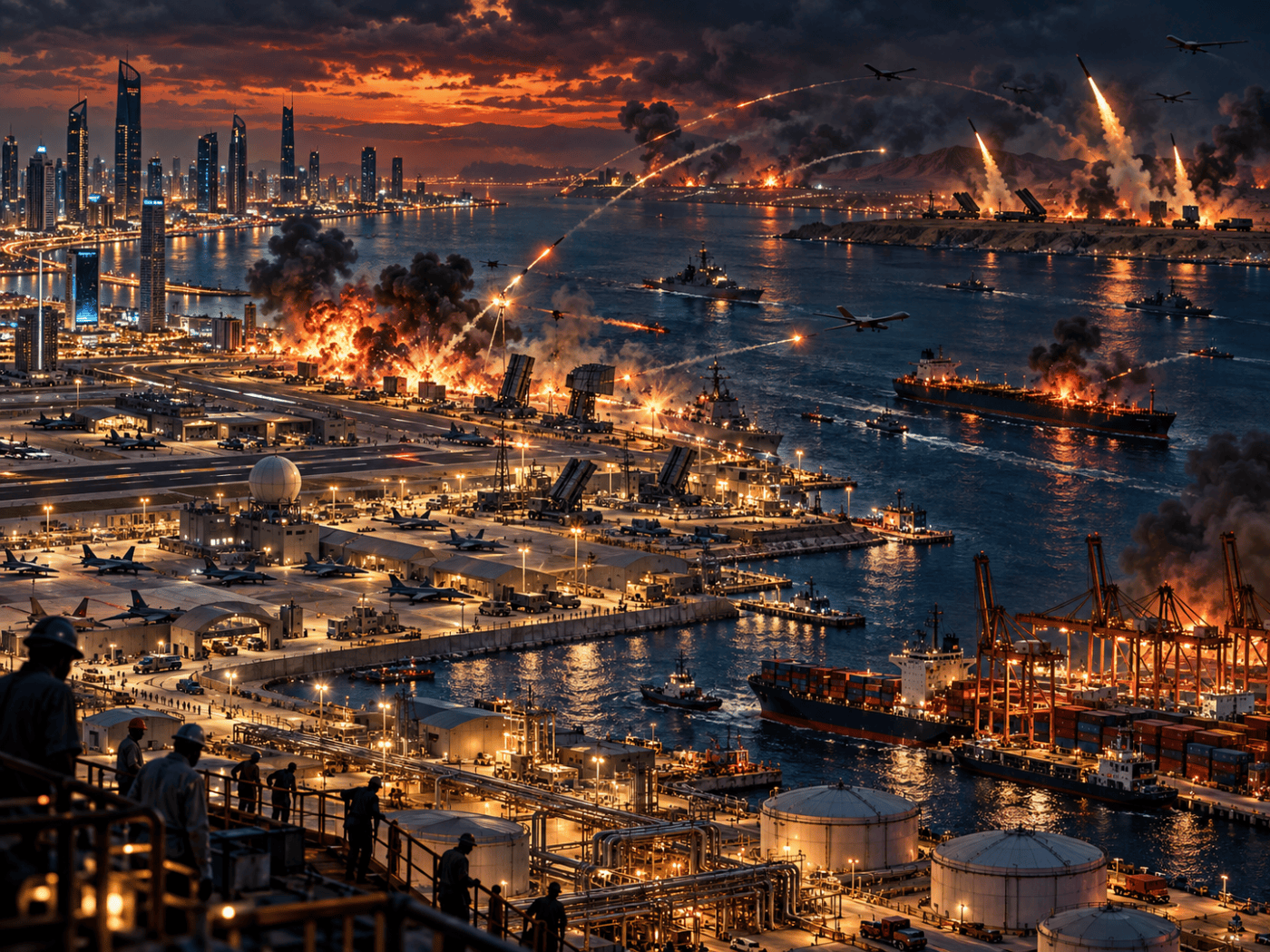
For decades, Washington pushed its military frontier toward Iran through bases, command centers, ports and logistics networks embedded across the Gulf, turning geographic proximity into an instrument of American power. The 2026 war exposed the contradiction inside that arrangement: the same infrastructure that shortened Washington’s road to Iran also shortened Iran’s road to American military power. Gulf ruling classes now face a system that still delivers weapons, protection and imperial partnership while threatening the ports, finance, energy networks and labor systems on which their own accumulation depends. Their turn toward dialogue with Tehran is not a break with Washington so much as an attempt to survive the military geography Washington helped build.
Prince Kapone | Weaponized Information | September 23, 2026
The Guarantor Arrives After the Missiles
Andrew England’s September 21 report for the Financial Times catches something real moving beneath the war. Qatar wants a regional security framework that includes Iran. The United Arab Emirates is calling for direct Arab-Iranian dialogue. Saudi Arabia has discussed a possible non-aggression arrangement. Gulf rulers who spent decades treating Washington as the central outside pillar of their security are now talking openly about building relations with the country across the water. The facts matter. The chronology wrapped around them is where the trouble begins.
The story effectively starts with the war’s consequences. Iran has struck Gulf territory. The United States has become a less dependable “external guarantor.” Washington is bogged down. Gulf governments have discovered that Iran can hit them and interfere with shipping through Hormuz. From there, rapprochement becomes an exercise in necessity: Iran remains dangerous, America looks less reliable, and geography forces the monarchies to make peace with an unpleasant neighbor they can’t move away from. Chatham House analyst Sanam Vakil supplies the frame neatly: Iran has been weakened, the American anchor has become less trustworthy, and Gulf states now have an opportunity to take greater control of their own security.
Notice where agency piles up. Iran strikes, threatens and can throttle shipping. Gulf governments manage, engage and search for stability. The United States, meanwhile, mostly becomes a guarantor whose warranty has started to expire. Even the phrase does ideological work. A “guarantor” sounds like somebody standing outside the trouble offering protection. The article spends far less time asking what kind of military relationship that guarantee required, what Washington was doing in the region before Gulf cities came under fire, or why a war launched by the United States and Israel could make neighboring Arab territory part of Iran’s retaliatory geography.
The omission is especially striking because the article contains pieces of the contradiction itself. Qatari Prime Minister Sheikh Mohammed bin Abdulrahman al-Thani calls the war a “wake-up call.” Emirati adviser Anwar Gargash says, with admirable geographic stubbornness, that “Iran remains our neighbour” and that geography leaves no alternative to engagement. Yet the reader is encouraged to wake up only when Iran’s missiles arrive. The military order that made the Gulf a theater of confrontation is already backstage when the curtain rises.
That late starting point changes the meaning of everything that follows. Iran’s retaliation becomes the obvious producer of insecurity; American protection becomes a promise that failed to deliver enough protection; Gulf diplomacy becomes damage control. The article reports the emerging reset, but it leaves its deepest question buried inside its own language: before asking why the guarantor couldn’t keep the Gulf out of the war, somebody has to ask what the guarantor had been doing there in the first place.
The Bases Moved America to Iran’s Shore
The Gulf didn’t become part of a struggle between Washington and Tehran when the first Iranian missile crossed into Arab airspace in 2026. Long before the United States built its modern military network there, European imperial power had already reorganized much of the Arabian side of the Gulf around external protection and restricted sovereignty. Britain’s 1916 treaty with Qatar guaranteed the ruler British protection while restricting independent relations with other powers and major concessions. On the Trucial Coast, whose sheikhdoms later formed the United Arab Emirates, British records described rulers bound against independent foreign agreements or transfers of territory without British approval. The histories of the Gulf monarchies differ, but outside military protection was woven deeply into much of the region’s modern political formation.
Washington later built a far denser military system across that geography. The decisive expansion came after Iraq’s 1990 invasion of Kuwait and the 1991 Gulf War. Bahrain became home to the U.S. Fifth Fleet. Qatar’s Al Udeid developed into a major air and command hub. Kuwait became a logistics platform. The United Arab Emirates, Saudi Arabia and Oman supplied different combinations of facilities and operational access. After September 11, those positions supported wars in Afghanistan and Iraq, intelligence operations, maritime patrols and broader U.S. force projection. Their advantage was concrete: forward deployment kept troops, weapons, fuel, communications and command systems close to the places where Washington expected to fight.
These weren’t decorative flags planted in the desert. Bahrain’s naval facilities anchor American maritime operations. Al Udeid has housed major command-and-control functions. Kuwait supplies logistical depth. Al Dhafra in the UAE hosts U.S. forces, while other agreements provide access, surveillance, training and air- and missile-defense cooperation. The regional basing system was negotiated with host governments, which supplied land, infrastructure and political permission while Washington gained reach and operational flexibility. The Gulf monarchies therefore helped sustain the system even though each government placed different limits on how its territory could be used.
That distinction matters. Several Gulf governments publicly insisted before the present war that their territory shouldn’t be used as a launching ground for offensive attacks on Iran. Hosting the wider American military system didn’t mean every runway launched strikes or every government approved every mission. But those restrictions didn’t remove the command centers, naval headquarters, logistics depots, intelligence links, defensive systems and access agreements already surrounding Iran’s western and southern approaches.
The 2026 war changed the military condition of that infrastructure. Fixed airfields, radars, communications sites, fuel stores and intelligence facilities that had long functioned as rear-area support entered the missile-and-drone battlefield. A postwar assessment of the bases found that installations built for deterrence and rapid U.S. power projection had also exposed their hosts to retaliation, prompting discussion of dispersion, smaller footprints and wider access networks rather than reliance on a few giant hubs.
Iran’s own military thinking hardened under the same pressure. A September study of Iranian deterrence traced a shift from calibrated restraint toward faster and heavier counter-escalation. The emerging doctrine treats U.S. bases, regional military infrastructure, maritime routes and economically important systems as connected pressure points through which Tehran can impose costs when attacks on Iranian territory escalate. Iran doesn’t possess anything resembling Washington’s worldwide network of foreign bases. In the Gulf, however, American military power had already been brought physically close to Iranian missile and drone forces.
The stakes extend far beyond the bases. The same narrow body of water carries much of the infrastructure through which Gulf capitalism lives: energy exports, container traffic, petrochemicals, fertilizers, basic chemicals, aluminium and supply chains tying the region increasingly to Asia and Africa. Political economist Adam Hanieh has stressed that Hormuz is more than oil. War there reaches into industrial production and food systems far outside the Gulf while threatening the ports, airports, finance, logistics and investment circuits on which the Gulf states themselves depend.
The people keeping those systems running don’t share equally in the decisions that put them at risk. Migrant workers make up a large part of the labor force that builds, maintains and services Gulf logistics, construction and support infrastructure, including work historically tied to U.S. military contracting. During the war, migrant workers reported lost wages, layoffs, rising food costs and physical danger while holding little power over the military and foreign-policy choices shaping the battlefield around them. The infrastructure carries class relations as surely as it carries fuel and cargo.
That pressure is now visible in the diplomacy the Financial Times calls a reset. On September 22, Qatar’s emir told the UN General Assembly that the region’s central problem was the absence of a collective security system and described the crisis as the accumulated result of years of postponed solutions. Oman and Iran had already announced an August framework for a temporary Hormuz corridor, joint mine clearance, information sharing, traffic management and negotiations over a more permanent arrangement involving consultation with other Gulf states.
None of this shows that the Gulf monarchies have broken with Washington. They still value U.S. weapons, intelligence, naval power, logistics and air defense. What the record does establish is that the war exposed fixed military and commercial infrastructure across the Gulf to direct pressure while regional governments began openly discussing security arrangements that include Iran rather than organizing the region exclusively around containing it.
The Shield Shortened Iran’s Range
The map looks different once Washington’s military frontier is separated from Washington’s national border. The continental United States sits an ocean away from Iran. American military power doesn’t. It has been moved forward into airfields, ports, command centers, logistics hubs and access agreements along the opposite shore of the Gulf. That was the point. Distance is a military problem, and forward deployment solved it for Washington by bringing the machinery of war closer to the place where Washington expected to use it.
But geography doesn’t sign loyalty agreements. The same system that shortened America’s flight paths, supply lines and command chains also shortened the distance between Iranian weapons and American military infrastructure. Washington could move its frontier thousands of miles from home, but it couldn’t move Iran away from that frontier. The war exposed the other side of a system whose advantages had been discussed for decades as though only one military possessed a ruler and a map.
This is the contradiction buried underneath the language of a failing “security guarantee.” The problem wasn’t simply that Washington promised protection and then failed to provide enough of it. Protection itself had been organized through a forward military system whose usefulness depended on embedding American power close to Iran. When war came, the bases didn’t suddenly become relevant. Their relevance was the reason they were there. What changed was that Iran demonstrated the capacity to make proximity hurt in the opposite direction.
Iran’s strategy hardened as the war developed, and retaliation became a means of imposing costs as well as defending against attack. Strip that response from the military geography that preceded it, however, and the Financial Times frame performs a neat magic trick: American military infrastructure fades into the wallpaper while Iranian missiles arrive from somewhere called “Iranian aggression,” apparently carrying their own history inside the warhead.
The Gulf monarchies sit directly inside this contradiction because their governments entered, maintained and benefited from relationships that placed land, facilities, access and infrastructure inside the U.S. regional military system. Those arrangements served real ruling-class interests. They delivered weapons, intelligence, protection, military technology and privileged access to the strongest armed power in the capitalist world. They also developed alongside an economic order in which Gulf wealth moves through energy, finance, shipping, aviation, real estate, sovereign investment and global trade.
That second side matters because ruling power there depends on far more than military agreements. Ports have to move cargo. Airlines have to fly. Financial centers have to function. Oil and gas have to leave. Food and industrial inputs have to arrive. Capital wants circulation, predictable infrastructure and somewhere safe enough to collect its return. A missile war across one of the world’s busiest commercial corridors is a hell of a way to run a logistics hub.
And the people keeping those systems alive don’t stand in the same relation to the war as the rulers who shape foreign policy. Migrant workers build, maintain and service much of the infrastructure on which Gulf accumulation depends, yet they carry the risks of disrupted wages, rising costs and physical danger without controlling the military choices that produce them. The contradiction therefore runs through class as well as state strategy: decisions concentrate at the top while a large share of the danger travels downward.
So this can’t be reduced to “America versus Iran,” with the Arab Gulf states balancing between two stronger powers. That would turn a historical relation into a board game. The deeper problem lies inside the way Gulf ruling-class power has been reproduced. Integration with Washington helped supply military security and political insulation. Yet the forward military architecture attached to that integration also made Gulf territory part of the physical space through which confrontation with Iran could be fought. The arrangement held while deterrence held. Direct war forced those interests into collision.
Iranian resistance became a causal force in that collision because Washington couldn’t enjoy the advantages of forward deployment while guaranteeing that its forward infrastructure would remain a sanctuary. Iran doesn’t possess a mirror image of the American global basing system. It confronted instead the portion of American military power Washington itself had brought into the neighborhood. The military asymmetry remained enormous, but the geography created a narrower field in which Iran could still impose costs.
That helps explain the emerging diplomatic movement. Gulf rulers aren’t simply reacting to fear. They are calculating what allows their states, assets and accumulation to survive. They can buy more interceptors, harden installations and diversify partnerships, yet none of those measures changes the most stubborn fact in the equation: Iran lives across the Gulf. The United States does not. Washington can disperse forces or redesign its footprint. The monarchies can’t tow their coastlines into another sea.
The new talk of collective security therefore grows from a material problem. Gulf rulers are trying to preserve valuable ties with Washington while reducing the chance that those ties repeatedly drag their own territory into confrontation with Iran. That is a ruling-class strategy of managing exposure while protecting military relationships and keeping capital moving. It isn’t emancipation from imperial power. It is an attempt to survive inside a contradiction whose costs have become harder to hide.
That effort contains its own countertendency. Iranian military power can force recognition that Tehran can’t simply be excluded from any durable regional order, but coercion can also push Gulf states toward stronger defenses against Iran. Accommodation and balancing can grow from the same battlefield. The region can move toward dialogue while preparing harder for the next war. History has produced uglier marriages.
This is where the Financial Times gets close enough to the truth to obscure the larger one. Yes, confidence in Washington’s protection has been damaged. Yes, Gulf rulers are reconsidering relations with Iran. But the “guarantor” didn’t simply stand outside the house and fail to stop the fire. Washington had spent decades installing part of its military power inside the building.
The Gulf reset begins there. Washington shortened its road to Iran. In doing so, it shortened Iran’s road to Washington’s forward power. The rulers living between those two roads are now trying to build a security arrangement that doesn’t leave their own territory paved beneath both of them.
The War Has Infrastructure
Wars like this survive because institutions turn political decisions into material force. Congress appropriates the money, the Pentagon maintains the bases, contractors keep supply lines moving, and executive power treats foreign military intervention as ordinary state business. Those institutions create pressure points. The task is not simply to object to one bombing campaign, but to contest the machinery that makes repeated campaigns possible.
One pressure point is public consent. The ANSWER Coalition organized emergency demonstrations after the war began, using coordinated street actions to turn scattered opposition into visible national protest. CODEPINK built an Iran campaign around demonstrations, political education and congressional pressure while tying the conflict to broader opposition to Pentagon spending. The intended effect is straightforward: make continued war harder to normalize politically and harder to present as something carried out with uncontested public support.
Executive war-making is another. Veterans For Peace connected its opposition to the Iran war directly to congressional War Powers action. Its leverage lies partly in the political authority attached to military service. Veteran organizing can challenge the legitimacy of endless war while pressing Congress to contest executive freedom to continue hostilities without sustained legislative resistance.
The overseas base network reaches deeper than any one administration. The Black Alliance for Peace explicitly links the Iran war to Washington’s global military infrastructure and campaigns against foreign U.S. bases. Its organizing combines political education, coalition work and public mobilization around a structural target: the installations that allow American military power to operate thousands of miles from home and directly beside populations expected to live under its guns. Fighting the smoke while leaving the furnace running was never much of a strategy.
The United National Antiwar Coalition has worked another part of the same terrain by coordinating rallies, vigils, speak-outs, leafleting and other local actions into national days of protest. The purpose is to connect isolated pockets of resistance, keep prolonged war visible and build durable political relationships across local campaigns rather than allowing opposition to dissolve into private anger.
These organizations don’t share one complete program, but their campaigns identify concrete points where the war machine can be contested: public legitimacy, congressional authority, military spending and the overseas infrastructure that makes permanent intervention possible. The war has infrastructure. So does resistance. The practical question is whether opposition remains episodic, rising only after the bombs fall, or becomes organized enough to confront the institutions that make the next war ready before the last one has even ended.


Leave a comment