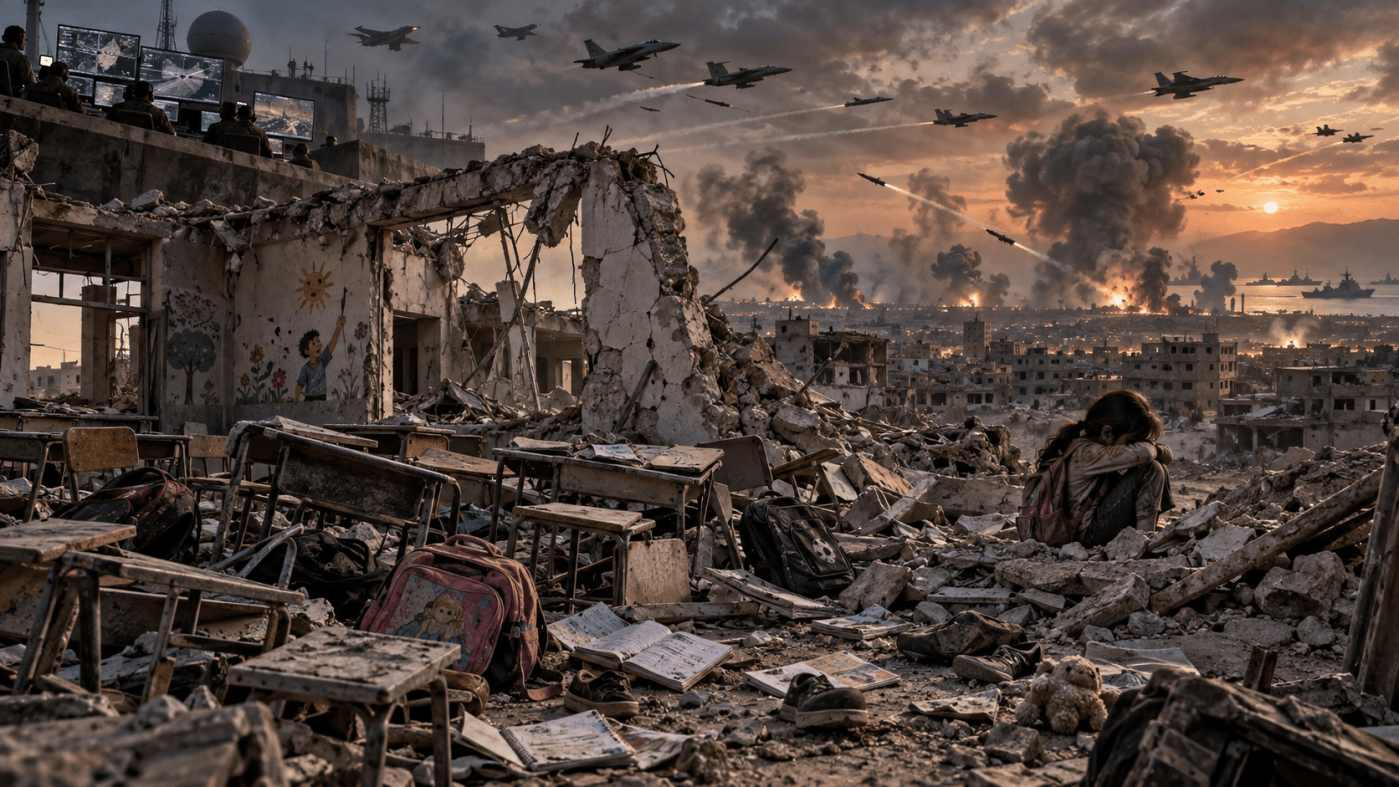
CNBC reports devastating UN findings about the destruction of a primary school in Minab while allowing the U.S.-Israeli attack that placed American missiles over Iran to fade into background scenery. Reconstructing the February 28 assault, the diplomacy still underway, the competing legal claims, the targeting chain and the wider civilian toll shows why Minab cannot be explained away as one bad coordinate or a malfunctioning database. The strike belongs to a longer campaign of sanctions, political pressure, military encirclement and increasingly direct bombardment in which overwhelming destruction is used to break resistance, demonstrate vulnerability and force Iran into submission. The final question is therefore larger than who approved one strike: whether organized opposition can connect the schoolyard back to the governments, war powers, military machinery and political decisions that created the battlefield in the first place.
Prince Kapone | Weaponized Information | September 21, 2026
The Massacre Gets a Case Number
On September 17, CNBC reporter Lim Hui Jie published UN mission finds evidence signaling U.S. war crimes in Iran; Washington rejects report, and the facts should make the respectable vocabulary of modern war choke on itself. A United Nations fact-finding mission found reasonable grounds to believe U.S. forces committed war crimes in Iran. More than 150 people were killed when a Tomahawk struck a primary school in Minab. Another attack killed 22 civilians near a sports complex and residential area. Investigators found no evidence that the school was being used for military purposes. They concluded that the school itself was the intended point of impact.
CNBC doesn’t bury the massacre. It does something more useful to power: it contains it. Minab becomes an incident with an allegation, an investigation, a rebuttal and eventually a place in the filing cabinet of war. The question placed before the reader is whether American forces violated the rules at particular sites. The larger political act that made Iranian schools available to American targeting enters already naturalized as the Iran war. War becomes the condition. The massacre becomes the controversy.
The underlying UN report preserves a chronology CNBC drops. U.S. and Israeli attacks on Iran came first on February 28, followed by Iranian missile and drone attacks. CNBC doesn’t have to falsify that sequence to weaken its meaning. It only has to remove the beginning. Once the initiating act falls outside the frame, Washington’s force becomes background and its consequences become isolated cases. History is not denied. It is administratively misplaced.
The source hierarchy helps seal the container. UN investigators describe the attacks, then Washington receives two direct avenues of rebuttal. A State Department official attacks the credibility of the Human Rights Council. The White House declares that only Iran has committed war crimes. Iran receives no comparable space to address the U.S. attack itself. Instead the article turns immediately to the mission’s separate findings concerning Iranian human-rights violations and crimes against humanity. Those allegations belong in the record, but their placement encourages the reader to process unlike acts and different chains of causation as entries in one ledger of misconduct.
That is the ideological achievement. A school full of dead children can appear in the story without forcing the reader to ask what kind of war is being waged, who initiated it, or what political purpose such overwhelming violence serves. The atrocity becomes legible precisely because it has been cut loose from the larger process that produced it. A massacre gets a case number. The war gets to remain common sense.
Then CNBC moves on. Possible negotiations may resume. Iran’s UN delegation faces travel restrictions. Its officials can’t buy luxury goods. The article hasn’t denied the horror. It has put walls around it. Minab becomes something to investigate, Washington’s rejection becomes another position to quote, and the machinery that created the battlefield slips back into the shadows. The school is visible. The war that made it a target is not.
Before Minab Was a Target, Iran Had to Become a Battlefield
The school at Minab was struck on the first day of the war, not somewhere deep inside a conflict whose origins had disappeared into diplomatic fog. On February 28, UN Secretary-General António Guterres told the Security Council that the United States and Israel had launched large-scale attacks on Iran that morning and that Iranian strikes across the region followed. He also recorded a fact CNBC leaves outside the frame: Washington and Tehran were still negotiating. A third round of Oman-mediated talks had taken place, technical negotiations were being prepared in Vienna, and another political round was expected. The UN chronology leaves little room for the comforting fiction that diplomacy had already died of natural causes.
Iran answered the attacks that same day with a Security Council letter calling them an act of aggression, invoking the Charter’s prohibition on interstate force and asserting a right of self-defense under Article 51. Washington filed its own formal justification on March 10. In its Article 51 notification, the United States said it had begun combat operations on February 28 to protect U.S. forces, regional allies and navigation through the Strait of Hormuz, while also acting in collective self-defense with Israel. It described the assault as another stage of an “ongoing international armed conflict” and maintained that peaceful means had been exhausted. Those are Washington’s legal claims. They aren’t self-proving simply because the state making war writes them on UN letterhead.
This distinction is decisive because international law asks two separate questions. The ICRC explains that jus ad bellum governs whether a state may lawfully resort to force, while jus in bello governs how forces must behave once fighting exists. The separation protects civilians by making humanitarian rules binding on every belligerent, regardless of who began the war. A war-crime finding therefore can’t answer whether the original resort to force was lawful. Nor does applying the same humanitarian rules to both sides make their historical roles identical.
The character of the campaign matters just as much as its legal paperwork. Washington didn’t publicly describe Operation Epic Fury in the dry language of limited necessity. The White House celebrated “overwhelming power” and “crushing dominance” and boasted that the operation had already delivered twice the air power of the 2003 campaign remembered as Shock and Awe. That comparison has a history. U.S. military writing on Shock and Awe described shock as a means of intimidating an adversary through overwhelming fear, vulnerability, panic, hopelessness and paralysis in order to affect will and compel submission. The comparison doesn’t prove that Minab was chosen because children were inside the school. It does mean terror, spectacle and the breaking of political will can’t simply be ruled out of the explanatory field while Washington itself advertises a tradition of war built around overwhelming psychological effect.
Israel described a campaign wider than the destruction of missiles as well. Its military announced that it was striking the Iranian state’s “repression mechanisms”, including the Basij, internal security forces and intelligence headquarters, as part of what it called a structured war plan against the regime’s systems and capabilities. These weren’t all remote launch pads sitting in empty desert. They were institutions embedded in cities, workplaces and neighborhoods, where destroying state capacity meant bringing large-scale military violence directly into civilian space.
Amnesty International later investigated three such attacks in the densely populated Tehran neighborhoods of Niloufar, Resalat and Javadieh. Its September investigation found that explosive weapons with wide-area effects killed at least 41 civilians and damaged homes, businesses, a school and other civilian buildings. Amnesty found no effective advance warning in any of the three attacks and said the resulting civilian destruction was foreseeable. Police and Basij facilities appear to have been among the intended targets, although the organization also documented a residential building likely struck separately from the nearby Basij site. The significance isn’t that every police building was legally protected or that every civilian death proves deliberate murder. It is that Minab sits inside a campaign repeatedly carrying spectacular destructive force into populated civilian environments, not inside a laboratory where one faulty database can explain the entire pattern.
That brings the question back to the school. Human Rights Watch found that the Shajareh Tayyebeh Primary School sat beside an Islamic Revolutionary Guard Corps naval compound but had been physically separated from it for years. Satellite imagery showed a wall dividing the properties, a separate entrance, changes to the old military perimeter and a clearly marked schoolyard. HRW also identified multiple direct impacts across the compound, including the school, consistent with guided weapons hitting intended coordinates rather than a missile simply wandering off course.
That shifts attention from the weapon’s flight to the system that dictated its destination, but it doesn’t end the inquiry there. Human Rights Watch later noted that reporting on a preliminary U.S. government inquiry said Central Command officers had used outdated Defense Intelligence Agency information when generating the target coordinates. The school and the neighboring military property had once been more closely connected, but publicly available evidence showed that the site had long since functioned as a school. Stale intelligence may help explain how the target was bureaucratically classified. It doesn’t by itself explain why the campaign was organized around overwhelming force, why civilian space was repeatedly exposed to that force, or what political work spectacular destruction was expected to perform.
The Pentagon’s own Inspector General had already documented weaknesses in the machinery nominally meant to protect civilians. Its civilian-harm evaluation found gaps in personnel, tools and implementation across the system responsible for civilian-environment awareness, target verification and post-strike accountability. Military officials warned that reducing those capacities could weaken battlefield awareness and increase target misidentification and civilian casualties. Those deficiencies haven’t been proven to have caused Minab. They establish that the technical apparatus offered as the immediate explanation for the massacre was itself operating with documented weaknesses inside a campaign whose political language glorified overwhelming destructive power.
The September UN fact-finding mission entered from another institutional direction. Its original mandate centered on serious human-rights violations in Iran. As the war developed, the mission examined particular incidents under international humanitarian law and concluded that there were reasonable grounds to believe U.S. forces committed war crimes at Minab and Lamerd. That explains why its findings deal with targeting, civilian protection, precautions and recklessness rather than deciding the legality of February 28 itself. The absence of an aggression ruling isn’t a ruling that aggression didn’t occur. It reflects the legal lane the mission was actually traveling in.
The institutional difference extends further. The Rome Statute recognizes aggression alongside genocide, crimes against humanity and war crimes, but the International Criminal Court operates under a more restrictive jurisdictional regime for aggression. During the ICC Assembly’s review of those provisions, many States Parties argued that the existing rules leave a jurisdictional gap and called for greater harmonization with the Court’s treatment of the other core crimes, while other states defended the Kampala compromise. International law can therefore investigate the school, classify the strike and debate individual responsibility while still fighting over how far responsibility for starting the war itself can reach.
Two questions sit beside the graves at Minab. One asks how a functioning primary school became an intended point of impact and what criminal responsibility follows from that decision. The other asks what kind of war was being waged when a government publicly celebrated overwhelming force, invoked Shock and Awe, struck institutions embedded in populated cities and repeatedly carried explosive violence into civilian neighborhoods. The stale-data explanation belongs in the record. It no longer gets to own the story.
The Missile Was Precise. The Empire Wasn’t Neutral.
A missile can hit exactly where it was told to go and still reveal something larger than a targeting failure. That is the deeper horror of Minab. The weapon’s precision doesn’t rescue the war from barbarism. It shows how thoroughly barbarism can be organized. Coordinates were entered, commands moved down the chain, machinery performed as designed, and a schoolyard filled with dead children. The crucial question is therefore larger than whether American technology can place explosives onto a patch of earth with astonishing accuracy. It plainly can. The question is what political order sent the missile there, what kind of war surrounded the strike, and what purpose overwhelming violence performs when an empire is trying to compel submission.
This is where CNBC’s frame reaches its limit. Minab can be processed as a defect inside an already existing war. Investigators examine targeting. Lawyers classify the strike. Washington points toward stale intelligence. Every institution receives its fragment and performs its assigned task. But a technical explanation becomes ideological the moment it is allowed to explain too much. Outdated data may tell us how a bureaucracy classified one building. It cannot explain the character of a campaign whose commanders and political leaders celebrated overwhelming force, invoked the spectacle of Shock and Awe, carried heavy explosive violence into populated neighborhoods and openly attacked institutions meant to maintain the Iranian state’s internal authority.
The significance of spectacle therefore cannot be pushed outside the analysis simply because nobody has produced a targeting memo saying: destroy this school to terrorize Iran. The evidence doesn’t establish that specific intent, and we don’t need to manufacture it. Terror has a material existence larger than the private thoughts of the officer approving one coordinate. When a military campaign announces its power through overwhelming destruction, carries that destruction into civilian space and presents domination itself as evidence of success, fear becomes part of the political environment the violence produces. The bomb destroys a building. The spectacle addresses everyone still standing.
That relation has a history. Empire rarely arrives wearing one uniform or speaking in one register. A country can be squeezed through finance, isolated diplomatically, sabotaged, sanctioned, threatened and finally bombed. WI understands this changing arsenal through Hyper-Imperialism. The instruments differ, but the political relation persists: imperial power attempts to narrow the field within which a sovereign state can act until compliance appears cheaper than resistance. Economic punishment addresses the population through scarcity. Military encirclement addresses it through threat. Bombardment brings the argument down in concrete, steel and fire.
That is why causal asymmetry matters. Iran’s internal contradictions remain real. Iranian actions can themselves violate law. None of that turns February 28 into an exchange between historical equals who simply woke up shooting at one another. A response can contain crimes and remain historically a response. Humanitarian law properly judges each attack on its own terms. Historical materialism has to do what the courtroom alone cannot: reconstruct who created the battlefield, what structures brought them there, and what kind of political obedience the violence was meant to secure.
“Security” is too thin a word for that job. Security for which regional order? Freedom of action for whom? Command over which routes, institutions, markets and political choices? The U.S. state’s war-making apparatus operates inside a wider system of military reach, financial discipline and strategic command. When that apparatus enters Iran, the process doesn’t begin with the missile. Political objectives are translated into military plans. Plans become target systems. Target systems convert living institutions into coordinates. The final explosion looks technical because all the politics have been buried upstream.
Minab exposes the danger of letting that technical language become the verdict. Bad intelligence. Verification failure. Outdated data. All may describe part of the immediate mechanism. None can explain the surrounding pattern. A war advertised through overwhelming force, extending into densely populated civilian environments and directed in part against the institutions through which a state governs its own society, cannot be reduced to a stack of unfortunate targeting errors. At some point quantity becomes political quality. Repeated spectacular destruction does more than remove designated objects. It demonstrates vulnerability. It teaches the population that nowhere is beyond reach. It makes domination visible.
This is where Imperialist Recalibration gives the violence its larger determination. Washington still possesses enormous destructive power. But destructive power and effortless political command are different things. Sanctions, isolation and pressure have not produced the obedience demanded of Iran. Maintaining the hierarchy therefore requires harder instruments, greater expenditure and more visible force. The empire can still smash the door. The historical problem is that more doors have to be smashed because fewer open automatically.
Iran’s resistance also unfolds inside the wider New Cold War and an unfinished multipolar transition. Alternative centers of production, finance, trade and diplomacy give sanctioned states more room to maneuver beyond Washington’s immediate command. Multipolarity isn’t socialism. Its significance here is material: punishment loses some of its ability to produce complete isolation when other economic and political relationships remain available. Sovereign maneuver becomes harder to extinguish, and imperial coercion becomes more expensive to reproduce.
That rising cost helps explain why spectacle matters. Hyper-Imperialism under pressure doesn’t merely seek to destroy military hardware. It has to demonstrate that resistance carries consequences. The destroyed bridge, headquarters, neighborhood or school enters a larger economy of coercion in which physical destruction communicates political power. This doesn’t mean every civilian death was individually planned as terror. It means terror can become a social effect of warfare whose political usefulness lies precisely in making overwhelming vulnerability visible.
International law can capture pieces of this process without capturing the whole. It can ask whether a target was lawful, whether precautions were taken, whether a commander acted recklessly. Those questions matter enormously. Children depend upon those protections. But when aggression, targeting, civilian harm and political purpose are split into separate institutional compartments, the war can become a collection of cases instead of a historical relation. The violence is itemized while the machinery producing it escapes synthesis.
That is why CNBC’s framing can remain factually serious and still politically narrow. The propaganda doesn’t require a lie. It requires the reader never to put the pieces back together. Minab becomes a possible war crime. Stale intelligence becomes a possible explanation. The campaign becomes background. The larger architecture of coercion disappears precisely when its consequences are most visible.
Put the pieces back together and Minab looks different. The school may have entered the targeting system through obsolete intelligence, but it was destroyed inside a war that publicly glorified overwhelming force and repeatedly carried destructive spectacle into civilian space. Technical failure can explain a file. It cannot explain the political world that made the file lethal. The missile reached its coordinates with precision. The message traveled farther: an empire struggling to preserve command was willing to make Iranian society feel the weight of the machinery at its disposal. That doesn’t close the question of specific intent at Minab. It opens the more dangerous question of what terror becomes when spectacular violence is no longer an accident outside the strategy, but one of the conditions through which coercion does its political work.
Put the Whole War Back on the Docket
If spectacular violence does political work, then the struggle over what that violence means is not decoration added after the bombs fall. It is one of the places where war is reproduced or contested. A government that presents overwhelming destruction as proof of power depends on that spectacle being accepted as normal, distant and inevitable. Existing antiwar formations have already begun attacking that normalcy from different pressure points, each aimed at a different piece of the machinery that turns destruction abroad into routine policy at home.
Black Alliance for Peace has treated the war on Iran as both military aggression and an ideological struggle, circulating political-education material designed to counter the propaganda used to make U.S. warfare appear natural or defensive. The United National Antiwar Coalition documented more than thirty coordinated actions around the country, including rallies, speak-outs, vigils, leafleting and banner drops. These forms of public organization operate at the point where spectacle is supposed to produce passivity. Their material effect lies in denying the war political quiet, forcing civilian deaths and the question of aggression back into public view instead of allowing them to disappear behind Pentagon briefings and diplomatic routine.
Another pressure point sits inside the institutions that authorize and finance military operations. Iran War Powers measures have repeatedly forced Congress to vote on executive war-making, while Veterans For Peace has connected veteran antiwar opposition to those congressional fights. War Powers resolutions don’t dismantle the imperial apparatus, but they can force responsibility back onto elected institutions, contest executive freedom of action and place authorization and funding under political pressure rather than allowing war to proceed as an administrative fact.
The legal terrain reaches farther upstream. The International Association of Democratic Lawyers has challenged the February 28 attack as aggression under the UN Charter, while the Coalition for the ICC and allied organizations have pressed to narrow the jurisdictional disparity surrounding the crime of aggression. Their work targets the contradiction exposed earlier in this essay: international institutions can investigate how a missile was used while responsibility for creating the battlefield remains harder to reach.
Minab creates a separate point of accountability inside the war machine itself. Human Rights Watch has called for the full military investigation to be made public, for responsibility to be pursued where the evidence supports it, and for the civilian-harm safeguards weakened under the current administration to be restored. That line of pressure matters even if Minab ultimately proves to involve stale intelligence rather than a documented order to terrorize children. A state cannot advertise overwhelming lethality, weaken the institutions meant to protect civilians, produce mass death and then make the word mistake carry the entire burden of explanation.
Taken together, these struggles reveal the terrain the CNBC frame breaks apart. Public mobilization contests normalization. Political education contests the story that imperial violence is merely defensive necessity. War Powers fights contest the executive machinery that sustains the campaign. Civilian-harm investigations follow responsibility through the targeting chain. Aggression law follows responsibility farther back, toward the decision to make Iran a battlefield at all. Minab sits where those lines meet. Any account that stops at the targeting file leaves the larger machinery untouched; any account that speaks only of empire and forgets the children turns concrete suffering back into abstraction. The whole chain has to remain visible, from the political decision to wage war to the schoolyard where that decision finally became flesh.
 Weaponized Information
Leave a comment