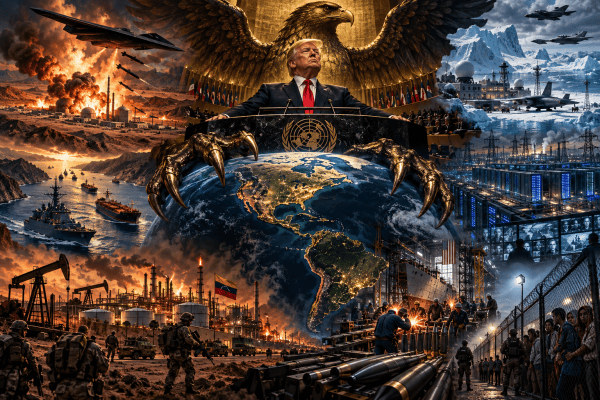
Trump's United Nations address declares America’s resurgence, yet it reveals an empire grappling with an escalating need for military force and economic coercion to maintain supremacy. His speech elevates military spending, sanctions, and immigration enforcement as signs of strength while ignoring the underlying contradictions—an empire that once commanded effortlessly now relies heavily on intimidation. The reality is that the U.S. must work harder to enforce its will both abroad and domestically as competition grows and global power dynamics shift. Instead of showcasing dominance, Trump's rhetoric underscores a declining ability to produce consent, exposing the fragility of American imperialism. The mask of effortless domination is slipping.
The Nerd Reich Wanted to Exit the State: Then Capital Learned It Needed the Machinery
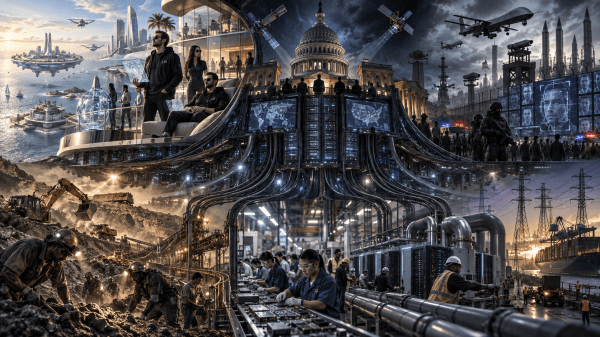
Gil Durán's "The Nerd Reich" provocatively dissects the tech elite's evolution from libertarian ideals to an authoritarian grasp on power. Far from escaping state oversight, Silicon Valley's billionaires, like Peter Thiel, reveal a dark shift: they now seek to enhance governmental control while championing the illusion of individual freedom. Durán labels this new reality "tech fascism," where technology conglomerates and capital intertwine with state apparatus. As these technocrats consolidate power, a crucial question emerges: can humanity reclaim technologically wielded potential, or will it remain enslaved by elite ownership? This critical inquiry forebodes a future dominated by private interests rather than collective governance.
The State Got Stronger Where Capital Needed It: From the SNAP Office to Technofascist Consolidation
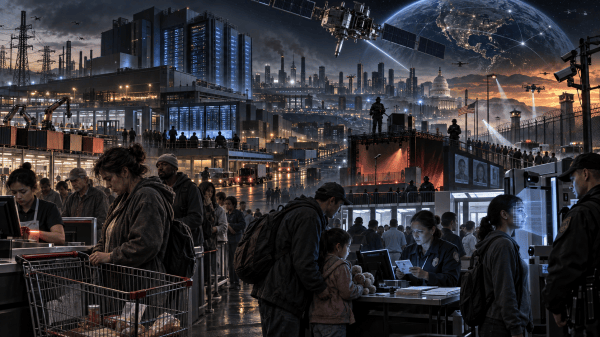
The U.S. state is vigorously fortifying its military and technological apparatus while systematically withdrawing social support through food assistance and healthcare, showcasing a disturbing trend of technofascist consolidation. As military might is acknowledged in orbit and social benefits dwindle, the ruling order exacerbates class divisions, demanding increased legitimacy from a population now subjected to strict classification and conditionality. Political expression faces barriers in increasingly privatized venues, reflecting a tactical alliance between state interests and tech monopolies. This ominous shift marks a historical reckoning: the state is reallocating its substantial resources toward military supremacy at the expense of everyday security, creating a precarious societal structure poised for conflict.
We Built the Master: Marx and the World That Rules Its Makers
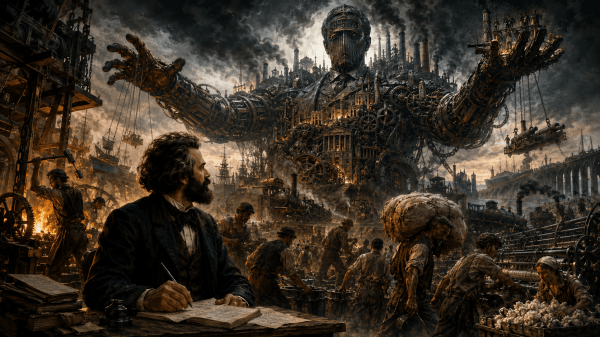
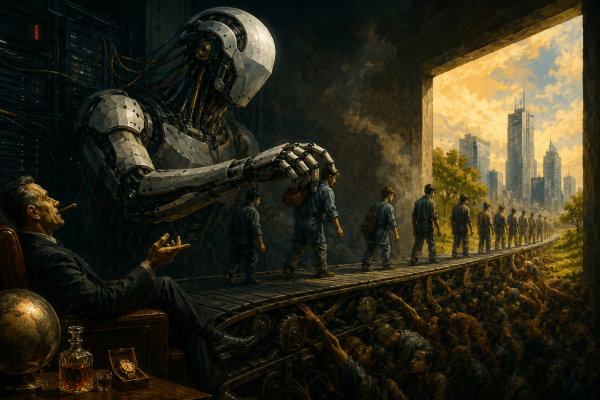
In the Economic and Philosophic Manuscripts of 1844, Marx discovers a contradiction that will haunt the whole development of his critique of capitalism: workers build an expanding world of wealth, machinery, knowledge and social power that returns to rule them as capital. This review follows that insight from wages and estranged labour through private property, colonial history, slavery, money, communism, Hegel and revolutionary humanism. It argues that the manuscripts are neither immature philosophy nor finished Marxism, but a breakthrough under pressure—one already forcing “Man” into history and asking the question that still matters: who controls humanity’s accumulated powers?
The Worker Becomes Optional: The Wage Still Demands Your Life
Bill Gates has finally acknowledged a truth that capitalists prefer to ignore: as AI and automation advance, corporations can reduce their reliance on human workers, yet those workers still need jobs to survive. This dystopian paradox manifests as corporations accumulate vast fixed capital while employing fewer people, leading to increasing labor insecurities. The state, ostensibly aiding automation's growth, is simultaneously crafting systems to manage this emerging class of excess workers. Gates proposes measures to protect jobs, but under capitalism, preserving employment becomes essential simply for survival, distorting the very essence of technological progress into a means of perpetuating exploitation rather than liberating humanity from labor.