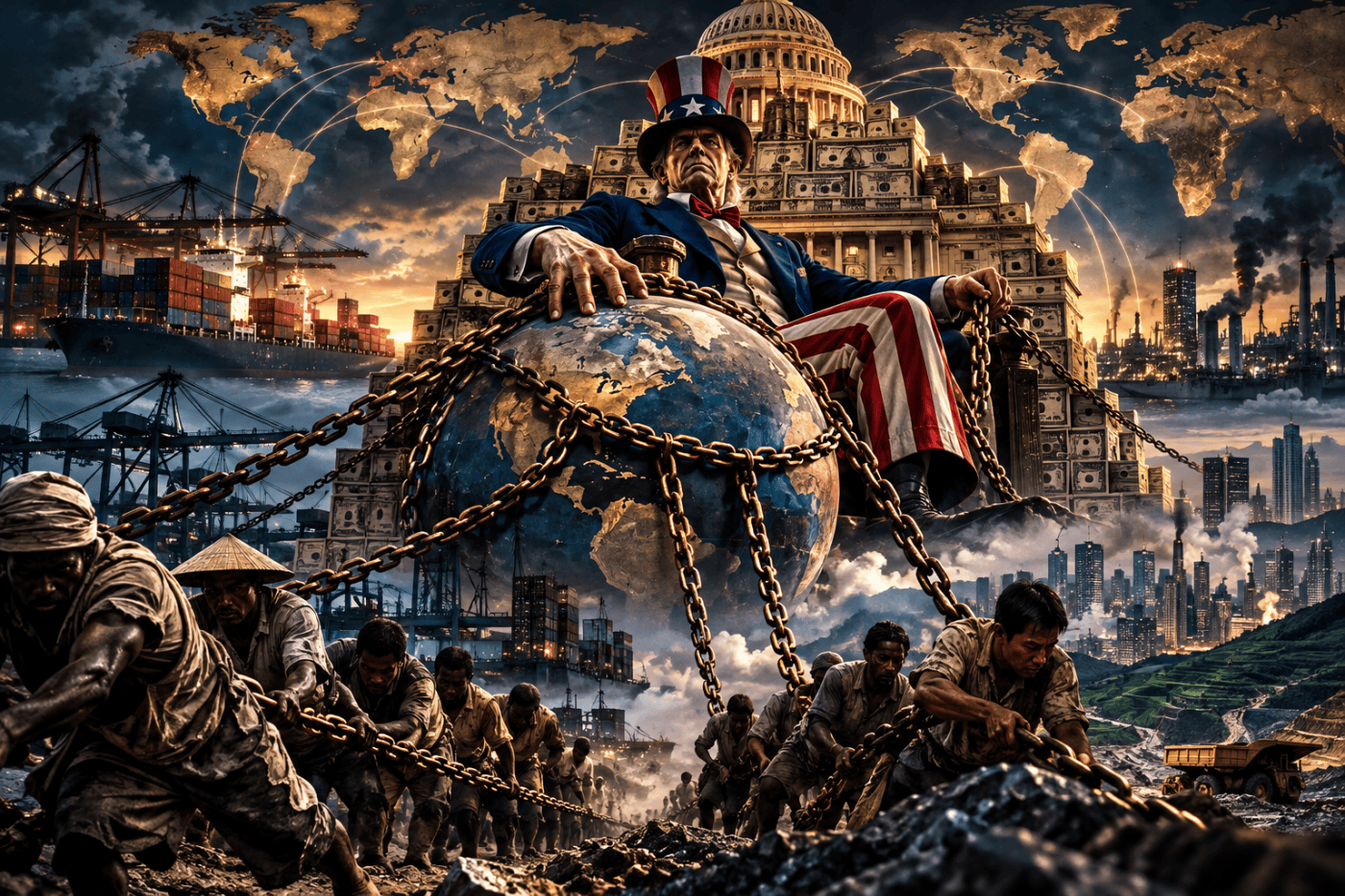
Michael Hudson’s Super Imperialism follows one of the strangest reversals in the history of capitalism: the United States rose as the world’s great creditor, built that supremacy into the institutions of the postwar order, then discovered that its own debts could become instruments of power. Hudson caught the moment when dollars flowing abroad returned as reserves and claims on the U.S. state, allowing the ordinary discipline of the debtor to be pushed outward onto others. But capitalism kept moving: production spread across the world, private dollar finance outgrew the Treasury-bill circuit, and the monetary architecture survived the erosion of the productive supremacy that originally created it. The contradiction now runs straight through the emerging multipolar order: the factories have moved faster than the money, leaving the struggle for sovereignty bound up with the deeper question Hudson’s balance sheets ultimately lead us back to—who controls the productive powers that money can command but never create?
Prince Kapone | Weaponized Information | Weaponized Intellects Book Review | September 27, 2026
I. Before the Debtor Could Rule: The Making of American Creditor Power
Michael Hudson begins the rise of American financial power with a proposition that cuts against the usual story of private bankers dragging the state behind them. “From the outset,” he writes, “the role of government in U.S. overseas investments was decisive.” The government, however circuitously, shaped the growth and direction of American investment abroad rather than simply receiving its foreign policy from private finance (Super Imperialism, p. 56). Hudson is putting the state inside the accumulation process. American capital expanded internationally, but the federal government increasingly organized the credit relations through which that expansion acquired political force.
The First World War transformed the scale of that relation. Europe entered the conflict at the center of world finance and emerged burdened by intergovernmental obligations, while the United States emerged as the principal creditor of its former allies. Hudson shows how thoroughly public debt had displaced older forms of international lending: nearly 80 percent of bond flotations in the United States during 1921–25 were by government entities, compared with 60 percent in Britain (Super Imperialism, pp. 57–58). These weren’t simply large loans. War had reorganized the international balance sheet around states, and Washington occupied the strongest position inside the new creditor structure.
Hudson’s account becomes sharper when he follows what those debts did. He argues that the Inter-Allied obligations compelled European governments to drain their treasuries, deepen public indebtedness, restrict credit available to industry and struggle to generate the means of payment demanded by the United States (Super Imperialism, p. 58). The creditor relation therefore wasn’t sitting above production as a pile of financial paperwork. Servicing debt reached into national budgets, industrial credit and trade. A claim denominated in money became power because payment had to be reproduced through the material economy.
But this is also where Hudson’s starting point needs its historical ground beneath it. The United States didn’t become a creditor because finance discovered some mysterious technique for creating supremacy from paper. American credit rested on an enormous productive base built through continental expansion, dispossession, enslaved and exploited labor, industrial accumulation and access to a world market already structured by centuries of colonial conquest. The European powers entering Hudson’s story had themselves accumulated through empire. World War I redistributed power inside that already imperial world economy. Hudson’s object isn’t the birth of imperialism. It is a transformation within it.
Creditor power can otherwise appear self-generating, as though money produces command simply because one government possesses claims against another. The historical movement runs the other way before it turns back upon itself: productive development and accumulated wealth make large-scale creditor power possible; creditor power then becomes a means of defending and extending the material advantages from which it arose. Finance acquires relative power without floating free of production.
The interwar crisis showed that this new creditor position wasn’t yet a stable world order. Washington possessed enormous financial leverage, but the system linking German reparations, Allied debts and American claims repeatedly collided with the inability of debtors to generate the required payments. Hudson’s account of the 1920s and 1930s is therefore less a story of completed American rule than of power without a durable institutional form. The United States could demand payment and refuse responsibility for stabilizing the whole arrangement, but it hadn’t yet built a system capable of making American leadership part of the normal reproduction of other capitalist states.
The Second World War supplied both the destruction and the opportunity that the first had left incomplete. Hudson’s treatment of Lend-Lease is especially important because it shows American power operating against an imperial ally rather than a colony. Britain needed American matériel to survive the war. Washington used that need to press for a postwar commercial order that would weaken Imperial Preference and open markets and raw-material zones previously sheltered inside the British imperial system. Article VII of the Lend-Lease agreement tied assistance to cooperation in reconstructing multilateral trade after the war (Super Imperialism, p. 121).
Keynes understood the material stakes. Complaining about Treasury Secretary Henry Morgenthau’s pressure on British assets, he wrote that Britain’s objective had to be retaining enough resources to remain “capable of independent action” (Super Imperialism, pp. 121–22). That phrase gets closer to the bone than the diplomatic language surrounding it. Independence required more than sovereignty on paper. Britain needed reserves, productive capacity, markets and room to determine its own economic policy. American assistance arrived inside a struggle over precisely that room.
Hudson’s point isn’t that Britain suddenly became an American colony. Such a formulation would flatten the hierarchy it is supposed to explain. Britain remained an imperial power with colonies, overseas assets, military forces and claims against subordinate peoples. But its ability to organize the capitalist world around its own imperial preferences was collapsing while American productive and financial power was rising. An empire that had spent centuries teaching weaker peoples the virtues of an “open” world market now discovered that openness felt different when somebody stronger held the keys. Somebody bigger had entered the fucking cage.
The contradiction becomes even clearer in Britain’s sterling balances. By the end of 1944 Britain owed nearly $10 billion, mainly to India, Egypt and Argentina, while lacking the export surplus needed to liquidate those claims (Super Imperialism, p. 144). Those balances carried the colonial history into the new monetary order. India wasn’t simply another creditor standing beside Washington. British obligations to India had grown through an imperial relationship in which colonial resources, production and wartime support had been mobilized for Britain. The weakening of sterling therefore didn’t erase the colonial contradiction. It reorganized a world in which Britain could be subordinated relative to the United States while remaining dominant relative to peoples it had colonized.
By Bretton Woods, the balance of material power was brutal. Britain had become a major debtor and chronic deficit country. The United States stood on the other side with the productive capacity, financial resources and export strength to shape reconstruction. Hudson notes that American exports produced an average annual trade surplus of roughly $3.5 billion between 1945 and 1950 (Super Imperialism, pp. 143–44). Washington didn’t walk into Bretton Woods carrying a clever monetary theory and talk the world into submission. It arrived with factories running, creditors waiting, gold concentrated in American hands and war-ravaged allies needing dollars, imports and reconstruction finance. Bretton Woods therefore didn’t create American supremacy. American supremacy made Bretton Woods possible.
The importance of the conference lies in what happened next. A historically exceptional concentration of productive and creditor power began to acquire an institutional life beyond the immediate conditions that produced it. Hudson describes the International Monetary Fund, World Bank and emerging trade regime as parts of a postwar arrangement built around fixed currency relations, international lending and expanding markets for American exports (Super Imperialism, pp. 143–44). The United States was beginning to convert a temporary historical advantage into rules, organizations and obligations capable of surviving after the ruins of war had been rebuilt.
This is the decisive movement in the first part of Hudson’s book. The First World War made the United States a creditor power. The interwar breakdown exposed the limits of creditor power without a stable international machinery. The Second World War weakened rival capitalist centers and gave Washington unprecedented leverage over reconstruction. Lend-Lease showed that aid could carry conditions reaching far beyond the immediate transaction. Bretton Woods began transforming those relations into institutions through which other states would obtain credit, settle payments and organize trade.
Yet the “open world” Washington sought was never simply open. Chapter 6 makes the contradiction visible as the United States moved to isolate the emerging socialist bloc while organizing capitalist reconstruction around access to American finance and markets. The universality of the postwar order already had political boundaries. Capital could circulate under rules presented as international while states challenging the social relations beneath those rules faced exclusion and containment. The new architecture didn’t abolish political power in favor of neutral economics. It gave political power an institutional economic form.
That is where Hudson’s real story begins. American dominance no longer depended only on possessing more factories, more gold or more claims against exhausted allies. Those advantages had made the new order possible, but an order becomes durable when other states must reproduce its rules through their own daily economic life. Washington had accumulated the material strength to build the house. Now it was writing the rules by which much of the capitalist world would have to live inside it.
II. The Rules of the House: How American Power Became International Institution
When John Maynard Keynes arrived at the inaugural meetings of the International Monetary Fund and World Bank in Savannah in 1946, Hudson records his bitter verdict: “I went to Savannah to meet the world and all I met was a tyrant” (Super Imperialism, p. 179). Keynes wasn’t discovering American power. Britain had already encountered that power through Lend-Lease, the stripping down of its reserves and the postwar loan. What changed at Savannah was the form. The unequal relation between creditor and debtor was becoming an international institution whose rules could outlive the immediate emergency that produced them.
The World Bank shows the movement clearly. Hudson notes that the United States initially held nearly 40 percent of its subscribed capital, giving Washington enormous influence over an institution whose formal membership was multinational (Super Imperialism, p. 179). But voting strength alone doesn’t explain the Bank’s importance. The deeper power lay in defining what counted as development, what counted as a sound investment and what kind of project deserved access to international credit.
That definition hardened as the Bank moved from European reconstruction toward development lending. Latin American governments had pressed for an institution capable of financing industrialization. American officials also spoke openly about industrial development abroad, but Hudson shows the limits inside that support. Development was welcomed where it created demand for machinery and equipment, expanded complementary markets and fitted foreign growth into an international division of labor favorable to American exports (Super Imperialism, pp. 184–85). The argument wasn’t that poorer countries should remain frozen in poverty. It was that their development should take a form compatible with the structure of the world market Washington was building.
The Bank’s lending pattern made that distinction material. Hudson reports that only about 8 percent of World Bank lending through 1962 went directly to agriculture. Much of its financing instead favored infrastructure serving mineral exports, plantations, transport and other sectors capable of earning foreign exchange (Super Imperialism, pp. 187, 205–06). Roads, ports and power systems could raise productive capacity. They could also deepen an economy’s dependence on exporting a narrow range of commodities to obtain the foreign exchange required for machinery, food, debt service and further investment. Development and dependency weren’t opposites. Under the right structure, the first could reproduce the second.
The Bank’s treatment of local-currency financing sharpened the contradiction. Hudson argues that its reluctance to finance expenditures such as land reform, rural credit and cooperatives pushed borrowers toward projects whose returns could be measured in foreign exchange. United Nations experts criticized this logic for putting the “cart of foreign exchange difficulties before the horse of economic development” (Super Imperialism, pp. 190–91). The joke lands because the relation is backwards. A society’s development needs were being filtered through the prior question of whether a project could generate the currency needed to service external claims.
Useful infrastructure could still reproduce an unequal division of labor. A railway may move crops to market and bind an export enclave more tightly to foreign demand. A power project may electrify communities while supplying an extractive sector whose earnings leave the country through debt service and profit repatriation. The issue isn’t whether development occurred, but what pattern of reproduction the investment strengthened.
Hudson finds the same relation stripped of some of its institutional dignity in American foreign aid. He pauses over the word itself. In modern usage, aid means assistance; in feudal law, he notes, an aid was a payment from vassal to lord. Hudson uses the irony to attack programs whose public language emphasized generosity while their financial structure supported American exports, the U.S. balance of payments and long-term strategic objectives (Super Imperialism, pp. 218–19).
The Export-Import Bank makes the circuit unusually visible. A 1970 report acknowledged that its operations were “designed to promote U.S. exports and only incidentally contribute to international development,” while Britain’s Radcliffe Report put the material movement even more plainly: “United States exports, not the Bank’s dollars go overseas” (Super Imperialism, pp. 219–20). The borrower received machinery or commodities. American producers received the sale. The foreign government acquired an obligation denominated through a financial relation structured by the creditor. Calling the transaction aid didn’t change who produced the goods, who sold them or who had to service the debt afterward.
Public Law 480 carried the same logic into food. The program disposed of American agricultural surpluses while expanding foreign markets for U.S. farm commodities. Hudson’s Iranian example is wonderfully concrete: an agreement supplying Iran with 18,000 metric tons of American vegetable oil under P.L. 480 required Iran to purchase another 55,000 tons commercially on world markets (Super Imperialism, p. 230). “Usual marketing requirements” protected established commercial sales while aid enlarged the market around them. Hunger could be relieved in the immediate term while the structure of supply pushed the recipient toward continued import dependence.
Hudson argues that foreign assistance offered “short-term resources” in exchange for “long-term strategic, military and economic gains” to the United States (Super Imperialism, p. 220). The immediate use-value of the food, loan or machine could be perfectly real. The imperial relation lay in how the transaction reorganized future choices: what had to be imported, what had to be exported, which markets had to remain open and what political alignment accompanied access to resources.
GATT carried the same struggle onto the terrain of trade. Hudson’s argument in Chapter 9 isn’t that the United States opposed every tariff while practicing absolute free trade at home. His charge is a double standard: Washington pressed other states to dismantle protections that obstructed American exports while defending arrangements useful to American producers and strategic sectors. Formal nondiscrimination operated upon economies whose productive capacities had been built through radically different histories. Equal rules imposed on unequal structures don’t produce equal freedom. They can freeze yesterday’s advantages into today’s competition.
The language of “openness” helps bury that history. A tariff can protect an inefficient monopoly or shelter an infant industry from a producer whose productivity advantage was accumulated over generations. Currency controls can defend ruling-class privilege or preserve scarce foreign exchange for industrialization. Once every protection becomes a distortion and every opening becomes freedom, unequal competitors appear to have arrived at the starting line together. The rule says the same thing to everyone; the material world makes sure it doesn’t mean the same thing for everyone.
The IMF completed the architecture by placing monetary adjustment inside an international framework. Hudson stresses that its influence came “not so much as a maker of loans but as a setter of policy” (Super Imperialism, p. 285). Its early lending was modest. Its greater significance lay in the rules surrounding exchange rates, payments stability, reserves and acceptable adjustment. Those rules didn’t fall evenly because the countries entering them didn’t possess equal reserves, currencies or productive power.
Hudson states the asymmetry without much ceremony. The Fund adopted what he calls a “deflationary monetarist philosophy” toward its members “except for the United States.” America possessed enough gold and international monetary power to give domestic employment, income and productive expansion priority over immediate payments balance. Other countries could expand only within limits set by their foreign-exchange reserves, IMF access, World Bank borrowing and bilateral credit (Super Imperialism, pp. 285–86). A formally international institution therefore mediated a materially unequal freedom to pursue domestic development.
This doesn’t mean Washington dictated every budget line in every member state. Institutions organize the terrain on which governments, creditors and domestic ruling classes fight. A government dependent on external credit can embrace the discipline imposed through that terrain because its own banks, exporters or property owners benefit from the resulting order. Workers, peasants and public-sector users may experience the same adjustment very differently. “The nation” doesn’t tighten its belt. Somebody tightens it around somebody else’s waist.
By the end of Chapter 10, Hudson has completed the transformation begun at Bretton Woods. American productive and creditor supremacy has become a system of institutions governing development finance, aid, trade and monetary adjustment. The World Bank helps define financeable development. Aid ties immediate resources to longer-term commercial and strategic relations. GATT universalizes trade rules across unequal productive structures. The IMF makes balance-of-payments discipline an international concern while the United States occupies an exceptional position inside that discipline.
But the architecture carried a contradiction inside itself. Hudson writes that under IMF rules the dollar and gold had become “virtual identities,” allowing dollar assets held abroad to function as international reserves (Super Imperialism, p. 285). The system built to stabilize American supremacy therefore encouraged the world to accumulate American liabilities. As Washington expanded abroad, more dollars moved outward. The institutions had made the dollar indispensable just as American overseas commitments began producing the deficits that would strain its promise of gold convertibility. The rules of the house had been written. Now the landlord’s own debts were starting to pile up inside it.
III. Power Through Bankruptcy: Hudson’s Great Inversion
Hudson opens the third part of Super Imperialism with a paradox that turns the logic of conventional international finance upside down. The United States financed its wars abroad with other nations’ resources, he argues, but “did not run into debt in the conventional sense of the term.” It didn’t borrow under the contractual conditions it had imposed on its own wartime debtors. Instead, it “inject[ed] paper dollars into the world economy,” creating liabilities whose holders increasingly lacked any practical way to redeem them without threatening the monetary system itself (Super Imperialism, p. 291). The creditor that built the postwar monetary order was becoming its largest debtor, yet the debtor wasn’t being forced to submit to the discipline that order imposed elsewhere.
The immediate pressure came through the American balance of payments. Hudson puts overseas military expenditure at the center of the story. By 1963, he writes, advisers around Robert McNamara were already warning that American military spending abroad had grown incompatible with maintaining the dollar’s gold cover (Super Imperialism, p. 291). Dollars spent on bases, troops and war circulated abroad and eventually reached foreign monetary authorities. Those authorities could hold the dollars as reserves or exchange them for American gold. As the liabilities multiplied, the promise that dollars were as good as gold became increasingly expensive to honor.
Hudson sometimes makes military expenditure carry more of the causal burden than the broader payments history comfortably permits. Capital exports, foreign investment, trade movements, inflation and other international flows also shaped the pressure on the dollar. But qualifying his strongest claim doesn’t dissolve the mechanism he identifies. American officials treated overseas military commitments as politically protected expenditures and looked elsewhere for the adjustment. Hudson quotes economist Seymour Harris making the logic explicit in 1962: given large military, aid and capital expenditures abroad, the United States needed an export surplus large enough to finance them; otherwise a payments deficit followed (Super Imperialism, p. 293). The state wasn’t preparing to subordinate its strategic commitments to the balance of payments. It was trying to make the rest of the economy, and increasingly the monetary system itself, carry them.
The strain appeared first as a gold problem. Foreign central banks could still present dollars to the United States and demand gold at the official price. Washington tried to preserve the arrangement through currency swaps, tied aid, military procurement agreements and special Treasury securities designed to encourage foreign monetary authorities to hold interest-bearing dollar claims instead of converting them. Hudson shows how even the accounting was bent around this effort: securities that could ultimately be exchanged for liquid assets or gold were classified as long-term capital inflows, making the reported payments deficit look smaller (Super Imperialism, pp. 292–93). The bookkeeping couldn’t abolish the contradiction. The United States was issuing more claims upon its gold than it could safely permit their holders to exercise.
By March 1968 the pressure broke through the first barrier. After repeated runs on American gold, the London Gold Pool collapsed. The United States and other central banks separated the official monetary price of gold from the open-market price, while foreign monetary authorities were pressed to stop converting their accumulating dollars into U.S. gold. The dollar formally remained convertible for official holders, but the relation was already becoming political rather than automatic. The right existed on paper while exercising it on a sufficient scale threatened the structure that made the dollar valuable in the first place.
Hudson calls the resulting position “Power through Bankruptcy.” By the end of 1968, he writes, European official dollar balances had reached about $12.5 billion, already exceeding total U.S. gold holdings. In his formulation, those balances were effectively “frozen.” Most couldn’t be converted into American gold without exhausting the stock that anchored the monetary order, so foreign central banks continued holding dollars and invested much of the surplus in U.S. Treasury securities (Super Imperialism, p. 311). The United States had crossed the historical line Hudson has been building toward since the opening chapters: the world’s great intergovernmental creditor had become its largest intergovernmental debtor.
Under ordinary creditor logic, that should have weakened American power. A debtor running persistent external deficits should eventually lose reserves, face higher borrowing costs, cut spending, devalue or submit to creditor demands. Those were precisely the pressures the postwar system could impose on weaker states. But the United States issued the currency in which much of the system settled its obligations and held its reserves. Its liabilities weren’t merely somebody else’s claims against it. They were also assets other governments needed to operate inside the monetary order Washington had helped construct.
Debt therefore changed its political meaning. A weak state’s external liabilities can become a lever in the hands of its creditors. American liabilities increasingly became part of the monetary reserves of the creditors themselves. The more dollars accumulated abroad, the harder it became to demand redemption without damaging the value and stability of the assets foreign monetary authorities already held. The creditor still possessed a claim, but the debtor had acquired leverage over the conditions under which that claim could be exercised.
That is the material relation behind Hudson’s provocative language about foreigners financing American power. A central bank holding Treasury securities owns an interest-bearing claim on the U.S. state. That claim isn’t the factory producing weapons, the worker producing value or the tax revenue that ultimately services government debt. But reserve accumulation can supply the Treasury with financing and reduce the immediate external pressure that would otherwise force adjustment. Monetary claims don’t create the resources consumed by war. They help determine where adjustment pressures generated through international payments and financing are ultimately imposed.
August 1971 resolved the gold contradiction by destroying one side of it. Nixon suspended official convertibility of dollars into gold. Hudson describes the result bluntly: the gold-convertible key-currency standard died and the “U.S. Treasury bill standard” was born. Foreign governments could no longer return their surplus dollars to the Treasury for American gold; their principal reserve outlet became dollar-denominated financial assets, especially Treasury obligations (Super Imperialism, pp. 15–16). The promise that had constrained American liabilities was abolished while the liabilities themselves remained central to the system.
That is why 1971 has to be understood as both rupture and preservation. Gold convertibility was negated. Dollar centrality survived. The crisis didn’t sweep away the monetary hierarchy built after the Second World War; it reorganized that hierarchy around an inconvertible dollar. What looked like the breakdown of American monetary discipline became the condition for a new form of American monetary freedom.
Hudson’s Treasury-bill circuit follows from that transformation. American external expenditure sends dollars abroad. Exporters and commercial banks exchange part of those dollars for domestic currency. Foreign central banks absorb the dollars while managing their exchange rates and reserves. With gold redemption closed, those authorities place substantial portions of their dollar holdings into U.S. government obligations. The dollars generated by American deficits therefore return as financing for the American state. “The larger the U.S. payments deficit grew,” Hudson writes, “the more dollars ended up in foreign central banks,” which then invested them in Treasury obligations (Super Imperialism, p. 16).
Hudson deliberately attacks the comforting claim that this was simply a harmonious exchange of preferences. The contemporary “International Financial Intermediary” argument treated the United States like a giant savings bank: foreigners wanted liquid dollar assets, while American institutions borrowed short and invested long. Hudson doesn’t deny that holders could prefer dollar assets. His objection is that calling the outcome voluntary erases the structure that produced those preferences. Foreign monetary authorities needed reserves, had accumulated dollar claims through the operation of the payments system, and faced limited alternatives for disposing of them without destabilizing exchange rates or the value of their existing holdings (Super Imperialism, pp. 320–21).
The coercion here doesn’t require an American official to telephone every central bank governor with an order. The constraint lies inside reproduction of the system itself. A government could dump dollars, but doing so could drive up its own currency, weaken exporters, reduce the value of remaining dollar assets and intensify monetary instability. It could continue absorbing them, but then it helped finance the debtor whose deficits generated the dollars. The choice was real, but it was made inside a structure whose costs weren’t evenly distributed.
By the Smithsonian negotiations and the monetary confrontations of 1972–73, Hudson argues, American officials had learned to use that asymmetry consciously. “Benign neglect” became a strategy: other governments could finance the U.S. deficit by absorbing surplus dollars, or they could allow their currencies to appreciate as the dollar fell, improving the competitive position of American exporters (Super Imperialism, pp. 347–48). The adjustment burden had shifted. Washington could refuse the medicine traditionally prescribed to deficit countries and make surplus countries decide how much of the resulting pain they were willing to absorb.
Hudson sometimes describes this leverage in near-total terms, even calling foreign support for the dollar a response to the threat of monetary “anarchy” (Super Imperialism, p. 348). His own narrative nevertheless reveals the limits. Europe possessed industrial capacity, accumulated dollar claims and the possibility of using those claims differently. By 1973 the United States was losing some of the commercial and productivity advantages it had enjoyed after the war. Hudson notes that American productivity growth trailed other industrial states while U.S. officials confronted competitors increasingly capable of extending their own export credit (Super Imperialism, p. 371). Monetary privilege hadn’t abolished uneven development or intercapitalist rivalry. It had given the United States an extraordinary way to manage their consequences.
This is Hudson’s decisive contribution. The postwar institutions built under American productive and creditor supremacy didn’t disappear when the United States ceased to occupy the same creditor position. They made the reversal itself manageable. Foreign governments accumulated American liabilities because those liabilities had become reserve assets; ending gold convertibility removed the mechanism through which accumulation could automatically drain American gold; Treasury securities supplied an interest-bearing outlet for the resulting reserves; and the burden of adjustment increasingly fell on states deciding whether to absorb dollars or accept the consequences of dollar depreciation.
The creditor had become the debtor without becoming an ordinary debtor. That inversion is real enough to survive the strongest qualifications to Hudson’s account. But the very system that made it possible was already becoming larger than the official circuit through which he explained it. Private banks were creating dollar credit beyond American borders. Corporations were financing production and investment through increasingly international balance sheets. Dollar claims were multiplying outside foreign central-bank reserve accounts. Hudson had captured the moment when American liabilities became pillars of power. Capital was already building a much bigger structure on top of them.
IV. Beyond the Treasury Bill: The System Outgrows Hudson
Hudson opens his final chapter by returning to the inversion that gives Super Imperialism its force. The “sense of shock” at persistent American deficits, he writes, disappeared as those deficits became “built into the world economic system.” After 1971, the Treasury-bill standard enabled the United States to “govern financially through its debtor position, not through its creditor status” (Super Imperialism, p. 377). That remains Hudson’s great discovery. But the very phrase “built into the world economic system” points beyond the mechanism he uses to explain it. By the time of the second edition, the dollar order was no longer reproduced mainly through foreign central banks recycling official surpluses into Treasury securities. The Treasury hadn’t vanished. It had moved inside a larger organism.
The first breach is already visible inside Hudson’s own narrative. In Chapter 12 he describes foreign dollar holders depositing funds in offshore branches of American banks, which then lent Eurodollars to corporations financing international investment and acquisitions (Super Imperialism, pp. 320–21). Hudson presents this while attacking the claim that America’s deficit was merely the harmless activity of an international financial intermediary. Yet the Eurodollar market also reveals something his Treasury-bill category can’t contain. Private banks could create, borrow and lend dollar credit outside the United States. Corporations could organize investment through those markets. Dollar finance was becoming a working medium of international accumulation, not merely the residue of official payments surpluses returning to Washington.
As Lapavitsas argues, contemporary dollar power has to be located inside the internationalization of production and finance themselves. Multinational corporations produce across jurisdictions, invoice trade, borrow, hedge currency risk, hold liquid assets and move profits through a financial system in which dollar credit occupies a privileged position. Banks and institutional investors likewise reproduce dollar demand through lending, securities markets and collateral. The official reserve circuit Hudson identified survives, but it operates inside a much denser network of private balance sheets.
The movement is historical rather than merely additive. American state power helped establish the postwar monetary order. That order created the conditions for expanding private dollar finance. Private institutions then multiplied dollar claims far beyond the official reserve relations from which Hudson’s argument begins. The system appeared increasingly detached from the state because banks, corporations and investors reproduced it through their own pursuit of profit. Yet financial crisis exposed the limit of that apparent autonomy: private dollar markets ultimately depended on public institutions capable of supplying liquidity when private credit seized up.
The global financial crisis of 2008 made that dependence impossible to miss. Dollar liabilities had accumulated throughout international banking, leaving institutions outside the United States scrambling for dollars when private funding markets froze. The Federal Reserve responded through large-scale liquidity operations, including dollar swap lines with selected foreign central banks. The pattern returned during the 2020 market shock. The modern dollar system therefore contains a hierarchy deeper than foreign reserve managers buying Treasury bills: private institutions can internationalize dollar credit, but the ultimate capacity to manufacture emergency dollar liquidity remains concentrated around the American central bank.
This doesn’t mean Washington commands every dollar transaction. It doesn’t need to. Banks lend in dollars because borrowers demand them. Corporations invoice in dollars because suppliers, customers and creditors already use them. Investors hold dollar assets because American financial markets are deep and liquid. Those choices are real. They also reproduce the structure that makes choosing something else more costly. The railroad can be useful and still determine which towns become junctions and which remain sidings. Use-value doesn’t abolish power.
Hudson’s formulation becomes stronger once placed inside this larger circuit. The dollar isn’t powerful simply because foreign governments are tricked or bullied into holding Treasury securities. It performs necessary monetary functions for an internationalized capitalist economy. Precisely because capital needs those functions, control over the institutions that issue and backstop the dominant world money carries extraordinary advantages. The hierarchy reproduces itself through everyday accumulation before any government reaches for overt coercion.
Monetary privilege doesn’t manufacture the resources Hudson describes. Workers labor, firms organize production, commodities are sold, surplus is realized, profits and interest are distributed, and states tax and spend. World money doesn’t manufacture value. It helps determine the conditions under which claims on that value are settled, financed and enforced.
Monetary hierarchy therefore matters because it redistributes adjustment capacity. A state borrowing in a currency it can’t issue may have to acquire that currency through exports, new borrowing, reserve depletion or domestic contraction. The issuer of the dominant reserve and funding currency has greater room to finance deficits and withstand external pressure. Interest rates, exchange rates, reserve requirements and access to liquidity then feed back into investment, employment, public spending and the reproduction of labor itself. An external claim eventually reaches somebody’s workplace, tax bill, wage, pension, electricity rate or public hospital. “The nation” still isn’t the unit that suffers equally.
This class differentiation has to cut through Hudson’s national language. American monetary privilege doesn’t distribute its gains evenly across the American population. The Treasury gains financing room. Financial institutions gain from their position inside the world’s central currency markets. Multinational corporations gain a familiar monetary infrastructure for international investment. Workers don’t receive an equal share merely because their passports bear the same eagle. The same distinction applies abroad. Banks, exporters and internationally connected capital may profit from integration into dollar circuits even while public budgets and workers absorb adjustment costs. A hierarchy between states is mediated through struggles within them.
That is why the relation between the United States, Europe and Japan can’t be reduced to a simple map of one exploiting nation and several exploited ones. Hudson’s earlier chapters already showed Washington subordinating allied capitalist powers in monetary and strategic matters. But those powers also became major centers of accumulation with corporations and financial institutions operating throughout the world. Their capitals could benefit from the same international property relations, debt structures and unequal divisions of labor that disciplined poorer countries. Subordination in one dimension can coexist with privilege in another. The postwar order increasingly became a collective imperial structure organized around American monetary and military predominance without abolishing competition among the capitals inside it.
The distinction raised by Prabhat Patnaik sharpens Hudson rather than simply contradicting him. Hudson emphasizes the exceptional capacities the dollar system grants the American state. Patnaik pushes attention toward the broader requirements of an imperial capitalist order organized around a dominant currency. Both relations can operate together. International capital needs a money capable of settling transactions, denominating debts and storing liquidity across borders. American institutions disproportionately provide that money and the public machinery behind it. Capital’s demand for world money reproduces American monetary capacities; those capacities, in turn, help reproduce the conditions under which international accumulation proceeds.
The history after 1971 makes clear why the Treasury-bill standard can’t stand as the finished category. The end of gold convertibility was followed by offshore dollar expansion, financial liberalization, multinational restructuring and vastly deeper cross-border credit markets. The Volcker shock at the end of the 1970s then showed another side of monetary hierarchy. Dollar interest rates set in the United States could rip through countries carrying dollar debts, intensifying debt-service burdens and helping drive the Third World debt crisis. The issuer’s domestic monetary policy could become somebody else’s external adjustment crisis.
Debt here is more than a balance sheet. When claims can’t all be honored on existing terms, somebody must absorb the loss. Creditors can accept restructuring. Owners can lose assets. Governments can raise taxes, cut spending, privatize property or squeeze wages. Currency holders can absorb depreciation. The institutional balance of power helps decide where the damage lands. Financial hierarchy becomes class struggle by other means because the settlement of debt determines who keeps a claim on future social labor and who is ordered to surrender one.
Hudson nevertheless remains indispensable precisely because the larger system didn’t abolish his mechanism. Chapter 15 returns to foreign central banks and calls their accumulation of Treasury securities the Treasury-bill standard’s most exploitative feature (Super Imperialism, pp. 382–83). In the second-edition preface he again describes Europe and Asia confronting the choice between allowing the dollar to depreciate or recycling surplus dollars into U.S. government securities. The official circuit survives. What changed is that it became one layer of a system in which dollar credit, corporate production, securities markets, bank funding and central-bank liquidity became internally connected.
Hudson also gives this monetary structure a productive objective. He writes that American policy sought to turn foreign economies into “a set of residual functions”: foreign demand should expand with American export capacity, while foreign production should serve American import requirements without producing self-sufficiency or displacing U.S. products (Super Imperialism, p. 382). Monetary power never existed by itself. Its purpose was bound to the organization of production, trade and accumulation.
History pushed directly against the world Hudson describes. Production didn’t remain distributed according to the pattern American planners preferred. Industrial capacity spread. New centers of accumulation emerged. Some states acquired technological, financial and productive capabilities that the postwar hierarchy was supposed to keep concentrated elsewhere. The monetary architecture proved far more durable than the productive geography that originally sustained it.
American productive supremacy helped create creditor supremacy; creditor supremacy helped institutionalize dollar power; dollar power survived the transition to American debtor status; private capital then carried the dollar deeper into international production and finance. The result is a world economy in which the geography of production has moved faster than the geography of monetary command.
V. When Production Moves but the Dollar Doesn’t: Super-Imperialism in a Multipolar Transition
Hudson’s final chapter contains a claim that history has tested more severely than almost any other in the book. American policy, he writes, sought to turn foreign economies into “a set of residual functions”: their demand would expand with American export capacity, while their production would serve American import needs without achieving enough self-sufficiency to displace U.S. producers (Super Imperialism, p. 382). The formulation captures the ambition of the postwar order. It doesn’t describe the world that order ultimately produced.
Foreign production refused to remain residual. Europe and Japan rebuilt, industrial centers spread across East Asia, national liberation broke direct colonial rule across much of Africa and Asia, and China eventually developed productive capacities on a scale that no serious account of the world economy can treat as an appendage of American production. Yet the monetary architecture proved far more durable than the productive hierarchy that originally sustained it. The factory moved faster than the money.
China is the sharpest test because it breaks two mechanical theories at once. Its productive ascent occurred without first displacing the dollar as world money, so monetary subordination can’t by itself condemn a state to permanent productive subordination. But Chinese industrial power hasn’t automatically produced equivalent monetary power either. The Federal Reserve’s measures of international currency use show the dollar retaining a vastly larger global monetary role than the renminbi despite China’s enormous weight in world output and trade, while IMF reserve data show the same divergence in official foreign-exchange holdings. Productive weight and monetary command have separated far more sharply than Hudson’s postwar geography anticipated.
Hudson’s own history helps explain the lag. World money isn’t simply awarded to whichever country has the largest factory floor. The dollar’s position rests on accumulated financial relationships, deep securities markets, international credit networks, commodity invoicing, legal and institutional habits, collateral, reserve practices and a central bank capable of supplying emergency dollar liquidity. China’s state-directed financial system and capital controls have helped protect domestic investment and productive development from some pressures of global finance, but those same controls complicate the unrestricted convertibility associated with a conventional global funding currency. Productive power and monetary power are internally related without moving in lockstep.
Capital accumulation has become increasingly internationalized and geographically redistributed across production, circulation and finance, while the capacity to issue, backstop and politically condition the dominant world money remains disproportionately concentrated in institutions of the United States.
That contradiction is producing real attempts to reduce exclusive dependence on the dollar, but they shouldn’t be confused with a completed successor system. BRICS initiatives, local-currency settlement, new payment infrastructure, reserve diversification and development lending in national currencies can each reduce a particular vulnerability. They don’t all perform the same monetary function. Settling bilateral trade outside the dollar isn’t the same as creating a global funding currency; a new payment rail isn’t the same as a reserve asset; reserve diversification isn’t the same as replacing the liquidity and collateral infrastructure surrounding the dollar. De-dollarization is better understood as an uneven process of building alternatives than as an obituary for the dollar.
Hudson gives those alternatives their material stakes. His “residual functions” aren’t merely trade categories. They describe economies denied the freedom to organize production around their own reproduction. Monetary independence matters when it expands a society’s ability to finance development, import necessary goods, maintain production and survive external pressure without surrendering its economic program. Sovereign capacity begins here: not sovereignty as a flag and a seat at the United Nations, but the productive, monetary, technological, logistical, food-energy and defensive capacity to reproduce society when outside powers try to narrow its choices.
But capacity has class content. A state can gain room to maneuver and use it for public investment, industrial development and greater popular control over strategic sectors. Another can use the same room to strengthen domestic monopolies, financiers and extractive capital. A new payment system can carry a socialist development plan or an old capitalist profit. Multipolarity can weaken an imperial monopoly over international command without abolishing exploitation. The political question isn’t merely whether more poles exist, but which classes control the productive capacities opened by that wider field.
Hudson’s Super-Imperialism names a historically specific monetary-financial mutation: the United States moved from creditor supremacy to a debtor position whose liabilities had become necessary assets of the international monetary system. Hyper-Imperialism describes a broader contemporary relation in which financial restrictions, sanctions, technological controls, military power, legal jurisdiction and logistical chokepoints can be integrated as instruments for enforcing an imperial order. The second depends partly upon infrastructure whose monetary history Hudson explains, but it can’t be reduced to Treasury securities or dollar reserves.
The distinction separates structural power from its active weaponization. A bank can use dollars because they are liquid and widely accepted without receiving instructions from Washington. A government can hold dollar assets because the existing system makes them useful. But when access to dollar clearing, financial institutions or related networks becomes an instrument of political coercion, the infrastructure reveals another capacity embedded within it. The same system can function as ordinary machinery of accumulation in one moment and as a chokepoint in another.
Imperialist Recalibration develops from the same contradiction. Relative erosion of American productive predominance doesn’t automatically dissolve the monetary, military, technological and institutional advantages accumulated during the previous era. It can make those inherited advantages more strategically important. As cheaper forms of command become less reliable, the imperial state has stronger reason to lean on the forms of leverage it still disproportionately controls. Yet coercive use of those advantages also gives targeted states stronger reason to construct alternatives. Command produces defensive adaptation; defensive adaptation can reduce exclusive dependence; reduced dependence can make command more expensive.
Nothing in that contradiction guarantees a linear American decline. Dollar debt contracts, financial-market depth, established invoicing practices, reserve habits, Treasury collateral, international banking networks and central-bank arrangements can reproduce dollar centrality long after the productive distribution that originally created it has changed. Nor does China’s rise prove that the renminbi must become a new dollar. A more multipolar monetary order could distribute different functions among currencies, payment systems and regional arrangements rather than crown a single successor hegemon.
Hudson writes that “super imperialism” arose because the U.S. government came to dominate the international system “by virtue of its debtor position” rather than its earlier creditor status (Super Imperialism, p. 23). That inversion was real. It remains indispensable for understanding why American liabilities could become supports of American power rather than simply evidence of weakness. But the historical development of that relation produced something larger than the official reserve mechanism through which Hudson first captured it: internationalized production, private dollar finance, multinational balance sheets, global credit markets and a monetary hierarchy increasingly separated from the geography of productive power.
Hudson’s achievement is therefore strongest when stated precisely. He didn’t discover a financial trick that replaces production, class or imperialism’s older material foundations. He identified a new mediation inside them. Productive and geopolitical supremacy helped create dollar supremacy; dollar supremacy acquired institutional durability; that durability gave the American state exceptional room to operate as its creditor position eroded; and the resulting monetary hierarchy became one of the mechanisms through which an increasingly internationalized capitalist economy continues to reproduce unequal capacities among states and classes. The postwar order was built when American productive and monetary supremacy largely occupied the same geographical center. Its own development helped internationalize capital, rebuild competitors and spread productive capacity far beyond that original center while the monetary architecture proved far more durable.
But no monetary rearrangement can finish the work that politics and class struggle must do. A world with more currencies can still exploit labor. A development bank can finance an extractive enclave. A sovereign state can defend its independence while its own ruling class strips workers of the surplus they produce. Breaking a monopoly over world money can widen the terrain on which liberation becomes materially possible; it can’t decide what social order will occupy that terrain.
Behind every reserve asset stands a world of labor, land, factories, mines, farms, technology and social reproduction. Hudson taught us to look behind the debtor’s balance sheet and find an empire. The harder task now is to look behind the changing monetary order and ask who will control the productive powers that money can only command, never create.


Leave a comment