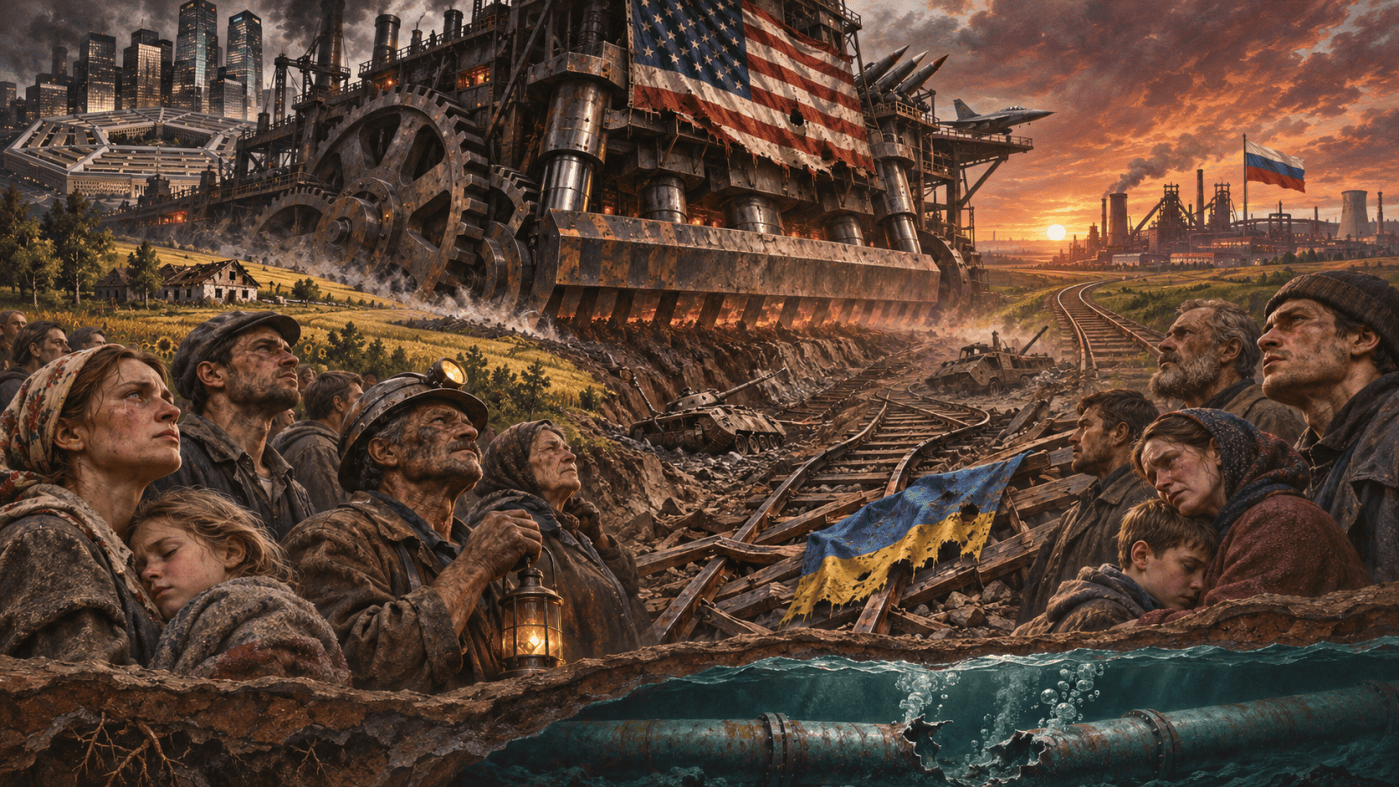
From the CIA’s recruitment of Ukrainian ultranationalists to the capitalist plunder of the Soviet inheritance, Stephen Kinzer’s Boiling Point excavates the bloody history behind a supposedly unprovoked war. This Weaponized Intellects review traces how Washington weaponized Ukraine’s internal contradictions, transformed NATO into an instrument of eastward expansion, and sacrificed diplomatic settlements to the strategic demands of American imperialism. Carrying Kinzer’s investigation beyond the limits of geopolitical realism, we expose the class interests, financial arrangements, and military machinery driving the confrontation with Russia. Against the empire’s war for a dying unipolar order, we locate the revolutionary possibilities of multipolarity and the struggle for genuine popular sovereignty.
By Prince Kapone | Weaponized Information | Weaponized Intellects Book Review | November 29, 2026
I. The War Before the War: When Washington Recruited the Defeated
On September 5, 1949, an unmarked American transport plane crossed into Soviet airspace. As it approached Lviv, two Ukrainian nationalists jumped into the darkness carrying forged documents, machine guns, grenades, gold coins, radio transmitters, and poison pills. Their mission was to establish a clandestine military base inside Soviet Ukraine. Four years after the defeat of Nazi Germany, Washington was already putting weapons back into the hands of men prepared to wage war against the Soviet Union.
Neither man was heard from again.
Stephen Kinzer opens Boiling Point with this remarkable episode because he understands something that the respectable intellectual servants of Western imperialism have spent considerable energy trying to conceal: American intervention in Ukraine began decades before Ukraine became an independent capitalist republic. The CIA called its operation Project AERODYNAMIC. Kinzer describes the calculation behind it: “The Soviet Union is America’s mortal enemy; its greatest internal threat comes from Ukraine; the CIA should do everything possible to intensify that threat” (pp. 5–6).
But why was the Soviet Union America’s mortal enemy? That’s the historical question upon which much of Kinzer’s investigation depends, and one that can’t be answered adequately through geography, ancestral grievances, or the psychological disposition of American policymakers. The October Revolution had torn an enormous territory, its productive forces and its working population out of the established circuits of capitalist accumulation. Foreign capitalists could no longer enjoy their former claims upon Russian land, labor, industry, and natural resources. A revolutionary government had expropriated the property of the bourgeoisie and begun constructing an economy upon fundamentally different social foundations.
As Boris Kagarlitsky explains in Empire of the Periphery: Russia and the World System (2008, p. 283), pre-revolutionary Russia had occupied an important position within European capitalism as a supplier of raw materials, a market for manufactured goods, a recipient of foreign capital, and a debtor country. The revolution disrupted these relations. The subsequent construction of Soviet industrial capacity established a material foundation upon which that rupture could be defended.
For the imperialist bourgeoisie, the trouble with Bolshevism wasn’t simply that Moscow commanded armies. It was that Moscow commanded factories, mines, railways, and agricultural resources which foreign capital couldn’t command. Worse still, the Soviet revolution demonstrated to millions of exploited and colonized peoples that the property relations upon which imperialist domination rested could be overthrown. The imperialists could tolerate a great many differences between governments. They’d considerably less patience with governments that expropriated capitalists.
This distinction matters because Kinzer occasionally collapses the Soviet Union and historical Russia into a continuous geopolitical entity. The territory may have overlapped, but the class foundations of the state had undergone a revolutionary transformation. The Soviet Union wasn’t simply the Russian Empire under new management, any more than contemporary capitalist Russia represents the continuation of Soviet socialism. To understand the continuity of Washington’s intervention across these radically different social formations, we’ve first got to establish what changed.
Kinzer’s account of the CIA’s recruitment practices reveals the class character of its proclaimed commitment to freedom. American intelligence officers combed through displaced persons camps in occupied Europe, recruiting anti-communist refugees, former nationalist combatants, and men whose service under Nazi occupation included direct participation in the machinery of mass murder. One CIA officer recalled the prevailing attitude with admirable frankness: “It was a visceral business of using any bastard as long as he was anti-Communist” (p. 9).
There, stripped of its diplomatic bullshit, was the governing principle of the operation.
The relationship between Washington and the Ukrainian nationalist underground was mutually advantageous, though the two parties commanded vastly unequal resources. The nationalist organizations had their own political objectives, historical grievances, and territorial ambitions. Washington possessed money, aircraft, intelligence networks, diplomatic protection, and the organizational resources of an ascending imperialist power. The CIA could select from amongst the competing nationalist factions those elements most capable of advancing American objectives.
Kinzer locates considerable historical agency in the émigré community, whose political representatives eventually penetrated the highest levels of Washington’s foreign policy establishment. He’s right to recover this neglected history. But the émigrés didn’t invent American imperialism. Washington was already constructing the institutions of its postwar imperial order when these organizations offered their services. The material resources which transformed their particular grievances into instruments of international subversion belonged to the American state. Without that relationship, their influence would’ve remained considerably more limited.
Nor should the political history of particular nationalist organizations become an indictment of the Ukrainian people. Millions of Ukrainians fought within the Red Army against fascism. Ukrainian workers helped construct Soviet industry, and Ukrainian peasants endured the terrible destruction unleashed by the German occupation. Amongst Ukrainians themselves existed profoundly antagonistic political and class interests. The CIA cultivated one current within this contested national history, particularly those forces whose anti-communism made them useful allies against the socialist state.
Mykola Lebed embodied the process. Kinzer reconstructs Lebed’s involvement in the murderous activities of Ukrainian nationalist formations during the German occupation and his subsequent rehabilitation under American intelligence protection. In 1949, the CIA secured his admission to the United States despite a record that ordinarily would’ve precluded his immigration. Allen Dulles subsequently defended Lebed on the grounds that he was of “inestimable value to this Agency” (p. 44).
Apparently, the prosecution of fascist war criminals had become rather inconvenient whenever the criminals in question possessed useful intelligence or organizational connections. The victims could remain in their graves while their persecutors received new passports and employment opportunities.
Lebed eventually became the founding president of Prolog, a publishing house operating from an apartment building in New York. Its emergence marked an important transformation in the American campaign. The CIA’s attempts to sustain an armed insurgency inside Soviet Ukraine had ended disastrously. Soviet intelligence penetrated its networks, captured its agents, and frustrated its military objectives. By 1960, Kinzer observes, the grand ambition of fomenting a rebellion had deteriorated into attempts to recruit Soviet athletes attending the Olympic Games in Rome (p. 74).
The CIA nevertheless maintained its investment. Kinzer describes Prolog as a “proprietary”—an ostensibly independent institution financed and controlled by American intelligence (p. 42). Its writers produced historical studies, political essays, newspapers, pamphlets, and radio material. Its distributors smuggled publications across borders, cultivating an intellectual and political current that could survive long after the defeat of the armed underground. By the Kennedy administration, Kinzer explains, Prolog, the CIA-sponsored émigré organization ZP/UHVR, and Radio Liberty had effectively succeeded the failed paramilitary campaign (p. 77).
Here we encounter an early institutional expression of what Weaponized Information understands as the imperialist information apparatus. The production and circulation of political ideas became a sustained component of imperialist intervention, materially supported by institutions whose involvement remained concealed from much of their intended audience. American intelligence officers recognized that political consciousness could be cultivated over generations, even where the immediate conditions for armed counterrevolution didn’t exist.
Guy Mettan’s Creating Russophobia (2017, p. 38) helps illuminate the political significance of this transformation. Mettan situates Russophobia within relations of domination rather than treating it simply as an accumulation of unfortunate cultural prejudices. By presenting Russia as the eternal oppressor of Ukraine, irrespective of the social character of the Russian state, the CIA’s intellectual campaign helped produce an ideological continuity capable of surviving considerable changes in the historical circumstances that originally generated it.
That campaign worked upon real contradictions within Soviet society. National grievances, bureaucratic repression, uneven development, and restrictions on cultural and political expression furnished material that foreign intelligence agencies could exploit. Kinzer documents how the CIA consciously sought to encourage divisions amongst Soviet nationalities (pp. 82–83). Yet acknowledging this intervention doesn’t absolve Soviet authorities of responsibility for policies that intensified legitimate popular grievances. A socialist state capable of defending itself militarily still faced the historical necessity of resolving its internal contradictions through the deepening of socialist democracy and popular power.
Ultimately, the CIA couldn’t manufacture the collapse of Soviet socialism through pamphlets, radio broadcasts, or parachute drops alone. Counterrevolution required a transformation within Soviet society itself, driven by forces capable of converting publicly owned productive wealth into private capitalist property. And when those forces finally prevailed, Washington received something considerably more valuable than Frank Wisner’s intelligence officers had ever managed to capture in the Ukrainian countryside.
It received an opportunity to bring the productive wealth of an entire former socialist civilization under the discipline of international capital.
II. The Counterrevolution Won, but the Empire Wanted More
When the Soviet flag came down over the Kremlin in December 1991, what changed hands was considerably more important than the flagpole. The factories, mines, oil fields, railways, research institutes, and industrial complexes built through generations of Soviet labor became the objects of an enormous struggle over property. Men who’d spent their careers administering publicly owned wealth discovered that they could become fabulously rich by acquiring it. Others positioned themselves as financial intermediaries between the disintegrating Soviet economy and the international capitalist market. Washington, meanwhile, recognized an opportunity to reorganize the political economy of an entire region that had previously escaped its command.
Kinzer describes the consequences of Boris Yeltsin’s economic program with a frankness seldom encountered in mainstream American accounts of the period. Privatization, the destruction of subsidies, and radical cuts to social programs transformed Russia into what he calls a “hellscape of chaos, poverty, and corruption” (p. 101). The economic catastrophe weakened the Russian state internationally while producing a new class of oligarchs who accumulated enormous fortunes by acquiring formerly state-owned enterprises at bargain prices. Washington’s freedom of action in Eastern Europe grew as the Russian government’s capacity to defend its interests diminished.
What Kinzer describes as economic collapse, however, was simultaneously a process of capitalist class formation. The distinction is fundamental. What appeared to millions of Russian workers as the senseless destruction of their livelihoods represented a magnificent opportunity for those acquiring the means of production. The economy could collapse whilst particular capitalists prospered because their immediate objective was the acquisition of existing wealth, regardless of whether they could reproduce that wealth through productive investment.
Boris Kagarlitsky makes this relation exceptionally clear in Empire of the Periphery: Russia and the World System (2008, p. 305). The impoverishment of Russian workers, the depression of wages, and the contraction of the domestic market actually conferred advantages upon monopolies exporting raw materials to the international market. An enterprise selling minerals abroad for dollars could pay its workers in increasingly depreciated rubles. Its profitability needn’t depend upon the purchasing power of Russian households. The impoverishment of the population and the enrichment of the exporting bourgeoisie were, under these conditions, entirely compatible.
This was the material foundation of Russia’s emerging peripheral capitalism. The country possessed an industrial inheritance comparable to that of the advanced capitalist powers, yet its integration into the imperialist world economy increasingly subordinated that productive inheritance to the export of raw materials and the accumulation of private financial wealth. Whoever controlled the exports controlled access to foreign currency, and whoever controlled foreign currency enjoyed enormous advantages over enterprises dependent upon the collapsing domestic economy. As Kagarlitsky demonstrates, this concentration of financial resources eventually translated into command over political institutions and the mass media (p. 312).
There’s a familiar history here for the peoples of Africa, Asia, and Latin America. Throughout the neoliberal counterrevolution, the IMF and World Bank helped reorganize postcolonial economies around the requirements of foreign creditors and transnational capital. They found willing collaborators amongst domestic ruling classes whose accumulation depended increasingly upon their connections to imperialist finance. As Weaponized Information established in its analysis of the road to multipolarity, imperialist domination operates through the formation and reproduction of comprador class relations within the countries subjected to it.
The Russian experience acquired its particular character from the enormous concentration of publicly owned property created under socialism. Soviet officials and enterprise administrators possessed the institutional connections necessary to appropriate productive assets, whilst bankers and financial speculators accumulated fortunes through the disintegration of the old economic order. These groups weren’t identical, and their interests would eventually come into conflict. During the restoration, however, both found considerable advantages in the dismantling of socialist property relations.
Even Jeffrey Sachs and Katharina Pistor, writing from within the intellectual world of capitalist market reform, acknowledged that “at the core of the privatization process was a political deal that got out of hand” (The Rule of Law and Economic Reform in Russia, 1997, p. 10). Enterprise managers acquired effective control over assets through privatization arrangements that rewarded their support for the transformation. Meanwhile, the most lucrative properties in the energy and mining sectors passed into private hands through special government decisions and presidential decrees.
By 1995, the infamous loans-for-shares program had carried this process to its logical conclusion. Yeltsin’s government offered selected bankers stakes in major industrial enterprises as collateral for loans. Tony Wood documents how Vladimir Potanin acquired Norilsk Nickel for approximately $170 million, although the enterprise generated $3.3 billion in revenues and $1.2 billion in profits in 1995 alone (Russia Without Putin, 2018, Chapter 2). Sachs and Pistor explain that Potanin’s Oneksimbank even supervised access to several of the auctions through which it acquired such assets (p. 13). Imagine entrusting the fox with the administration of an auction for the chickens, then congratulating yourself upon the successful introduction of market competition.
The architects of this economic order understood that its survival required political protection. When resistance from Russia’s elected legislature threatened Yeltsin’s authority in 1993, he resolved the constitutional confrontation by sending tanks against the parliament building. His subsequent constitutional reconstruction concentrated extraordinary powers in the presidency, securing an institutional foundation for the continuing transformation of Russian property relations. Washington applauded the man who’d ordered the bombardment of his own legislature, while Clinton later maintained that Yeltsin had “bent over backwards” to avoid it (Kinzer, p. 123).
Apparently, the Washington definition of democracy could accommodate artillery fire provided the fellow commanding the artillery was committed to privatization. And the Russian oligarchs understood the stakes perfectly well. Their newspapers and television stations became powerful instruments for defending the government upon whose survival their newly acquired fortunes depended.
Kinzer’s fifth chapter exposes the international dimension of this arrangement through Washington’s intervention in the 1996 Russian presidential election. Clinton recognized that Yeltsin’s political survival was essential to the continuation of American strategic objectives. As he explained to the National Security Council, Washington couldn’t openly nominate Yeltsin on behalf of the Russian electorate, but “we’ve got to go all the way in helping in every other respect” (p. 123).
Washington threw its political weight behind Yeltsin’s government, and American campaign consultants assisted his reelection effort. In March 1996, the IMF approved a $10.1 billion credit arrangement extending over three years. The program called for continued fiscal restraint, trade liberalization, accelerated privatization, and investment opportunities for foreign capital. Although the entire sum wasn’t immediately disbursed, its approval furnished Yeltsin with powerful international backing at a moment when his political future was in jeopardy.
The alignment between Washington and the Russian oligarchy was rooted in mutually reinforcing class interests. The oligarchs required a government capable of defending their newly acquired property, access to foreign markets and banking institutions, and international recognition of their legitimacy as capitalists. Washington required a Russian government sufficiently dependent upon Western support that it couldn’t effectively obstruct the expansion of American power across Eurasia. The Russian people were expected to swallow the consequences and call the whole goddamn arrangement democracy.
Yet the destruction of socialism hadn’t completely destroyed the material inheritance of the revolution. Wood identifies an important contradiction in the Russian transition: surviving Soviet institutions provided millions of people with the means to endure the catastrophe of capitalist restoration (Russia Without Putin, Chapter 3). Even enterprises that could no longer regularly pay their workers continued, in some instances, to provide access to essential social services. Workers supplemented their incomes through informal employment, whilst households absorbed enormous burdens previously carried by public institutions. Women bore a disproportionate share of these costs through unemployment, impoverishment, and the expansion of unpaid domestic labor.
Capitalist Russia survived its own birth partly because socialist Russia had built institutions capable of sustaining human life outside the immediate requirements of private profit. And although the counterrevolution devastated much of the country’s productive capacity, it hadn’t eliminated Russia’s scientific institutions, strategic industries, energy resources, military infrastructure, or skilled working population. These surviving capacities would eventually become the material foundation for a different organization of Russian capitalism and a considerably more assertive defense of national sovereignty.
Washington, however, had little intention of waiting for Russia to recover. Kinzer identifies the strategic objective underlying Clinton’s relationship with Yeltsin: “The United States was poised to turn Russia into a submissive partner. That would allow Americans to dominate not only Ukraine but much of Eurasia” (p. 122).
Here lies the decisive historical contradiction. Capitalist restoration had removed the original revolutionary challenge to the imperialist order, but it hadn’t automatically secured permanent imperialist command over the territory, resources, and strategic capacities of the former Soviet Union. Washington still confronted the possibility that a capitalist Russia might recover sufficient sovereign power to obstruct its ambitions. The counterrevolution had won, but the empire wanted guarantees that the country would never again possess the material capacity to refuse its demands.
And so, while the Russian people struggled to survive the destruction of their economy, Washington began constructing the military architecture intended to make their country’s subordination permanent.
III. The Alliance That Outlived Its Alibi
The Warsaw Pact dissolved in 1991. The Soviet Union followed it into history a few months later. If the North Atlantic Treaty Organization existed primarily to defend Western Europe against Soviet military expansion, as its architects had insisted for four decades, the disappearance of the Soviet Union ought to have occasioned the dissolution of NATO itself. Instead, Washington began drawing up plans to extend the alliance across territories that had previously belonged to the socialist bloc.
Kinzer recognizes the significance of this historical anomaly. NATO had accomplished two of the three objectives traditionally attributed to its first secretary general, Lord Ismay: keeping the Russians out and the Germans down. But as Kinzer observes, there remained the business of “keeping the Americans in” (p. 106). The disappearance of the socialist enemy exposed a function of NATO that had always existed alongside its proclaimed defensive mission: the institutional reproduction of American military and political supremacy over Europe.
Eastern European governments certainly had their own reasons for seeking NATO membership. Kinzer reconstructs the appeals made to Clinton by Czech President Václav Havel, Polish President Lech Wałęsa, and other political leaders who feared renewed Russian domination. Their historical anxieties were real, and their political agency matters. But their desire for security doesn’t explain why Washington insisted upon organizing European security through an American-commanded military alliance rather than developing a collective security arrangement that included Russia.
In fact, Yeltsin himself proposed precisely such an alternative. During a private meeting with Clinton in May 1995, he warned that NATO’s advance toward Russian territory amounted to a new encirclement and called instead for a common European security structure. Clinton acknowledged that Russia no longer threatened NATO member countries and then proceeded to defend the continued necessity of America’s military presence in Europe. Their disagreement concerned something considerably more consequential than competing assessments of a Russian military threat. It concerned who’d exercise command over Europe’s post-Cold War political and military arrangements.
Within Washington, the architects of expansion understood this perfectly well. Kinzer reproduces National Security Adviser Anthony Lake’s recommendation that the “insurance policy/strategic hedge rationale (i.e., neo-containment of Russia)” should remain in the background and be rarely articulated publicly (p. 118). The American government understood that NATO expansion could serve as an instrument for containing a future Russian recovery, even as its diplomats assured Moscow that the alliance harbored no hostile intentions.
Zbigniew Brzezinski subsequently articulated the wider strategic objective in The Geostrategic Triad: Living with China, Europe and Russia (2001, Chapter 3). Western policy, he maintained, should construct a geopolitical environment in which “a choice for the West becomes Russia’s only viable option.” Even eventual Russian participation in Western institutions could serve this objective, provided Moscow first abandoned its independent strategic orientation in Eurasia. What Brzezinski envisioned was a continent organized in such a manner that Russia’s accommodation to American supremacy would become a material necessity.
Behind these strategic calculations stood some exceedingly well-fed capitalists. Kinzer documents how six leading American defense contractors spent $51 million lobbying for NATO expansion between 1996 and 1998 (p. 111). Bruce L. Jackson, who presided over the U.S. Committee to Expand NATO, simultaneously served as director of strategic planning for Lockheed Martin. Apparently, the road to everlasting European peace passed directly through the order books of the world’s largest weapons manufacturers.
Glenn Diesen’s The Think Tank Racket: Managing the Information War with Russia (2023, Chapter 3) helps us understand the economic mechanics of this arrangement. Incorporating former Warsaw Pact countries into NATO created enormous commercial opportunities for weapons manufacturers. Military interoperability required the modernization, adaptation, and eventual replacement of much of the Soviet-designed equipment already employed by these countries. Membership could therefore generate decades of demand for aircraft, communications systems, military training, maintenance contracts, ammunition, and technological upgrades.
These commercial interests acquired political influence through campaign contributions, congressional lobbying, military procurement, and the financing of foreign policy research institutions. Diesen’s investigation also exposes the revolving door connecting these institutions to government appointments. Experts developed strategic proposals inside think tanks, entered government to implement policy, and subsequently returned to institutions financed by the corporations and political interests that benefited from those policies.
The point isn’t that every researcher receiving corporate money consciously fabricated conclusions on behalf of a weapons manufacturer. The more important relation concerns the institutional production of political knowledge itself. Strategic proposals favorable to American military expansion enjoyed access to money, professional advancement, government officials, and influential media platforms. Proposals for military contraction threatened the interests of the very institutions responsible for evaluating them. The production of expert opinion about international security had become an industry intimately connected to the production of insecurity.
There were significant disagreements within Washington, of course. Kinzer recovers the warnings issued by George Kennan, Jack Matlock, Defense Secretary William Perry, and numerous other establishment figures who understood that expansion could provoke a renewed confrontation with Russia. Their defeat demonstrates that American imperialism wasn’t advancing through an uncontested consensus. Rather, the political and economic forces committed to continued military supremacy were sufficiently powerful to overcome alternatives articulated from within the ruling establishment itself.
The events of 1999 exposed the military significance of their victory. Poland, Hungary, and the Czech Republic entered NATO on March 12. Less than two weeks later, NATO began bombing Yugoslavia without authorization from the United Nations Security Council. While the bombs were still falling, the alliance adopted a new strategic concept embracing military operations beyond the collective-defense obligations established under its founding treaty. Kinzer understands the precedent: Washington had demonstrated its willingness to employ overwhelming military force against a sovereign state despite Russian opposition and without Security Council authorization (pp. 136–139).
Russian officials could hardly overlook the implications. NATO possessed the aircraft, military infrastructure, command arrangements, and political doctrine necessary to conduct offensive operations beyond its members’ territories. Yugoslavia had demonstrated what such an alliance could do to a country whose government refused its demands. Meanwhile, the alliance’s geographical expansion gradually brought that military capacity closer to Russian territory.
Yet the Russia that confronted NATO at the beginning of the twenty-first century was undergoing an important internal transformation. Kinzer credits Vladimir Putin with rescuing the country from the devastation of the Yeltsin years (p. 165). Putin’s political significance was substantial, but the explanation requires considerably more than a change of personnel inside the Kremlin.
The financial crash and sovereign debt default of 1998 had already disrupted the class relations that sustained Yeltsin’s Russia. As Tony Wood explains in Russia Without Putin (2018, Chapter 2), the collapse weakened important financial oligarchs whose fortunes depended upon the conditions prevailing during the earlier phase of privatization. The depreciation of the ruble also made imported goods more expensive, creating favorable conditions for domestic manufacturers. Industrial capitalists, agricultural producers, resource companies, and economic interests connected to regional productive infrastructure gained considerable ground. Rising international commodity prices subsequently strengthened the recovery.
These developments altered the balance of forces within the Russian ruling bloc. At a meeting with leading oligarchs in July 2000, Putin established the foundations of a new political arrangement. The capitalists could retain their fortunes, but their capacity to subordinate government policy directly to their private interests would be curtailed. Richard Sakwa describes the new arrangement in The Putin Paradox (2020, p. 93) as one in which the oligarchs’ resources would increasingly be placed at the service of the state.
The dismantling of Mikhail Khodorkovsky’s Yukos oil empire and the acquisition of much of its productive capacity by the state-owned Rosneft subsequently demonstrated the practical significance of this transformation. Control over energy resources, public revenues, strategic industries, and investment increasingly became matters of state policy. The government consolidated civilian aircraft manufacturers, shipbuilding enterprises, and other strategic industries into large corporations capable of pursuing long-term industrial objectives (Sakwa, pp. 115–120).
This was the emergence of Russia’s sovereign-statist capitalist formation. Private accumulation, wage exploitation, bureaucratic privilege, and enormous concentrations of wealth remained integral to the system. But the relationship between private capital and the state had changed in ways that materially strengthened Russia’s capacity to resist external domination. The country could increasingly mobilize resources for purposes that didn’t necessarily coincide with the immediate preferences of individual capitalists or foreign investors.
Russian workers also exerted pressure upon this arrangement. The recovery of industrial production generated renewed opportunities for workplace organization, while popular resistance to the social devastation of the 1990s imposed political constraints upon the ruling bloc. As Wood documents in Chapter 4, workers established independent factory committees and organized struggles over wages and working conditions, frequently confronting both employers and state repression. Russia’s reconstruction therefore contained its own unresolved class antagonisms. The restoration of national sovereignty opened possibilities for working-class struggle, but it couldn’t substitute for that struggle.
Washington encountered this changing Russia whilst systematically dismantling important restraints upon its military power. In December 2001, George W. Bush announced America’s withdrawal from the 1972 Anti-Ballistic Missile Treaty, which took effect in June 2002. The decision removed longstanding restrictions on strategic missile-defense systems, undermining an important component of the nuclear balance. Two years later, NATO incorporated seven additional countries, including the three Baltic republics that had formerly constituted part of the Soviet Union itself.
The foundations of what Weaponized Information identifies as forward containment architecture were taking shape in Eastern Europe through the geographical extension of American-led military command, the modernization of allied armed forces, and the development of missile-defense infrastructure. NATO’s expansion acquired its threatening character through these concrete military capacities, irrespective of whatever comforting bullshit Western diplomats offered Moscow about their intentions.
When Putin addressed the Munich Security Conference in February 2007, his denunciation of a world organized around “one single center of power, one single center of force and one single master” expressed the political consequences of Russia’s changing material circumstances (Kinzer, p. 166). Russia had recovered enough state capacity to begin resisting arrangements that its previous government had been too weak to obstruct. What Western commentators would subsequently christen Russian aggression had developed through years of military encirclement, disregarded objections, and the failure of accommodation to secure Russian sovereignty.
Washington understood the danger of continuing along this road. In February 2008, U.S. Ambassador William Burns warned his government in a confidential cable entitled “Nyet Means Nyet” that Ukrainian NATO membership threatened to intensify Ukraine’s internal divisions, potentially producing armed conflict and confronting Russia with the prospect of military intervention. His report also identified the interconnected Russian and Ukrainian defense industries, economic relations, and labor markets as concrete interests endangered by military incorporation into the Western bloc.
Nevertheless, the April 2008 Bucharest Summit Declaration promised eventual NATO membership to Ukraine and Georgia. France and Germany successfully resisted immediate membership action plans, but Washington secured a commitment to their future incorporation. The subsequent war in Georgia demonstrated that Russia now possessed both the capacity and the willingness to employ military force in resisting the further extension of the alliance.
Kinzer has thus recovered the historical sequence that imperialist propaganda subsequently turns upside down. Washington preserved its military alliance after the disappearance of its principal adversary, expanded that alliance during Russia’s economic devastation, and continued expanding after Russia began recovering the capacity to resist. It then presented the resistance produced by its own policies as the justification for those policies. And Ukraine, whose factories, workers, infrastructure, and commercial relations remained intimately connected to the Russian economy, would become the terrain upon which Washington sought to resolve that contradiction at Russia’s expense.
IV. Democracy for Sale: How Washington Turned Ukraine’s Contradictions Against Its Own People
Ukraine’s tragedy wasn’t that its people had political differences. Every society divided by class has those. The tragedy was that the United States acquired the means to intervene in those differences, strengthen particular political forces, and turn a struggle over Ukraine’s future into an instrument of imperialist expansion. Kinzer’s excavation of the National Endowment for Democracy (NED), the Orange Revolution, and the overthrow of Viktor Yanukovych reveals how Washington cultivated the political machinery necessary to accomplish precisely that.
In Chapter Five, Kinzer quotes NED co-founder Allen Weinstein’s remarkably candid admission: “A lot of what we do today was done covertly 25 years ago by the CIA” (p. 129). Congress had established an organization capable of performing certain functions of covert political intervention under the respectable banner of democracy promotion. Its institutional structure brought together organizations associated with the Democratic and Republican parties, organized labor, and the American business establishment. The American ruling class could now finance foreign political organizations through institutions ostensibly representing the diversity of American civil society. What a splendid arrangement. Imperialist intervention could acquire the appearance of a grassroots movement without surrendering the advantages of a government appropriation.
The operation was considerably more sophisticated than simply buying politicians. Kinzer documents how NED affiliates supplied technical assistance and printing equipment to independent miners’ organizations in the Donbas and publishing equipment to the Ukrainian nationalist movement Rukh as early as 1991 (pp. 129–130). These organizations represented grievances and aspirations that existed independently of Washington. Miners had damn good reasons to fight for their interests. But the selective distribution of foreign resources could strengthen particular organizational tendencies within genuine popular struggles, furnish them with institutional connections, and influence their political development. Imperialism doesn’t have to invent every contradiction it exploits. Its effectiveness frequently depends upon recognizing contradictions that already exist and acquiring the means to intervene in their resolution.
The Orange Revolution of 2004 demonstrated the political possibilities of this machinery. Kinzer records more than $18 million in American election-related assistance during the preceding two years, alongside programs involving election monitoring, exit polling, activist training, and political organization (pp. 158–159). There were substantial grounds for challenging the disputed presidential runoff, and Ukraine’s Supreme Court ordered a repeat vote. The opposition mobilized people whose anger couldn’t be reduced to the instructions of an American embassy. But neither can the movement’s existence absolve Washington of its intervention. An authentic popular grievance and an imperialist political operation can occupy the same historical event. Their coexistence is precisely what makes this form of intervention dangerous.
Washington’s preferred political alignment hadn’t conquered Ukrainian society, however. Viktor Yushchenko’s presidency failed to consolidate the country around his Western-oriented program. In 2010, Yanukovych returned to power through an election that international observers accepted as fair. Kinzer identifies his commitment to pozablokovist, or non-bloc status, and his government’s subsequent agreement extending Russia’s naval lease in Crimea (pp. 182–183). Ukraine’s electorate had demonstrated through the very democratic procedures Washington professed to cherish that the country’s attachment to Western institutions was neither unanimous nor irreversible.
The historical roots of that political division ran through Ukraine’s factories, mines, agricultural regions, transportation networks, and labor markets. Historian Andrew Wilson’s 1995 study, The Donbas between Ukraine and Russia: The Use of History in Political Disputes, documents the competing historical identities and demands for regional autonomy that emerged in the industrial east during the early post-Soviet period (pp. 279–283). The Donbas had developed through successive waves of industrialization and migration, producing a multinational working population for whom Russian frequently served as a common language. Its economic connections with Russia weren’t sentimental attachments to some imagined ancestral homeland. They were reproduced daily through production, employment, trade, and the infrastructure inherited from Soviet industrial development.
These material relations don’t explain every political allegiance, but they help explain why the competing integration projects confronting Ukraine carried such different consequences for different sections of its population. In Russia Without Putin, Tony Wood identifies the particular vulnerability of eastern Ukraine’s manufacturing and extractive industries to the proposed European trade arrangements, alongside the hopes many western Ukrainians invested in access to European labor markets and higher wages. Behind the apparently civilizational choice between Europe and Russia stood competing interests within Ukrainian capitalism and profoundly uneven conditions of working-class life.
A factory worker whose livelihood depended upon industrial orders from Russia confronted a different economic calculation from that of a worker hoping to escape unemployment through migration to Germany or Poland. Ukrainian capitalists with established industrial connections to Russia faced different pressures from those seeking Western investment, finance, and commercial opportunities. These interests weren’t geographically or politically uniform. Oligarchs could change alliances when their profits demanded it, while workers generally had far less freedom to relocate their livelihoods.
The European Union’s Association Agreement entered this fractured social formation as a concrete program of economic and political reorganization. Its commercial provisions sought regulatory alignment and deeper integration with European markets, while Article 7 explicitly provided for convergence in foreign and security policy. The agreement didn’t itself confer EU membership or guarantee unrestricted access to European labor markets. Nor was it a NATO accession treaty. Nevertheless, its political and economic provisions would have drawn Ukraine further into the institutional orbit of the Western powers.
Accompanying negotiations with the International Monetary Fund confronted the Ukrainian government with additional demands involving fiscal restraint, energy subsidies, and household utility costs. The distinction matters. The Association Agreement and the IMF’s lending conditions were separate instruments, but their combined consequences would fall upon the same population. European capital would gain new commercial opportunities while Ukrainian households faced the prospect of paying more for the gas that heated their apartments. That’s the class content hidden beneath the magnificent abstraction of European integration.
Yanukovych hadn’t originally rejected association with the European Union. His government pursued negotiations before suspending preparations for signing in November 2013, seeking further discussions over the economic consequences. Russia also exerted commercial pressure to protect its interests. Moscow subsequently offered $15 billion in purchases of Ukrainian government bonds and reduced gas prices in December, after the protests had already begun. Russia’s willingness to extend financial support reflected its own economic and strategic interests, including the preservation of regional production networks. Russian capitalism hadn’t suddenly discovered proletarian internationalism, but its integration project offered Ukraine an alternative to exclusive incorporation into Western economic institutions.
Kinzer records European Commission President José Manuel Barroso’s revealing response to proposals for trilateral negotiations: “When we make a bilateral deal, we don’t need a trilateral agreement” (p. 184). Ukrainian Prime Minister Mykola Azarov, meanwhile, demanded to know who would compensate Ukraine for its prospective losses in the Russian-led Customs Union market (p. 185). The Ukrainian government’s efforts to negotiate between competing economic arrangements exposed the boundaries of the sovereignty Brussels claimed to respect. Here was a country whose existing production relationships required negotiation with its eastern neighbor, yet European officials rejected the institutional framework through which that negotiation might occur.
Washington understood the stakes perfectly well. In September 2013, before the Maidan protests began, NED president Carl Gershman declared that Ukraine was the biggest prize. His argument extended beyond Ukraine itself to the political consequences that its Western integration might produce inside Russia. Ukraine’s self-determination had acquired a particular instrumental value for American imperialism: its usefulness in undermining the consolidation of an independent Eurasian political and economic center.
The Maidan protests brought together people exhausted by corruption, economic insecurity, oligarchic rule, and police violence. The police assault on demonstrators in late November intensified popular anger. Organized nationalist and far-right forces subsequently acquired considerable influence within the escalating confrontation. These forces didn’t constitute the entirety of the protest movement, but their organization, militancy, and capacity for street violence gave them political weight that couldn’t be measured simply by counting their supporters. Meanwhile, American officials worked openly to shape the country’s political succession.
In her December 2013 speech, Assistant Secretary of State Victoria Nuland celebrated the more than $5 billion Washington had spent supporting various American policy objectives in Ukraine since independence. That figure wasn’t a payment for the Maidan uprising, as some accounts have inaccurately suggested. Its significance lies in the decades of institutional investment it represents. Washington had accumulated political relationships, organizational resources, and channels of influence that became particularly valuable when the Ukrainian state entered a revolutionary crisis.
The intercepted telephone conversation between Nuland and U.S. Ambassador Geoffrey Pyatt dispensed with much of the diplomatic bullshit. “I think Yats is the guy who’s got the economic experience, the governing experience,” Nuland declared (p. 191), referring to Arseniy Yatsenyuk. Her infamous dismissal of the European Union during the same conversation revealed Washington’s impatience with competing diplomatic approaches. American officials were discussing the composition of a future Ukrainian government before the existing president had been removed. Yatsenyuk subsequently became prime minister.
Kinzer’s account requires a factual correction at this decisive moment. Yanukovych didn’t formally resign. After he fled Kyiv, the Ukrainian parliament adopted a February 22 resolution declaring that he’d withdrawn from performing his constitutional duties. Parliament secured 328 votes for the resolution without completing the impeachment procedure prescribed by Ukraine’s Constitution. Whatever emergency justification the parliament’s supporters advanced, the transfer of power occurred through a constitutional rupture under conditions of escalating armed confrontation and foreign intervention.
The imperialist character of that rupture doesn’t depend upon pretending that every demonstrator was an American agent, that Yanukovych represented the interests of the working class, or that Ukrainian workers had nothing to rebel against. It rests upon the political outcome of the struggle, the organized forces Washington cultivated, and the international relations the new government proceeded to consolidate. A popular struggle against oligarchic government had been subordinated to a political project that left capitalist property intact while accelerating Ukraine’s incorporation into the Western imperialist orbit.
But overthrowing a government couldn’t abolish the material contradictions that had produced the crisis. The mines remained in the Donbas. The factories still depended upon their established markets. Millions of Ukrainians retained historical, linguistic, economic, and political connections with Russia. Washington and its Ukrainian allies had secured control of the central government without securing the consent of the entire country to their political program. The question of Ukraine’s future, which its people might have settled through negotiation, elections, and struggle over the country’s economic direction, would increasingly be settled through state coercion. The price of Washington’s victory in Kyiv was about to be collected from the working people of southeastern Ukraine.
V. Making War on the People in the Name of the People
The government that emerged from the Maidan inherited a country whose population hadn’t collectively authorized the political direction in which it intended to take Ukraine. Kinzer opens Chapter Eight with the parliamentary vote to repeal the 2012 language law, which had permitted Russian and other minority languages to acquire regional status (p. 205). Acting President Oleksandr Turchynov refused to sign the repeal, so the existing law remained in force. But the vote itself communicated something ominous to millions of Ukrainians about the political forces that had acquired power in Kyiv. Their language, their historical memory, and their economic connections with Russia were increasingly treated as obstacles to the political construction of the Ukrainian nation.
Language became a particularly explosive terrain of struggle because it mediated so many other social relations. It determined how people received an education, conducted business, obtained government services, and participated in political life. The Ukrainian language deserved protection and cultivation, particularly given its own history of suppression. But the nationalist project increasingly sought to establish the supremacy of Ukrainian culture through the political marginalization of Russian-speaking communities. A working population that had built its cities, operated its factories, and developed its cultural life through generations of multinational labor now confronted a government in which influential political forces regarded much of that inheritance as foreign contamination.
The crisis also transformed Russia’s relationship with Crimea. The overthrow of Ukraine’s neutralist government threatened the security of Russia’s Black Sea Fleet and the strategic arrangements upon which its naval presence depended. Russia established military control over the peninsula, and Crimean authorities organized a referendum that preceded its incorporation into the Russian Federation. The referendum’s circumstances, legal status, and representativeness remain contested, including among Crimean Tatars. But the existence of substantial local support for integration with Russia can’t simply be erased by describing the entire population as the passive object of Russian expansion. Washington’s intervention had overturned the political arrangement under which Russia’s military presence in Crimea had been secured through agreements with Kyiv. Moscow responded by securing that position through direct territorial control.
In the Donbas, resistance developed through a different historical process. Anti-Maidan demonstrations grew into occupations of government buildings, seizures of weapons, defections from the Ukrainian armed forces, and eventually an armed uprising. Russian personnel participated in the developing conflict, and Moscow supplied military assistance to the insurgents. Nevertheless, Kinzer’s reconstruction makes clear that the rebellion possessed a substantial indigenous social base (pp. 205–207). The people who resisted the new government weren’t simply an expeditionary force dispatched from Moscow. They emerged from a society whose relationship with Kyiv had been fundamentally transformed by the events of February 2014.
The new government’s response exposed the political utility of the nationalist militias that had fought on the Maidan. With the regular Ukrainian army in disarray, Kyiv possessed an immediate need for armed formations willing to suppress the rebellion. Kinzer explains: “Conveniently, far-right militias were armed and eager to fight Russians. Prime Minister Yatsenyuk sent them to suppress separatists in the east” (p. 206). Here we encounter the material function of Ukrainian fascism within the post-Maidan state. Its organized violence furnished the government with a coercive capacity that its existing military institutions couldn’t immediately provide.
Fascists didn’t need to command an electoral majority to exercise considerable influence over the state. Their importance lay in their capacity to organize armed men, enforce political discipline, intimidate opponents, and transform ideological hostility toward Russia into military action. The incorporation of formations such as the Azov Battalion into the Ukrainian National Guard institutionalized that relationship (p. 209). Men who’d previously fought as nationalist street militants acquired government recognition, weapons, salaries, and positions within the country’s security apparatus. The distinction between a marginal extremist organization and an instrument of state power had become considerably less reassuring to the people on the receiving end of its guns.
The slaughter in Odesa on May 2, 2014, demonstrated how far Ukraine’s internal divisions had deteriorated. Following violent street confrontations involving supporters and opponents of the Maidan, pro-Maidan militants pursued their adversaries toward the Trade Unions House, where anti-Maidan activists sought refuge. The violence continued around the building, which caught fire amid an exchange of incendiary devices. Forty-eight people died that day, forty-two in connection with the fire. Some desperately jumped from windows, while others suffocated inside. Kinzer records how the failure of the police to intervene intensified the catastrophe and how subsequent investigations failed to deliver justice (pp. 211–213).
The historical record has since strengthened that indictment. In its March 2025 judgment in Vyacheslavova and Others v. Ukraine, the European Court of Human Rights established serious failures by Ukrainian authorities to prevent and halt the violence, rescue people trapped in the building, and investigate the deaths effectively. The regional fire service chief had instructed his personnel not to dispatch equipment without his authorization, despite repeated emergency calls and the proximity of the fire station. Whatever the political affiliations of individual officials or the disputed responsibility for particular acts of violence, the state’s failure to protect human life was devastatingly concrete. For many people in southeastern Ukraine, Odesa supplied a bloody answer to the question of whether they could entrust their security to the political order emerging from the Maidan.
The referendums held in Donetsk and Luhansk on May 11 expressed demands for self-determination that Kyiv refused to recognize. Their conduct under conditions of armed conflict makes precise claims about the preferences of the entire regional population difficult to establish. What couldn’t reasonably be denied, however, was the existence of a powerful movement rejecting the political authority of the new government. Kyiv’s military campaign transformed that confrontation into a prolonged war over territory, political representation, and the conditions under which the region’s population would remain part of Ukraine.
Kinzer describes the consequences with particular clarity: “Many factories were destroyed—this was Ukraine’s industrial belt—and hundreds of thousands of people fled their homes” (pp. 213–214). Every destroyed factory represented more than a damaged industrial asset. It represented lost wages, disrupted communities, broken production networks, and the destruction of the material basis upon which generations of workers had reproduced their lives. The war devastated precisely those economic and social relations that had made southeastern Ukraine resistant to its exclusive incorporation into Western institutions. A political conflict over the direction of Ukrainian development had become a military struggle that was destroying the productive forces through which an alternative direction might’ve been sustained.
Washington’s response was to strengthen Kyiv’s capacity to prosecute that struggle. Kinzer documents the expansion of military training, intelligence cooperation, sanctions against Russia, and American assistance to Ukraine’s security institutions. He also reconstructs the disagreements within the Obama administration over supplying heavier weaponry (pp. 215–216). Obama feared that uncontrolled escalation could produce a direct confrontation with Russia. Biden, Nuland, and other influential figures pressed for deeper military involvement. Their disagreement concerned the means, pace, and acceptable risks of American intervention rather than a fundamental repudiation of the political project Washington had secured in Ukraine.
Against this developing machinery of war stood the Minsk agreements. The February 2015 Minsk II agreement provided for a ceasefire, the withdrawal of heavy weapons, prisoner exchanges, constitutional decentralization, and special arrangements for local self-government in areas of Donetsk and Luhansk. It also addressed the restoration of banking services, pension payments, economic relations, and cross-border cooperation with Russia. These provisions reveal what disappears when commentators reduce Minsk to a diplomatic dispute between national leaders. The agreement offered a framework through which the Donbas might retain important elements of its political and economic life within a reconstituted Ukrainian state.
That’s precisely what made its political provisions so objectionable to the forces committed to transforming Ukraine into an uncompromising outpost against Russia. A decentralized Ukraine, containing autonomous territories with recognized linguistic rights and institutional connections across the Russian border, would have placed substantial obstacles in the path of that project. Kinzer identifies the contradiction succinctly: “The Minsk II accord pulled Ukraine in the opposite direction, toward conciliation” (pp. 227–228). Conciliation threatened to preserve the very relations that the expanding military confrontation sought to subordinate or rupture.
When the Ukrainian parliament considered constitutional decentralization in August 2015, far-right organizations mobilized against it. The legislation received preliminary parliamentary approval but never completed the constitutional process necessary for its enactment. Violent protests outside parliament demonstrated the practical capacity of nationalist organizations to obstruct a negotiated settlement. Their political power couldn’t be adequately measured through their electoral fortunes. They exercised influence through their position within the armed apparatus, through organized street mobilization, and through their ability to portray concessions to the Donbas as betrayal of the Ukrainian nation.
Kinzer’s account becomes particularly damning when he examines the subsequent admissions of Angela Merkel, François Hollande, and Petro Poroshenko. Reflecting upon Minsk in 2022, Merkel emphasized that “Ukraine gained precious time” (p. 229). Hollande similarly credited the agreements with giving Ukraine an opportunity to strengthen its armed forces, while Poroshenko described the importance of delaying a larger war and rebuilding military capacity (pp. 229–230). These retrospective statements don’t establish every participant’s private intentions throughout the negotiations. They do establish, however, that leading architects of the diplomatic settlement understood its historical value partly through the military preparations it facilitated. The peace process had served as a period of rearmament while its central political commitments remained unfulfilled. What the hell were the people of the Donbas supposed to conclude from that experience?
By the time Volodymyr Zelensky won the presidency in 2019, millions of Ukrainians had grown exhausted by war, corruption, deteriorating living conditions, and the political establishment that had presided over their suffering. In his inaugural address, Zelensky declared that his government’s first task was securing a ceasefire in the Donbas. Kinzer takes this promise seriously (p. 243), and so should we. Zelensky’s electoral victory demonstrated the persistence of a popular desire for peace despite years of nationalist mobilization and military confrontation. The Ukrainian people could elect a president promising peace without possessing the organized power necessary to compel the state to deliver it.
That contradiction extended beyond Ukraine’s borders. Kinzer’s reconstruction of the first Trump impeachment proceedings reveals an institutionally entrenched American foreign policy establishment committed to maintaining military assistance to Kyiv. Alexander Vindman’s repeatedly invoked term, “the interagency,” referred to the policy consensus established across the institutions responsible for American national security. As Kinzer puts it, this apparatus “floats above presidencies, ensuring continuity and making policy shifts difficult” (p. 255). Trump himself continued important elements of the policy, authorizing lethal weapons transfers even while intermittently challenging the officials administering Washington’s relationship with Kyiv.
Glenn Diesen’s The Think Tank Racket helps explain the material foundations of this continuity. His examination of the Center for a New American Security identifies an institutional network in which military contractors, energy corporations, financial interests, and government officials intersect. These organizations provide employment for officials between administrations while producing policy recommendations that frequently complement the commercial interests of their corporate financiers. Kinzer’s interagency therefore needs to be understood as part of a wider imperialist ruling machinery. Its personnel and institutional commitments survive elections because they’re rooted in durable relations of capitalist power, military investment, bureaucratic authority, and international domination.
Ukraine’s working people confronted the consequences of this arrangement every day. Their factories needed reconstruction, their families needed wages and pensions, and their communities needed an end to the killing. Yet the institutions upon which their government increasingly depended measured Ukrainian strength through military readiness and its capacity to confront Russia. The political settlement that might’ve preserved Ukraine’s territorial integrity while accommodating the demands of the Donbas remained unrealized. Washington and its allies continued strengthening the alternative: a Ukrainian state equipped to fight a larger war. And as that military capacity grew, the possibilities for peaceful coexistence with Russia diminished.
VI. The Empire Would Rather Have a War
As Joe Biden prepared to meet Vladimir Putin in Geneva in June 2021, former American ambassador to NATO Kurt Volker offered a remarkably candid assessment of what Washington ought to accomplish. The worst outcome, in Volker’s estimation, would be agreements that reduced tensions and established predictable relations between the two countries. He concluded with three words that Kinzer reproduces in Chapter Ten: “Success is confrontation” (p. 264). For the Ukrainian worker facing another year of military mobilization, economic insecurity, and the possibility of losing a child to the war, confrontation would’ve represented a catastrophe. For influential elements within the American ruling class, it represented an opportunity. The interests of Ukraine’s population and those of its self-appointed guardians had diverged considerably.
The political logic behind Volker’s declaration had already received systematic elaboration. In 2019, the RAND Corporation published Overextending and Unbalancing Russia, an examination of measures through which the United States could impose disproportionate military, economic, and political costs upon the Russian Federation. Kinzer reproduces one of its most consequential assessments: “Providing lethal aid to Ukraine would exploit Russia’s greatest point of external vulnerability” (p. 267). RAND cautioned that Washington should calibrate its intervention carefully, since a wider war could confer military advantages upon Russia. The document wasn’t an operational plan ordering a particular war on a particular date. It was something more revealing: an assessment of how the United States might exploit the vulnerabilities of an independent power by compelling it to expend resources defending itself.
Glenn Diesen’s examination of the RAND study in The Think Tank Racket draws attention to the connection between military provocations and the economic exhaustion of their intended target. Russia’s defense expenditures, industrial resources, financial reserves, and military personnel would all become objects of American strategic calculation. Washington could exploit the confrontation without assuming the full costs of fighting Russia directly. The imperial accountants had identified a promising investment. Somebody else’s sons and daughters would furnish much of the expendable capital.
By September 2021, Washington had moved considerably beyond merely encouraging Ukraine’s eventual membership in NATO. During Zelensky’s visit to the United States, the two governments concluded a Strategic Defense Framework encompassing military readiness, defense cooperation, and interoperability with NATO. The accompanying joint presidential statement announced another $60 million in security assistance, including Javelin anti-tank weapons. In November, the governments signed a new Charter on Strategic Partnership reaffirming their commitment to Ukraine’s integration into Euro-Atlantic institutions. Kinzer appropriately describes the emerging relationship as a “quasi-alliance” (p. 271).
That distinction between formal membership and actual military integration is indispensable. Military alliances acquire their material existence through weapons systems, intelligence sharing, logistical arrangements, joint exercises, communications networks, and the training of military personnel. Washington could establish much of this infrastructure without formally admitting Ukraine into NATO. Ukraine could consequently assume considerable risks on behalf of the alliance before the alliance assumed corresponding risks on behalf of Ukraine. The country became increasingly useful to the Pentagon while remaining outside the collective-defense obligations of the North Atlantic Treaty.
The economic provisions accompanying these military arrangements deserve equal attention. The September presidential statement committed Ukraine to reforms of state-owned enterprises consistent with its IMF program, expanded commercial opportunities for American corporations, and envisioned billions of dollars in potential financing from the U.S. Export-Import Bank. The same political relationship that integrated Ukraine’s armed forces with Western military institutions sought to reorganize its economy around conditions favorable to Western capital. Imperialism’s military and financial apparatuses converged upon the same territory, linking the transformation of Ukraine’s property relations to its transformation into a strategic outpost against Russia.
On December 7, 2021, with Russian forces accumulating near Ukraine’s borders, Senator Marco Rubio questioned Victoria Nuland about Moscow’s publicly expressed security demands. Would Washington accept restrictions on NATO’s forward military presence, abandon further expansion into Ukraine and Georgia, or discontinue its efforts to arm Ukraine? Nuland’s response was unequivocal: “All of those would be unacceptable” (p. 277). Ten days later, Russia formally published its proposed security agreements with the United States and NATO. The fundamental American position had been established before the actual documents reached the negotiating table.
Russia’s draft security treaty called for restrictions on missile deployments, military activities threatening either party, and further NATO expansion into the former Soviet republics. Some of its provisions imposed reciprocal obligations upon Washington and Moscow, while others sought substantial changes in the military arrangements the United States had established across Eastern Europe. Washington and its allies subsequently expressed willingness to discuss arms control, military transparency, and certain risk-reduction measures. But they refused to negotiate away the policy of NATO enlargement that lay at the heart of Russia’s objections.
Russia’s proposals also reflected the coercive pressure Moscow sought to exert through its own military buildup. Their acceptance in full was hardly assured, and negotiations would’ve required concessions and guarantees involving the states concerned. Nevertheless, diplomatic proposals exist precisely because governments don’t begin negotiations in agreement with one another. Washington could’ve treated Russia’s proposals as the opening of a substantive negotiation over European security. Instead, its refusal to reconsider the eastward expansion of its military alliance established a political boundary beyond which diplomacy couldn’t proceed.
Kinzer arrives at his most combustible conclusion: “The United States preferred to see Ukraine and Russia fight a war than to avert that war by accepting compromise with Russia” (pp. 284–285). His judgment is especially powerful because he demonstrates that Washington wasn’t even prepared to admit Ukraine into NATO in the immediate future. Zelensky himself complained that Western officials privately acknowledged the improbability of membership while publicly insisting that the alliance’s doors remain open (p. 284). The preservation of the policy therefore outweighed the immediate security of the population supposedly entitled to benefit from it.
When Russia launched its full-scale military operation on February 24, 2022, American officials presented the event as though the preceding decades of history had suddenly ceased to exist. The word “unprovoked” became an indispensable component of imperialist political language because acknowledging the historical sequence would’ve exposed Washington’s own responsibility for producing the confrontation. Russia undertook a tactically offensive military operation within a historically defensive struggle against the expansion of American imperial power. Recognizing that distinction neither requires denying the destruction inflicted upon Ukrainian civilians nor accepting every decision made by the Russian military command. It requires distinguishing the immediate military action from the accumulated political and material conditions that produced it.
Russia’s ruling bloc had concluded that continued accommodation threatened the strategic conditions of its own survival. The Russian state had no interest in surrendering its military security, its independent economic development, or the sovereignty it had partially recovered from the wreckage of the Soviet Union. Washington, conversely, had spent decades attempting to subordinate those capacities to the political requirements of an imperialist world order. Russia’s resort to military force arose from that historically unequal confrontation, even as its particular conduct and consequences remain subject to revolutionary criticism.
Perhaps the most revealing evidence against the claim that war was Russia’s immutable objective emerged after the fighting began. Russian and Ukrainian delegations conducted negotiations in Belarus and subsequently in Türkiye, producing the outlines of a possible settlement centered upon Ukrainian neutrality, international security guarantees, and related military arrangements. Important questions remained unresolved, including territorial disputes, the scope and enforcement of security guarantees, and the future size of Ukraine’s armed forces. Nevertheless, the Istanbul negotiations established that a political settlement remained a serious possibility even after Russian troops had crossed the border.
Kinzer devotes considerable attention to British Prime Minister Boris Johnson’s April 2022 visit to Kyiv and the Western hostility toward a negotiated agreement (pp. 294–296). Davyd Arakhamia, who headed the Ukrainian negotiating delegation, subsequently confirmed in a November 2023 interview that neutrality was Russia’s central demand and that Johnson advised the Ukrainians to continue fighting. Arakhamia also emphasized that his delegation lacked authority to sign a final agreement, that Kyiv distrusted Moscow’s assurances, and that accepting neutrality would’ve required constitutional changes. He rejected the suggestion that Johnson alone had compelled Ukraine to abandon negotiations.
The material significance of Johnson’s intervention doesn’t depend upon establishing a theatrical scene in which a British prime minister single-handedly tears up a completed peace treaty. Ukraine’s government depended increasingly upon Western weapons, financial assistance, intelligence, and the diplomatic support of the very governments whose participation would’ve been necessary to establish credible international security guarantees. Their preference for continued military resistance consequently carried enormous practical weight. Western governments didn’t need to issue a formal prohibition against peace when their commitments could make continued warfare appear considerably more feasible than a negotiated settlement.
Zelensky himself acknowledged the grotesque contradiction when he observed that certain Western governments welcomed the prospect of exhausting Russia through a prolonged war, even at the expense of Ukraine’s survival and Ukrainian lives (pp. 295–296). The admission came from the president of the country supposedly being defended. Washington had discovered that the destruction of Ukraine could coexist with the advancement of American strategic objectives. The liberation of its territory and the weakening of Russia weren’t necessarily identical projects, and the people paying for their divergence were overwhelmingly Ukrainians.
The struggle over Nord Stream reveals another material dimension of the confrontation. The pipelines represented a durable commercial relationship between Russian energy producers and German industrial capital. Reliable access to Russian natural gas supported important sectors of German manufacturing, while energy exports furnished Russia with revenue and sustained economic connections with Western Europe. Washington regarded this relationship as a strategic liability. Kinzer documents the determination of American politicians to prevent Nord Stream 2 from becoming operational even before February 2022 (pp. 277–280).
The controversy exposed a contradiction between the particular accumulation requirements of German capitalism and the wider interests of the U.S.-dominated imperialist bloc. German manufacturers could benefit from economic cooperation with Russia, while Washington feared that such cooperation would strengthen an independent Eurasian economic center and weaken American leverage over its European allies. American energy producers also stood to benefit commercially from European diversification away from Russian gas. For Washington, however, the issue extended far beyond the profits realized on individual shipments of liquefied natural gas. Control over the sources and routes of Europe’s energy supplies carried consequences for the political discipline of the entire Atlantic alliance.
Biden made the American position unmistakable on February 7, 2022, when he promised that a Russian invasion would bring about the termination of Nord Stream 2: “We will put an end to it” (p. 287). Germany suspended the pipeline’s certification later that month. On September 26, explosions severely damaged both Nord Stream systems. Kinzer examines competing explanations for the sabotage, including Seymour Hersh’s investigation alleging direct American involvement (pp. 301–302).
Subsequent developments require distinguishing the established sabotage from the competing allegations concerning its organization and authorization. German federal prosecutors filed an indictment against a Ukrainian suspect in June 2026 and announced another arrest in August. Those proceedings constitute material evidence of an alternative explanation involving Ukrainian personnel, although the allegations themselves don’t establish guilt or definitively settle who authorized the operation. Neither Washington’s prior threats nor its subsequent strategic benefit independently proves that American officials ordered the explosions.
What the destruction accomplished, however, remains politically significant regardless of the identity of the perpetrators. It disabled infrastructure that could’ve facilitated the restoration of substantial energy cooperation between Russia and Germany, raised the material barriers to economic normalization, and reinforced the separation of the European and Russian economies. A commercial relationship that Washington had spent years trying to terminate became considerably more difficult to reconstruct. Freedom, it turns out, can be manufactured by destroying the alternatives.
Kinzer’s historical excavation brings us face to face with a ruling class whose commitment to Ukrainian sovereignty extended only as far as that sovereignty could be made compatible with American imperial interests. Washington had cultivated its political allies, financed the transformation of Ukraine’s military institutions, rejected meaningful concessions on NATO expansion, and supported the continuation of a war that offered an opportunity to weaken Russia. The consequences reached far beyond the territory upon which the fighting occurred. Through the destruction of economic connections, the reorganization of energy markets, and the mobilization of its allies against Russia, American imperialism attempted to arrest the development of an international order increasingly capable of escaping its command. The war in Ukraine had become a battle over the material possibility of a world beyond empire.
VII. The Empire’s War, the People’s Future
Near the conclusion of Boiling Point, Kinzer delivers his harshest judgment upon the entire history he’s reconstructed: “The real combatants were not Russia and Ukraine, but Russia and the United States. Ukraine was roadkill” (p. 299). Beneath the brutality of that formulation lies the book’s greatest achievement. Kinzer restores American imperial power to the history of a war whose official explanation requires its disappearance. He demonstrates how successive administrations cultivated political forces, consolidated military institutions, exploited domestic contradictions, and subordinated Ukraine’s development to a confrontation with Russia. What liberal historiography presents as an inexplicable eruption of Russian aggression emerges from his investigation as the culmination of a historical process.
But Kinzer’s explanation encounters its own theoretical limits. When he concludes that “Geography is the reason” Washington intervened so persistently in Ukraine (p. 303), he identifies a strategic condition without fully explaining the social forces that made it strategically significant. Ukraine’s geographical position didn’t suddenly change when the Soviet Union disintegrated. What changed were the property relations governing its economy, the political institutions governing its people, and the possibilities available to Western capital and its military apparatus. Geography supplied the terrain; imperialism supplied the historical purpose.
Kinzer similarly invokes the security dilemma, through which states responding to perceived threats generate successive rounds of military escalation (p. 300). This framework helps explain the interaction between Russian military preparations and NATO expansion, but it can’t adequately explain the historical inequality of the forces involved. The United States possessed a worldwide military apparatus dedicated to preserving the political conditions of capitalist accumulation under its leadership. Russia confronted that apparatus while attempting to recover and defend its sovereign capacities. Their military preparations developed in relation to one another, but they didn’t arise from equivalent positions within the world system. Reciprocal determination doesn’t erase historical sequence, and military confrontation doesn’t automatically establish the existence of two competing imperialisms.
The same theoretical limitation becomes apparent in Kinzer’s emphasis upon the Eastern European family backgrounds of prominent American foreign policy officials. His research exposes an important network of political recruitment and ideological influence, but inherited national grievances alone couldn’t have produced seven decades of American intervention. Those grievances acquired institutional power because they complemented the requirements of the American ruling class. Washington hasn’t ordinarily been particularly charitable toward peoples carrying historical grievances against their oppressors. Just ask the Palestinians. The decisive question concerns which grievances imperialism finds useful, which organizations it finances, and which political figures it elevates into positions of authority.
Here we must carry Kinzer’s historical investigation into the political economy of the present. On April 30, 2025, the United States and Ukraine signed the agreement establishing their joint Reconstruction Investment Fund. Its provisions committed Ukraine to contributing half of specified future government revenues from qualifying new natural-resource licenses. The United States could contribute capital through additional financial support or future military assistance. Under the subsequent commercial partnership terms, the American Development Finance Corporation acquired preferential consideration for certain investment and resource-purchase opportunities.
The agreement preserves Ukrainian legal ownership of its natural resources, provides for equal representation on the fund’s governing board, and requires the reinvestment of profits during its first decade. It doesn’t retroactively transform previous American military assistance into Ukrainian debt. Nevertheless, the arrangement establishes an institutional connection between future military assistance, the commercial exploitation of Ukrainian natural resources, and the investment opportunities available to American capital. Having supplied weapons during the destruction of Ukraine, Washington has secured a privileged position within the financing of its reconstruction. The Ukrainian people bury the dead, rebuild the roads, restore the electrical grid, and descend into the mines. Capital shows up with an accountant.
Kinzer couldn’t have constructed his historical narrative around every subsequent development, but the reconstruction agreement illuminates something his geopolitical framework leaves underdeveloped. American intervention concerns the organization of property, production, finance, and trade as much as it concerns the placement of military forces. The political subordination of a country creates opportunities to reorganize its economic life. And once foreign capital acquires a privileged position within that economy, its investments furnish additional reasons for maintaining the political arrangements upon which those privileges depend.
This is why the confrontation with Russia belongs within the wider historical development that the Tricontinental Institute for Social Research has characterized as hyper-imperialism. As the relative economic supremacy of the imperialist countries encounters increasingly powerful challenges, Washington relies more heavily upon its military apparatus, sanctions, technological monopolies, financial restrictions, and control over international institutions to preserve its advantages. Russia’s resistance assumes world-historical significance within this contradiction because it challenges the capacity of the United States to determine the political and economic destinies of other countries.
That challenge has material consequences well beyond Russia’s borders. The Eurasian Economic Union maintains regional production and commercial networks outside exclusive Western control. Cooperation through BRICS has established alternative development-finance institutions, while efforts to expand trade in national currencies challenge particular mechanisms of dollar dependence. As the African political economists contributing to Siphamandla Zondi’s The Political Economy of Intra-BRICS Cooperation demonstrate, these initiatives possess genuine significance for countries seeking greater developmental autonomy. Their importance lies partly in the alternatives they make available to peoples whose governments have historically faced the disciplinary power of Western creditors.
From Cuba’s struggle against economic blockade to the Sahel’s efforts to break the machinery of French neocolonial domination, the weakening of Washington’s capacity to isolate sovereign states creates new possibilities for resistance. Russia contributes to that historical process through its energy resources, industrial capacities, military cooperation, commercial relationships, and participation in institutions outside the imperialist core. That’s the objective progressive content of its confrontation with American imperialism. It remains progressive even though the Russian bourgeoisie pursues its own class interests within that confrontation.
But a Russian worker doesn’t cease to be exploited because their employer happens to be Russian. An independent capitalist state can defend its sovereignty while reproducing private wealth, wage labor, bureaucratic privilege, and inequalities of power between workers and owners. The revolutionary significance of multipolarity therefore depends upon what organized peoples can accomplish within the political space created by imperialism’s retreat. As we’ve argued in The Contradiction Is the Compass and The Long Road to Multipolarity, the struggle for sovereign development acquires its fullest emancipatory content when the working masses acquire power over the institutions, resources, and productive forces that sustain that sovereignty.
Our defense of Russia against imperialist subordination consequently entails no obligation to defend Russian capitalism against its own working class. Nor does our opposition to Washington’s exploitation of Ukraine require denying Ukrainian national sovereignty. On the contrary, we defend the right of the Ukrainian people to determine their future without becoming expendable instruments of a foreign ruling class. Their liberation requires the recovery of political independence from imperial command and the establishment of popular power over the wealth their labor produces.
The revolutionary value of Boiling Point lies in its demolition of the historical mythology through which American imperialism absolves itself of responsibility for the Ukrainian catastrophe. Kinzer’s archive of interventions, institutional maneuvering, diplomatic betrayals, and military preparations supplies invaluable ammunition against that mythology. His account deserves to be weaponized, while his geopolitical explanation must be carried further into the historical materialism necessary to understand why these policies survive presidents, parties, and even the disappearance of the socialist state they were originally directed against.
The task confronting us isn’t to recover some imaginary, innocent America from the hands of its corrupt politicians. American imperialism has accumulated its power through the subordination of other peoples, and no amount of diplomatic enlightenment can reconcile that material foundation with their genuine emancipation. We must oppose the system that converts independent development into a security threat, national sovereignty into an obstacle to investment, and working people into disposable military resources. Kinzer has shown us how that system brought war to Ukraine. Our responsibility is to understand it well enough to fight for a world in which it can never do so again.
Bibliography
Primary Text Under Review
- Kinzer, Stephen. Boiling Point: How America Brought War to Ukraine. New York: Henry Holt and Company, 2026.
Books, Scholarly Research, and Political Economy
- Brzezinski, Zbigniew. The Geostrategic Triad: Living with China, Europe, and Russia. Washington, D.C.: CSIS Press, 2001.
- Diesen, Glenn. The Think Tank Racket: Managing the Information War with Russia. Atlanta: Clarity Press, 2023.
- Kagarlitsky, Boris. Empire of the Periphery: Russia and the World System. Translated by Renfrey Clarke. London: Pluto Press, 2008.
- Mettan, Guy. Creating Russophobia: From the Great Religious Schism to Anti-Putin Hysteria. Atlanta: Clarity Press, 2017.
- Sachs, Jeffrey D., and Katharina Pistor, eds. The Rule of Law and Economic Reform in Russia. Boulder: Westview Press, 1997.
- Sakwa, Richard. The Putin Paradox. London: I.B. Tauris, 2020.
- Tricontinental: Institute for Social Research. Hyper-Imperialism: A Dangerous Decadent New Stage. Studies on Contemporary Dilemmas, no. 4. January 23, 2024.
- Wilson, Andrew. “The Donbas between Ukraine and Russia: The Use of History in Political Disputes.” Journal of Contemporary History 30, no. 2 (1995): 265–289.
- Wood, Tony. Russia Without Putin: Money, Power and the Myths of the New Cold War. London: Verso, 2018.
- Zondi, Siphamandla, ed. The Political Economy of Intra-BRICS Cooperation: Challenges and Prospects. Cham: Palgrave Macmillan, 2022.
Weaponized Information: Theoretical and Analytical Continuity
- Kapone, Prince. “Central Asia as the Multipolar Hinge: Imperialism’s Kill-Chain, Multipolarity’s Dialectical Furnace.” Weaponized Information, June 22, 2025.
- Kapone, Prince. “Civilizations Don’t Clash—Empires Do.” Weaponized Information, July 17, 2025.
- Kapone, Prince. “The Contradiction Is the Compass: Empire, Multipolarity, and the Revolutionary Horizon.” Weaponized Information, July 4, 2025.
- Kapone, Prince. “The Long Road to Multipolarity: BRICS+ and the Contradictions of the Imperial Order.” Weaponized Information, April 14, 2025.
- Weaponized Information. “Glossary of Concepts and Terms.” Updated June 19, 2025.
Historical Archives, Intelligence Records, and Post-Soviet Economic Transformation
- Breitman, Richard, and Norman J. W. Goda. Hitler’s Shadow: Nazi War Criminals, U.S. Intelligence, and the Cold War. Washington, D.C.: National Archives and Records Administration, 2010.
- Central Intelligence Agency. Project AERODYNAMIC, Volume 5: Development and Plans. Declassified intelligence records concerning Ukrainian nationalist networks, Mykola Lebed, and the Prolog operation.
- International Monetary Fund. “IMF Approves Three-Year EFF Credit for the Russian Federation.” Press Release No. 96/13. March 26, 1996.
- Savranskaya, Svetlana, and Tom Blanton, eds. “NATO Expansion: What Gorbachev Heard.” National Security Archive, December 12, 2017. Collection of declassified diplomatic records concerning German reunification and Western security assurances.
NATO Expansion, Imperial Strategy, and Diplomatic Records
- Burns, William J. “Nyet Means Nyet: Russia’s NATO Enlargement Redlines.” United States Embassy in Moscow, Diplomatic Cable 08MOSCOW265, February 1, 2008. Published by WikiLeaks.
- North Atlantic Treaty Organization. “Bucharest Summit Declaration.” April 3, 2008. Particularly paragraph 23, concerning prospective Ukrainian and Georgian membership.
- Gershman, Carl. “Former Soviet States Stand Up to Russia. Will the U.S.?” The Washington Post, September 26, 2013.
- Nuland, Victoria. “Remarks at the U.S.-Ukraine Foundation Conference.” United States Department of State, December 13, 2013. Archived transcript.
- RAND Corporation. Overextending and Unbalancing Russia: Assessing the Impact of Cost-Imposing Options. Research Brief RB-10014-A. Santa Monica: RAND Corporation, 2019.
- Russian Federation, Ministry of Foreign Affairs. “Treaty between the United States of America and the Russian Federation on Security Guarantees.” Draft treaty published December 17, 2021. English translation.
Ukraine: State Formation, Political Rupture, and the Minsk Process
- Ukraine. Constitution of Ukraine. Adopted June 28, 1996, as amended. Particularly Articles 108–111 concerning termination of presidential authority and impeachment.
- Nuland, Victoria, and Geoffrey Pyatt. “Ukraine Crisis: Transcript of Leaked Nuland-Pyatt Call.” Transcript published by BBC News, February 7, 2014.
- Verkhovna Rada of Ukraine. Parliamentary record concerning the removal of Viktor Yanukovych and the appointment of early presidential elections. February 22, 2014.
- European Union and Ukraine. Association Agreement between the European Union and Its Member States, of the One Part, and Ukraine, of the Other Part. Official Journal of the European Union, L 161, May 29, 2014. Particularly Articles 7 and 10.
- United Nations Security Council. Resolution 2202 (2015). Adopted February 17, 2015. Annex I: “Package of Measures for the Implementation of the Minsk Agreements.” February 12, 2015.
- Zelenskyy, Volodymyr. “Inaugural Address.” Office of the President of Ukraine, May 20, 2019.
- Office of the President of Ukraine. Official announcement of the United States–Ukraine Strategic Defense Framework. September 1, 2021.
- United States of America and Ukraine. “Joint Statement on the U.S.–Ukraine Strategic Partnership.” September 1, 2021.
- European Court of Human Rights. Vyacheslavova and Others v. Ukraine. Application no. 39553/16 and six others. Judgment of March 13, 2025.
War, Negotiations, Energy Infrastructure, and Economic Reconstruction
- Hersh, Seymour. “How America Took Out the Nord Stream Pipeline.” Independent investigative report, February 8, 2023.
- Roshchina, Olena. “Head of Ukraine’s Leading Party Claims Russia Proposed ‘Peace’ in Exchange for Neutrality.” Ukrainska Pravda, November 24, 2023. Reporting on Davyd Arakhamiia’s interview with Nataliia Moseichuk concerning the 2022 peace negotiations.
- Bovdunov, Alexandr. “Türkiye and Russia Can Work Together to Liberate Africa from Western Imperialism.” Interview by Işıkgün Akfırat. BRIQ: Belt & Road Initiative Quarterly 5, no. 2 (2024): 188–191.
- Ministry of Economy of Ukraine. “Ukraine and the United States Sign Economic Partnership Agreement and Establish the Reconstruction Investment Fund.” May 1, 2025.
- Ministry of Economy of Ukraine. “U.S. and Ukraine Launch Search for an Administrator of the Reconstruction Investment Fund.” July 15, 2025.
- Federal Public Prosecutor General of Germany. “Arrest in Relation to the Suspected Sabotage Against the ‘Nord Stream’ Gas Pipelines.” Official press release, August 19, 2026.


Leave a Reply