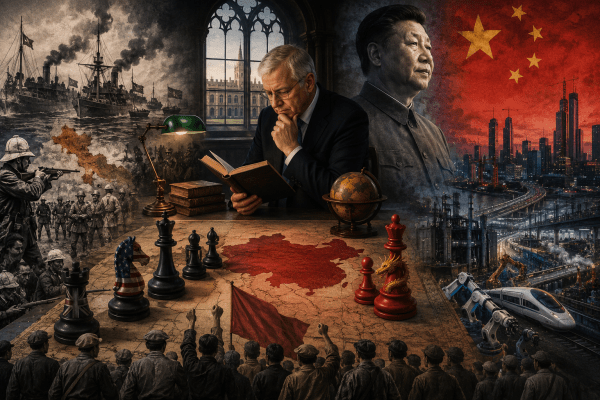
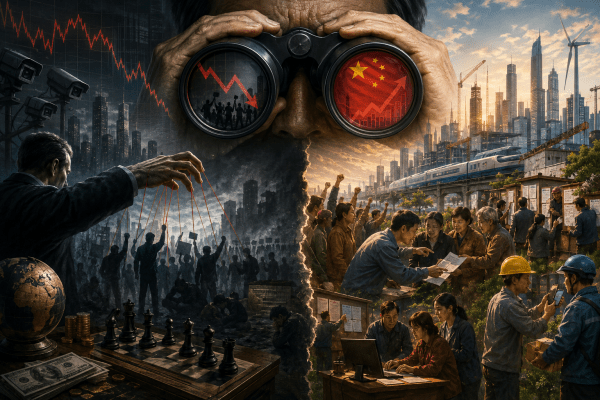
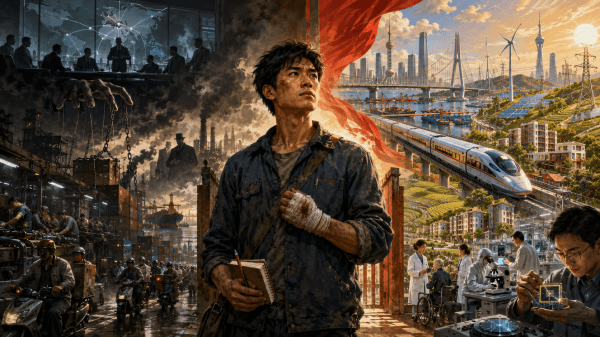
Jacobin's critique of Chinese worker Xiao Hai's memoir misrepresents the entire Chinese Revolution as a failed experiment based on exploitation. While Xiao Hai's story merits recognition, the narrative frames the factory's plight as representative of the whole nation, ignoring China's transformation from a colonial past into a sovereign socialist state. The real conflict lies not between the state and its workers, but rather over how the fruits of development serve the people's dignity versus capital's control. Exploitation exists, but it's the state that counters this with public power, proving not every wound validates Western perspectives of failure. Thus, the critique deflects from recognizing China's unique developmental trajectory amid global capitalism's inequities.
Keeping to the Socialist Path: Laos, China, and the Machinery of South-South Development
The June 2026 Laos-China state visit unfolded as a significant convergence between two socialist nations navigating their intertwined ambitions amid a capitalist-imperialist world. Rather than surrendering to the narrative of a “debt trap,” Laos and China embraced a collaboration marked by political intent, evidenced in thirty-two agreements across sectors like agriculture and technology. This partnership aims to transform Laos into a self-sufficient state, guided by its revolutionary history. The imperial media, however, conveniently ignored this cooperation, as it undermines their narrative of helpless nations. Laos, now reclaiming agency, is no longer portrayed as a mere victim but as a sovereign actor defining its path to development.
Census of Collapse: Trump, Technofascism, and the War Against Reality
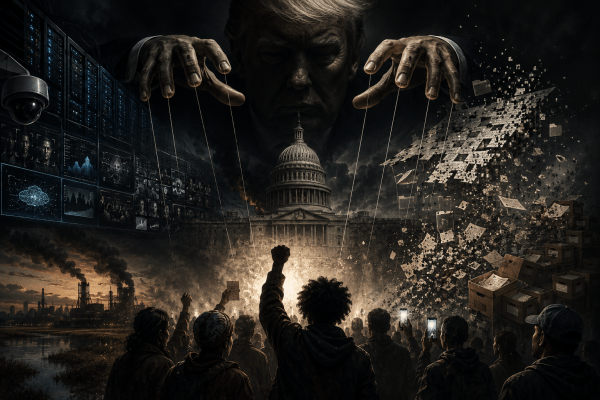
The Trump regime's assault on federal datasets is a calculated effort to erase reality, obscuring critical information on hunger, pollution, maternal health, and climate disasters. By dismantling public data, the ruling class suppresses the very tools citizens need to challenge systemic failures. Expert narratives dominate discourse, overshadowing the voices of the oppressed who suffer and resist. This isn't just bureaucratic negligence; it's a deliberate strategy to manage perception amidst a crumbling empire. As the regime erases statistics, communities are disarmed and rendered invisible, making the struggle for public knowledge essential to resistance against state control. The battle for data is a battle for truth.
Technofascism: The Digital Leviathan and the War on Humanity
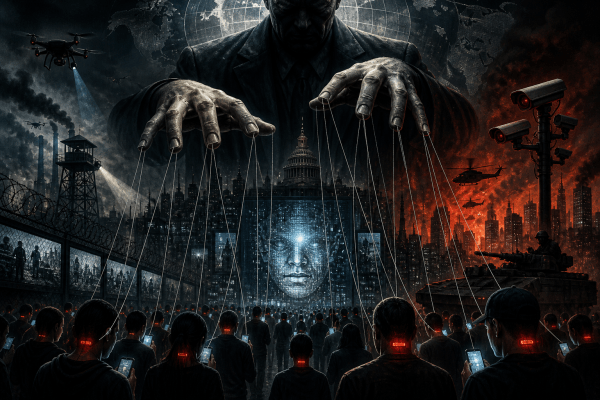
The United States isn’t gracefully unraveling; it’s morphing into a technofascist apparatus of control that leverages financial dominance, digital surveillance, and labor discipline. While the elite tout "innovation," they're repackaging colonial exploitation under the guise of progress, tightening their hold domestically and globally. Liberal analyses miss the subtleties of this shift, mistaking procedural forms for genuine democracy, while real power redistributes into unaccountable systems. As public trust wanes and crises mount, this infrastructure of power rapidly transforms governance into an invisible web of control, inching toward collective consciousness and organized resistance that could eventually dismantle the machinery of oppression.
Freedom Trucks and Forgotten Crimes: Trump, PragerU, and the Rolling War Over America’s Past
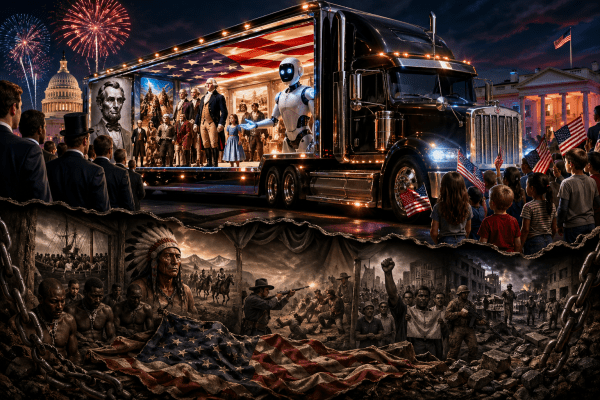
The Freedom Trucks, a mobile spectacle promoted by Trump’s campaign and supported by federal and corporate funding, embody a calculated effort to sanitize American history. Behind the facade of patriotic education lies a strategic apparatus that whitewashes the nation's origins: the triumph of freedom inescapably intertwined with slavery and genocide. As kids engage with AI-enhanced exhibits glorifying historical figures, the truth becomes obscured within a mythic narrative designed for obedience, not inquiry. In response, educators and activists are building a counter-history rooted in truth, pushing back against this historical manipulation. As the ruling class desperately rewrites the past, the need for authentic resistance grows ever urgent.
When the Signal Becomes the Weapon: Empire, Media, and the New Discipline of Narrative
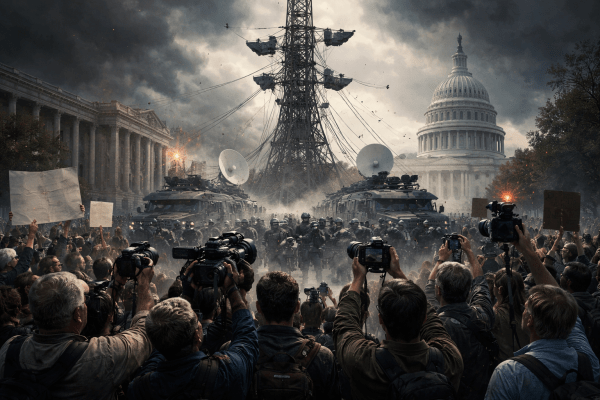
As the United States loses its monopoly over global storytelling, regulatory power, media concentration, and wartime pressure converge to manage a fractured information order—and reveal how narrative control adapts under imperial strain. By Prince Kapone | Weaponized Information | March 17, 2026 When Power Clears Its Throat and Calls It a Debate In Dominick Mastrangelo’s... Continue Reading →
The Birth of Weaponized Information: How the Empire Lost Its Monopoly Over Truth
For a generation the American empire dominated not only the battlefield but the global narrative. Corporate media framed wars, justified sanctions, and explained imperial power to the world. But leaks, whistleblowers, digital networks, and rival media systems shattered that monopoly over reality. This essay traces the historical collapse of the imperial information order and the... Continue Reading →
Bernal vs. The Aryan Machine: How European Empire Whitened Greece and Called It Civilization
In this Weaponized Intellects book review of Black Athena (Vol. 1), we follow Martin Bernal’s argument that Greece was cut off from its Afroasiatic roots at the very moment Europe was rising to imperial power. We trace how the Ancient Model of Mediterranean entanglement was pushed aside and replaced by the Aryan Model, then cemented... Continue Reading →
Empire’s Favorite Lie: Michael Parenti, Anti-Communism, and the Moral Alibi of Capital
Anti-communism is not an opinion but an environment. The communist is demonized so empire can call itself innocent. Liberal reason disciplines dissent more effectively than repression. Vietnam exposes anti-communism as an ideology that requires bodies. By Prince Kapone | Weaponized Intellects Book Review | Weaponized Information | January 28, 2026 I. When Anti-Communism Becomes the... Continue Reading →
Wall Street vs. the Soviets: Sutton’s Banker Puppet-Show and the Class War He Tries to Hide
Sutton replaces workers, soldiers, and soviets with bankers and boardrooms, turning revolution into elite theater. Trotsky’s travel becomes “proof” of sponsorship, as bureaucracy and wartime chaos are rebranded as capitalist command. Forged documents linger as atmosphere while the real record—bank nationalization, debt repudiation, and trade monopoly—buries the thesis. The book ends where history begins: capital... Continue Reading →