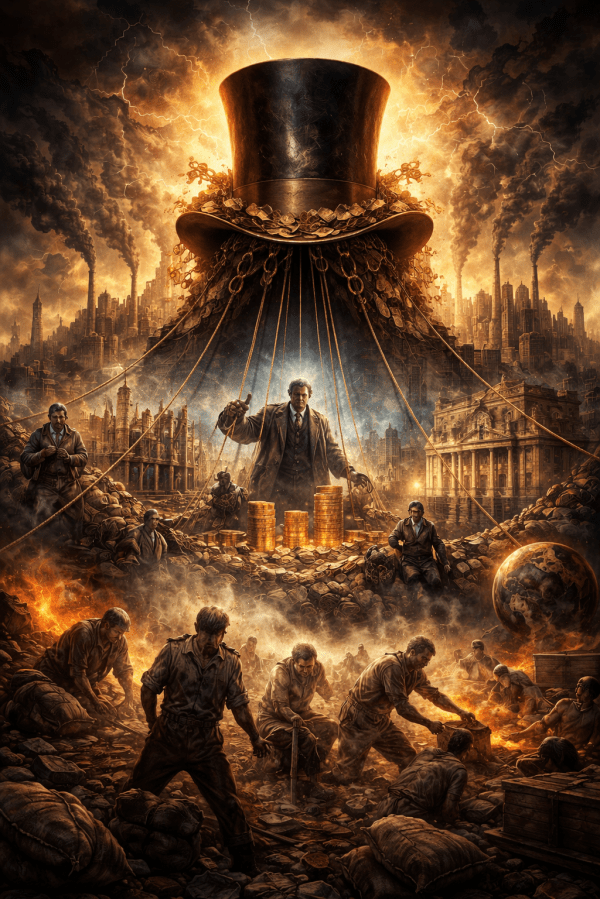
Naomi Klein and Astra Taylor's exploration reveals a chilling reality: a ruling class now reconciled with catastrophe, believing individual salvation lies in their wealth's capacity to buy security. Their book dissects the convergence of Big Tech, military might, and the capitalist state—a recipe for "technofascism" that shapes survival into a privilege reserved for the elite. As apocalyptic ideologies morph into a rationale for inequality, they argue against passive acceptance of a world where privilege fortifies walls while others suffocate outside. True resistance lies not in mere survival, but in collective power that demands ownership of the systems and resources shaping our future.
The Debtor Became the Banker: How America Learned to Rule the World by Owing It Money
Michael Hudson's "Super Imperialism" reveals capitalism's peculiar twist: the U.S. transitioned from a great creditor to a dominant debtor, utilizing its debts as leverage in a world where power dynamics are shifting. Post-World War I, American financial institutions crafted a system that exploited other nations through debt, claiming to promote development while actually enforcing dependency. The contradiction lies in the U.S. controlling the world's currency even as its productive supremacy fades. As the global landscape evolves, the implications of dollar dominance become increasingly tenuous, demanding us to confront a crucial question—who ultimately commands the productive forces that money can influence but not generate?
The Nerd Reich Wanted to Exit the State: Then Capital Learned It Needed the Machinery
Gil Durán's "The Nerd Reich" provocatively dissects the tech elite's evolution from libertarian ideals to an authoritarian grasp on power. Far from escaping state oversight, Silicon Valley's billionaires, like Peter Thiel, reveal a dark shift: they now seek to enhance governmental control while championing the illusion of individual freedom. Durán labels this new reality "tech fascism," where technology conglomerates and capital intertwine with state apparatus. As these technocrats consolidate power, a crucial question emerges: can humanity reclaim technologically wielded potential, or will it remain enslaved by elite ownership? This critical inquiry forebodes a future dominated by private interests rather than collective governance.
We Built the Master: Marx and the World That Rules Its Makers
In the Economic and Philosophic Manuscripts of 1844, Marx discovers a contradiction that will haunt the whole development of his critique of capitalism: workers build an expanding world of wealth, machinery, knowledge and social power that returns to rule them as capital. This review follows that insight from wages and estranged labour through private property, colonial history, slavery, money, communism, Hegel and revolutionary humanism. It argues that the manuscripts are neither immature philosophy nor finished Marxism, but a breakthrough under pressure—one already forcing “Man” into history and asking the question that still matters: who controls humanity’s accumulated powers?
Marx and Engels Against Their Own Ghosts: The German Ideology and the Fight to Keep Materialism Inside History
Marx and Engels' The German Ideology brutally uncovers the egregious folly of detaching philosophy from material conditions. They weaponize critiques of German idealists, exposing how revolutionary thought that ignores the tangible, lived experiences of class struggle morphs into mere ideology. Highlighting the perils of alienation, they assert that human powers can unwittingly turn oppressive when subjected to capitalist structures. Moreover, they admonish socialists who, by elevating abstract ideas above real movements, dilute the revolutionary essence of their theories. In a world increasingly interlinked yet profoundly unequal, their insistence on rooting ideas in concrete history remains a clarion call for genuine transformation against ideological hauntings.
The Market Came Armed: Sven Beckert and the World Capital Built by Conquest
Sven Beckert demolishes capitalism’s favorite myth: that it emerged from free markets, innovation, and peaceful exchange. His global history shows a system built through conquest, slavery, colonial dispossession, state power, coerced labor, and repeated counterrevolution. Yet Beckert repeatedly turns rebellions, socialist revolutions, and anticolonial victories into episodes in capitalism’s adaptation. This review seizes his historical arsenal while rejecting that retreat, arguing that a world made through organized class and colonial power can be remade only through the organized power of workers and oppressed peoples.
Capital Unmasked: How Exploitation Disappears While Domination Deepens
This Weaponized Intellects review of Capital, Volume III is the third strike in our front-to-back reconstruction of Marx’s trilogy. If you haven’t read the first two reviews, start there:Capital as Crime Scene: How Marx Dissects the Social Machinery of Exploitation — Volume ICapital Never Rests: Karl Marx’s Capital, Volume II and the Circulation of Exploitation... Continue Reading →
Capital as Crime Scene: How Marx Dissects the Social Machinery of Exploitation
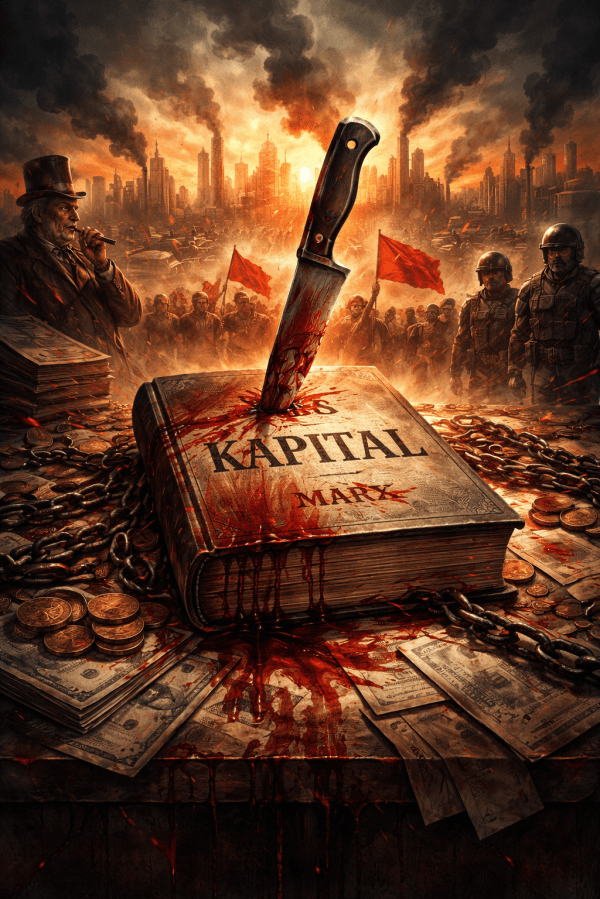
A Weaponized Intellects reconstruction of Capital that follows Marx’s dialectical knife from the commodity to the state, exposing capitalism not as a flawed system in need of reform, but as a coherent social order built on abstraction, dispossession, and organized domination—and reclaiming Marx’s method as a weapon for the global working class and colonized nations.... Continue Reading →
“The Philosopher of the Master Class” — Why Losurdo’s Nietzsche Matters Now
A review of Nietzsche: The Aristocratic Rebel by Domenico Losurdo — a ruthless excavation of Europe’s most reactionary philosopher. Losurdo drags Nietzsche out of myth and into history, exposing his war on equality as the moral software of empire. Our review reads Losurdo as a weapon: a guide for revolutionaries to unmask how Nietzsche’s aristocratic... Continue Reading →
Reparations or Nothing: Penny Hess and the Death of Western Marxism
Weaponized Intellects Review of Overturning the Culture of ViolenceBy Prince Kapone | Weaponized Information | September 21, 2025Turning the World Right Side UpPenny Hess’s Overturning the Culture of Violence does not mince words—it announces from the opening lines that neutrality is treason. Hess follows the leadership of Omali Yeshitela and the African People’s Socialist Party,... Continue Reading →