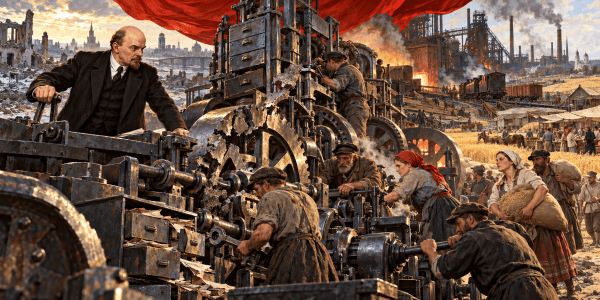
On March 27, 1922, Lenin laid bare the haunting reality: the very Communists who seized power found themselves ensnared by its apparatus. This stark confession at the Eleventh Party Congress revealed a party entangled in bureaucratic paralysis while popular hunger and dissatisfaction grew. Lenin's urgent demand for practical economic leadership served as a clarion call to reconnect with the peasant workforce crucial for reconstruction. He confronted the failure to actualize revolutionary ideals, asserting that maintaining authority required genuine engagement with people’s needs. In essence, he challenged the Bolshevik leadership: Could they transform power into effectiveness before disillusionment turned into revolt? The stakes were sky-high, a failure to adapt would be their undoing.
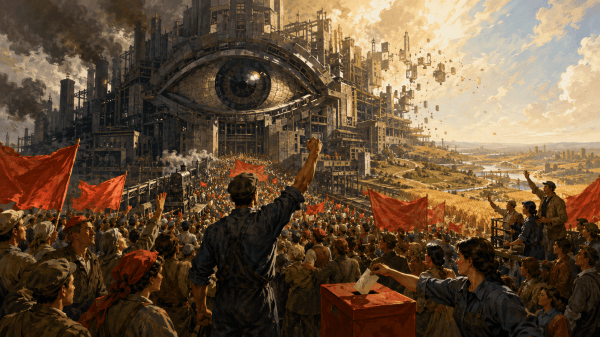
Big Brother, Meet the Working Class: Who Actually Rules Under Socialism?
Capitalist democracy, while appearing politically equitable, safeguards bourgeois interests by leaving the means of production in elite hands. The proletarian revolution aims to dismantle this class dominance, yet it often gives rise to a new set of tensions within the ruling apparatus. Historical examples from Lenin's Soviet Union to Mao's China show that the transfer of power must be constantly defended against bureaucratic detachment. Yugoslavia's self-management experiment illustrates the struggle for genuine worker control, revealing that even radical reforms can’t bridge gaps between individual workplace democracy and broader economic coordination. Ultimately, socialism must evolve toward a society where its ruling structures diminish as proletarian power matures.
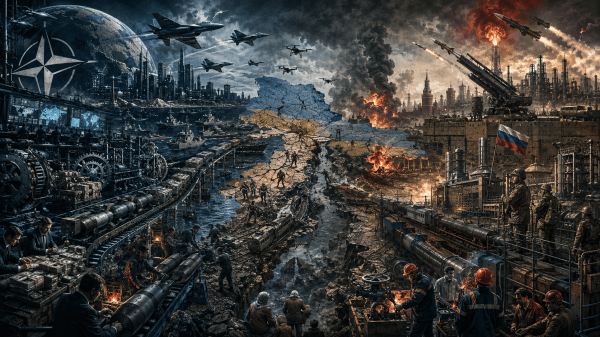
Primacy Produced the Resistance: How the Atlantic Order Turned Russian Sovereignty Into a Threat
The Economist’s recent piece on Putin frames him as a cornered gangster, obscuring the complex geopolitical history that shapes the current conflict in Ukraine. It reduces a crisis rooted in thirty-five years of U.S.-led strategy, NATO expansion, and Russia's own capitalist evolution to Putin’s psychological profile. This overlooks how pre-existing economic and military pressures prepared the battlefield for escalation. By ignoring this context, the narrative becomes dangerously simplistic, presenting Russia's actions as mere reactions to outside threats, not as part of a larger historical clash of powers. The truth? This war is as much about systemic tensions as individual leaders.