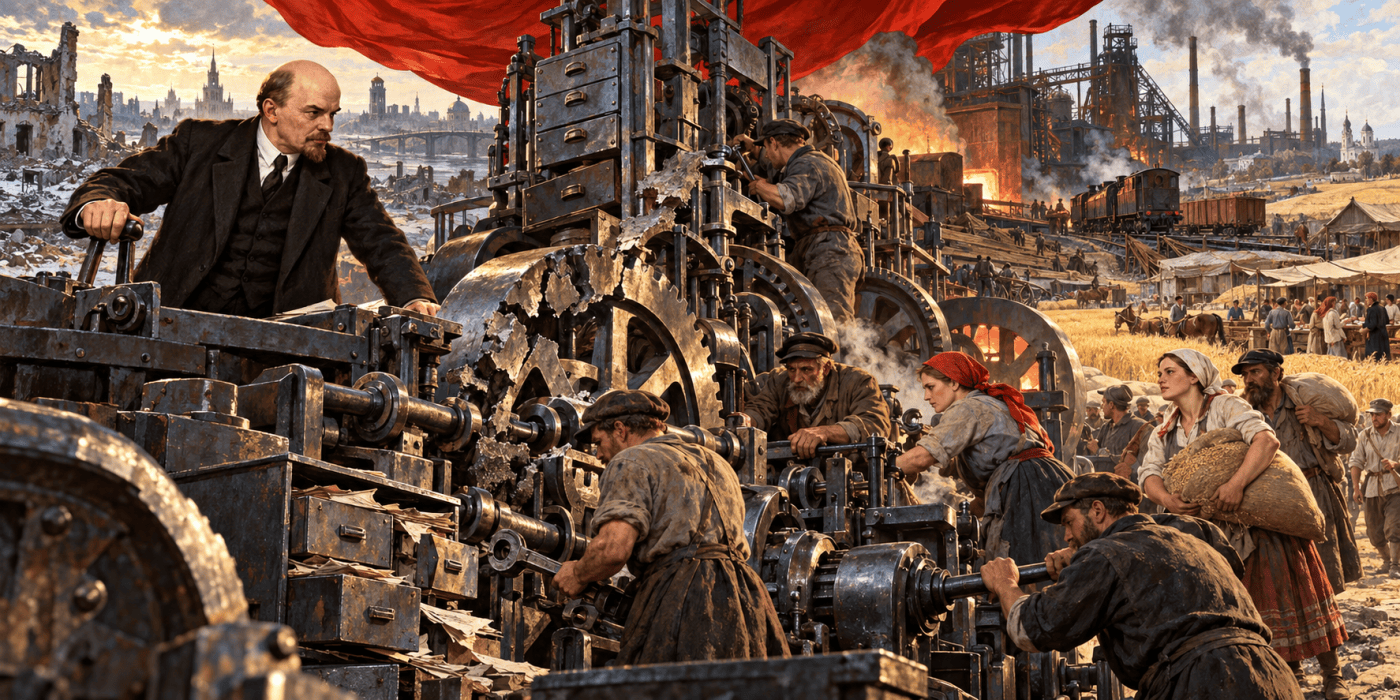
On March 27, 1922, Lenin confronted the Eleventh Party Congress with a brutal admission: Communists held state power, yet the apparatus could direct them. This Weaponized Statecraft excavation follows his attempt to turn revolutionary authority into practical economic leadership amid hunger, market retreat, and imperial pressure. Through his own words, it examines the struggle to rebuild the worker–peasant alliance, master administration, and give producers effective influence over officials governing in their name. The stakes reached beyond keeping the government alive: who would command reconstruction, and whose interests would it serve?
Prince Kapone | Weaponized Information | Weaponized Statecraft Series | October 15, 2026
I. The State They Held
Lenin stood before the Eleventh Party Congress on March 27, 1922, and drove a wedge into the comfortable assumption that conquering power meant knowing how to wield it. The Bolsheviks had broken the bourgeoisie’s political rule and organized the defence of the revolution. Reconstruction now demanded abilities that victory in war could not automatically supply. A Communist could take the chair, sign the order, and still discover that the machinery beneath him moved according to somebody else’s priorities.
“The state in this society is not ruled by the bourgeoisie, but by the proletariat. We refuse to understand that when we say ‘state’ we mean ourselves, the proletariat, the vanguard of the working class.”
Lenin brought the passage down to five words: “We are the state.” These words appear in his political report, inside the discussion of state capitalism. The revolution had wrested government from the exploiting class and acquired the political authority to set boundaries on the capitalist relations it now permitted. But authority carried a burden that revolutionary credentials couldn’t discharge. Lenin followed his declaration with an admission sharp enough to cut through the Congress’s self-assurance:
“State capitalism is capitalism that we must confine within certain bounds; but we have not yet learned to confine it within those bounds. That is the whole point.”
Lenin, “Political Report of the Central Committee of the R.C.P.(B.),” March 27, 1922, Collected Works, vol. 33, pp. 278–279.
The two statements belong together. The conquest of power had changed which class could determine the country’s direction. It hadn’t instantly supplied the knowledge, institutions, or economic relations through which that direction could become everyday practice. Confusing those achievements would turn a genuine revolutionary victory into an excuse for refusing the next struggle.
After a year of the New Economic Policy, Lenin demanded that the Party look at the results:
“Well, we have lived through a year, the state is in our hands; but has it operated the New Economic Policy in the way we wanted in this past year? No. But we refuse to admit that it did not operate in the way we wanted. How did it operate? The machine refused to obey the hand that guided it.”
Lenin, “Political Report,” p. 279.
The sting lies in that refusal to admit failure. A leadership could mistake the issuing of commands for evidence of their fulfilment. Whoever understood the machinery could bend its operation, exploit the leadership’s ignorance, or turn an official’s authority into cover for interests he imagined himself to be controlling. Lenin identified profiteers and private capitalists as possible beneficiaries. Class struggle had entered the office, the account book, and the execution of an apparently routine decision.
Later in the report, he confronted the excuse that the Party simply needed more power. The principal large enterprises and railways were already in its hands. He then turned to the capital, where the concentration of Communist officials should have made control most secure:
“If we take Moscow with its 4,700 Communists in responsible positions, and if we take that huge bureaucratic machine, that gigantic heap, we must ask: who is directing whom? I doubt very much whether it can truthfully be said that the Communists are directing that heap. To tell the truth they are not directing, they are being directed.”
Lenin, “Political Report,” p. 288.
Four thousand seven hundred responsible Communists, by Lenin’s reckoning, and still the question: who directs whom? Political trust could coexist with dependence on officials who knew the business better. Expertise was indispensable. Dependence became dangerous when those possessing it could shape decisions beyond effective political supervision. The defeat of a ruling class didn’t make all its social advantages disappear. Knowledge, connections, managerial habits, and command over information could survive the loss of government and become means of influence inside the new order.
Bettelheim traces the return of former officials and the persistence of bureaucratic methods within Soviet institutions. He also examines the divisions of labour that kept administration distant from producers. Changing the person behind the desk could leave those relations intact. A Party card supplied no immunity against reproducing them. (Bettelheim, Class Struggles in the USSR: First Period, pp. 330–334.)
This was more than a complaint about inefficient officials. The workers’ state confronted the task of making its class direction effective through an apparatus whose operation could resist, dilute, or redirect it. Political power supplied the possibility of transformation; the actual transformation required a struggle over how people worked, who decided, and whose needs organized the economy. The report’s indictment leads straight to the fields and factories: what could this state deliver to the workers and peasants whose sacrifices had made it possible?
II. The Alliance Had to Be Rebuilt in Exchange
Lenin brought the Congress down from the commanding heights of state power to the peasant household, where hunger had no patience for another declaration about the radiant future. The revolution had to connect its socialist purpose to an improvement people could recognize in their own lives:
“We must prove that we can help him and that in this period, when the small peasant is in a state of appalling ruin, impoverishment and starvation, the Communists are really helping him. Either we prove that, or he will send us to the devil. That is absolutely inevitable.”
Lenin, “Political Report,” passage on establishing the connection with the peasant economy.
The peasant appears here as someone capable of judging the government and withdrawing support. A household struggling to feed itself could hardly accept the promise of socialism as payment for grain. The alliance needed an economic life: food moving toward the towns, useful goods moving toward the countryside, and production recovering sufficiently to sustain both.
War had torn those connections apart. Robert Allen records an industrial workforce falling from approximately 2.6 million in 1917 to 1.2 million in 1920. Over those years, cotton-yarn output fell by 93 percent and pig-iron output by 96 percent. These separate series convey the scale of the wreckage. The proletariat exercising political leadership had itself been depleted, while the factories needed to supply the countryside were struggling to survive. (Allen, Farm to Factory, p. 48.)
That depletion sharpened the political problem. The revolution needed an industrial working class capable of leading reconstruction, yet economic collapse had weakened the workplaces around which its collective strength could develop. Rebuilding production would help restore that social foundation. But production depended on food and raw materials from peasants who needed something useful in return. The relationship couldn’t be repaired from either end alone.
Requisitioning helped sustain the army and towns through the Civil War while sharpening conflict with producers whose ability and incentive to sow had been damaged. Drought struck the devastated countryside in 1921, bringing catastrophic famine. Peasant resistance forced a reckoning with the government’s methods. Lenin’s March 1921 assessment acknowledged that requisitioning without adequate knowledge of local possibilities and needs had intensified the agrarian crisis. By the Tenth Congress, he insisted that the existing relationship couldn’t continue. (Bettelheim, First Period, pp. 234–235; Allen, Farm to Factory, p. 48.)
The political warning also came from Kronstadt. The rebels’ published resolution demanded new Soviet elections, freedoms for specified working-class and left political organizations, and greater freedom for peasant production without hired labour. Those demands didn’t make the revolt the voice of all workers or peasants. They showed that armed opposition could challenge the government in the language of revolutionary representation and producers’ needs. The crisis couldn’t be dismissed as a shortage of enthusiasm.
Stalin identified the changing foundation of the alliance in December 1921. During the war, revolutionary power defended the peasants’ land against restoration while peasants supplied food and recruits. Reconstruction required an economic arrangement advantageous to workers and peasants. Without the peasant’s ability to dispose of produce, he warned, declining cultivation and food shortages would undermine industry, transport, the army, and the alliance itself. (Stalin, “The Prospects,” December 18, 1921, Works, vol. 5, p. 99.)
The shared enemy had helped hold together forces with different immediate interests. Once survival depended increasingly on reconstruction, those differences demanded a new practical settlement. The town needed grain; the village needed manufactured goods and room to revive production. Revolutionary leadership had to organize their connection without allowing either immediate extraction or private enrichment to determine the whole relationship.
The Tenth Congress’s turn toward a tax in kind, followed by the expansion of legal trade, opened that route. By March 1922, Lenin insisted that past achievements had bought the Party time, not permanent consent:
“The peasant is allowing us credit, and, of course, after what he has lived through, he cannot do otherwise. Taken in the mass, the peasants go on saying: ‘Well, if you are not able to do it yet, we shall wait; perhaps you will learn.’ But this credit cannot go on for ever.”
Lenin, “Political Report,” passage on peasant credit to the government.
His commercial metaphor turned the government into the debtor. The defeat of the landlords could not indefinitely excuse an inability to relieve present misery. Lenin imagined the peasants presenting the bill:
“You have postponed payment for so many months, so many years. But by this time, dear rulers, you must have learnt the most sound and reliable method of helping us free ourselves from poverty, want, starvation and ruin. You can do it, you have proved it.”
Lenin, “Political Report,” same passage.
That demand governed his call to halt the retreat. He was calling for regrouping within NEP, not announcing its abolition:
“When I speak about halting the retreat I do not mean that we have learned to trade. On the contrary, I am of the opposite opinion.”
Lenin, “Political Report,” passage immediately preceding the account of mixed companies.
The advance would have to move at a pace the population could sustain:
“Link up with the peasant masses, with the rank-and-file working peasants, and begin to move forward immeasurably, infinitely more slowly than we expected, but in such a way that the entire mass will actually move forward with us.”
Lenin, “Political Report,” conclusion to the first political lesson of NEP.
Speed acquired a political meaning. An advance that outran the material participation of the population could undermine the forces needed to sustain it. Slower reconstruction could strengthen revolutionary power if workers and peasants experienced it as their own improvement. But restoring exchange also opened opportunities for merchants and private accumulation. The retreat created room to rebuild the alliance while bringing the struggle over its economic direction into sharper focus.
III. Learn to Trade, Preserve Direction
The merchant approaching the village needed no lecture on historical materialism. He needed goods to sell, knowledge of the market, and a price that left something in his pocket. His transaction could accomplish what a Communist’s speech could only promise: put something useful into the peasant’s hands. Lenin dragged this encounter into the Congress because the revolution’s future depended partly on who could organize it:
“We must win the competition against the ordinary shop assistant, the ordinary capitalist, the merchant, who will go to the peasant without arguing about communism.”
Lenin, “Political Report,” discussion of the second lesson of NEP.
The merchant’s advantage was practical. He could purchase, transport, calculate, and sell. Communists who despised his class position still had to learn the business he understood. Lenin refused to award revolutionary virtue a certificate of economic competence:
“We need a real test. The capitalists are operating along side us. They are operating like robbers; they make profit; but they know how to do things. But you—you are trying to do it in a new way: you make no profit, your principles are communist, your ideals are splendid; they are written out so beautifully that you seem to be saints, that you should go to heaven while you are still alive. But can you get things done?”
Lenin, “Political Report,” same discussion.
A Communist could emerge spotless from an examination of his convictions while the enterprise under his supervision failed the people it existed to serve. Lenin demanded a test conducted through the economy itself. Could revolutionary institutions organize supply effectively enough to prevent the merchant from becoming indispensable?
The stakes exceeded which seller completed a transaction. Whoever reliably connected producers with supplies acquired influence over the terms of exchange. If private commerce alone could make that connection work, the government’s political authority would coexist with dependence on forces accumulating wealth through the relationship. Commercial incompetence could therefore become a channel of class subordination.
Yet abolishing the transaction by decree would not produce the missing goods. The revolution had to learn methods developed under capitalism while changing the purposes and relations through which they operated. This was the hard content of the retreat: employing capacities it did not yet possess without allowing dependence on their existing bearers to govern the transition.
Lenin specified the different ends toward which apparently similar activities could be directed:
“The capitalists create an economic link with the peasants in order to amass wealth; you must create a link with peasant economy in order to strengthen the economic power of our proletarian state.”
Lenin, “Political Report,” passage beginning “The retreat has come to an end; it is now a matter of regrouping our forces.”
That distinction had to become material. The same commercial form could serve different strategic purposes, but calling an enterprise socialist could not settle how it actually operated. Which investments were made? What happened to the surplus? How did enterprise decisions affect employment, supply, and the relationship between town and country? Public ownership gave revolutionary power a means to direct these questions; it did not answer them automatically.
Allen identifies a concrete limit of enterprise profitability: a firm calculating only its own returns could reject investment whose benefits accrued elsewhere in the economy. The enterprise ledger and reconstruction’s wider requirements could point in different directions. (Allen, Farm to Factory, p. 50.) Bettelheim’s distinction between legal ownership and production relations likewise directs attention toward the work required to turn ownership into social direction over labour, resources, and surplus. (Bettelheim, First Period, pp. 139–140.)
Lenin’s state capitalism was therefore a strategic relation to be constructed under specific conditions. The revolution would permit and employ capitalist activity while struggling to contain its reach. Mixed companies involving Communists and Russian or foreign capitalists offered opportunities to learn, but Lenin described the initial experience as reconnaissance. Agreements created an arena in which the struggle could proceed. They didn’t certify that the Communists controlled its outcome.
Ustryalov understood that those outcomes might favour the defeated class. In Lenin’s account, the émigré supported Soviet power because economic accommodation might gradually transform it into an ordinary bourgeois state. Lenin welcomed the candour:
“We must say frankly that the things Ustryalov speaks about are possible. History knows all sorts of metamorphoses. Relying on firmness of convictions, loyalty, and other splendid moral qualities is anything but a serious attitude in politics.”
Lenin, “Political Report,” discussion of Smena Vekh and Ustryalov.
The danger was a change in the relations that Communist authority presided over. Officials could continue speaking the language of revolution while economic practice strengthened another direction. Lenin treated that possibility as a reason for struggle:
“The enemy is speaking the class truth and is pointing to the danger that confronts us, and which the enemy is striving to make inevitable.”
Lenin, “Political Report,” same discussion.
The enemy’s hope was neither an accomplished restoration nor a prophecy. It identified a tendency that practical revolutionary policy had to defeat. Learning commerce would help only if the knowledge became a means of directing reconstruction toward the producers’ collective development. That required institutions capable of carrying political purposes through the work.
IV. Authority Had to Become Execution
A starving city, a cargo of canned meat, and a seller willing to accept Soviet currency: somehow, the purchase required the attention of the Bolshevik leadership. Lenin brought this affair before the Congress because an ordinary transaction had become an extraordinary political undertaking. Kamenev and Krasin eventually helped settle it. Their intervention was the indictment:
“But Kamenev, a member of the Political Bureau, and Krasin—the latter is busy with diplomatic affairs connected with Genoa, affairs which have entailed an enormous, an excessive amount of labour—cannot be dragged into every transaction, dragged into the business of buying canned goods from a French citizen. That is not the way to work. This is not new, not economic, and not a policy, but sheer mockery.”
Lenin, “Political Report,” first practical example of administration.
The transaction succeeded by consuming the attention of people responsible for much larger affairs. Repeat that arrangement across an economy and the summit becomes a clearinghouse for disputes that responsible officials should settle themselves. Every minor decision travels upward; responsibility disappears along the way. A government can become overwhelmed by its own supposed centralization.
Lenin’s investigation found responsible Communists quarrelling, including one who would no longer speak to another without a lawyer present. While Moscow needed food, the officials had developed an impressive capacity to defend their positions against one another. The meat required purchasing; the machinery produced a case file.
This dependence on exceptional intervention could reproduce the weakness it temporarily overcame. If senior leaders repeatedly rescued routine work, departments could remain unable or unwilling to perform it. The resulting congestion then made higher authority less capable of attending to strategic questions. Concentrating decisions at the summit could weaken effective central direction.
The Donets Basin illustrated why some questions did require concentrated leadership. Coal production was fundamental to reconstruction. According to Lenin, the Central Committee instructed that capable leaders remain in place and that conflicts be reported. Yet the group was replaced. He also criticized excessive administrative zeal among the managers themselves. Authority at the centre and command within an enterprise had both failed to secure the relationships necessary for the work:
“The task is to learn to organise the work properly, not to lag behind, to remove friction in time, not to separate administration from politics. For our administration and our politics rest on the ability of the entire vanguard to maintain contact with the entire mass of the proletariat and with the entire mass of the peasantry.”
Lenin, “Political Report,” Donets Basin example.
Lenin’s criticism was political precisely because it concerned execution. Coal left unproduced weakened transport and industry; failed supply weakened the alliance. A dispute over personnel could obstruct a whole chain of reconstruction. The answer required capable people, defined responsibilities, and knowledge of what happened after a decision.
“In connection with NEP some people are beginning to fuss around, proposing to reorganise our government departments and to form new ones. All this is pernicious twaddle. In the present situation the key feature is people, the proper choice of people.”
Lenin, “Political Report,” concluding discussion of personnel and practical control.
A new department could inherit the old incompetence with fresh stationery. Revolutionary service deserved recognition, but it couldn’t qualify a person for every industrial or commercial assignment:
“The key feature is that we have not got the right men in the right places; that responsible Communists who acquitted themselves magnificently during the revolution have been given commercial and industrial functions about which they know nothing; and they prevent us from seeing the truth, for rogues and rascals hide magnificently behind their backs. The trouble is that we have no such thing as practical control of how things have been done.”
Lenin, “Political Report,” Collected Works, vol. 33, p. 303.
The honest Communist could become the dishonest operator’s best protection. His reputation might secure confidence in an institution whose business he could neither understand nor supervise. Political loyalty had to acquire practical knowledge or risk becoming a screen against scrutiny.
That knowledge couldn’t be assembled exclusively inside the Party:
“The idea of building communist society exclusively with the hands of the Communists is childish, absolutely childish. We Communists are but a drop in the ocean, a drop in the ocean of the people.”
Lenin, “Political Report,” passage preceding the administrative examples.
Specialists had to contribute their skills, and administrators had to learn enough to direct and evaluate their work. Otherwise, supervision would consist of signing documents prepared by people who controlled the relevant knowledge. The task was to reduce that dependence through learning while preserving the expertise reconstruction required.
Lenin’s April 11 deputy-chairmen draft developed the mechanism through delegated responsibility, inspection, and reporting. Written in 1922 and first published in 1928, it records a proposed correction rather than proof of uniform execution. The personnel problem remained visible in Stalin’s 1923 organizational report: of 700 cadres mobilized since the preceding Congress, receiving districts judged approximately 300 suitable. The Party could transfer people more readily than it could guarantee their fitness for the assignment. (Lenin, Collected Works, vol. 33, pp. 335–343; Stalin, Works, vol. 5, p. 174.)
Selection and inspection could improve administration. Their effectiveness depended on the knowledge and conduct of the selectors and inspectors. When those officials made mistakes, the producers experiencing the consequences needed ways to make correction unavoidable. Lenin’s programme thus led into a question its administrative instruments could not settle by themselves.
V. Who Could Correct the Commanders?
An official might understand his business and still shut workers out of decisions governing their lives. An inspector might expose failures below while leaving his own superiors untouched. Practical competence and proletarian influence were connected achievements, but one could develop without the other. An efficient enterprise could still train workers to obey while reserving judgment for those above them.
Lenin supplied the political standard:
“In the sea of people we are after all but a drop in the ocean, and we can administer only when we express correctly what the people are conscious of. Unless we do this the Communist Party will not lead the proletariat, the proletariat will not lead the masses, and the whole machine will collapse.”
Lenin, “Political Report,” concluding discussion of practical administration.
The Party’s leading role required a relationship through which workers’ experience could shape decisions. If their knowledge reached officials only after being filtered into an acceptable report, leadership could lose the information needed to lead. If workers learned that initiative meant carrying out instructions while criticism brought punishment, the apparatus could suppress capacities reconstruction urgently needed.
The Workers’ Opposition pressed on that danger. Rooted in trade-union activity, with footholds in industrial Party organizations including Moscow and the Donets Basin, it remained a minority within the Party. Its position was not the undivided will of the working class. Its base nevertheless gave substance to its challenge over who would build the new economy. (Bettelheim, First Period, pp. 388–389.)
Kollontai stated the demand:
“The workers’ unions must be drawn from the present position of passive assistance to the economic institutions into active participation in the management of the entire economic structure.”
Kollontai, The Workers’ Opposition, chapter II, section 2, quoting the opposition’s theses.
Her programme went beyond distributing separate factories to their individual workforces. It envisaged a national organization of producers coordinating economic direction. Kollontai retained technical specialists and envisaged preparation for transferring responsibilities. Workers would acquire governing capacity through exercising and developing it, rather than waiting indefinitely for administrators to declare them ready. (Kollontai, The Workers’ Opposition, chapter II, sections 7–8.)
This exposed a genuine limit in an approach resting mainly on better appointments. Workers’ power could not mature if the practices of administration continually reproduced their exclusion. But locating revolutionary capacity among producers did not establish that their proposed institutions could coordinate the damaged economy, reconcile sectoral demands, or maintain the peasant connection. The programme’s strongest insight did not prove the adequacy of its entire settlement.
Lenin answered through the requirements of retreat:
“The Workers’ Opposition said: ‘You are underrating the workers; the workers should display greater initiative.’ But initiative had to be displayed then by retreating in good order and by maintaining strict discipline.”
Lenin, “Political Report,” discussion of the decisive tasks of 1921.
Coordination mattered because the economy was interdependent. A decision satisfactory to one industrial body could impose costs elsewhere; workers’ immediate demands and peasant producers’ needs could pull in different directions. The Party’s strategic responsibility extended across those relations. Fragmentation could destroy the collective power through which any workplace gains might endure.
Yet the need for coordination could also become a defence against correction. Officials could identify their own decisions with revolutionary necessity and classify resistance as a threat to unity. Concentrated leadership then risked weakening the initiative and knowledge on which effective leadership depended. The contradiction ran through the means of reconstruction themselves.
The Twenty-Two’s appeal alleged imposed appointments, pressure on dissenting workers, and weakened Party connections to its working-class base. These participants sought intervention from the Communist International against practices they challenged. Their allegations require examination, but the appeal itself demonstrates an attempt to activate a corrective channel beyond the immediate hierarchy. Democratic Centralist criticism of concentrated authority and weakened collegiality addressed related dangers; the surviving evidence used here does not establish their complete March 1922 programme. (Bettelheim, First Period, pp. 384–387.)
Lenin’s January trade-union theses recognized conflicts between workers and state-enterprise management. They assigned unions protective and participatory functions while maintaining managerial authority and Party leadership. Workers’ grievances couldn’t be dismissed as grievances against themselves because the enterprise belonged to the workers’ state. The contradiction had to be worked through inside that state’s institutions.
The Party also attempted correction through its membership purge. Lenin’s June 1921 purge proposals required questioning Party and non-Party workers familiar with members under examination, including officials and people holding privileged posts. Workplace knowledge could expose what an administrative endorsement concealed. But consultation became effective only where that knowledge could affect the decision; a prescribed hearing alone supplied no guarantee.
Discipline sharpened the stakes. In his March 28 reply to Shlyapnikov, Lenin clarified:
“What I had in mind was Party disciplinary measures, and not machine-guns as such.”
Lenin, “Reply to the Discussion on the Political Report,” March 28, 1922.
That distinction cannot honestly be converted into a threat to machine-gun Shlyapnikov. Nor can it erase the report’s threat against external opponents:
“For the public manifestations of Menshevism our revolutionary courts must pass the death sentence, otherwise they are not our courts, but God knows what.”
Lenin, “Political Report,” discussion of discipline during retreat.
Lenin separated economic concessions from political freedom for forces he regarded as serving counterrevolution. His position must be understood through the struggle to preserve revolutionary power without treating every restriction as self-evidently necessary. The April 2 Congress resolution warned Shlyapnikov, Medvedev, and Kollontai about future expulsion; it did not expel them. It distinguished appeal to the International from continued factional organization. The earlier faction prohibition nevertheless restricted the collective organization of criticism without establishing an automatic expiry.
The question was how revolutionary power could preserve coordinated action while developing the producers’ ability to correct its direction. Foreign military pressure made fragmentation more dangerous and mistakes more costly. That pressure strengthened the demand for unity without abolishing the need for criticism capable of reaching those who commanded.
VI. Reconstruction Under Foreign Pressure
Lenin’s programme rested on a condition the Soviet government could labour for but never guarantee:
“The first condition is that there shall be no intervention. We are doing all we can in the diplomatic field to avoid it; nevertheless, it may occur any day. We must really be on the alert, and we must agree to make certain big sacrifices for the sake of the Red Army, within definite limits, of course.”
Lenin, “Political Report,” concluding conditions for reconstruction.
Factories needed what defence would devour. Peasants needed relief from burdens that another invasion would pile higher. And in the Far East, the Japanese army had not gone home. On March 9, 1922, the British Under-Secretary of State for Foreign Affairs, Cecil Harmsworth, stood in the Commons and admitted what could not be hidden: “Vladivostok and the surrounding zone are in the occupation of Japanese forces.” He added, with the serene confidence of an empire that has never had to live under occupation, that His Majesty’s Government was satisfied with Japanese assurances of withdrawal. (British House of Commons, March 9, 1922, Hansard, vol. 151, col. 1473.)
So the pressure wasn’t a rumour. It was a boot on the soil, a fleet in the bay, a budget line that armed the guards while the towns went hungry. Imperial pressure walked straight into the domestic economy — into labour, food, transport, finance — and demanded its cut. The revolution had to defend the ground on which reconstruction could even begin, knowing that every rouble sent to the Red Army was a rouble not sent to the village. Lenin called for sacrifice, yes, but sacrifice with a limit, because a workers’ state that eats its own society to feed its army will not have a society left to defend.
Two days after the report, Trotsky rose before the same Congress and made the demand concrete. He quoted Lenin’s formula back to the hall — “Comrade Lenin said here that we must make sacrifices for the Red Army, but strictly defined ones. That is a correct view. We are poor.” — and then laid out the real scandal. The army had been funded by improvisation since 1918: given what it needed when it needed it, stripped when something else seemed more urgent, given again, stripped again. No plan, no stability, no way to train or build. A firm size and a firm budget, he insisted: “The army must be matched with the military budget and the military budget with the army.” He would rather have “a very considerable reduction in the army, but with a firm budget” than the present size with an undefined one. (Trotsky, “Report to the Eleventh Congress of the R.C.P.(B.),” March 29, 1922, in The Military Writings of Leon Trotsky, vol. 4.)
And then Trotsky put his finger on a wound Lenin had already opened. The army was being eaten alive by guard duties — Red Army men detached for months to watch over freight and government property, their units dissolving behind them. “A Red Army man costs the state too much in the role of a mere watchman.” Here was the same disease Lenin had diagnosed in the civilian apparatus, wearing a uniform: resources formally committed to one purpose, quietly consumed by another, and no one at the top able to see it because no one was tracking what happened after the order was signed. Trotsky’s answer — small, specialized escort teams, guard duties cut to the bone — wast a military reform. It was a demand for the same thing Lenin demanded in the economy: practical control. (Trotsky, “Report to the Eleventh Congress.”)
The immediate threat was military. The longer struggle was diplomatic, and here Lenin moved with the cold eye of a man who had studied his enemies and intended to use their divisions. At Genoa, the Soviet delegation would sit down with capitalist governments whose interests did not perfectly align:
“Needless to say, we are going to Genoa not as Communists, but as merchants. We must trade, and they must trade. We want the trade to benefit us; they want it to benefit them.”
Lenin, “Political Report,” Collected Works, vol. 33, pp. 263–309, opening discussion of the Genoa Conference.
Three currents ran through the bourgeois camp, Lenin noted: those who wanted to wreck the conference, those who wanted it to meet at any cost, and the pacifists of the Second and Two-and-a-Half Internationals, whose fine words would not survive a single honest test. A merchant who can’t tell these currents apart, Lenin said, is a bad merchant. But he was equally clear that Genoa wasn’t the main battlefield. The bourgeois press was inflating the conference “in order to deceive the masses,” and the Party had “made a greater fuss about this subject than it deserves.” The real struggle was at home — in the apparatus, in the factories, in the choice of people. Genoa was a front, not the war. (Lenin, “Political Report,” Collected Works, vol. 33, pp. 263–309.)
None of this meant that agreements were unimportant. Even famine relief required negotiating over authority. The August 1921 ARA agreement was a detailed instrument of negotiated access: the American Relief Administration won freedom to bring in personnel, full liberty of movement, complete freedom in selecting local staff, and unrestricted use of radio, telegraph, telephone, cable, and couriers. The Soviet authorities, for their part, agreed to bear the costs of discharge, handling, loading, and transportation from the ports inland, to provide storage and onward transport, to furnish guards and convoys on demand, and to cover “all expenses of the relief operation” beyond the cost of supplies at port and the direct expenses of American control. Obtaining food meant negotiating how a foreign organization would operate on Soviet territory — and on what terms. Each side reserved the right to suspend or terminate for non-compliance. The agreement wasn’t charity. It was an arrangement between parties who each held a knife. (American Relief Administration and Russian Socialist Federal Soviet Republic, “Agreement, Signed August 20, 1921,” in Papers Relating to the Foreign Relations of the United States, 1921, vol. 2, document 786.)
Rapallo, signed on April 16, opened another route. Articles 1 and 2 waived mutual war claims and compensation for war damages, including requisitions and civilian losses from exceptional measures. Article 3 resumed diplomatic and consular relations immediately. Articles 4 and 5 established most-favoured-nation treatment for commercial and economic relations and committed both governments to cooperate “in a spirit of mutual goodwill in meeting the economic needs of both countries.” Together these widened Soviet room to act without abolishing capitalist hostility. However, this wasn’t a live option in March, when these crucial debates were taking place. (Treaty of Rapallo, April 16, 1922, articles 1–5.)
But read Article 4 closely. The most-favoured-nation principle would “not apply to the privileges and facilities which the Russian Socialist Federal Soviet Republic may grant to a Soviet Republic or to any State which in the past formed part of the former Russian Empire.” The commercial opening was bounded. The Soviet state preserved a distinct sphere within the territory it had inherited, even as it negotiated on capitalist terms outside it. The same logic that governed the foreign-trade monopoly — learn commerce, but don’t let it learn you — was written into the treaty’s structure. (Treaty of Rapallo, article 4.)
Later that year, the foreign-trade dispute tested that boundary directly. Bukharin proposed relaxing the monopoly. Lenin’s response was blunt: relaxation would expose economically weaker Soviet producers to organized foreign capital, and administrative weakness — real as it was — was no reason to dismantle the protection that kept weakness from becoming dependence. Correct the apparatus, yes. But don’t mistake the surgeon’s incompetence for a reason to hand the patient to the vulture. (Lenin, “The Foreign Trade Monopoly,” December 13, 1922, Collected Works, vol. 33, pp. 455–459.)
Foreign pressure neither made every domestic restriction necessary nor left domestic policy free of constraint. It changed the resources, the time, and the risks. Lenin’s intervention sought room to consolidate revolutionary power through reconstruction. The test was whether that room to act could become capacities that strengthened the alliance — or whether it would merely postpone the next emergency.
VII. Recovery Didn’t Resolve Control
The workers’ state had learned to trade without being captured—for now. It had used the forms of the market without surrendering the direction of the economy to those forms. Recovery answered the first question and sharpened the second. Production revived under NEP. The chervonets entered circulation in late November 1922, backed by gold, and for a moment the rouble was a currency rather than a campfire story. Allen records industrial and agricultural output climbing back toward prewar levels later in the decade. (Allen, Farm to Factory, p. 49; Bank of Russia Museum, history of the chervonets, section 2.)
But recovery didn’t resolve the question of direction. It changed its terrain. The crisis of 1921 had been a crisis of want—famine, ruin, the threat of collapse. The crisis of 1923–25 was a crisis of whose recovery it would be. Scarcity had made production urgent. Expanding production then forced the question of the terms on which its products moved between social groups—and those terms were not neutral.
The price scissors exposed the danger. Agricultural produce bought too little industrial merchandise. By October 1923, the ratio of industrial to agricultural prices stood at roughly 323 percent of the 1913 level—a disparity that made the peasant’s grain buy less and less of what he needed. (Strumilin’s calculations, cited in the proceedings of the Thirteenth Party Conference, January 1924.) The figure measures a relative-price relationship, not every household’s welfare, but the pressure on exchange is unmistakable.
Read the scissors as a class question, not a price question. Who bore the cost of industrial recovery? The peasant, whose grain bought less and less of the goods he needed. Who benefited? The state enterprise and the official who ran it, whose accounts looked healthier the more the terms of trade favoured industry. The alliance that had been built in the civil war—the worker and the peasant, the town and the village, the factory and the field—was being strained by the very policy that was supposed to strengthen it.
A state enterprise could seek commercial recovery through prices that burdened the peasants whose purchases it needed. Decisions that looked rational in the enterprise’s own accounts—raising prices, refusing investment whose benefits fell elsewhere—could weaken the worker–peasant alliance on which industrial reconstruction depended. The alliance required coordination across enterprises and social groups, including decisions over who carried the costs of recovery. Restoring the market connection didn’t determine its political content. It determined only that the content would now be fought over.
The fight moved inside the Party. In October 1923, the Declaration of the Forty-Six named the mechanism by which direction had escaped political control: “the party is increasingly splitting into a secretary hierarchy and ‘ordinary people,’ into professional party officials selected from above and the ordinary mass of party members who do not participate in their factional life.” Free discussion within the party had “virtually disappeared”; the “party’s public opinion has been stifled.” The signatories weren’t merely complaining about appointments. They were saying that the Party’s capacity to detect and correct its own failures had been destroyed by the very hierarchy that was supposed to exercise that capacity.
Lenin had seen this coming. In “Better Fewer, But Better”—written in March 1923, as his health collapsed—he proposed not merely better selection but a structural correction: merge the Workers’ and Peasants’ Inspection with the Central Control Commission, select a small number of irreproachable workers and peasants into the CC, test them rigorously, and build “something really exemplary” over years of patient work. “It is better to get good human material in two years, or even in three years, than to work in haste without hope of getting any at all.” The apparatus was not merely defective. The method of correcting it had to be transformed. (Lenin, “Better Fewer, But Better,” March 2, 1923, Collected Works, vol. 33.)
He also extended the problem beyond the apparatus, toward the population’s capacity to participate in socialist construction. His cooperation writings argued that under Soviet conditions the growth of cooperation was identical with the growth of socialism, and that the emphasis now shifted to “peaceful, organisational, ‘cultural’ work.” His nationalities notes confronted administrative practices carrying inherited Great Russian domination despite formal guarantees. Internationalism on the part of the oppressor nation, he wrote, “must consist not only in the observance of the formal equality of nations but even in an inequality of the oppressor nation, the great nation, that must make up for the inequality which obtains in actual practice.” Neither text announced a completed transformation. They identified work through which the social substance of Soviet power had to catch up with its declared purposes.
Then Lenin’s health collapsed. From late 1922 he was increasingly incapacitated; on January 21, 1924, he died. The question of who directs whom didn’t die with him. It passed to a leadership that would answer it differently.
Production conferences offered a practical response. The January 1924 Party Conference—held sixteen days after Lenin’s death, during the Thirteenth Conference, which also conducted the struggle against Trotskyism—promoted meetings involving economic officials, union representatives, and Party and non-Party workers. The proposed arrangement could bring knowledge from the workplace directly against managerial judgment. Workers would participate in identifying production problems and assessing results rather than appearing only as labour to be directed.
But the conferences emerged in the midst of an economic crisis—a sales crisis, wage arrears, strikes and walkouts—and a political crisis. The Trotskyists had come out against the Party leadership, and the conference’s resolution on party building combined calls for “greater intraparty democracy” with the warning that this did not imply “freedom for factions and alignments.” The production conferences were not merely an idealistic experiment in workers’ participation. They were also an instrument for channeling working-class discontent into production rather than politics, and for mobilizing the Party’s base against an opposition that claimed to speak for the working class.
The means of participation confronted the relations it was supposed to change. Bettelheim records resistance from economic bodies and enterprise management. The Fifteenth Party Conference (October 1926) was still insisting on “a form of direct participation by the workers in the organisation of production,” but the resolution was “strongly resisted” by managers who feared a reappearance of workers’ control. The Seventh Trade Union Congress (December 1926) retreated further, stressing that control commissions “must in no case be interpreted as a direct interference in the functions of administrative or economic management.” By April 1928, the Central Committee was still blaming trade-union cadres for the poor organization of the production conferences, the infrequency of their meetings, and the lack of interest shown by many workers. The instrument had not worked. Workers raised problems; managers ignored them. Conferences became formalities. The “really broad strata” stayed away because experience had taught them that participation without power was theater. Administrative correction needed knowledge from producers; administrators could resist the forms through which that knowledge challenged them. The instrument depended on changing relationships that a resolution alone could not transform. (Bettelheim, Class Struggles in the USSR: Second Period, part 3.)
Here the dialectic of the whole period becomes visible. The revolution had solved the crisis of scarcity by learning to trade, to count, and to build. But success in that task produced a new form of the old question. The economy worked; the question was who it worked for. The apparatus functioned; the question was whom it answered to. The Party directed; the question was who directed the Party.
Lenin’s strategic direction was necessary and its institutional realization incomplete. But the incompleteness was not an accident of history or a failure of will. It was the form the contradiction took: a state that had solved the problem of production found itself facing the problem of direction, and the institutions it had built to solve the first problem were not adequate to the second. The production conferences had been an attempt to institutionalize the producers’ capacity to correct the commanders—the question Section V had raised and left open. They failed because the relations they were meant to change resisted the forms through which that change was to be exercised. Recovery strengthened the material basis from which socialist construction could proceed, while creating new struggles over prices, management, accumulation, and participation. The task had advanced; its contradictions had changed. Treating that movement as either complete vindication or proof of original impossibility would erase the historical work still being fought over—the work of making the producers, and not merely their representatives, the directors of the society they had saved.
VIII. The Contradiction Enemy Propaganda Erases
Seven sections have traced a history of struggle: a revolution that seized power without yet knowing how to wield it; a workers’ state that learned commerce from its class enemies while fighting to keep commerce from learning it; a Party that produced its own critics and then struggled to answer them. None of this appears in the enemy’s account. The enemy’s history begins at the grave and works backward. Once the Soviet Union has disappeared, every earlier struggle becomes another symptom of the death supposedly waiting inside October. Recovery postpones the inevitable. Correction proves the original defect. Failure confirms the verdict; achievement buys the accused another few years before sentencing.
Richard Pipes supplies the formula in “The Last Empire.” After listing particular causes of Soviet collapse, he names a decisive cause that supposedly guaranteed destruction: “no matter what it did and no matter what was done to it.” Every choice, every policy, every external attack is subordinated to a destination already fixed. The society’s defeat is made to explain its origins, its development, and the futility of every attempt to change course. This isn’t history. It is a retroactive death sentence dressed as scholarship. Lenin’s intervention exposes exactly what the method removes: conflicting forces, conditional strategies, capacities that could develop, dangers whose realization required a struggle.
Pipes isn’t a neutral scholar who happens to hold certain views. He headed the CIA’s Team B in 1976—the panel convened to challenge the CIA’s own analysts and produce a more belligerent assessment of Soviet capabilities. He served on the White House National Security Council in 1981–83, at the height of the Reagan administration’s second Cold War, as Harvard’s memorial records confirm. Lee Edwards repeated his explanation through the Heritage Foundation, the same institution that supplied policy ammunition to the Reagan and Bush administrations and later to the architects of the “end of history” triumphalism. These are the institutional coordinates of an imperial propaganda apparatus. Pipes wrote within an academic complex whose purpose was to bury the Soviet project. His argument fulfills that purpose. The question of whether he believed it is irrelevant.
A specific documentary distortion shows the method at work. Pipes presents the October 27 press decree as the founding act of Communist press monopoly. The decree itself names only three categories of publications subject to closure—those calling for open resistance, those sowing confusion through “obviously slanderous distortion of facts,” and those calling for “obviously criminal, i.e., criminally punishable acts”—and declares the restrictions temporary, to be repealed “as soon as normal conditions of social life set in.” The coercion was real. The distortion isn’t accidental. It’s the method: use a later outcome to fix the meaning of an earlier, conditional act, as if the door, once opened, could only lead to one room.
Nor can revolutionary criticism discard its own worst documents. Lenin’s March 19, 1922 church-valuables letter isn’t a mere proposal for “ruthless confiscation.” It’s an operational plan: use the famine as a political opportunity, deceive the clergy into believing the removals were suspended, arrest “not less than several dozen” clergy and bourgeois in Shuia, shoot “the very largest number of the most influential and dangerous” of them, and secure the seized wealth to fund Soviet diplomacy at Genoa. Lenin instructed that Trotsky must never appear publicly in connection with the campaign; that the telegram suspending removals “must not be rescinded” because it created the useful impression of vacillation; that a secret party commission should give orders “not in the name of the commission but as an all-soviet and all-party order.” Molotov agreed that same day. The executions followed. This letter doesn’t embarrass the revolution. It records what the revolution, under siege and famine and facing a hostile church hierarchy, decided to do. That decision is part of the history. An account that omits it isn’t an honest account, and an account that presents it as a single regrettable line isn’t much better. The difference between that honesty and the enemy’s method isn’t that one is soft and the other hard. It’s that one can hold the whole record and the other can hold only verdicts.
The deeper issue is what it meant to build socialism after taking power. Lenin refused to confuse the opening of that possibility with its accomplishment:
“But for us, members of the Communist Party, this meant only opening the door. We are now confronted with the task of laying the foundations of socialist economy. Has this been done? No, it has not. We still lack the socialist foundation. Those Communists who imagine that we have it are greatly mistaken.”
Lenin, “Political Report,” passage distinguishing the Soviet state’s historic achievement from its unfinished economic foundation.
Opening the door mattered enormously. Workers and peasants destroyed a ruling order’s political command and defended a government capable of directing resources toward a different future. Without that conquest, the inherited economy would’ve continued to confront them under the authority of their exploiters. With it, they acquired the means to transform their conditions. Those means still had to be learned, organized, and made effective. That’s why Lenin’s call to learn from merchants and specialists can’t be reduced to ideological surrender. The revolution had to acquire capacities formed under the old order because people needed food, production, and exchange before those capacities could be remade on a new basis. Yet acquiring them through existing forms also carried their relations of dependence and command into reconstruction. The retreat was strategically justified by the need to preserve and rebuild revolutionary strength. Its socialist direction depended on whether the permitted relations could be subordinated and transformed.
The Party faced an equally demanding struggle within its own leadership. It had to coordinate interests extending beyond individual workplaces and immediate demands. It also had to develop the producers’ capacity to participate in that coordination. If it treated their initiative chiefly as a disturbance to administration, it could weaken the social force whose leadership gave its authority revolutionary content. If it abandoned coordination to fragmented demands, it could destroy the shared power needed to defend their gains. Neither problem disappeared by declaring one side the whole answer.
Lenin was right to make practical economic leadership the test. The report’s limit lay in the institutional guarantees still missing between a correct demand and its realization. Suitable officials and effective inspection were necessary; they could not by themselves ensure that workers’ knowledge would prevail against a mistaken hierarchy. The opposition identified part of that danger without proving that its own complete settlement could overcome the economic crisis.
The worker–peasant alliance brings these relations together. It had to be reproduced through goods, food, prices, work, and participation. A state that failed to organize those connections would exhaust the credit earned by the revolution. A state that restored them while allowing accumulation and administrative command to acquire independent purposes could face a different erosion of its direction. Socialist construction required building material capacity while transforming who could use it, shape it, and compel its correction.
Lenin’s question—who directs whom?—therefore reaches beyond the competence of a minister. It asks whether the power seized by producers can become their growing capacity to organize social life. The answer could only be fought out through institutions, production, learning, and class struggle. Its possibilities can’t be secured by a revolutionary title deed, and they can’t honestly be buried beneath an obituary written backward.
Bibliography
Primary Intervention and Lenin’s Related Writings
Lenin, Vladimir Ilyich. “Political Report of the Central Committee of the R.C.P.(B.).” March 27, 1922. In Collected Works, vol. 33, pp. 263–309. Moscow: Progress Publishers, 1965.
———. “Reply to the Discussion on the Political Report of the Central Committee of the R.C.P.(B.).” March 28, 1922. In Collected Works, vol. 33, pp. 310–324. Moscow: Progress Publishers, 1965.
———. “Proposals on a Check-Up and Purge of the R.C.P.(B.) Membership.” Written not later than June 21, 1921. In Collected Works, vol. 42, pp. 315–316. Moscow: Progress Publishers, 1977.
———. “The Role and Functions of the Trade Unions Under the New Economic Policy.” Written December 30, 1921–January 4, 1922; adopted by the Central Committee January 12, 1922. In Collected Works, vol. 33. Moscow: Progress Publishers, 1965.
———. “Letter to Molotov for Members of the Politburo concerning the Confiscation of Church Valuables.” March 19, 1922. English translation published in Revelations from the Russian Archives. Library of Congress. Exhibition heading: “Translation of Letter from Lenin.” [Full text consulted, including the operational directives on arrests, executions, deception of the clergy, and the secret party commission. The letter is marked “Top Secret” and includes Molotov’s agreement of the same date.]
———. “Decree on the Functions of the Deputy Chairmen of the Council of People’s Commissars and of the Council of Labour and Defence.” Draft written April 11, 1922; first published 1928. In Collected Works, vol. 33, pp. 335–343. Moscow: Progress Publishers, 1965.
———. “The Foreign Trade Monopoly.” December 13, 1922. In Collected Works, vol. 33, pp. 455–459. Moscow: Progress Publishers, 1965.
———. “The Question of Nationalities or ‘Autonomisation.’” December 30–31, 1922. In Collected Works, vol. 36, pp. 605–611. Moscow: Progress Publishers.
———. “On Co-operation.” January 4 and 6, 1923. In Collected Works, vol. 33, pp. 467–475. Moscow: Progress Publishers, 1965.
———. “How We Should Reorganise the Workers’ and Peasants’ Inspection.” January 23, 1923. In Collected Works, vol. 33, pp. 481–486. Moscow: Progress Publishers, 1965.
———. “Better Fewer, But Better.” March 2, 1923. In Collected Works, vol. 33, pp. 487–502. Moscow: Progress Publishers, 1965.
Contemporary Political Documents and Testimony
Council of People’s Commissars. “Decree on Suppression of Hostile Newspapers.” October 27/November 9, 1917. Reproduced in Robert V. Daniels, ed., A Documentary History of Communism. London: I.B. Tauris, 1985. Online transcription: Marxists Internet Archive. [Consulted in full: Article 1 specifies three categories of publications subject to closure; Article 3 declares the restrictions temporary and subject to repeal “as soon as normal conditions of social life set in.”]
Kollontai, Alexandra. The Workers’ Opposition. 1921. Especially chapter II, “The Trade Unions: Their Role and Problems,” and chapter III, “Bureaucracy and Self-Activity of the Masses.” Online edition: Marxists Internet Archive.
Kronstadt Provisional Revolutionary Committee. “Resolution of the General Meeting of the Crews of the Ships of the First and Second Squadrons.” Adopted March 1, 1921. Published in Izvestia of the Provisional Revolutionary Committee, no. 1, March 3, 1921. Online edition: Marxists Internet Archive.
Russian Communist Party (Bolsheviks). “On Party Unity.” Resolution of the Tenth Party Congress, March 16, 1921. Online edition: Marxists Internet Archive.
———. “Resolution on Certain Members of the Former Workers’ Opposition.” Resolution of the Eleventh Party Congress, April 2, 1922. Online edition: Marxists Internet Archive.
Shlyapnikov, Alexander, and other signatories. “Appeal of the Twenty-Two.” 1922. Reproduced in Eleventh Congress of the R.C.P.(B.): Stenographic Report, pp. 749–750. Moscow, 1961. English translation by Barbara C. Allen. Marxists Internet Archive.
Signatories of the Declaration of the Forty-Six. “Declaration of the Forty-Six.” October 15, 1923. English text reproduced from E. H. Carr, The Interregnum, 1923–1924. Online edition: Marxists Internet Archive.
Stalin, Joseph V. “The Prospects.” December 18, 1921. In Works, vol. 5, pp. 94–102. Moscow: Foreign Languages Publishing House, 1953. Consulted in The Collected Works of Josef Stalin, vol. 5. Iskra Books, 2026.
———. “The Organisational Report of the Central Committee of the R.C.P.(B.).” April 17, 1923. In Works, vol. 5, pp. 162–181. Moscow: Foreign Languages Publishing House, 1953. Consulted in The Collected Works of Josef Stalin, vol. 5. Iskra Books, 2026.
Trotsky, Leon. “Report on the Red Army to the Eleventh Congress of the Russian Communist Party (Bolsheviks).” March 29, 1922. Included in How the Revolution Armed. Online edition: Marxists Internet Archive. [Consulted in full: Trotsky quotes Lenin’s call for “strictly defined” sacrifices, demands a firm budget matched to a firm size, and criticizes the army’s overburdening with guard duties. The report also addresses demobilization, the call-up of young Communists, section-leader training, and a polemic against “unified military doctrine.”]
Diplomatic, Parliamentary, and Institutional Sources
American Relief Administration and Russian Socialist Federal Soviet Republic. “Agreement between the Russian Socialist Federal Soviet Republic and the American Relief Administration.” August 20, 1921. Reproduced in Papers Relating to the Foreign Relations of the United States, 1921, vol. 2, document 786. U.S. Department of State, Office of the Historian. [Consulted in full: Clauses 1–3, 12, 16–17 establish ARA freedoms of movement, personnel selection, and communications; Clauses 4–6, 13(E), 19, 22 establish Soviet transport, storage, and financial obligations; closing paragraph reserves each side’s right to suspend or terminate for non-compliance.]
Bank of Russia Museum. “Путь червонца: листаем страницы истории” [“The Path of the Chervonets: Turning the Pages of History”]. Especially section 2, “Золото или товары” [“Gold or Goods”].
Germany and Russian Socialist Federal Soviet Republic. “Treaty of Rapallo.” April 16, 1922. Articles 1–5. Avalon Project, Yale Law School. [Consulted in full: Article 1–2 waive mutual war claims and compensation for war damages; Article 3 resumes diplomatic and consular relations immediately; Article 4 establishes most-favoured-nation treatment with a reservation excluding privileges granted to Soviet republics or former imperial territories; Article 5 commits both governments to economic cooperation.]
United Kingdom, House of Commons. “Siberia and Saghalien.” Hansard, March 9, 1922, vol. 151, col. 1473. [Consulted in full: Under-Secretary of State for Foreign Affairs Cecil Harmsworth confirms that “Vladivostok and the surrounding zone are in the occupation of Japanese forces” and expresses confidence in Japanese assurances of withdrawal.]
Historical Scholarship
Allen, Robert C. Farm to Factory: A Reinterpretation of the Soviet Industrial Revolution. Princeton, NJ: Princeton University Press, 2003.
Bettelheim, Charles. Class Struggles in the USSR: First Period, 1917–1923. Translated by Brian Pearce. New York and London: Monthly Review Press, 1976. Originally published in French in 1974.
———. Class Struggles in the USSR: Second Period, 1923–1930. Translated by Brian Pearce. New York and London: Monthly Review Press, 1978. Originally published in French in 1977. [Part 3 consulted in full for material on the Fifteenth Party Conference, the Seventh Trade Union Congress, and the April 1928 Central Committee plenum.]
Anti-Communist Texts Examined and Author-Provenance Documentation
Edwards, Lee. “The Collapse of Communism.” Heritage Foundation, June 27, 2014. Originally published in National Review Online.
Harvard University, Department of History. “Harvard Mourns the Loss of Richard Pipes.” May 17, 2018.
Pipes, Richard. “The Last Empire.” Hoover Institution. Adapted from “The Fall of Communism,” in Lee Edwards, ed., The Collapse of Communism. Stanford, CA: Hoover Institution Press, 2000.
Additional Sources Consulted
Note on the Soviet Press Decree. The October 27/November 9, 1917 decree was consulted via the Marxists Internet Archive transcription, with Article 1 (specifying categories of suppression) and Article 3 (declaring temporary character) checked against the original.
Note on the Lenin Church-Valuables Letter. The full English translation was consulted via the Library of Congress Revelations from the Russian Archives exhibition. The letter’s operational directives—on arrests, executions, the deception of the clergy regarding suspension of removals, the secret party commission, and the Genoa rationale—are cited in Section VIII.
Note on the Thirteenth Party Conference and the Price Scissors. The January 1924 conference resolution and Strumilin’s price-index calculations were consulted through the Russian-language record. The conference’s condemnation of the Trotskyist opposition as a “petty-bourgeois deviation” and its resolution “On the Results of the Discussion” are cited in Section VII.


Leave a Reply