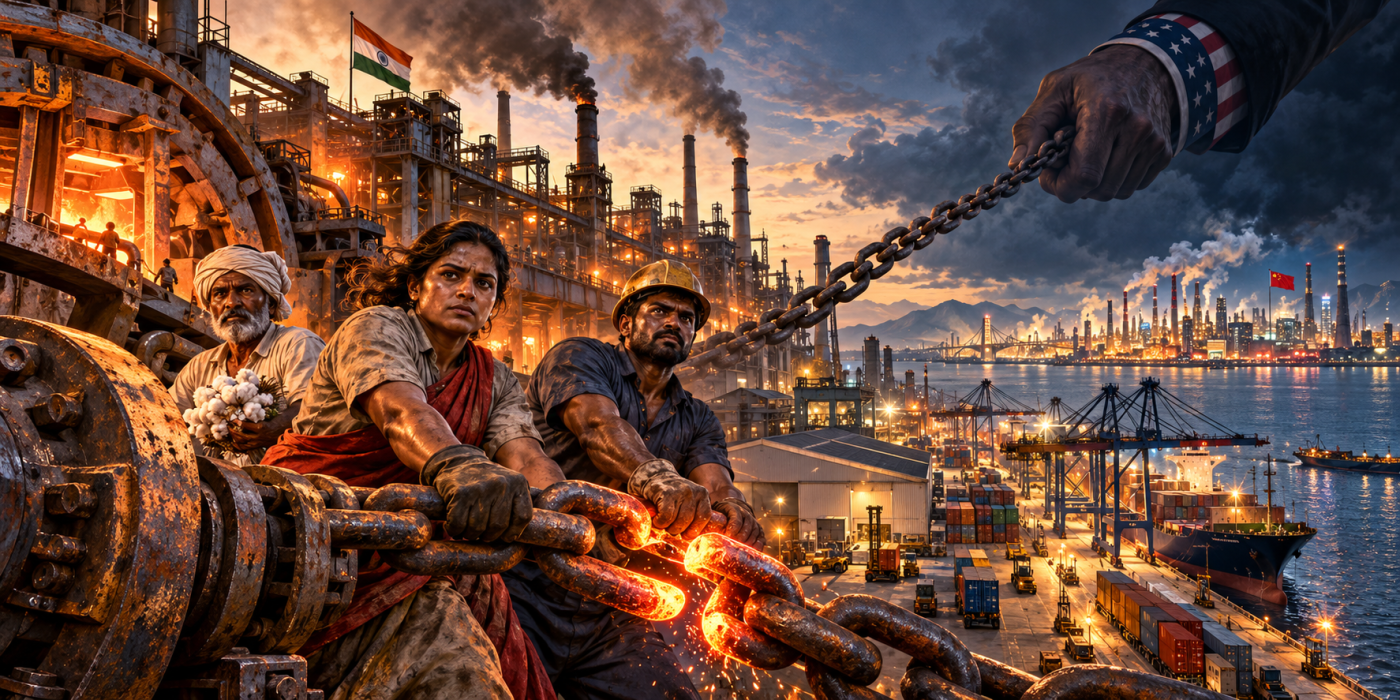
Washington calls China’s development an American gift, then treats its independence as a manufacturing defect. Brahma Chellaney recognizes the coercion behind America’s India policy, but steers the reader toward repairing a partnership whose terms reach into factories, farms and sovereign decisions. Behind the diplomatic quarrel stand competing owners and unequal powers, while workers and peasants disappear inside a national interest somebody else defines. Their liberation demands organized power to challenge imperial punishment and the domestic bosses bargaining over the wealth they produce.
Prince Kapone | Weaponized Information | October 15, 2026
I. The Benefactor Claims the Factory
Washington helped China rise and now regrets the competition. That’s the opening premise of Brahma Chellaney’s October 15 opinion essay in The Hill, “America’s China lesson is reshaping its India policy.” American assistance takes center stage; China’s development enters as the troublesome offspring of American generosity. An entire people’s achievement becomes a defect in Washington’s quality control. The factory has grown too capable, and the benefactor would like to know why nobody checked the warranty.
Chellaney doesn’t claim Washington built everything. His sleight of hand works more quietly: American help becomes the explanation that matters, while the workers and institutions that turned outside inputs into productive power disappear into the scenery. China’s history begins when Washington walks into it. The clock starts with assistance and strikes midnight when the grateful recipient becomes a competitor. Before India even enters the story, America is already sitting in the supervisor’s chair, deciding how carefully to manage its next investment in somebody else’s future.
The argument gets its purchase from something real. Chellaney recognizes American commercial self-interest, sees pressure reaching beyond Trump’s latest tantrum, and names the collision between Washington’s demands and India’s freedom to act. That makes his remedy all the more revealing. A struggle over who commands development becomes a disagreement the two ruling establishments might settle by expecting less of each other. Washington should tolerate some independence; New Delhi should exercise it without becoming a nuisance. After all that, the prescription is another few inches of leash.
“National interest” makes this arrangement sound like enough. India wants industry; America wants markets. Each country speaks with one mouth, as though the boss and the worker take home the same paycheck, as though a farmer bears a trade bargain the way an exporter does. Landau and Colby get names and quotations. American strategy documents arrive wearing the authority of office. China’s alleged campaign against Indian manufacturing slips in beneath “widely seen,” that handy phrase that supplies an accusation with a crowd while sparing the writer the trouble of naming witnesses. Who sees it? On what evidence? What does the accused country say? Workers and farmers don’t even get a speaking part.
Mentions in documents, absences from summits and a prefix removed by the Pentagon pile up as proof that India has slipped down Washington’s strategic ladder. These may be signals, but Chellaney loads them with more weight than his material account can support. The reader is put to work counting India’s appearances in American paperwork while the terms governing production, purchases and cooperation remain largely out of sight. Meanwhile, the familiar pairing of democratic India and autocratic China blesses the partnership before anybody has counted the cost or asked whose back will carry it.
The closing accusation against China tightens the fence: even disappointment with Washington becomes an argument for repairing the American partnership. Chellaney identifies the pressure, then hands responsibility for the cure to the ruling establishments administering it. The workers and farmers whose labor, livelihoods and purchasing power give the relationship its substance remain outside the room. The people bargaining over their heads have already announced what their national interest is.
II. The Capacity Was Built; the Terms Were Imposed
The history missing from Chellaney’s opening belongs to the people whose achievement Washington has claimed for itself. China’s official industrial history records factories, major industrial projects, inland development and technological acquisition before 1978. Reform accelerated growth on foundations Chinese workers and public institutions had already laid. Foreign machinery, investment and export markets entered an industrial world that already existed. Chinese labor and organization made those inputs productive. Washington didn’t deliver an industrial civilization in a shipping container, however much its statesmen now behave as though they kept the receipt.
Deputy Secretary of State Landau’s remarks at the Raisina Dialogue conference lay Washington’s demand bare: India’s development must remain subordinate to American power. In March 2026, he warned against repeating the experience of another country developing commercial capabilities and beating the United States. There is the imperial grievance, straight from the official’s mouth: the people making the products might become competitors instead of staying profitable subordinates. His talk of mutually beneficial cooperation sprays diplomatic perfume over the demand. Washington welcomes Indian growth on terms that serve American capital and preserve American command. India may build the factory, but the empire still expects to set the terms and collect its fucking due.
Washington has already shown how it punishes disobedience. Its August 2025 Russian-oil tariff order slapped an additional 25 percent duty on covered Indian goods because India bought Russian oil. The American market became a weapon against India’s right to choose its trading partners. Washington removed that duty in February 2026, but the episode exposed the machinery of coercion. Trade with a country Washington wants punished, and Washington can make you pay for access to its market. The empire calls this partnership while opening the customs ledger to collect the price of disobedience.
The February trade framework spells out what Washington wants from the bargain: industrial and selected agricultural concessions, investment screening, export-control cooperation and purchases of American goods. Through these demands over markets, investment and technology, American capital seeks to shape India’s development. Chellaney’s picture of deadlock obscures the bargaining still underway. On October 15, officials reported substantial progress toward an agreement. Washington is putting its power to work extracting concessions while the two governments hammer out terms they could both accept. They are haggling over the price of partnership, with American demands already sitting on the table.
The supposed strategic downgrading rests too heavily on Washington’s paperwork as well. The 2026 defense strategy omits India. The National Security Strategy assigns it roles in commercial and security cooperation, the Quad, critical minerals and maritime security. India also joined Pax Silica in February, an initiative spanning minerals, semiconductor production and AI infrastructure. Officials stood alongside executives from Micron and Tata Electronics. Beneath the diplomatic quarrels, governments and corporations kept assembling the material foundations of technological power. Count the missing names if you like; the minerals, factories and infrastructure need accounting for too. A claim of strategic retreat has to stand on what these states withdraw, maintain or expand.
India’s ruling class helped build the dependence through which foreign capital now exercises power. Tricontinental’s dossier The Turbulence of the Indian Economy traces how public industrial construction after independence coexisted with entrenched inequality in the countryside and the accumulation of private wealth. The country laid industrial foundations while leaving its propertied classes firmly in command. Manmohan Singh’s 1991 budget speech then announced greater reliance on foreign investment and technology, deregulation and exposure to foreign competition. India’s rulers opened those doors through their own state, pursuing a development strategy that served capital while tightening the country’s dependence on it. Washington found willing partners with fortunes of their own to build. Chellaney’s tale of American generosity lets these domestic architects of dependence walk out of the picture, taking their decisions and the class interests behind them out of the line of fire.
Indian capital has acquired real industrial property. Tata Electronics announced a controlling 60 percent stake in Pegatron Technology India in January 2025. The electronics ministry’s separate July 2026 sector-wide value-addition estimate stood at 23 percent. Indian owners are enlarging their holdings within an industry still substantially dependent on imported content. Ownership papers cannot manufacture components, supply machinery or conjure technical knowledge. The Tata acquisition establishes control of that company; the industry figure establishes the wider reliance on imports. To establish who commands that particular factory’s technology and suppliers, we have to examine its arrangements. Industrial power runs through the connections that keep production alive, and a serious reckoning has to follow them.
New Delhi helps decide which connections can be built. In March 2026, the Cabinet approved selective investment easing involving neighboring countries, including provisions for small, non-controlling beneficial ownership and faster approval for specified manufacturing investments. The latter retained resident Indian majority ownership and control. The government explicitly sought technology access and manufacturing expansion. India’s rulers were adjusting the gates through which foreign capital could enter. Their hands are on those gates, and their decisions belong in any explanation of access to Chinese investment. The policy tells us what they permitted; actual investment volumes tell us what followed.
Chellaney’s accusation against China requires evidence he hasn’t supplied. Indian reporting documented magnet licensing delays in August 2025 while shipments resumed elsewhere. India’s foreign ministry confirmed some license approvals that October. That record raises a concrete question about selective treatment. Chellaney turns it into a sweeping accusation of a coordinated, India-specific campaign across several industries imposed in 2026, without establishing the connections between the dates, commodities, decisions and intentions he bundles together. Political hostility cannot do the work of missing evidence. China doesn’t become guilty of the whole charge because an opinion columnist has packed the allegations into one paragraph.
The market Washington covets is also the home of people whose interests the partnership buries. RUPE’s domestic-demand analysis connects restricted mass purchasing power to corporate reliance on exports and state-supported opportunities. Millions need what industry could produce, but their poverty disqualifies them from the market’s attention. Capital looks into empty pockets and finds no profitable reason to meet human needs. Those people also have the power to fight: a farmers’ movement account records the November 2021 repeal of three farm laws and credits sustained struggle. Producers fought and forced a retreat. Chellaney reduces them to a market or folds them into a national interest pronounced by their rulers, then entrusts those same ruling establishments with repairing the bargain. The people capable of challenging its terms disappear from the story precisely where their struggle threatens to change the ending.
III. The Partnership Has Owners; the Nation Pays
Chellaney reaches the threshold of his own argument and stops. He recognizes that Washington’s pressure grows from interests deeper than one president’s temperament. Then he asks the establishments to adjust their expectations, as though naming the conflict were halfway to settling it. Governments can trade concessions, ease friction and strike agreements both find useful. Better manners cannot settle the struggle over whose development serves whom. Washington can punish an Indian economic decision; New Delhi’s appeals to mutual respect carry no comparable force. Behind the diplomatic language stands a customs office, a market and the power to make refusal hurt.
Here the benefactor story earns its keep. Call development American assistance, and Washington acquires a moral claim over everything that follows. Commercial participation becomes generosity; a profitable relationship becomes a debt of gratitude. The recipient develops purposes of its own, and suddenly the benefactor discovers that its kindness has been abused. China’s productive history tears through this story because outside investment entered a process Chinese workers and institutions were already building. Revolutionary state power helped shape what that encounter became. Foreign capital brought resources and came looking for returns; neither gave it a deed to the country’s future. Washington’s great China grievance is that development produced capacities American policymakers couldn’t simply order back into their allotted place.
Applied to India, this lesson concerns the terms on which productive growth proceeds. Cooperation can build factories, expand knowledge and open opportunities Indian owners have sound commercial reasons to want. Those gains help explain why the relationship survives punishment. They can also deepen its conflict: greater productive capability can strengthen demands for greater freedom over suppliers, markets and policy. American officials may welcome profitable cooperation while fighting consequences of Indian industrial success that escape their command. Corporations pursue commercial advantages of their own, sometimes pulling against their government’s restrictions. The struggle lives inside the partnership. Chellaney treats keeping it alive as the sensible destination; the material question is what India can build through it, and who gets to dictate the conditions.
His unified India buries another struggle inside that question. India’s ruling class inherited a country where public industrial construction stood alongside entrenched private property and agrarian inequality. Its later opening to international capital grew through that same social order. Here the comprador relationship takes shape: domestic owners accumulate through unequal international ties, while the development strategy they pursue helps reproduce dependence on those ties. They can acquire factories, enlarge fortunes and gain bargaining strength within the arrangement. They can fight Washington when its demands cut into their profits. These owners bargain as participants with property to defend, and the workers producing their wealth have interests of their own.
Chellaney’s appeal to the national interest irons those conflicts into a single negotiating position. An owner seeking export access and a worker demanding higher wages may both want production to grow while fighting over who pockets the proceeds. A concession that pleases an industrial importer can threaten a grower’s livelihood. A government can win better terms for domestic capital while giving producers next to no say over what it surrenders. That is why repairing an elite partnership serves a narrower purpose than popular sovereignty. The negotiators can improve the bargain and keep intact their authority to bargain over other people’s lives. Those who produce the wealth are still spoken for by those who command it.
The domestic market lays bare the cost of that substitution. Chellaney treats its size as a national asset Washington wants access to. But purchasing power grows out of wages, property and the division of social wealth. People can need desperately what industry could produce and still lack the money to buy it. Their need counts for nothing at the cash register. When corporate growth leans on foreign customers, access to those customers acquires political weight. A development strategy shaped at home gives external pressure something to grip. Imperial coercion gains a domestic foothold through these relations, while responsibility for imposing it remains with Washington. Indian class relations help determine how far the punishment spreads and which owners can shove its costs onto the people beneath them.
Industrial ownership brings us to a related question. A domestic acquisition gives its owner real authority, but an ownership deed cannot settle who commands the wider chain that keeps production running. The evidence establishes particular gains and particular limits; other arrangements remain to be established. That is already enough to challenge Chellaney’s easy passage from a stronger India to a freer India. Freedom must mean the power to do something concrete: obtain necessary technology, choose suppliers, sustain production or direct its gains. Each power can belong to a different holder. Widening a billionaire’s commercial options and giving a worker greater control over working life demand different political changes.
At precisely this point, Chellaney’s closing accusation against China sends the reader looking elsewhere. Another external obstacle comes into view, and restoring the American relationship becomes the answer again. Documented Chinese restrictions deserve investigation on their own terms. Establishing them would give Washington no entitlement to discipline India and would conjure no common interest between Indian owners and everyone they employ. Chellaney keeps his preferred destination in sight by making the choice appear to lie between external partners. The domestic power to choose those partners, concede their demands and distribute the costs remains largely undisturbed.
Workers and peasants have every reason to resist imperial punishment and defend India’s freedom from it. They also have claims against the owners and officials bargaining in their name. A capitalist’s quarrel with Washington gives him no fucking right to declare a ceasefire in the class struggle. Producers have already demonstrated their capacity to force a government retreat, breaking the article’s confinement of political action to the establishments. Governments negotiate, but organized people can change what governments are able to surrender. Through that struggle, national independence acquires popular content. A repaired partnership may settle a quarrel between governments; the people whose labor sustains it still need power over the terms.
IV. The Producers Must Set the Terms
When an establishment commentator claims to speak for India, put the demands of Indian producers beside his prescription. A repaired partnership looks different from the factory floor or the cotton field. Workers need secure jobs, decent wages and the collective strength to confront their employers. Growers need protection from concessions struck for somebody else’s profit. Those demands give producers grounds to judge the bargain before officials drape it in the national flag and send them the fucking bill.
Organized forces already connect these struggles. The Centre of Indian Trade Unions’ constitutional program joins higher wages, shorter hours and union rights to the struggle for socialism. The All India Kisan Sabha’s stated objectives confront landlord exploitation, domestic monopoly and foreign capital. These programs measure development through the lives and power of the people doing the work. Investor satisfaction cannot answer what producers gain, what they stand to lose or how much authority they retain over their own future.
A February 2026 organizing call from CITU, AIKS and the All India Agricultural Workers’ Union documented workplace gate meetings, village meetings, conventions and collective protest. Through these forms, people can challenge the establishments’ claim to have settled everybody’s interests in advance. Union and village discussions can hold proposed concessions against the realities of wages, jobs and crop incomes, then carry collective demands to employers and political representatives. Organizers can demand to see the negotiated terms and insist that those expected to bear the costs have a voice in resisting them. Workers confront employers with organization rooted in production; organized constituencies confront governments with the power to contest the bargain in public.
AIKS’s cotton-trade declaration puts a concrete conflict on the table, warning that concessions favoring industrial importers could damage growers. Circulating that argument alongside the government’s promises lets affected producers examine the bargain through organizations of their own. Demands for secure jobs and collective bargaining belong alongside that fight. A government has no business selling national greatness while telling the people building it to swallow another rotten deal for the shareholders.
For workers in the United States, responsibility begins at home: oppose Washington’s use of economic punishment to dictate another people’s relationships, and bring Indian labor and peasant demands into union education and public argument. American workers owe their rulers no help collecting an imperial debt of gratitude. Chellaney entrusts the partnership’s repair to the establishments. The people whose labor gives it value need organizations strong enough to fight over its terms, and a voice that neither government nor boss gets to impersonate.


Leave a Reply