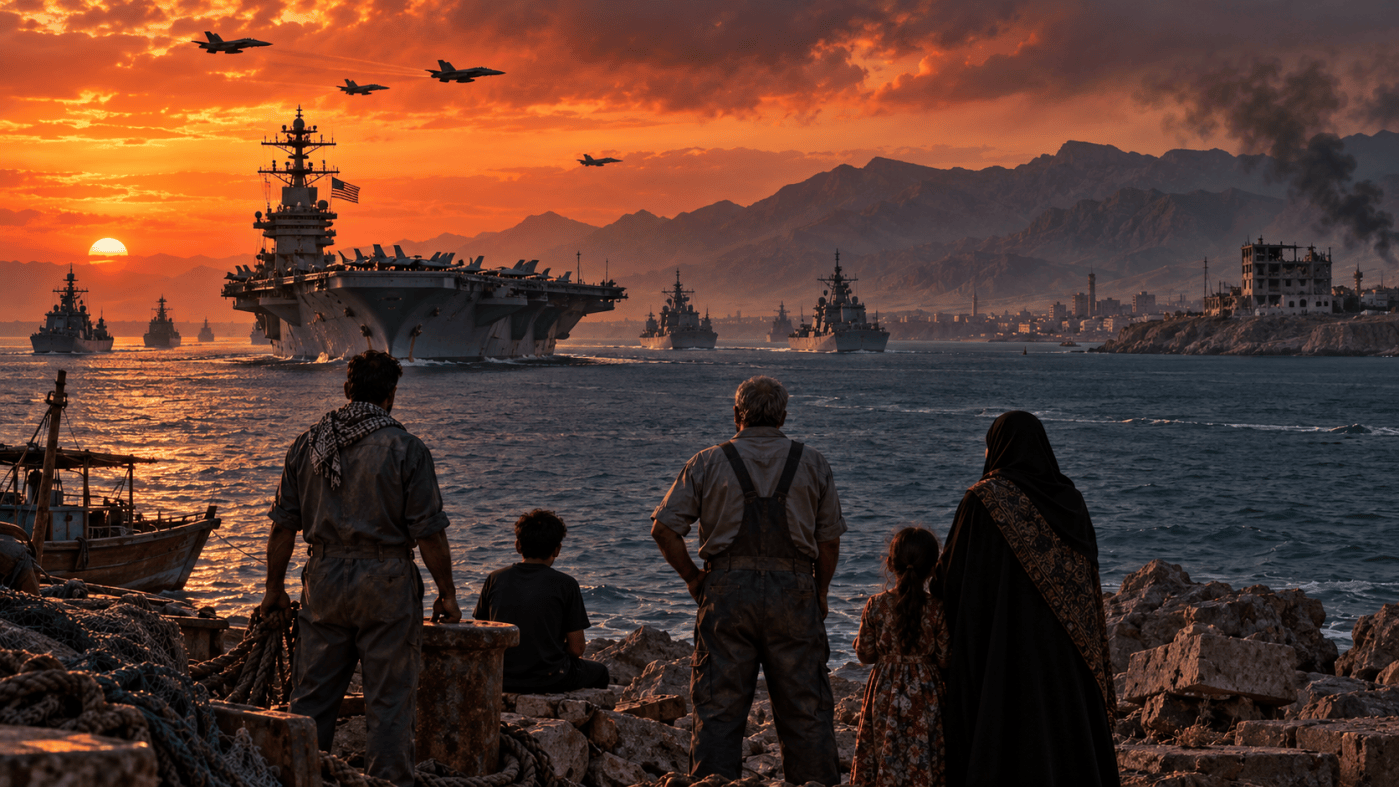
William H. McRaven sees American force stumble in Iran and calls for wiser leadership, clearer aims, and firmer commitment. The war’s own chronology points to a deeper cause: Washington and Tel Aviv attacked a sovereign country, while U.S. bases, weapons networks, sanctions, and control of strategic routes sustain imperial command across West Asia. Iran’s resistance exposes the limits of that command; defending sovereignty matters, while the struggle for working-class power inside Iran remains its own fight. The way forward runs through organized antiwar pressure on Congress to stop funding the attack and enforce the War Powers resolutions.
Prince Kapone | Weaponized Information | October 20, 2026
The Limits of Force—and the Story That Preserves It
William H. McRaven’s October 20, 2026 essay, “The Limits of American Power”, turns a retired admiral’s career in the U.S. military into an argument about the gap between battlefield superiority and political victory. His opening indictment is sharp: the Trump administration entered the war on Iran without a clear rationale, kept changing its aims, and ended up demanding help with a crisis the war itself had created.
McRaven says Washington and Israel began the attack without building international support, and that the administration failed to notify regional allies. He also condemns the administration’s silence after the strike on an Iranian school. He presents that silence as a further blow to the war’s legitimacy. His account gives Washington the power to launch the war, choose its targets, and define its aims; then it measures the disaster by the damage done to U.S. interests and the region.
Vietnam supplies the warning. McRaven recalls how U.S. forces won battles and lost the war, while the 1991 Gulf War stands in his essay as the model of clear objectives, experienced leadership, coalition-building, and moral legitimacy. From these histories he draws a lesson about judgment: presidents must hear frank advice, understand the limits of force, and commit when the cause is righteous. He calls American reluctance to put troops on the ground a limit that can bring defeat, and argues that ground troops are sometimes necessary for the greater good.
That remedy keeps the machinery of U.S. power intact. McRaven condemns bad leadership, weak institutions, and a war without a coherent plan; he leaves better leaders, stronger institutions, legitimate coalitions, and firmer commitment ready to carry out the next intervention. The question becomes how Washington can wield force wisely. The question of why Washington claims the right to wield that force across West Asia gets pushed aside.
Iran enters the essay chiefly as a state whose will, geography, and defenses frustrate American aims. Iranian people appear as an enemy population whose resolve limits U.S. power. The Gulf becomes terrain. U.S. command becomes a tool that needs wiser hands. McRaven’s demand for moral legitimacy carries a harder implication: he treats reluctance to commit ground troops as an obstacle to overcome when Washington judges the cause worthy. The essay condemns a war launched without a plan while preserving the imperial ambition to make the next war work.
A War Has a History Before It Has a Lesson
McRaven opens with the U.S.-Israeli attack on Iran on February 28. He describes an administration that moved from regime change and nuclear policy to reopening the Strait of Hormuz, even though the passage wasn’t closed before the war. Tricontinental records that the attack came within hours of negotiators saying Iran had accepted many demands in nuclear talks. It describes the U.S.-Israeli strikes as violations of Iran’s sovereignty and the UN Charter. Washington and Tel Aviv launched the war; Tehran didn’t. Tricontinental’s account restores that opening chronology.
McRaven reports that an early strike hit an Iranian elementary school and killed 120 students. Amnesty International’s investigation identifies U.S. forces as responsible for the strike on Shajareh Tayyebeh Elementary School in Minab, which killed 156 people, including 120 children. Amnesty examined satellite imagery, videos, photographs, missile remnants, and interviews; it found the school building had been struck alongside structures in an adjacent Islamic Revolutionary Guard Corps compound. The school had been separated from that compound and used for civilian education. Amnesty’s investigation lays out the evidence and the U.S. responsibility.
Iran’s experience of war began decades earlier. Iraq invaded Iran on September 22, 1980; the war lasted nearly eight years and ended in 1988. Encyclopaedia Iranica’s history records the invasion and the war’s duration. Tricontinental documents the later campaign against Iran through economic sanctions, sabotage, assassinations, and information warfare. Those measures turned coercion into a standing feature of Iran’s political and economic life. Its account of the hybrid war details those mechanisms.
Hormuz carries a material weight that McRaven’s military narrative cannot contain. In the first half of 2025, before this war, an average of 20.9 million barrels of oil per day passed through the Strait—about one-fifth of global petroleum liquids consumption and one-quarter of maritime oil trade. The Energy Information Administration’s figures show why any war around the Strait reaches far beyond the battlefield: it threatens a major artery of energy circulation.
U.S. forces are already embedded across the Gulf through bases and military agreements. The Congressional Research Service describes that basing network as the product of decades of security cooperation, enabling major U.S. operations across the region since the 1980s. U.S. appropriations and host-government contributions have both funded the construction and upkeep of facilities, while many access and cooperation agreements remain classified. The CRS account of U.S. basing names the material infrastructure behind Washington’s regional reach.
The arms relationship moves alongside that military presence. Tricontinental documents the scale of Western weapons sales to West Asian states and the way arms trade binds regional security forces to external suppliers. During the current war, the Trump administration used emergency provisions to fast-track more than $30 billion in munitions and air- and missile-defense equipment for Israel, Jordan, Kuwait, Qatar, and the United Arab Emirates, bypassing the normal congressional review process. Tricontinental’s arms-trade analysis lays out the longer regional pattern; the CRS report documents the emergency sales.
Vietnam’s history also exceeds the battle counts in McRaven’s account. The Vietnamese liberation struggle joined military action to political organization and a fight over who would rule the country. The movement’s strategy developed through that struggle, not from U.S. commanders’ calculations of battlefield success. New Left Review’s history of Vietnamese liberation strategy reconstructs that political and military development.
Iran’s internal economic life carries its own contradiction. Tricontinental describes how U.S. and European sanctions, alongside poor domestic economic management, have created serious problems for Iran’s working people. Its account names the pressure on workers without collapsing the Iranian state into the people who endure those conditions. That analysis of Iran’s economic conditions establishes a social reality that any account of the war must confront: the people facing external attack also live with the consequences of sanctions and domestic economic policy.
The Command Behind the Lesson
McRaven sees the wound and blames the hand that missed its target. His own account shows Washington and Tel Aviv opening the war, changing its aims, and reaching for Hormuz after the attack had turned it into a point of crisis. Tricontinental places the strikes hours after negotiators said Iran had accepted many nuclear demands. The sequence exposes the article’s central evasion: the attack becomes a failed exercise in American judgment, while the power to launch it and impose its aims fades into the background.
That power has a purpose. Washington’s bases, military agreements, weapons transfers, and sanctions give U.S. command a material form across West Asia. Public funds build and sustain bases. Arms sales bind regional militaries to suppliers and equipment. Sanctions bear down on Iran’s working people. These aren’t loose details surrounding a war. They’re channels through which Washington maintains military access and pressures states that resist its direction. McRaven asks how an American president can use force with greater skill. He leaves the command structure itself standing, ready for the next president.
His praise of the 1991 Gulf War shows what he wants that structure to do. He celebrates clear objectives, coalition-building, leadership, and moral legitimacy. Those are conditions for organizing a war and sustaining support for it. In his telling, legitimacy becomes the seal Washington needs before it can exercise force effectively. The right of the United States to command the region never faces the same test. The empire’s appetite puts on a clean uniform and waits for better public relations.
Vietnam makes the limit of that argument harder to hide. The Vietnamese liberation struggle wasn’t a military obstacle that U.S. planners failed to measure correctly. It was a political force, organized around the liberation of the country and the defeat of foreign domination. McRaven understands that battlefield victories can coexist with strategic defeat, but his frame still makes the United States the principal actor: American leaders misread the war; American forces failed to make victory stick. The Vietnamese people appear chiefly as the force that frustrated them. A liberation struggle becomes an American lesson in management, and the people who made history are pushed out of their own story.
The same inversion operates in Iran. The United States and Israel launched an illegal attack against a sovereign country. U.S. forces struck the Minab school, killing children in a building separated from the nearby military compound and used for civilian education. McRaven calls the airstrike a failure that damaged the war’s legitimacy. That language makes mass death evidence of poor execution. The political relation runs the other way: U.S. military power crossed Iran’s borders, and Iranian civilians paid for the attack. Washington’s concern with legitimacy enters after the violence, as a question of how to preserve support for the war.
Iran’s defense of sovereignty grows from a history of war and coercion. Iraq’s 1980 invasion began an eight-year war; later sanctions, sabotage, assassinations, and information warfare kept pressure on Iran through other means. That history gives the Iranian state a material basis for treating sovereignty as a condition of survival. It also gives Iran’s people a long record of having war and economic punishment imposed on their lives. Resistance to U.S. command is real. So are the class conflicts that shape Iranian workers’ lives under sanctions and domestic economic policy.
Here the regional political economy comes into focus. Gulf bases give U.S. forces access across the region. Arms contracts direct public money toward weapons suppliers and tie military systems to outside producers. Hormuz carries roughly one-fifth of global petroleum liquids consumption and one-quarter of maritime oil trade. The passage matters because energy circulates through it; military power around it affects who can move goods, who bears disruption, and whose security receives protection. These relations connect command to money, infrastructure, state power, and the laboring people who absorb the costs.
McRaven recognizes geography as a limit on military movement. The deeper issue is who built the military order around that geography and what it secures. Hormuz appears in his essay as an obstacle and an objective. In the material record, it sits inside a Gulf system of bases, arms deals, and competing claims over sovereignty. The map doesn’t command events by itself. Governments build bases, sign agreements, authorize weapons, and send forces across borders. Then they call the resulting order security.
The working class needs a clear distinction here. Iran’s sovereignty gives its people the right to decide their country’s political future without U.S. dictation. Working-class emancipation requires workers to command their labor and social wealth. The defense of national sovereignty and the struggle against class domination meet in history, but each has its own political task. Holding that line lets us oppose imperial aggression without confusing state resistance with workers’ rule.
McRaven is right that superior weapons can’t guarantee political victory. His deeper lesson, though, points beyond his own remedy. Military command can strike and destroy; it can’t compel a people to accept foreign rule. Washington’s failure in Iran grows from the collision between its regional command and a state defending sovereignty, with workers and civilians bearing the cost of the conflict. Better leadership can make that command more disciplined. It can’t erase the people who resist it—or the class struggle that continues within every state.
Make the War Cost Washington at Home
The machinery of war runs on money and political permission. Congress can refuse the funding. Constituents can make their representatives answer for the attack instead of letting the White House bury its costs beneath another speech about American strength.
The October 20 Seattle action puts that leverage in view. The Seattle rally listing names NIAC Seattle and Action Corps as organizers outside the Henry M. Jackson Federal Building. The demand runs through Congress: stop funding the war and enforce the War Powers resolutions. Deliver those demands, request meetings, and make lawmakers answer for the money and authority they give the attack. The aim is to make continued war harder to finance and authorize.
The national “United for a Just Peace” campaign gives that pressure an organized channel. NIAC and Action Corps are joined by other antiwar organizations in demanding an end to war funding, accountability, and diplomacy. NIAC is an Iranian-American community advocacy organization whose work includes mobilizing constituents and pressing elected officials. Work with it where the demands converge: stop the funding, enforce War Powers, and force Congress to confront the consequences of its votes. Keep the political line rooted in anti-imperialist organization and working-class power.
Seattle Against War and the Hands Off Iran Coalition have organized local antiwar rallies. Their Seattle rally organizing offers a base for building visible, collective opposition here. Keep bringing people together in the streets, carry the demand against war funding into congressional offices, and build a local movement capable of returning to both. Each tactic has a distinct job: rallies make opposition visible; organized constituent pressure targets the officials who control funding and authorization. Together they can make support for the war carry a political cost.
Washington wants war to feel remote: ordered from the executive branch, paid for with public funds, and borne by people kept outside the decisions. Break that distance. Organize where you live, confront the officials who authorize and finance the attack, and build antiwar power strong enough to outlast a single rally. The people who pay for empire can make Congress feel the cost in every vote that keeps the war machine running.


Leave a Reply