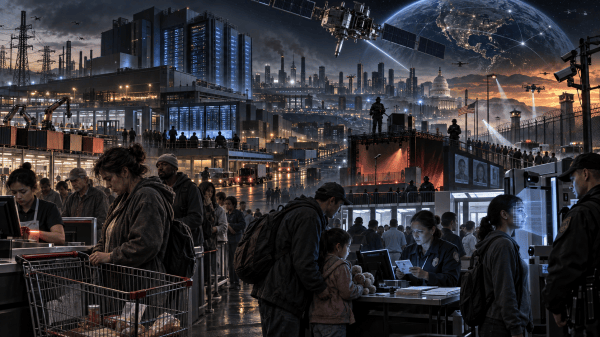
The U.S. state is vigorously fortifying its military and technological apparatus while systematically withdrawing social support through food assistance and healthcare, showcasing a disturbing trend of technofascist consolidation. As military might is acknowledged in orbit and social benefits dwindle, the ruling order exacerbates class divisions, demanding increased legitimacy from a population now subjected to strict classification and conditionality. Political expression faces barriers in increasingly privatized venues, reflecting a tactical alliance between state interests and tech monopolies. This ominous shift marks a historical reckoning: the state is reallocating its substantial resources toward military supremacy at the expense of everyday security, creating a precarious societal structure poised for conflict.
Communists and Patriots: The Flag, the Class, and the Lie of Imperial Nationalism
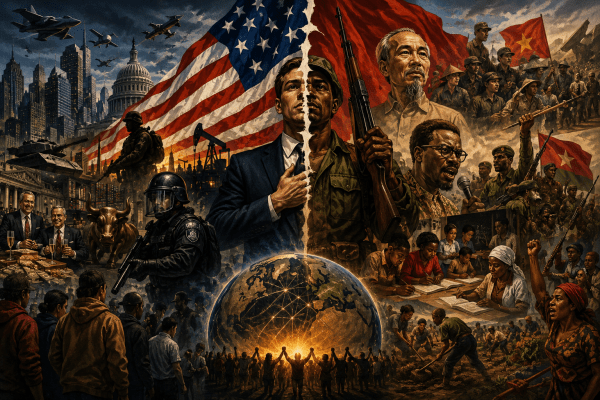
Trump says you can be a communist or a patriot—but not both. This essay exposes the historical fraud buried inside that slogan. By reconstructing the nation through historical materialism, it shows that nationalism has never possessed a fixed political content. In oppressed nations, communists repeatedly became the truest patriots because the struggle for national liberation demanded the overthrow of colonialism, imperialism, and comprador rule. In imperialist nations, however, nationalism serves the opposite function: binding workers to the ruling class and its global system of domination. The real contradiction is not between communism and patriotism, but between imperial patriotism and the liberation of the people.
Empire’s Digital Panic: China, Xinjiang, and the War Over Who Controls the Future
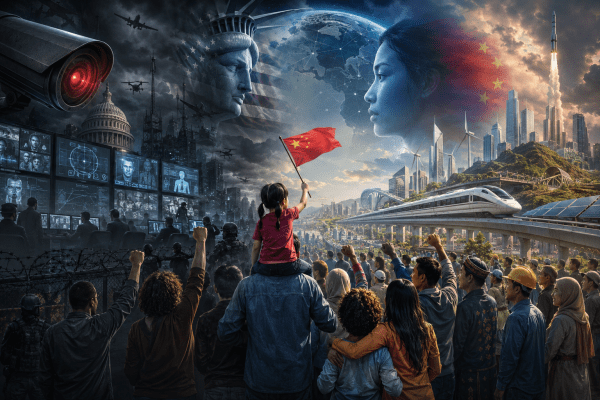
The Associated Press investigation reveals a shocking truth: Silicon Valley's complicity in building the surveillance apparatus that the West now demonizes in China. While framing China as a "digital police state," the report subtly shields the very imperial system enabling such technologies. It highlights a deeper confrontation—one where the U.S. grapples with losing its monopoly on development and technology. As the New Cold War intensifies, the true danger emerges: not the surveillance itself, but the realization that a socialist-oriented state can achieve modernization and stability without Western control. The empire's fear lies in losing its grip over a future it desperately seeks to define and dominate.