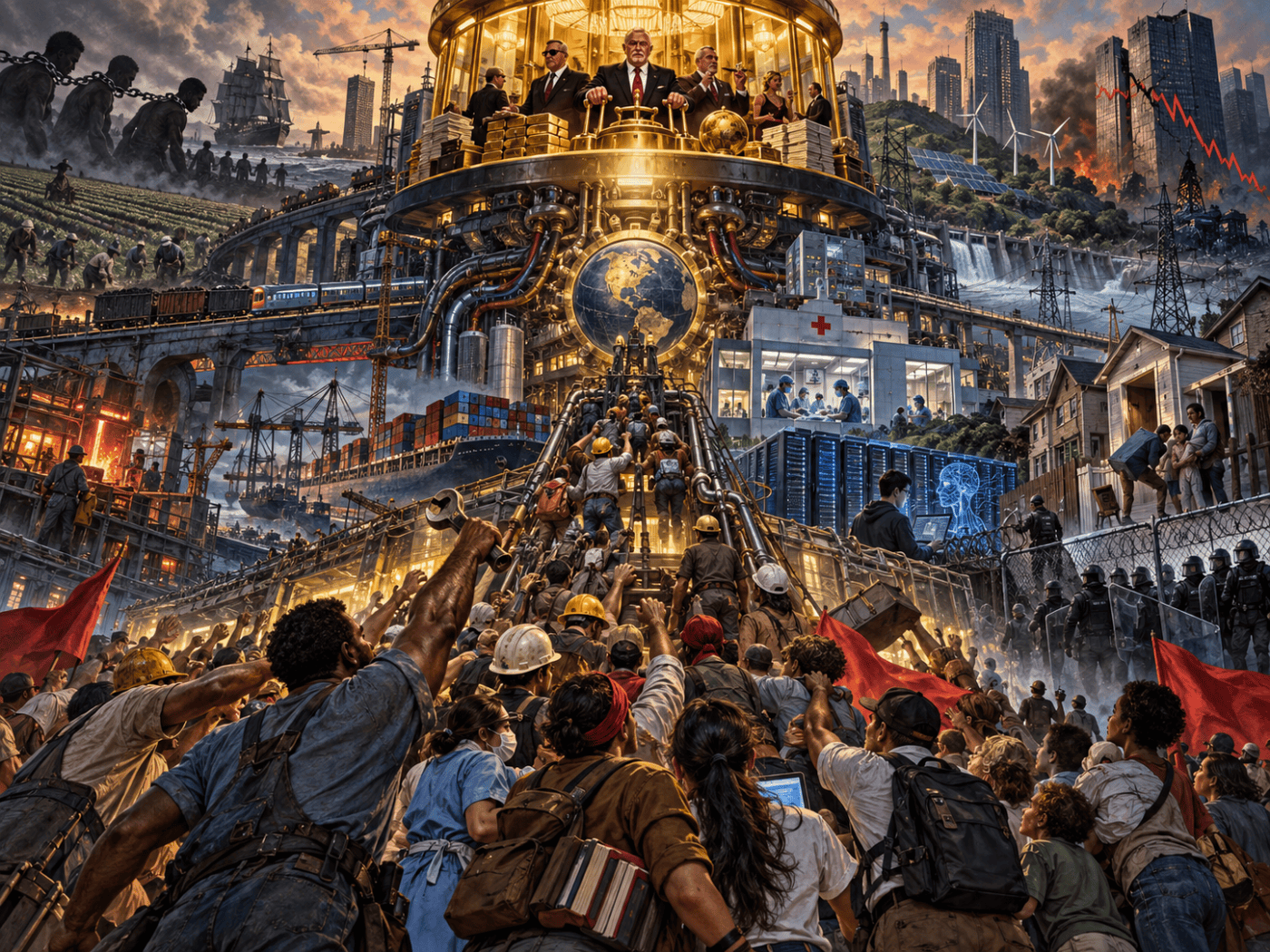
Peggy Noonan can see socialism returning because she can see the wounds capitalism has left behind, but she blames the consciousness of the wounded rather than the system that produced them. The supposedly natural capitalist order was built through dispossession, slavery, colonial plunder, class discipline, and state power, while socialism developed through distinct and evolving experiments from the Soviet Union to China, Vietnam, Cuba, and the DPRK. Beneath the ideological fog sits the contradiction capitalism cannot abolish: production has become more collective, technological, and socially interdependent while ownership keeps the power to command its wealth in private hands. Polls may reveal an opening, but only organized workers and tenants can turn that opening into a struggle over who owns, who plans, and who controls what all of us already build together.
By Prince Kapone | Weaponized Information | September 10, 2026
I. She Found the Wound, Then Blamed the Fever
Peggy Noonan begins with an admission that would’ve sounded almost obscene in respectable American politics not long ago: socialism is no longer passing through. It is arriving. Writing in The Wall Street Journal—whose opinion pages have long wrapped private property and capitalist markets in the language of “free people”—the former Reagan speechwriter points to polling showing a large share of Democratic-aligned adults identifying as democratic socialists, Abdul El-Sayed’s victory in Michigan’s Democratic Senate primary, and DSA national co-chair Megan Romer openly defending a program of sweeping political and economic change. The old Cold War punch line, Noonan warns, has become a political force.
Then she introduces the radicals. Fox News asks Romer whether socialists want to abolish the Senate, restructure the presidency and Supreme Court, abolish ICE, dismantle much of the prison system, slash the Pentagon, and bring large corporations into public ownership. Romer keeps saying yes. Noonan scarcely needs to editorialize. The format does the work for her. A program for reorganizing political and economic power is flattened into a procession of demolition charges: abolish this, replace that, defund the other thing. The reasons disappear. Only the blast remains.
From there Noonan turns from socialist demands to socialist character. Today’s organizers are highly educated, relentlessly online, and unusually skilled at manipulating the information environment. But unlike her warm old relative who once spoke fondly of the Industrial Workers of the World, these socialists strike her as colder, fiercer, even occasionally “sociopathic.” They don’t merely oppose institutions; they seem insufficiently attached to the people and traditions those institutions supposedly embody. Political disagreement quietly becomes a diagnosis of personality.
What makes the column interesting is that Noonan nearly arrives at a much more dangerous explanation. She remembers what a 25-year-old saw growing up: the 2008 financial crash, frightened parents, lost jobs, Wall Street bailouts, and very little visible punishment at the top. She asks whether that same young adult will ever afford a house. She asks what happens when AI advances and workers wonder whether the economy will still have a place for them. For a few paragraphs, the material world barges into the room.
And then, almost on cue, it gets escorted back out. Socialism’s appeal is relocated toward fading religion, left-wing education, critical theory, institutional distrust, and social media’s appetite for ideological intensity. The wounds remain, but the explanation shifts away from the system producing them and toward the consciousness of the people experiencing them.
The maneuver reaches completion when Noonan declares capitalism essentially organic. Human beings want to build, trade, invent, provide, and rise; therefore capitalism supposedly grows upward from human nature. Socialism, by contrast, is an abstract conception of justice imposed from above through coercion. There’s the trick. Capitalism gets to inherit every ordinary human act of creativity and exchange, while socialism gets assigned every conscious attempt to reorganize power. One system is allowed to disappear into nature; the other is condemned because it admits that property and power are political questions.
Noonan has found the wound. She has even traced several of the cuts. But when the fever appears, she blames the patient.
II. The Natural Order Needed a Lot of Machinery
The socialist opening Noonan describes is real, but the label still covers different levels of political commitment. A CNN/SSRS survey conducted July 23–27, 2026 found roughly one-third of Democrats and Democratic-leaning adults identifying as democratic socialists. Other polling finds smaller numbers adopting the unqualified label “socialist,” while support for socialist-associated policies can run higher. Gallup found 81 percent of Americans viewing “free enterprise” positively, compared with 54 percent for capitalism and 39 percent for socialism. The shift can’t be reduced to millions of people suddenly deciding that trade, invention, or initiative are bad things.
The generation encountering that opening is also living through a measurable crisis of independence. The Federal Reserve reported that 49 percent of adults under 30 were living with a parent in 2025, up 12 percentage points from 2019, while nearly half of adults ages 18 to 29 received financial help from somebody outside their household. Only 24 percent of that age group owned a home. Research on generative AI likewise finds weaker employment growth among very young workers in highly exposed occupations, though not an economy-wide jobs collapse.
But the “organic” capitalism she offers that worker has a much rougher birth certificate than her column admits. Ian Angus’s history of the commons traces centuries of enclosure and clearance through which ruling classes converted shared land into private property and pushed dispossessed peasants toward dependence on wage labor. Tricontinental’s study of slavery and sugar reconstructs plantation slavery, Indigenous dispossession, colonial loot, shipping, insurance, credit, and finance developing together inside the emerging capitalist world market. Sugar and cotton tied enslaved labor in the Americas to industrial and financial expansion across the Atlantic. In the settler United States, the spread of “free” labor advanced alongside the seizure of Indigenous land. Capitalism didn’t simply arrive because human beings discovered they liked to buy and sell things.
Its modern reproduction has been no less political. During the 2008 financial crisis, Congress initially authorized $700 billion for TARP, later reduced to $475 billion, with roughly $250 billion committed to stabilizing banks. The Financial Crisis Inquiry Commission concluded that the crash was avoidable and traced it through failures of regulation, corporate governance, risk management, and accountability. Some financial executives were prosecuted, so “nobody paid” is too absolute. But public power still mobilized extraordinary resources to keep finance functioning while households absorbed foreclosure, unemployment, and lost wealth.
The anti-socialist common sense surrounding that system was built politically too. Truman’s federal loyalty program subjected government workers to investigations for alleged disloyalty, while Taft-Hartley required union officers seeking NLRB protections to file anti-Communist affidavits. Labor histories document red-baiting and union splits that weakened communist-led and other radical currents inside organized labor. Anti-communism helped alter the organizational terrain on which workers could fight capital.
And socialism’s actual record is far wider than the Soviet obituary Noonan offers. The USSR emerged from war, foreign intervention, mass illiteracy, and profound underdevelopment. Socialist planning then transformed it into a major industrial, scientific, and military power. A Monthly Review history traces electrification, industrial planning, wartime production, rising postwar incomes, and the development of an advanced scientific economy. The Soviet experience generated contradictions over planning, bureaucracy, political participation, and later development, but those belong to socialist history; they don’t reduce that transformation to Noonan’s “economic lifelessness.”
Nor did socialist development stop with the Soviet experience. China’s revolution inherited one of the poorest societies on earth. Tricontinental’s study of Chinese modernisation documents land redistribution, mass improvements in literacy and life expectancy, rapid industrialisation, and a reform-era strategy that used markets and foreign capital while preserving Communist Party leadership, long-term planning, and public ownership across strategic sectors including banking, energy, telecommunications, and transport. More than 765 million people were lifted out of poverty between 1978 and 2019. China changed economic mechanisms without surrendering the commanding institutions of development to private capital.
Vietnam developed another socialist path. After colonialism and successive wars devastated the country, Đổi Mới opened space for domestic and foreign private capital while the Communist Party retained political leadership and the state sector remained the economy’s leading sector. Vietnamese communists describe their socialist-oriented market economy as a transitional form toward socialism, not a renunciation of it. The reform period brought rapid development and a dramatic reduction of poverty while Vietnam continued to defend public direction over the broader course of the economy.
The DPRK and Cuba developed under still different pressures. The DPRK rebuilt industry, mass education, housing, and a nationwide health system after catastrophic war, then absorbed the collapse of Soviet trade and decades of sanctions. Current reporting documents large housing and rural-development programs, while medical researchers describe an extensive centralized public-health system constrained by sanctions. Cuba faced its own rupture after the Soviet collapse. Rather than dismantle socialist state power, workers, unions, the Communist Party, and mass organizations used Workers’ Parliaments and other adjustments to confront the Special Period while defending health, education, and the Revolution’s social foundations.
These histories are not copies of one frozen Soviet blueprint. They are distinct attempts to build and defend socialist relations under different material conditions, with different mixtures of planning, markets, public ownership, and political struggle. That living argument has now returned to the United States. DSA reports more than 120,000 members, while its Workers Deserve More program calls explicitly for public ownership of major corporations and essential industries, stronger unions, workplace democracy, social housing, and a democratic socialist republic. The wider socialist-curious public doesn’t all share that program. But socialism is no longer entering American politics as a museum piece from a dead Soviet past. It is entering as a live struggle over property, class power, and what the economy is for.
III. The Machine Is Social. The Command Is Private.
Noonan’s argument depends on smuggling capitalism into human nature. People trade, invent, build, cooperate, compete, and try to improve their lives; therefore, she suggests, capitalism grows organically from what people already are. But Section II’s history leaves that story in pieces. Human creativity is ancient. Capitalism is not. Capitalism required a particular organization of property: land enclosed, commons broken up, Indigenous territory seized, enslaved people converted into property, workers separated from independent means of subsistence, and enormous productive resources accumulated under private command. What Noonan calls nature had to be made.
That history matters because it exposes where capitalist coercion hides. The worker appears “free” when the employment contract is signed, but that freedom begins after the decisive question has already been settled: somebody else owns the workplace, the machinery, the productive assets, and increasingly the conditions through which the worker obtains housing, food, healthcare, transportation, and the rest of life. The worker owns labor-power and must sell it. Capital owns the productive property and purchases that labor in order to produce more value than it returns in wages. Exploitation doesn’t stop being coercive because the command arrives through payroll instead of a soldier.
Capitalism’s greatest ideological victory was making those relations look nonpolitical. Yesterday’s law becomes today’s common sense. Property established through force, legislation, courts, contracts, inheritance, and state protection eventually starts looking like furniture. The boss’s authority becomes “management.” The landlord’s power becomes “the lease.” The creditor’s command becomes “the agreement.” Power becomes hardest to see after it has acquired an office, a statute book, and a billing department. Socialism looks political because it proposes changing ownership. Capitalism looks natural because its own political victories happened before the argument began.
The financial crash tears a hole in that illusion. When private finance endangered the wider economy, public power moved on a massive scale to keep the system functioning. The point isn’t that the bailout was socialism. The point is almost the exact opposite. Collective power was mobilized so private command could survive. Capital gets to describe government as an alien force when workers demand guarantees, then discovers the majesty of the public treasury when accumulation itself is threatened. Apparently the invisible hand keeps a government credit card in its back pocket.
Housing and technology expose the same relation from another direction. A society can become fantastically productive while younger workers remain unable to secure independent housing without outside help. Technology can increase productive capacity while the people whose labor makes production possible experience that advance as insecurity. There’s no contradiction in the machine itself. The machine isn’t born with a class position. The class question enters through ownership: who decides what technology is for, who receives the gains, whose labor becomes unnecessary, and whether greater productivity becomes greater freedom or simply greater power for those already commanding production. Technology opens possibilities. Property selects among them.
That is why the real argument isn’t socialism versus human initiative, or even planning versus markets. Modern production is already planned constantly by institutions that command investment, labor, credit, technology, and distribution. Markets themselves don’t arrive carrying a little capitalist flag. China and Vietnam make that especially difficult to pretend. Both have used market mechanisms while preserving socialist political direction, public command over strategic sectors, and long-term developmental planning. The class character of an economic mechanism comes from the property relations, political power, and social objectives inside which it operates.
This is also why socialism’s history can’t be reduced to a Soviet autopsy. The Soviet Revolution opened the first sustained attempt to build a modern economy on transformed property relations, and it produced industrial, scientific, educational, and social achievements on a scale that Noonan’s caricature of “economic lifelessness” simply can’t explain. It also generated contradictions in planning, bureaucracy, political participation, and development. But those contradictions became historical problems for socialism to confront, not commandments ordering every later socialist society to repeat the same institutional forms forever.
They didn’t. China changed course without surrendering Communist political leadership or the commanding economic institutions to private capital. Vietnam developed its own socialist-oriented market economy after war and underdevelopment. Cuba adjusted economic mechanisms during extraordinary crisis while defending the social foundations of the Revolution. The DPRK rebuilt under conditions of catastrophic war, isolation, sanctions, and the collapse of the socialist trading world, while continuing to reorganize its own socialist development. These countries don’t form one frozen “model.” Their differences are the point. Socialist history is a history of experimentation over how social ownership, planning, markets, state power, and popular needs can be combined under changing material conditions.
That doesn’t place socialism beyond criticism. It places criticism where it belongs: inside concrete history. Bureaucracy has to be analyzed as bureaucracy. Planning failures have to be analyzed through the institutions and conditions that produced them. Inequality, private accumulation, shortages, political deformation, and struggles over popular control have to be confronted wherever they emerge. But socialism doesn’t become historically bankrupt because socialist construction develops contradictions any more than capitalism becomes innocent because its violence has been normalized. A system should be judged by the class relations it creates, the people it empowers, the lives it transforms, and the forces required to reproduce it.
On that terrain, Noonan’s contrast begins turning upside down. Capitalism presents itself as freedom after privatizing the conditions under which everybody else must survive. Socialism makes those conditions political again. It asks who owns the land, factories, banks, housing, infrastructure, and technology; who produces the wealth; who receives the surplus; who decides what gets built; and whose needs become priorities. That is why the socialist question is inseparable from the democratic question. Political democracy remains radically incomplete when the institutions governing most of material life remain private jurisdictions.
None of this means capitalist crisis mechanically produces socialism. It can produce reaction, racial scapegoating, nationalism, resignation, or demands for reforms that stabilize the existing order. The contradiction creates an opening; organization and struggle decide what enters it. But the opening keeps returning because capitalism keeps reproducing the relation underneath it. Production grows more collective, interconnected, technological, and dependent on the labor and knowledge of millions, while ownership concentrates the power to command what that collective capacity is used for and who benefits from it.
Noonan sees socialism returning and asks what happened to the people. The harder question is what happened to the world capitalism built. It socialized production on a scale previous societies could barely imagine while preserving private appropriation and private command over the result. That contradiction didn’t disappear when the Soviet Union did. China, Vietnam, Cuba, and the DPRK kept proving that socialist construction itself could change form, survive crises, and continue developing. Capitalism didn’t bury the socialist question. Its own development kept digging it back up.
The machine became more social. The command stayed private. The argument was never over.
IV. Don’t Worship the Poll. Build the Power.
A poll can tell us that socialist ideas are becoming harder to bury. It can’t bargain with a boss, stop an eviction, rewrite a contract, or decide who benefits from a new technology. Political sympathy widens the field of possibility. Power begins when workers and tenants organize where capitalist ownership gives another class the right to command their work, homes, and material lives.
The workplace is one of those pressure points. Management controls hiring, staffing, surveillance, production, and the introduction of new technology because capital owns the workplace. Workers possess a different kind of leverage: production still depends on their labor and cooperation. The Emergency Workplace Organizing Committee, a project of DSA and UE, helps unorganized workers build committees, organize coworkers, and form unions. Around AI, the immediate fight is over management’s unilateral right to decide how technology enters the job. Collective organization gives workers the force to bargain over job security, surveillance, workloads, and the conditions under which new systems are deployed.
The AFL-CIO’s Workers First AI agenda pushes transparency, training, privacy protections, human oversight, and worker voice. Those demands aren’t socialism by themselves. Their importance is that workers contest capital’s assumed right to reorganize production without their consent. Every enforceable restriction on unilateral management power establishes a larger principle: the people who do the work have a claim on how the productive forces they operate are used.
Housing contains another leverage point. A landlord confronts tenants individually through ownership and rent; tenants begin changing that relation when they act collectively. The Tenant Union Federation trains renters to research landlords, organize buildings, develop collective demands, and bargain. DSA’s Emergency Tenant Organizing Committee helps groups of renters build autonomous tenant unions. The immediate fights may concern rents, repairs, leases, or protections, but the organized force comes from turning isolated households facing the same owner into a collective capable of confronting property power together.
Workplace and tenant organization also give socialist politics something deeper than an audience. The DSA program connects stronger unions and social housing to public ownership, workplace democracy, and a broader socialist transformation of political power. That program doesn’t become real because candidates repeat it or because polls turn favorable. It becomes materially possible to the extent that organized workers and tenants can fight for it, discipline elected representatives, survive defeats, and accumulate power outside election season.
That is the harder measure of whether socialism has become “serious.” Not whether thirty-four percent checked a box. Not whether a clip went viral. Not even whether one candidate won. The measure is whether working people are building organizations capable of withholding labor, bargaining collectively, confronting landlords, challenging management’s control over technology, and turning scattered grievances into a conscious struggle over ownership and class power.
Noonan fears that socialists want to transform the country’s “fundamental nature.” Good. The fundamental question is exactly what capitalism works hardest to keep off the table: who gets to command the wealth, machinery, housing, technology, and institutions that millions of people collectively produce and depend upon. Opinion can open that fight. Organization gives one class the power to win it.
The fight is over who gets to command what all of us already build together.
 Weaponized Information
Leave a comment