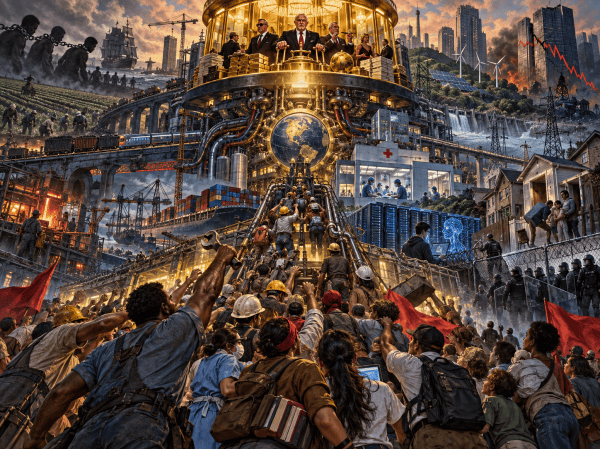
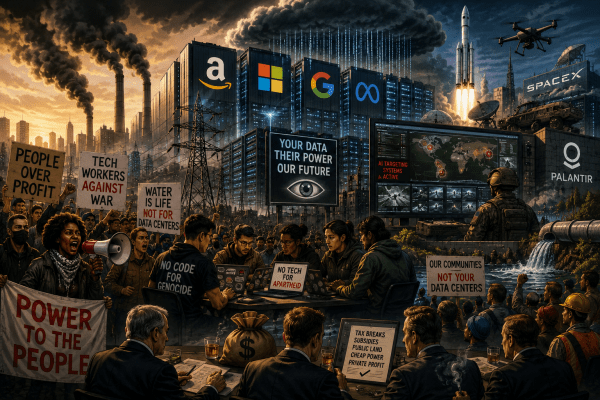
The Financial Times might report a stock market tremor as a mere sell-off, but beneath this facade lies a damning truth: Big Tech’s AI boom and SpaceX’s bubble float atop public resources, military contracts, and labor exploitation. This crisis isn't just an investor's blip; it reveals the rot of monopoly capitalism, where clouds obscure heavy debts to the state and imperialism. As SpaceX’s stocks drop, they signify a broader collapse of illusion, exposing the grim reality of military dependency and energy consumption. The future shouldn’t be left to financiers, but redirected to the people, demanding public ownership and accountability in the face of an engineered technological dystopia.
Bull Market, Broke People: The Stock Market’s Good News Is the Working Class’s Bad Joke
As markets soar, the majority of households are trapped in economic despair, cutting back on spending as essential prices rise and wages stagnate. The AP's analysis of "consumer confidence" reveals a grotesque class divide—where the wealthy thrive and the working class suffers under burdens of debt and inflation. This narrative cleverly masks the structural inequalities, framing economic distress as mere sentiment rather than a blatant symptom of a system rigged in favor of capital. The urgent call to action is clear: workers must unify and transform their economic plight into organized class power, recognizing that genuine change requires confrontational strategies, not empty optimism.
Inside the House of Cards: How Empire Manages Crisis Through Memory, Civility, and Myth
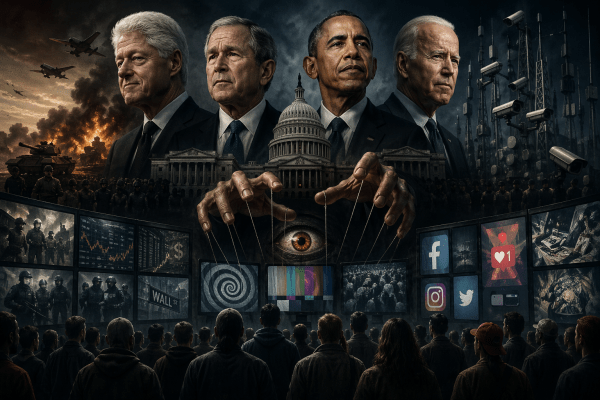
Four former presidents gather under corporate media lights to present democracy as a shared moral inheritance, grounded in unity, civility, and participation. Beneath that performance lies a material history of deregulation, war, surveillance, and repression that produced the very crisis now being discussed. The interview reveals not reflection, but a ruling-class effort to manage legitimacy... Continue Reading →
American Theocracy Revisited: Oil, Empire, and the Gospel of Decline
A dissection of how energy dependence, apocalyptic politics, and debt-fueled capitalism fused into a governing logic of U.S. power—and why, nearly two decades later, the contradictions Phillips identified have not resolved but evolved into a harder imperial strategy centered on energy command, infrastructural control, and technofascist crisis management. By Prince Kapone | Weaponized Information |... Continue Reading →
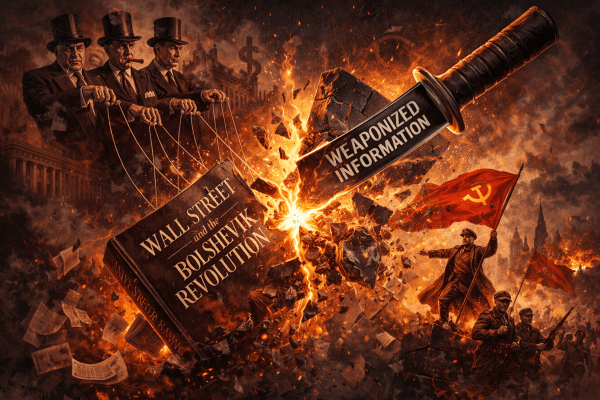
Wall Street vs. the Soviets: Sutton’s Banker Puppet-Show and the Class War He Tries to Hide
Sutton replaces workers, soldiers, and soviets with bankers and boardrooms, turning revolution into elite theater. Trotsky’s travel becomes “proof” of sponsorship, as bureaucracy and wartime chaos are rebranded as capitalist command. Forged documents linger as atmosphere while the real record—bank nationalization, debt repudiation, and trade monopoly—buries the thesis. The book ends where history begins: capital... Continue Reading →
Dope, Dollars, and Domination: A People’s History of Narco-Imperialism and the Making of the American Empire
The Drug War Isn’t a War — It’s the Operating System of U.S. Empire. From opium clippers to CIA proxy armies, from Panama’s offshore laundromat to Colombia’s paramilitaries and Mexico’s neoliberal narco-state, narcotics have long served as the financial engine, covert budget, social-control mechanism, and geopolitical scaffolding of the American Pole. By Prince Kapone |... Continue Reading →
Zohran Mamdani and the Contradictions of Socialist Governance in the Imperial Core
A victory born from crisis, constrained by capital, and tested by the global architecture of empire. By Prince Kapone | Weaponized Information | November 2025 A Victory Shaped by Crisis, Not Consensus Zohran Mamdani did not win the mayoralty of New York City because the city suddenly embraced socialism. He won because the crises that... Continue Reading →