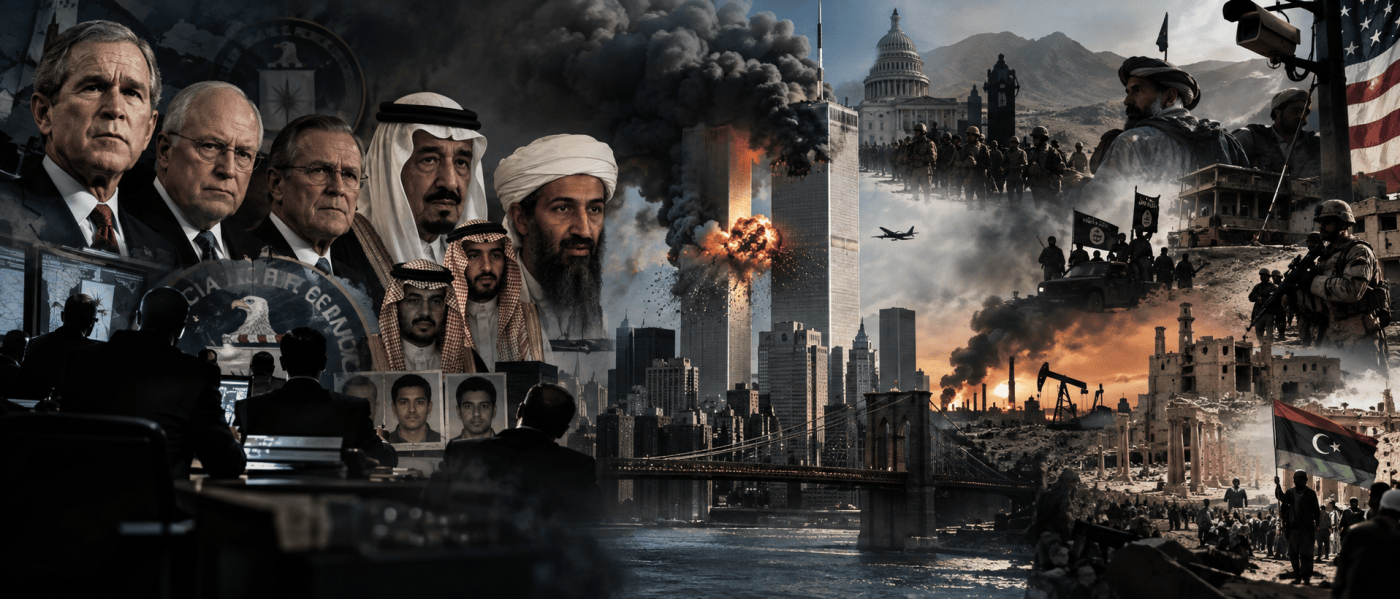
Max Blumenthal follows the armed networks cultivated through the Afghan jihad into Al Qaeda, 9/11 and the permanent wars Washington claimed would finally destroy the forces its own imperial statecraft had helped bring into being. The full architecture of September 11 may never be recovered, but the official story cannot explain the accumulated record of intelligence relationships, prior war planning, Saudi-linked facilitation, institutional obstruction and a catastrophe that arrived with extraordinary usefulness for an imperial project already waiting for political permission. Iraq, the domestic security state, Libya and Syria expose the contradiction at the heart of the project: empire repeatedly tried to weaponize instability and armed reaction, only to discover that the people and forces it empowered could develop objectives, alliances and consequences beyond imperial command. Twenty-five years later, permanent war has enlarged the coercive state while failing to preserve the unipolar world it was meant to secure—the savagery was managed, the managers became its servants, and the promised American century began collapsing under the weight of its own methods.
Prince Kapone | Weaponized Information | Weaponized Intellects Book Review | September 13, 2026
I. The Men Who Thought History Was Over
Max Blumenthal opens The Management of Savagery at a funeral. John McCain is dead, and Washington’s imperial establishment has packed itself into the National Cathedral to mourn one of its own. Dick Cheney is there. George W. Bush is there. Henry Kissinger and Barack Obama are there. Trump—the vulgar landlord who somehow wandered into the executive suite and occasionally insulted their wars—isn’t invited. The ceremony becomes what Blumenthal describes as a celebration of American empire, staged by a political class suddenly presenting itself as democracy’s last defense against the orange barbarian outside the gates. Then he drops the proposition around which the whole book turns: “Trump’s election would not have been possible without 9/11 and the subsequent military interventions conceived by the national security state” (PDF p. 11).
That sentence immediately places a problem before us. If September 11 helped produce the political world that eventually produced Trump, what kind of state was waiting for the attack when the planes hit? Blumenthal refuses the comforting fairy tale in which a peaceful republic woke up one morning, discovered terrorism, and reluctantly strapped on its gun belt. His history points in the opposite direction. Long before the towers fell, a powerful primacist current inside the U.S. ruling apparatus had already begun asking what should be done with the extraordinary prize dropped into Washington’s lap by the collapse of the Soviet Union.
The Red Army had retreated from Afghanistan. The Warsaw Pact dissolved. The Soviet Union itself disappeared. For the first time in the modern capitalist era, no state could match the United States militarily on a global scale. George H.W. Bush called the moment a “new world order.” Inside the Pentagon, the meaning was harder. The leaked 1992 Defense Planning Guidance placed the prevention of a new rival near the center of American strategy. Europe mattered. East Asia mattered. Southwest Asia mattered. The Cold War’s containment of an existing competitor was giving way to something more ambitious: stop the next one from becoming strong enough to challenge U.S. supremacy.
Blumenthal catches the arrogance of the moment through Paul Wolfowitz himself. After the Gulf War, General Wesley Clark visited the Pentagon expecting the usual victory lap. Wolfowitz gave him something closer to an imperial work schedule. “With the end of the Cold War, we can now use our military with impunity,” Clark remembered him saying. “The Soviets won’t come in to block us.” Washington had perhaps five or ten years, Wolfowitz continued, to “clean up” old Soviet-aligned governments such as Iraq and Syria “before the next superpower emerges to challenge us” (PDF p. 46).
There it is in plain English. No decoder ring required. The disappearance of the Soviet Union wasn’t received simply as relief from great-power war. It was received by an aggressive faction of the U.S. state as an opening that might close again. The problem was no longer how to contain Moscow. It was how to use the interval before another center of power arose.
West Asia sat near the center of that calculation for reasons more material than Washington’s later sermons about democracy. The Persian Gulf had already been declared a vital U.S. interest under the Carter Doctrine, with military force explicitly reserved against any outside power threatening control of the region. This was the zone containing the greatest concentration of exportable petroleum on earth, the fuel running factories, armies, shipping and industrial growth far beyond the Arab world. Oil mattered here as more than corporate profit. Whoever held decisive military power around the Gulf possessed leverage over a resource upon which competing industrial centers depended.
Blumenthal then shows how openly this new imperial confidence was being theorized. In 1996, Robert Kagan and William Kristol called for exploiting the vacuum left by the Soviet collapse so the United States could exercise “preponderant influence and authority over all others in its domain.” Their name for the arrangement was “benevolent global hegemony” (PDF p. 67). Empire had apparently discovered philanthropy. The bomb might fall on somebody else’s neighborhood, the sanctions might gut somebody else’s hospitals, but Washington’s intellectual class could still tuck the whole business under the warm blanket of benevolence.
More important, Kagan and Kristol identified the obstacle. Blumenthal notes that, in a world where the United States faced no comparable rival, they saw a relatively peaceful domestic atmosphere and lingering antiwar sentiment as barriers to renewed imperial expansion. Their complaint was not that the American state lacked military capacity. It lacked the political will to use that capacity as freely as they wanted.
Blumenthal gives that abstraction a social body a few pages later. In 1998, when Madeleine Albright, Sandy Berger and William Cohen appeared before a CNN town hall to sell another punishing strike on Iraq, they were met by a crowd of six thousand and what he calls “withering criticism” (PDF p. 69). Americans challenged the hypocrisy of supporting dictators elsewhere while threatening Baghdad, questioned the casualties sanctions and bombing were already producing, and refused to behave like a population begging for another war. The empire had aircraft carriers, bases, bombers and think tanks. It still had to manufacture consent.
That contradiction eventually took institutional form in the Project for the New American Century. Blumenthal follows Kagan and Kristol as they gathered Wolfowitz, Donald Rumsfeld, Richard Perle, Douglas Feith, Jeb Bush and other interventionists around the demand for a more openly militarized American supremacy. PNAC was not a secret cabal standing outside the state. It was the unusually candid ideological edge of a broader primacist current already moving through the Pentagon, Congress, think tanks and the foreign-policy establishment.
Its 2000 military blueprint called for preserving overwhelming U.S. military superiority, maintaining a durable Gulf presence and strengthening American military power in East Asia as China rose. Blumenthal quotes the line that would later acquire almost radioactive significance. Military transformation, the report warned, would likely proceed slowly “absent some catastrophic and catalyzing event—like a new Pearl Harbor” (PDF p. 68).
The sentence has often been asked to prove more than it can. By itself, it does not establish advance knowledge of September 11. Its historical significance is already damning enough. These strategists understood that their desired transformation exceeded the political conditions then available to them. They understood catastrophe could alter those conditions.
That is the contradiction Blumenthal leaves us with on the eve of 9/11: power was not the same thing as permission. The United States already possessed overwhelming military superiority, an empire of bases, a decades-old military stake in the Persian Gulf and a strategic current committed to preventing the rise of competing centers of power. But even an empire needs money voted, soldiers deployed and a population sufficiently frightened, persuaded or disciplined to tolerate the bloodletting.
So Blumenthal’s story begins before his terrorists arrive at center stage. One historical current is already moving: an empire that watched its principal rival disappear and decided the moment should be made permanent. Its strategists could see governments in West Asia they wanted broken or bent. They could see the oil fields, the bases, the shipping lanes and the next great-power challenger somewhere beyond the horizon. What they still lacked was the political event capable of turning imperial ambition into something closer to a blank check.
And while Washington was calculating how long its uncontested moment might last, another force was being assembled in the wreckage of an earlier imperial war.
II. The War That Built the Battlefield
The other force moving toward September 11 wasn’t born in a cave, and it wasn’t conjured into existence by Washington with a stamped CIA purchase order. Blumenthal is more careful than that. Afghanistan already contained deep social conflict before the Soviet Army crossed the border in December 1979. He describes a deeply conservative rural population leading much of the armed rebellion against Kabul’s secular modernization program, but his own account makes clear that the resistance was never one undifferentiated political body. Islamist factions competed with other mujahedin commanders while the communist government, rural communities, clerical networks and local power structures fought over the country’s future. Washington didn’t invent those contradictions. It intervened in them and changed their balance.
Blumenthal begins that transformation before the Soviet invasion itself. Zbigniew Brzezinski later acknowledged that covert U.S. intervention was intended “to induce a Soviet military intervention.” His calculation was cold enough to frost the page: lure Moscow into Afghanistan, give the Soviet Union its own Vietnam and bleed it through a war fought largely with other people’s bodies. Looking back, Brzezinski remained proud of the trap. The Soviets had entered it. Afghanistan would pay the bill (PDF p. 16).
But the trap couldn’t work through Washington alone. Pakistan became the workshop floor of the war. Jimmy Carter handed Muhammad Zia-ul-Haq’s military dictatorship and its Inter-Services Intelligence agency enormous power over the distribution of American weapons and assistance. The ISI wasn’t a neutral freight company hauling crates from one loading dock to another. Zia had his own political project: Islamize Pakistan, strengthen military rule and shape whatever government emerged next door. The factions receiving the best weapons and money were therefore selected through the strategic preferences of an allied state with ambitions of its own.
Blumenthal follows Mahmood Mamdani to the decisive point. Before the Afghan jihad, Mamdani writes, right-wing Islamists outside power lacked both mass organization and an alternative material base. Then the Reagan administration “rescued right-wing Islamism from this historical cul-de-sac” (PDF p. 17). That sentence tells us what imperial sponsorship actually does. An empire doesn’t have to manufacture an ideology from raw material. It can change history by deciding which existing political current gets rifles, money, training camps, refugee networks, foreign patrons and state protection.
Saudi Arabia supplied another pillar. The monarchy had just survived the 1979 seizure of the Grand Mosque at Mecca and responded to religious revolt by strengthening clerical power at home while projecting its official doctrine abroad. Afghanistan provided the perfect outlet. Blumenthal writes that Riyadh created a fund matching every CIA dollar committed to the mujahedin, while Saudi clerics sanctified the war and foreign volunteers were channeled toward Pakistan and Afghanistan (PDF p. 17). Reaction could be exported instead of confronted.
This is why Blumenthal’s history is more useful than the lazy formula that “the CIA armed the mujahedin.” Guns were only one part of what was being built. War had to reproduce itself socially. Refugee camps became political reservoirs. Aid passed through partisan institutions. Charities moved money. Clerics supplied purpose. Intelligence services supplied access. Schools could help shape the next generation. The battlefield extended into classrooms, mosques, aid offices, warehouses and barracks.
The grotesque little masterpiece was the American-funded schoolbook. A $51 million USAID grant helped produce roughly four million third-grade textbooks that taught Afghan children through images of weapons and arithmetic problems built around killing Russians. One lesson asked how many Soviet soldiers fled after twenty of fifty were killed. The Taliban later inherited and altered the books while preserving much of their jihadist language (PDF p. 21). What arrived as “education aid” helped turn the classroom into another firing position.
The refugee system worked similarly. Blumenthal cites UN research describing Afghans in Pakistan as “victims of political instrumentalization.” They were often received less as civilians entitled to refuge than as “partisan holy warriors” expected to demonstrate opposition to Kabul (PDF p. 26). Humanitarian relief bled into the war economy. Food, shelter and political allegiance could travel through the same channels. A displaced population became another terrain upon which states and armed movements struggled for power.
And then there was Gulbuddin Hekmatyar. The ISI and CIA poured money and weapons into one of the most ruthless Islamist commanders in the war because, as CIA veteran Vincent Cannistraro later put it, “He was the one who was the most effective fighter” (PDF p. 22). Blumenthal recounts Hekmatyar’s earlier involvement in violent Islamist organizing, including acid attacks against women and attacks on leftists, then shows him receiving hundreds of millions of dollars in weapons and aid. There’s the imperial moral code reduced to one sentence: effectiveness against the designated enemy outweighed the politics of the man holding the gun.
Secrecy made the arrangement easier. Blumenthal pauses over Congressman Charlie Wilson’s ability to double covert-war funding with almost no debate. “Covert proxy wars were easy this way,” he writes. “The public never had to know how or where their money was being spent” (PDF p. 20). That secrecy wasn’t merely administrative convenience. It insulated policymakers from antiwar pressure and democratic scrutiny while making room for profiteering. Washington could shape another country’s war while keeping American casualties—and much of the political responsibility—out of public view.
The cumulative effect was transformational. In 1984, Abdullah Azzam and Osama bin Laden founded Maktab al-Khidamat, the Services Bureau, which provided lodging, training and ideological instruction to foreign volunteers arriving from dozens of countries (PDF p. 18). Azzam supplied the religious-political network. Bin Laden supplied money and logistics. Saudi-backed charities reinforced the system. Pakistan provided the rear area. The Afghan war became an international school of armed politics where militants could meet, train, exchange contacts and imagine themselves as part of a single transnational struggle.
Then Reagan formalized the escalation through National Security Decision Directive 166, aimed at improving the resistance’s military effectiveness against Moscow. Operation Cyclone became the largest covert operation in CIA history, committing more than a billion dollars while supplying advanced weapons and training. Blumenthal’s judgment is exact: the American national-security state helped transform Afghanistan into a “petri dish for international jihadism” (PDF p. 19).
The metaphor matters because a petri dish doesn’t manufacture life out of nothing. It creates conditions in which selected organisms can multiply with extraordinary speed. Afghanistan already had Islamists, rural grievances, competing armed leaders and local political struggles. Pakistan pursued its own strategy. Saudi Arabia carried its own clerical project. Foreign volunteers brought their own convictions. The decisive imperial act was to concentrate money, weapons, logistics, intelligence and state sponsorship behind particular currents because those currents were useful against the Soviet Union.
And useful they were. The Soviets eventually withdrew. Washington celebrated.
But a force capable of defeating an empire’s enemy isn’t a sack of rifles that can be locked back in the warehouse when the contract expires. It has commanders, institutions, money, ideology, memories, grievances and ambitions of its own. The war had built far more than a battlefield.
It had built people who now knew how to carry that battlefield somewhere else.
III. The Weapon Learned to Choose Its Own Targets
A proxy isn’t a rifle. You can’t fire it across a border, wipe the fingerprints from the stock, and expect it to lie quietly in the armory when the war is over. The qualities that made the Afghan jihadists useful—organization, political conviction, military experience, independent leadership—also made permanent control impossible. Washington, Islamabad and Riyadh had spent the war expanding those capacities inside forces they wanted aimed at Moscow. Once the Red Army withdrew, the men they had helped empower did not become inert simply because the original target disappeared.
Blumenthal catches the transformation in a scene so absurdly perfect it could have been written as satire. Osama bin Laden returned from Afghanistan and sat with Prince Bandar bin Sultan, one of the Saudi royals who had helped coordinate the anti-Soviet war with Washington. Bin Laden thanked him enthusiastically for the American support that had helped defeat the “secularist, atheist Soviets.” Then Blumenthal turns the page of history with one sentence: “Bin Laden’s friendly attitude to Washington was fleeting” (PDF p. 36). Almost immediately after the Soviet withdrawal, bin Laden and Ayman al-Zawahiri were developing an organization capable of carrying jihad beyond Afghanistan. They called it Al Qaeda—the base—after their old Afghan military camp.
This is where both the official story and the crudest counter-story collapse. The official version wants a clean divorce: America supported Afghans fighting Moscow; later, unrelated fanatics mysteriously developed a hatred of the United States. The opposite simplification turns Al Qaeda into a CIA puppet whose every move remained remotely controlled from Langley. Blumenthal’s history permits neither escape hatch. Al Qaeda had an imperial genealogy and an autonomous political life. Those facts don’t cancel one another. They explain the contradiction.
That autonomy was already developing inside the movement itself. Zawahiri and Abdullah Azzam disagreed sharply over where jihad should go after Afghanistan. Azzam wanted to redirect armed struggle toward Israeli occupation and warned against spilling Muslim blood in campaigns against governments like Egypt. Zawahiri remained committed to overthrowing the Egyptian state. When a roadside bomb killed Azzam in Peshawar in November 1989, the perpetrators were never conclusively established. Blumenthal notes that suspicion ranged from Zawahiri to foreign intelligence services operating in the city. What is clear is that Azzam’s death removed the strongest internal rival to Zawahiri’s strategy and left Zawahiri with greater influence beside bin Laden (PDF p. 36).
The Gulf War pushed the break much further. When Saddam Hussein invaded Kuwait, bin Laden arrived before the Saudi leadership with battle plans and Afghan veterans, demanding the chance to defend the kingdom himself. The royals chose the U.S. military instead. To bin Laden, the decision confirmed that the Saudi state—with all its religious pageantry—ultimately depended on American military protection. Yesterday’s partner against Moscow became the armed guarantor of a monarchy he increasingly despised (PDF p. 42).
This is why “blowback” only gets us halfway there. The word makes the result sound like debris accidentally thrown backward after the original policy ended. But the relationships built during the Afghan war survived the Soviet withdrawal. Veterans moved through Sudan, Bosnia, Chechnya and elsewhere. Money networks remained. Training survived in memory and organization. Intelligence relationships endured. The institutions created for one conflict became available for another.
Jack Blum, the former Senate investigator who spent years examining the covert networks surrounding the Afghan war, called it Washington’s “disposal problem.” Teach men bomb-making, clandestine movement, assassination and covert organization, he warned, and they don’t forget because Congress stops appropriating money. Looking back at the jihadist infrastructure, he told Blumenthal, “we created the monster of all monsters” (PDF p. 35). Yet even “disposal” makes the militants sound too much like abandoned equipment. They were political actors deciding for themselves what to do with the capacities the war had given them.
Pakistan makes the point especially clear. Islamabad had never fought the Afghan war merely as Washington’s subcontractor. After the Soviet withdrawal, the Pakistani security establishment continued trying to shape the government next door according to its own strategic interests, eventually throwing major support behind the Taliban. Saudi backing followed. Parts of the U.S. foreign-policy apparatus initially treated the resulting order with remarkable tolerance. State Department spokesman Glyn Davies said Washington found “nothing objectionable” in the Taliban’s plan to impose Sharia law, while a senior U.S. diplomat told Ahmed Rashid that Afghanistan might develop like Saudi Arabia: an emir, pipelines, no parliament and plenty of Sharia. “We can live with that,” he said (PDF p. 59).
The bargain had consequences of its own. Bin Laden, forced from Sudan under American pressure, returned to Afghanistan in 1996. The Taliban distrusted him, but it needed patronage; he needed sanctuary. Blumenthal calls what followed a “marriage of convenience” that breathed new life into Al Qaeda just as the organization had reached one of its weakest points (PDF p. 60). The Taliban had an Afghan state project. Bin Laden and Zawahiri wanted an international war. Their objectives were not identical. They overlapped enough.
Meanwhile Zawahiri’s attempt to overthrow Egypt through the “near enemy” strategy was failing catastrophically. The 1997 Luxor massacre disgusted much of the Egyptian population and gave the state political room for a crushing crackdown. From Afghanistan, Al Qaeda began reworking the problem. If local governments survived because Washington armed and protected them, then the “far enemy” itself had to be struck.
The resulting strategy depended on American reaction. A Saudi dissident who knew bin Laden described the objective to Blumenthal as “full chaos in the region,” a breakdown in which existing governments could fall and jihadist politics could expand (PDF p. 65). By the time Al Qaeda bombed U.S. embassies and attacked the USS Cole, provoking Washington was no longer a side effect of its violence. Provocation was becoming the point.
Mohammed Atef, one of Al Qaeda’s senior military planners, eventually stated the strategy without disguise. He told Al Jazeera correspondent Ahmad Zaidan that Afghanistan, Iraq and Somalia were ideal places to bleed an overstretched United States. “We are expecting the United States to invade Afghanistan,” Atef said. “We want the United States to invade Afghanistan” (PDF p. 72).
The historical reversal is savage. Brzezinski had once sought to lure Moscow into an Afghan trap. The political descendants of the forces his strategy helped empower had studied the lesson and were preparing a trap of their own.
By then Al Qaeda wasn’t Washington’s obedient instrument. It had become something more dangerous: an autonomous enemy whose cadres, skills, institutions and strategic imagination had developed inside a political-military world that U.S. power and its allies had materially helped build. The weapon had walked out of the armory and chosen the imperial center as its target.
And it wasn’t moving invisibly. As Al Qaeda prepared the operation meant to pull the United States into its own Afghan war, pieces of the coming danger were already passing through intelligence files, surveillance operations, embassies and allied services. The question was no longer where the enemy had come from. It was how much the state that helped build the battlefield could see of what was now moving across it.
IV. The Day the Two Histories Met
By September 2001, the two historical currents Blumenthal has been following were moving toward the same point. Al Qaeda had decided that the United States could be bled through the very interventionist reflex its strategists were trying to provoke. Across Washington, meanwhile, a primacist current had spent the post-Soviet decade demanding greater freedom to use American military power. The coming collision would not make those projects identical. It would give each something it wanted from the other.
Blumenthal brings us into the immediate prehistory through Khalid al-Mihdhar and Nawaf al-Hazmi, two future hijackers whose movements had already crossed American intelligence screens. CIA officers photographed Mihdhar’s passport while monitoring an Al Qaeda meeting in Kuala Lumpur. The agency later learned that Mihdhar possessed a U.S. visa and that Hazmi had traveled with him to Los Angeles. Yet the information did not reach the FBI in time for an effective domestic investigation. Blumenthal is blunt: despite knowing the men had attended a gathering of senior Al Qaeda operatives, the CIA withheld critical information about their presence in the United States (PDF pp. 76–79). A later Justice Department review confirmed serious failures in the handling and transmission of that intelligence.
That failure becomes harder to dismiss as a simple problem of disconnected filing cabinets once Blumenthal follows the men into Southern California. Omar al-Bayoumi met Hazmi and Mihdhar soon after their arrival, helped them find housing, cosigned their lease and provided material assistance. Blumenthal also traces Bayoumi’s contacts with Saudi consular official Fahad al-Thumairy and notes that an FBI source suspected Bayoumi might be a Saudi intelligence officer. During the period when he was assisting the future hijackers, Bayoumi maintained extensive contact with Saudi officials and institutions (PDF pp. 77–78).
The later record makes this terrain even more difficult to close. The FBI’s Operation Encore investigated whether Saudi embassy official Musaed al-Jarrah may have stood above Thumairy and Bayoumi in a facilitation network. Released FBI material records investigators examining whether al-Jarrah had tasked the two men to assist Hazmi and Mihdhar. That finding must be kept precise. Bayoumi’s direct assistance is documented. Thumairy and al-Jarrah were investigated for possible facilitation and tasking. The public record still does not establish that senior Saudi leaders knew the operational plan for September 11 or ordered the attack.
That distinction strengthens the argument rather than weakening it. The historical problem is already severe: men preparing the deadliest attack on U.S. soil moved through networks connected to one of Washington’s closest regional allies, while American agencies were simultaneously committed to intelligence relationships and strategic alliances with the same states through which the earlier jihadist infrastructure had been built. “Intelligence failure” describes what happened administratively. It does not, by itself, explain the political relationships inside which those failures occurred.
Pakistan presents a similarly disturbing but less settled line. Journalists, former officials and 9/11 family members pursued allegations that Omar Saeed Sheikh transferred funds to Mohammed Atta and that Pakistan’s ISI chief, Lt. Gen. Mahmoud Ahmed, stood behind the transfer. The claim reached congressional discussion, but the publicly accessible documentary chain still does not prove the strongest version cleanly enough to treat it as settled history. The proper conclusion is narrower: the Pakistan financing question was serious, it was never resolved with the clarity the official narrative later projected, and it remains open.
The warning environment itself is less ambiguous. Blumenthal describes a summer in which CIA director George Tenet later said “the system was blinking red.” A July intelligence brief warned that “Bin Laden Threats Are Real.” Then, on August 6, Bush received the presidential daily brief titled “Bin Laden Determined to Strike Inside the US,” warning of an Al Qaeda presence and possible preparations for attacks inside the country (PDF pp. 80–81). The state did not possess the complete tactical plan—flight numbers, targets, timing and the full roster of attackers. But it was not confronting a domestic strike that no one had imagined.
Blumenthal’s own treatment of this material is useful because it resists the easy ending. The record contains warnings, missed opportunities, intelligence withheld between agencies and disturbing allied-state relationships. Those facts are enough to demolish the image of September 11 as an unknowable bolt from nowhere. They do not, by themselves, establish that U.S. officials possessed precise operational foreknowledge and consciously allowed the attack to proceed.
The official investigation did not close these questions as completely as its public authority later suggested. The Bush administration initially resisted the creation of an independent commission, and victims’ families had to fight to get one established. Its executive director, Philip Zelikow, and historian Ernest May produced a remarkably detailed report outline by March 2003, while much of the investigative work still lay ahead. May later described that early architecture in his own Commission memoir. The existence of the outline does not prove that every conclusion had been predetermined. It does establish that the narrative structure was taking shape unusually early.
The air-defense record adds another crack. NORAD and FAA officials initially supplied accounts of the military response that later proved materially inaccurate. When Commission investigators obtained underlying recordings, the discrepancies became serious enough that some commissioners and staff considered whether officials had deliberately misled them. Later inspectors general did not establish intentional deception. But the basic fact remains: a central part of the first official chronology had to be rewritten after investigators obtained the underlying tapes. The episode is documented in the later Commission record.
So the official story cannot function here as scripture. Too much evidence surfaced late. Too much remained compartmentalized or classified. Too many later investigations complicated conclusions that had once been presented with finality. But rejecting official closure does not require filling every unresolved space with a certainty the evidence cannot bear. Strategic warning is not the same as proven tactical foreknowledge. Material assistance is not the same as operational command. Investigative obstruction is not automatically authorship.
What is beyond serious dispute is the historical collision itself. An autonomous Al Qaeda operation emerged from the transnational jihadist world the earlier Afghan proxy war had helped expand. It struck an American state whose most aggressive strategists had already demanded greater military freedom, enduring Gulf power and a global order capable of preventing future rivals. The attack shattered the political restraints that had frustrated that project.
That is where PNAC’s “catastrophic and catalyzing event” returns with a new meaning. The phrase does not prove foreknowledge. It proves that the architects of military transformation already understood catastrophe as a force capable of breaking political resistance. On September 11, catastrophe arrived.
From that point forward, the most demonstrable question is not who benefited in the abstract. It is what the state did with the opening. Congress widened executive war authority. Afghanistan became the first battlefield. Iraq was already moving into view. Surveillance, detention and emergency government expanded behind the smoke.
A specific crime was about to become a world order.
V. A Crime Became a World Order
Congress answered September 11 by handing the executive branch a weapon with no clear expiration date. The 2001 AUMF authorized the president to use force against those he determined had planned, aided or harbored the attackers. But the political meaning quickly outran the crime itself. Bush had already promised a struggle without ordinary borders or timetables. Congress supplied the legal steel. Blumenthal puts it plainly: lawmakers “gave their blessing to America’s forever war” (PDF p. 96).
Afghanistan was the first battlefield, and even there the mission began expanding while its central target escaped. Bin Laden crossed into Pakistan after Tora Bora, moving through terrain and relationships inherited from the anti-Soviet jihad. The man whose capture supposedly justified the invasion vanished, but the war stayed behind. Washington built bases, financed a new Afghan army and sank itself into an occupation that grew around the absence of the enemy it had failed to catch. Failure did not narrow the mission. It enlarged it.
Then the category widened again. Iraq had no operational responsibility for September 11. Saddam Hussein’s secular Ba’athist government regarded Al Qaeda’s politics as a threat to its own rule. Yet the faction that had spent the 1990s demanding regime change now possessed something it had previously lacked: a traumatized public and a political language broad enough to dissolve distinctions that once mattered. Terrorism became the solvent poured over them. Once Saddam, bin Laden, weapons of mass destruction and September 11 could be poured into the same bucket, Baghdad could be made to look like an extension of Manhattan.
Blumenthal follows the machinery into the Pentagon’s Office of Special Plans, which the Senate Foreign Relations Committee later called an unofficial “Iraqi intelligence cell” created to circumvent the CIA and secretly brief the White House on supposed ties between Saddam Hussein and Al Qaeda (PDF p. 97). Donald Rumsfeld sponsored it. Dick Cheney gave it political cover. Douglas Feith and his circle fed material upward. Ahmed Chalabi and the Iraqi National Congress supplied defectors whose stories arrived conveniently tailored to Washington’s appetite. Intelligence no longer had to discover the case for war. The case for war had begun manufacturing intelligence.
Chalabi delivered Adnan al-Hadeiri, who claimed Saddam maintained clandestine chemical, biological and nuclear facilities. The CIA had already found his story unreliable enough that he failed a polygraph, but that did not stop Judith Miller’s New York Times from giving the allegations prestige while unnamed officials amplified them. The Pentagon paid public-relations firms millions to promote regime change. Blumenthal describes al-Hadeiri’s claims as the beginning of “a long line of hyped and fraudulent stories” that helped propel the United States toward invasion (PDF p. 98). Apparently the Republic’s solemn defense against terrorism came with a marketing department.
But Iraq matters in Blumenthal’s argument for a deeper reason than the fraud used to open the door. Washington did not merely invade the wrong country. It dismantled a state and created the political terrain in which the jihadist force it claimed to be fighting could grow.
The occupation authorities disbanded Iraq’s army and gutted the state through de-Ba’athification. Blumenthal shows how Douglas Feith’s plan, implemented by Paul Bremer, forced as many as 100,000 people from public employment, including roughly 40,000 schoolteachers who, George Tenet acknowledged, had often joined the Ba’ath Party simply to keep their jobs. Skilled administrators were thrown into unemployment while soldiers, officers and intelligence personnel watched a foreign army dissolve the institutions around which their lives had been organized. When reporter Rajiv Chandrasekaran asked an American soldier what had happened to the disbanded Iraqi army, the answer carried the occupation’s logic in four words: “They’re all insurgents now” (PDF p. 103).
The danger was not unknowable. A January 2003 National Intelligence Council assessment warned that Al Qaeda or other terrorist groups could maintain or expand a presence if a postwar government failed to establish effective security across Iraq. It also warned that former regime personnel might join terrorist organizations or wage guerrilla war against occupation forces (PDF pp. 103–104). The warning was brief, but it existed before the invasion. Washington invaded anyway.
Abu Musab al-Zarqawi entered the opening. Blumenthal traces him back through the same Afghan jihadist world already established in this review: the Services Bureau milieu, Hekmatyar’s forces and the generation of militants formed after the Soviet war. Before the U.S. invasion, Zarqawi operated from Kurdish territory outside Baghdad’s effective control. Colin Powell nevertheless displayed him before the United Nations as evidence of a Saddam–Al Qaeda connection. The reality ran in the opposite direction. Zarqawi had to remain outside the reach of a government hostile to him. Once the United States destroyed that government, his organization entered the chaos of the Sunni Triangle and began building power (PDF pp. 104–105).
Zarqawi’s strategy was brutally political. He wanted sectarian civil war. By massacring Shia civilians and attacking holy sites, he sought to provoke retaliation severe enough to convince Sunnis that only armed jihadists could protect them. “If we are able to strike them with one painful blow after another until they enter the battle, we will be able to reshuffle the cards,” he explained. The objective was polarization: destroy the social space between communities, force people behind armed camps and manufacture the constituency an Islamic state would need (PDF p. 105).
The occupation repeatedly helped him do it. Abu Ghraib exposed torture and sexual humiliation inside the American prison system. U.S. forces imported Israeli occupation methods into Iraq, including urban warfare and assassination tactics. Blumenthal then follows the “Salvador Option” into the country through James Steele, the former U.S. adviser associated with Washington’s dirty war in El Salvador. Steele helped organize Iraqi police commandos drawn heavily from Shia militias. Secret detention centers and torture accompanied the project. As those forces were unleashed against Sunni insurgent areas, sectarian killing escalated and the occupation’s counterinsurgency began ratifying the polarization Zarqawi wanted (PDF pp. 107–108).
By 2004, Al Qaeda had accepted Zarqawi’s pledge and established its first Iraqi franchise. Two years later, the organization declared an Islamic state and demanded Sunni allegiance to a new emir. Blumenthal’s Iraqi source Ruba Ali Al-Hassani states the historical consequence without euphemism: America’s 2003 war “definitely allowed for the festering of terrorism” (PDF p. 105). A British security study reached the same conclusion in colder language, finding that the invasion boosted Al Qaeda’s propaganda, recruitment and fundraising while turning Iraq into an ideal training and targeting ground (PDF p. 106).
This is where Blumenthal breaks cleanly with the liberal story of Iraq as an unfortunate detour from an otherwise legitimate War on Terror. Iraq wasn’t simply a distraction from counterterrorism. It revealed what the doctrine had become. A real enemy existed. Al Qaeda had attacked the United States and wanted further war. Washington took that real threat and stretched it into a political category large enough to contain governments uninvolved in the attack, regime-change projects conceived before it and strategic ambitions extending far beyond destroying the organization responsible.
The crime supplied the authorization. The authorization supplied the war. The war destroyed a state. The wreckage supplied a new generation of the enemy.
And while that cycle burned through Afghanistan and Iraq, the emergency was hardening into institutions at home. A forever war abroad required a homeland permanently organized to police the danger it claimed could arrive from anywhere.
VI. The War Came Home Before the Soldiers Did
The War on Terror didn’t stop at the shoreline. Long before veterans carried Afghanistan and Iraq home in their memories, the political logic of those wars had already crossed the border. The same state learning to map neighborhoods in occupied cities, cultivate informants, fuse intelligence and identify threats before they acted began rebuilding domestic policing around a similar demand: find the enemy hidden inside ordinary life. Blumenthal traces the transfer through armored vehicles, registries, police intelligence units, Muslim informants and maps of supposedly dangerous communities. Counterinsurgency was coming home dressed in a local uniform.
He catches the ideological bridge in Avi Dichter, the former head of Israel’s Shin Bet. Addressing thousands of American police officers in 2006, Dichter insisted there was an “intimate connection between fighting criminals and fighting terrorists,” warning that police now confronted “crimiterrorists.” FBI director Robert Mueller embraced him as a counterterror mentor (PDF p. 109). The ugly little word gives away the transformation. The criminal suspect and the military enemy were being pulled toward the same political category. Ordinary policing could now borrow the imagination of war.
Weapons followed the doctrine. Blumenthal tracks the post-9/11 flow of military equipment into police departments through the Pentagon’s 1033 program: assault rifles, armored vehicles and battlefield hardware moving into American towns. The Justice Department simultaneously funded police hiring that brought veterans of Afghanistan and Iraq into local departments. But the deeper transfer wasn’t hardware. It was a way of seeing.
Attorney General John Ashcroft announced the National Security Entry-Exit Registration System by warning that dangerous men could “move unnoticed through our cities, neighborhoods, and public spaces.” Their camouflage, he said, was ordinary clothing. NSEERS forced male visitors from overwhelmingly Muslim-majority countries into a registration and surveillance regime. The suspected enemy no longer had to be carrying a rifle or planting a bomb. He could be a student, cabdriver, shopkeeper or traveler whose nationality and associations placed him inside a category constructed before any crime had occurred.
New York carried the method further. The NYPD created a Demographics Unit that sent officers into mosques, cafes, restaurants, student groups and businesses. Blumenthal quotes a former police official describing its mission as an effort to map the city’s “human terrain,” a term borrowed from military counterinsurgency and influenced by Israeli practices in the occupied West Bank (PDF p. 110). The language is almost too perfect. A city becomes terrain. A neighborhood becomes an intelligence problem. A community becomes something to map before anyone in it has done anything.
The CIA was inside the project. Former agency operations official David Cohen entered the NYPD intelligence division and helped build the apparatus. Blumenthal describes “mosque crawlers” infiltrating places of worship and “rakers” moving through businesses and social spaces, sometimes asking Muslims what they thought about American wars in the Middle East. Political sentiment produced by imperial policy could itself become intelligence. Washington bombed Muslim societies abroad, then sent police into Muslim neighborhoods at home to measure the anger.
For all that mapping and infiltration, the Demographics Unit produced no terrorism cases. Blumenthal calls the surveillance apparatus “the domestic echo of the war on terror” (PDF p. 111). But what emerged after 9/11 was more than an echo. Foreign counterinsurgency’s central question—who might become dangerous?—was being wired into ordinary governance.
The federal government made the relationship explicit. The Bush administration’s homeland-security strategy joined fighting terrorism overseas to reorganizing security at home. The Department of Homeland Security consolidated agencies under a permanent domestic-security bureaucracy. Joint Terrorism Task Forces tied federal agents to state and local police. Watchlists allowed national-security classifications to follow people through airports, borders and routine encounters. The whole project depended on making information travel farther and faster across institutions that had once been more separated.
Fusion centers became local switchboards for that new wiring. Built in the political atmosphere of terrorism prevention, they linked state police, local departments and federal agencies into shared intelligence networks. But terrorism didn’t remain the sole mission for long. A GAO review found that forty-one of forty-three operational fusion centers it surveyed had expanded beyond counterterrorism. Many adopted “all crimes” or “all hazards” missions. Officials even described the broader mission as helping make the centers institutionally sustainable.
That sentence tells us more than a stack of mission statements. An institution created under emergency conditions discovers that terrorism alone can’t guarantee its permanence, so its jurisdiction widens. Terrorism becomes crime. Crime becomes hazard. Hazard becomes suspicious activity. The extraordinary security apparatus begins settling into ordinary government.
This is where Blumenthal’s “counter-jihad” becomes more than a story about racist ideologues. He describes a “comfortable, mutually reinforcing symbiosis” between jihadists and Western activists who treated Muslims themselves as a civilizational threat (PDF p. 115). Each camp needed the other’s ugliest image. Jihadists pointed to repression as proof that Muslims could never belong in the West. Counter-jihadists pointed to jihadist violence as proof that Muslims could never belong. Surveillance gave that political suspicion an administrative body.
The wars supplied the culture around it. Blumenthal describes veterans and propagandists redirecting the fury of Afghanistan and Iraq toward Muslim life inside the United States. By then, he writes, “Islamophobia had become the language of a wounded empire,” with rage increasingly displaced onto “the mosque down the turnpike, the hijabi in the checkout line, the Sikh behind the cash register” (PDF p. 114). Racism shouted from a television studio can poison a society. Racism connected to watchlists, police intelligence, immigration files and federal databases can organize state power.
None of this appeared from nowhere after September 11. The United States already possessed a long history of political policing, domestic intelligence, racialized surveillance and militarized repression. The War on Terror didn’t invent those capacities. It supplied a new enemy, new legal authorities, enormous new budgets and connective tissue capable of tying local observation to a permanent national-security apparatus.
That is why the post-9/11 order is best understood as an institutional embryo of what WI now calls technofascism, not the finished formation itself. The later system would require monopoly technology firms, commercial cloud infrastructure, mass digital data, predictive analytics and artificial intelligence woven much more deeply into military, police and intelligence power. But essential bones were being set here: permanent emergency, preventive surveillance, fused databases, militarized policing and the treatment of populations as fields of risk to be monitored before they acted.
The War on Terror had therefore accomplished something larger than sending armies overseas. It was reorganizing the relationship between the imperial state and people living inside the imperial center. The battlefield no longer needed a desert, a mountain pass or an occupied city. It could be a mosque, an airport, a college association, a traffic stop, a neighborhood.
Yet all this new supervisory power still hadn’t solved the contradiction at the center of Blumenthal’s history. The occupations grew more expensive, the wars more poisonous and the forces unleashed by them no easier to command. Washington would soon reach again for the method that had started the cycle: let somebody else carry the rifle.
VII. The Method Returns
By the time Washington reached Libya, nobody could honestly plead ignorance anymore. Afghanistan had already produced Al Qaeda. Iraq had already turned occupation, state destruction and sectarian war into the soil from which a new jihadist formation was growing. The lesson was written in blood and rubble: destroy a state, flood an armed political field with outside money and weapons, and the men carrying those weapons will develop purposes of their own. Blumenthal’s next chapters aren’t about Washington learning from that disaster. They’re about Washington changing the packaging.
Obama didn’t send an Iraq-sized occupation army into Libya. NATO bombed from above while local forces fought below. Airpower, intelligence, allied monarchies and armed intermediaries could carry the regime-change project without another American occupation authority sitting in Tripoli. The method promised leverage at lower political cost.
Blumenthal exposes the first contradiction through Muammar Gaddafi himself. Libya had abandoned its embryonic nuclear program, surrendered chemical weapons and cooperated extensively with Western intelligence against jihadist organizations. A secret 2008 U.S. embassy cable called Libya a “strong partner in the war against terrorism” and praised intelligence cooperation as excellent (PDF p. 130). Yet once rebellion erupted in 2011, Washington and its allies moved against the same government with an armed coalition containing men drawn from the jihadist milieu they had previously hunted.
Abdelhakim Belhaj embodied the reversal. A veteran of the Afghan jihad and leader of the Libyan Islamic Fighting Group, Belhaj had once moved through the wider world shaped by bin Laden’s networks. After 9/11, the CIA helped capture him and render him to Gaddafi’s Libya. During the 2011 war, he reappeared as commander of the Tripoli Military Council. Qatar poured weapons into Islamist currents inside the rebellion while Western leaders presented the armed opposition as a democratic uprising conveniently stripped of its most reactionary components.
Years later, a British parliamentary inquiry reached conclusions that make the triumphal story difficult to maintain. It found that Western intervention rested on weak intelligence, failed to account adequately for the rebellion’s significant Islamist element, drifted from civilian protection into regime change and helped produce political collapse, militia warfare, regional weapons proliferation and the growth of ISIS in North Africa. The consequences weren’t unforeseeable abstractions. They followed from the social forces actually being empowered on the ground.
Gaddafi had warned Tony Blair that destroying the Libyan state would open space for Al Qaeda. Washington dismissed the warning as the desperation of a doomed ruler. Then the state was shattered, arms depots were stripped, competing militias divided the country and weapons began moving outward across Africa and toward another war already opening to the east.
Blumenthal writes that a senior Clinton aide called the Syrian arm-and-equip project the “bank shot” from Libya (PDF p. 143). The metaphor is revealing. Libya wasn’t simply one failed intervention followed by an unrelated crisis. Networks, weapons and political relationships created or expanded through the destruction of one Arab state were redirected toward another. The ball struck Libya and ricocheted into Syria.
That changes the meaning of blowback. Afghanistan can still be defended as a Cold War policy whose ultimate consequences Washington supposedly couldn’t have foreseen. By Syria, that excuse had expired. The United States had already lived through Afghanistan, Al Qaeda, September 11, Iraq and the rise of an Islamic State organization in Iraq. Policymakers no longer had the luxury of pretending that heavily arming Islamist-dominated insurgent environments carried no foreseeable danger.
The intelligence record made the problem even harder to deny. In August 2012, a Defense Intelligence Agency report assessed that Salafists, the Muslim Brotherhood and Al Qaeda in Iraq were major forces driving the insurgency. It warned of the possible creation of a “Salafist principality in eastern Syria” and of renewed momentum for the Islamic State of Iraq across the Syrian-Iraqi border. Blumenthal notes that the document circulated while Lieutenant General Michael Flynn headed the DIA. Asked later whether the administration had ignored what his agency was reporting, Flynn answered, “I think it was a decision, I think it was a willful decision” (PDF p. 155).
The weapons kept moving.
CIA officers worked from Turkey while Saudi Arabia, Qatar and Turkey supplied arms into rebel networks. Washington publicly divided the insurgency into acceptable “moderates” and unacceptable extremists, but the battlefield refused to honor the brochure. Douglas Laux, the CIA officer Blumenthal identifies as a central figure in the agency’s Syrian program, later summarized the problem more bluntly than the program’s public defenders ever did: “There were no moderates” (PDF p. 156).
That doesn’t mean every armed opponent of Damascus belonged to Al Qaeda or ISIS. Blumenthal’s own account is more concrete than that. It shows specific U.S.-backed commanders and factions cooperating tactically with jihadist organizations, sharing battlespaces and losing fighters or materiel into stronger Islamist formations. At Menagh air base, U.S.-backed commander Abdul Jabbar al-Okaidi appeared beside ISIS commander Abu Omar al-Shishani after the rebel victory and later described his relationship with ISIS fighters as “good, even brotherly.” He also publicly praised Jabhat al-Nusra’s fighters for their conduct in battle (PDF p. 160). The point isn’t that organizational distinctions disappeared. It is that Washington’s clean political categories repeatedly broke down in the material relations of the war.
By 2013 the contradiction was naked enough for Representative Dennis Kucinich to put it in one savage sentence. As the Obama administration moved toward direct strikes against the Syrian government, he asked, “So what, we’re about to become Al Qaeda’s air force now?” (PDF p. 163).
The line sounds like sarcasm because reality had become almost too absurd for ordinary prose. The United States still claimed a global war against Al Qaeda while pursuing regime change against a government whose defeat would strengthen an insurgent field in which Al Qaeda’s Syrian affiliate had become one of the most powerful forces. Counterterrorism remained the universal doctrine. Overthrowing Damascus remained the immediate objective. When the two collided, the supposedly absolute enemy could become a tolerable beneficiary.
And this was no marginal experiment run from somebody’s basement. At its peak, Blumenthal writes, the CIA was spending “$1 out of every $15 in its entire budget” on covert operations in Syria (PDF p. 173). The scale matters. Washington was committing one of the world’s largest intelligence services to an armed political environment it already knew contained powerful jihadist organizations and porous boundaries among nominally separate factions.
As the war dragged on, support expanded beyond guns. Western governments financed communications, media, humanitarian programs and governance structures in rebel-held territory. Blumenthal’s sharpest conclusion arrives when he argues that the United States and its allies had provided “civil infrastructure for the very jihadists they had sworn to destroy during the so-called ‘war on terror’” (PDF p. 196). By then the contradiction had moved beyond accidental weapons leakage. The wider support system was helping sustain territory in which Al Qaeda-linked forces exercised substantial political and military power.
This is where the historical category has to change. Afghanistan could still be narrated as unintended consequence. Libya and Syria came after the consequences were known. Blumenthal’s record points instead toward strategic instrumentalization under incomplete control: imperial planners accepted the danger of empowering armed forces they couldn’t fully command because those forces remained useful against a more immediate enemy.
They didn’t have to love the jihadists. They didn’t have to command every fighter. They didn’t even need the relationship to last. They needed battlefield pressure now and accepted the danger later.
Once that recurrence becomes visible, Blumenthal’s title stops describing a sequence of mistakes. It begins to describe a method. The same state that vows to destroy savagery keeps discovering strategic uses for the conditions in which it grows—and then acts surprised when the thing refuses to stay where empire put it.
VIII. The Empire Manufactured the Crisis It Needed to Police
Blumenthal tells us where he is going before the first chapter begins. Abu Bakr Naji’s doctrine of exploiting breakdown and social chaos, he writes, “dovetailed neatly” with regime-change schemes circulating among Washington’s national-security hard-liners. Then comes the sentence that governs the book: “savagery by its very definition cannot be managed.” It has, Blumenthal adds, “already found its way back home” (PDF p. 12).
By this point, “management” no longer means that Washington secretly controlled every jihadist it encountered. Blumenthal has already demolished that fantasy. The forces useful to imperial strategy are useful precisely because they can recruit, organize, fight and govern without waiting for an American officer to issue instructions. Their autonomy is not an accidental flaw introduced into the arrangement. It is one of the conditions that makes indirect warfare possible.
That is why the historical relation keeps escaping the weak category of blowback. Washington and its allies selected and amplified reactionary armed forces in Afghanistan because they could hurt the Soviet Union. The resulting networks acquired purposes of their own. Al Qaeda later struck the United States and sought the imperial overreaction it believed would exhaust Washington. The United States answered by turning a specific attack into permanent war, destroying Iraq and helping create the terrain in which a new jihadist state could grow. Years later, after those consequences were already known, Libya and Syria returned Washington to armed political fields in which jihadist forces again became useful, tolerated or empowered against a more immediate enemy.
The recurrence is what changes the meaning. A policy can produce an unforeseen consequence once. When similar relations reappear after the consequence has become part of the historical record, ignorance becomes a thinner defense. What emerges in Blumenthal’s account is an imperial wager: accept forces that can’t be fully controlled because they can still perform strategic work now, then gamble that money, intelligence, airpower and allied governments will contain whatever follows.
History keeps refusing the wager.
States used as conduits pursue their own interests. Militias change patrons. Weapons migrate. Fighters defect. Intelligence services conceal things from one another. Occupied populations resist. Refugees cross borders. Organizations split and recombine. The very social depth that gives an intermediary military power also gives it the capacity to escape the designs of the state trying to use it. Imperial command repeatedly confronts the autonomy of the political forces through which that command is exercised.
But Blumenthal’s darker discovery is that failure doesn’t necessarily weaken the institutions that produced it. The consequences can become new resources for them. Al Qaeda attacks the United States; the national-security state receives greater authority. Iraq generates another jihadist formation; that formation justifies an enlarged counterterror apparatus. Foreign war produces displacement and political reaction; reaction strengthens borders, surveillance and police power. The crisis becomes evidence that the institutions which helped create the conditions for crisis need still more power to manage it.
That same motion appears ideologically in what Blumenthal calls a “comfortable, mutually reinforcing symbiosis” between jihadists and the Western counter-jihad movement (PDF p. 115). They are enemies, but their antagonism is politically productive for both. Jihadists point to Muslim repression as proof that coexistence with the West is impossible. Islamophobes point to jihadist violence as proof that Muslims themselves are the danger. Each camp turns the other’s ugliest act into recruitment material.
ISIS understood the relation with chilling precision. In its essay on “The Extinction of the Grayzone,” the organization argued that spectacular violence could push Western societies toward repression severe enough to destroy the middle ground in which Muslims could live without choosing between jihadism and an openly hostile state. Its objective was to “compel the crusaders to actively destroy the grayzone themselves” (PDF p. 231). Blumenthal then shows how Trump’s politics supplied exactly the kind of polarization ISIS wanted, writing that his candidacy presented “a perfect opportunity” for the strategy (PDF p. 232).
The same cycle had already acquired institutional form inside the United States. Section VI established the surveillance, police-intelligence and population-mapping apparatus that grew from the War on Terror. The important point here is not to inventory that apparatus again. It is to see its place in the larger relation: crisis enlarges state power; enlarged state power broadens the population treated as potentially dangerous; that expansion normalizes permanent emergency; permanent emergency gives the state new instruments for governing the next crisis.
This is the principal contradiction Blumenthal’s history forces into view: imperial power tries to convert destabilization into command, while the political forces released through destabilization develop consequences that exceed command. The empire then tries to absorb those consequences back into itself—as justification for more war, more surveillance, more policing and another attempt to manage what the last attempt helped unleash.
Here also lies the book’s deepest theoretical limit. Blumenthal exposes the national-security state with extraordinary force, but too often that state becomes the final explanatory subject. It acts, plots, arms, surveils and intervenes—but what social order keeps reproducing it across administrations, parties and repeated catastrophe? His own evidence points toward the answer without fully developing it: military industry, oil, finance, imperial alliances, intelligence institutions and ruling fractions whose interests survive the politicians temporarily sitting above them. The national-security state is not a free-floating monster. It is embedded in the reproduction of an imperial capitalist order.
That extension does not weaken Blumenthal’s argument. It gives his machine an engine. The same ruling order that repeatedly uses destabilization abroad also enlarges the coercive institutions required to manage the consequences at home. The book shows us the recurring method. A materialist reading explains why the method survives its disasters.
So the title finally becomes more than an accusation. The management of savagery names a recurring mode of imperial statecraft: produce or intensify disorder, enter it through armed intermediaries, use those intermediaries against a strategic enemy, then assume superior wealth and force will be enough to contain what comes afterward. The containment fails. The crisis returns. The state grows around the failure.
Yet one question remains. The men who built the post-Soviet order did not seek war, surveillance and proxy armies for their own sake. They wanted those instruments to preserve American command over the coming century. The coercive apparatus expanded enormously.
The world did not obey.
IX. The New American Century That Wasn’t
Blumenthal ends where the triumphalists of the 1990s never expected to arrive: not with an American century locked securely into place, but with an empire more militarized, more internally surveilled and less capable of dictating the political outcome of the wars it had unleashed. The national-security state grew. Its budgets expanded. Its coercive reach widened. Yet in the Afterword Blumenthal describes a United States confronting its “waning influence on the world stage” (PDF p. 256). That phrase closes the circle opened by Wolfowitz’s boast that Washington could finally use military force “with impunity.” The empire got its wars. It didn’t get the world those wars were supposed to secure.
The wreckage first returned through the people fleeing it. Blumenthal follows the refugee crisis produced by the destruction and prolonged warfare in Syria, Libya, Iraq and Afghanistan into European politics. The refugees appeared in the Western imagination stripped of the wars that had displaced them, as if millions of human beings had simply materialized at the border out of some mysterious reservoir of foreign misery. Yet the roads they traveled ran through political orders broken by invasion, proxy war, sanctions and externally fueled civil conflict. In one survey Blumenthal cites, only 16 percent of Syrian refugees held Assad solely responsible for forcing them from the country (PDF p. 199). The people arriving in Europe carried a history that election propaganda conveniently left at customs.
Reaction fed on that amnesia. Refugees, terrorism and economic insecurity were fused into a single image of civilizational siege. Far-right parties promised walls, expulsions, harder borders and more police power. ISIS understood the political chemistry perfectly. Its strategy sought to “compel the crusaders to actively destroy the grayzone themselves” (PDF p. 231), pushing Western states toward repression severe enough to convince Muslims that coexistence was impossible. Blumenthal writes that “Trump’s candidacy provided a perfect opportunity” for this strategy (PDF p. 232). Al-Shabaab even folded Trump’s anti-Muslim rhetoric into recruitment propaganda. The politicians promising to crush jihadism were supplying jihadists with campaign material free of charge.
Trump’s victory was therefore not a rejection of the world Blumenthal describes. It was one of its political products. He attacked the Iraq War after much of the blood had already dried, denounced sections of the foreign-policy establishment and exploited working-class fury toward elites who had spent fortunes abroad while communities at home were abandoned. But the antiwar pose sat beside militarized borders, expanded military budgets, deeper alignment with the Saudi monarchy and open threats against Iran. The revolt against the permanent-war establishment arrived wrapped in chauvinism and a promise to make the empire meaner rather than dismantle it.
That contradiction helps explain Blumenthal’s final movement into Russiagate. Liberal America, horrified by Trump, rehabilitated institutions it had spent the Bush years distrusting. Intelligence officials became television celebrities. The FBI and CIA were recast as guardians of constitutional order. Russia became what Blumenthal calls a “convenient and familiar national enemy,” while Russiagate supplied the national-security state with “a convenient lever” for restoring political authority after the War on Terror had lost much of its mobilizing force (PDF p. 256). By the final pages, “a new cast of evildoers was coming into focus” (PDF p. 269). The enemy category was changing. The institutions built to identify enemies remained.
This is where Blumenthal’s book ends and the larger historical result becomes visible. The architects of post-Soviet primacy had wanted more than a collection of successful interventions. Their strategic documents imagined a world in which American military superiority would remain unmatched, the Persian Gulf would remain under a durable U.S. security umbrella and no rival power would acquire the capacity to overturn the hierarchy created after the Soviet collapse. September 11 broke the political restraints that had limited that project. But political permission was never the same thing as strategic mastery.
Anti-imperialist analysts recognized the deeper significance of West Asia at the time. David Harvey argued during the Iraq War that control over the Middle East’s oil “spigot” could provide Washington leverage over Europe, Japan and, increasingly, China. Samir Amin similarly treated U.S. military dominance in the oil-producing Middle East and the containment of rising Eurasian powers as interconnected parts of the same imperial strategy. Neither analysis proves that every War on Terror campaign was secretly ordered as an anti-China operation. Their value is material: they explain why domination of West Asian energy and transport corridors mattered to a state trying to preserve global primacy while new centers of industrial power were emerging.
China was already becoming one of those centers. It had become a net oil importer before September 11, and the International Energy Agency was already tracking its expanding search for energy security. The same PNAC current that demanded a durable U.S. presence in the Gulf also identified China’s rise as a strategic challenge requiring stronger American military power in East Asia. The connection did not need to take the crude form of “invade Iraq to cut off China’s oil.” The larger project was to keep the strategic environment—energy, sea lanes, military access and regional balances—under conditions favorable to American command.
That project ran into history. Afghanistan consumed twenty years and ended with the Taliban back in Kabul. Iraq destroyed a regional state, strengthened Iran’s position and incubated the organization that became ISIS. Libya fragmented into competing armed zones. Syria survived the regime-change war. These interventions demonstrated an enormous American capacity to destroy, punish and disrupt. They demonstrated something much less impressive about Washington’s ability to produce stable political orders obedient to its designs.
Meanwhile China’s development did not stop. Washington spent the opening decades of the century trying to reorganize West Asia through invasion, occupation and proxy war while China expanded the productive, commercial and infrastructural capacities that made it progressively harder to subordinate. The point is not that the War on Terror caused China’s rise. It is that the coercive strategy meant to preserve the unipolar hierarchy failed to prevent productive power from accumulating outside the imperial center.
Here the contradiction of the whole project becomes visible. Military supremacy can destroy a bridge more easily than it can determine what social order replaces the government beneath it. Sanctions can produce deprivation more reliably than obedience. A drone can kill a commander without resolving the political forces that produced his movement. The United States retained immense coercive advantages while losing the cheap conversion of those advantages into durable command.
This is the terrain WI has called Imperialist Recalibration. American power has not disappeared. The error would be to confuse a crisis of command with the end of empire. Washington still possesses extraordinary military, financial, technological and institutional power. What has changed is the cost of turning that power into stable political outcomes. Resistance is more distributed. Rival centers are stronger. Allies bargain harder. Coercion remains devastating, but obedience comes less cheaply.
That is the final historical irony Blumenthal leaves us with. September 11 gave the national-security state the permission its primacists had lacked. It loosened the restraints on war, expanded the security apparatus and made permanent emergency ordinary. Yet the methods used to consolidate the new American century—occupation, proxy warfare, regime destruction, securitization and endless enemy production—generated resistance, exhaustion and strategic openings the empire could not fully control.
The men who wanted to freeze the unipolar moment got their chance to try. They enlarged the state, scattered fire across West Asia and called it a new century.
History kept moving anyway.
 Weaponized Information
Leave a comment