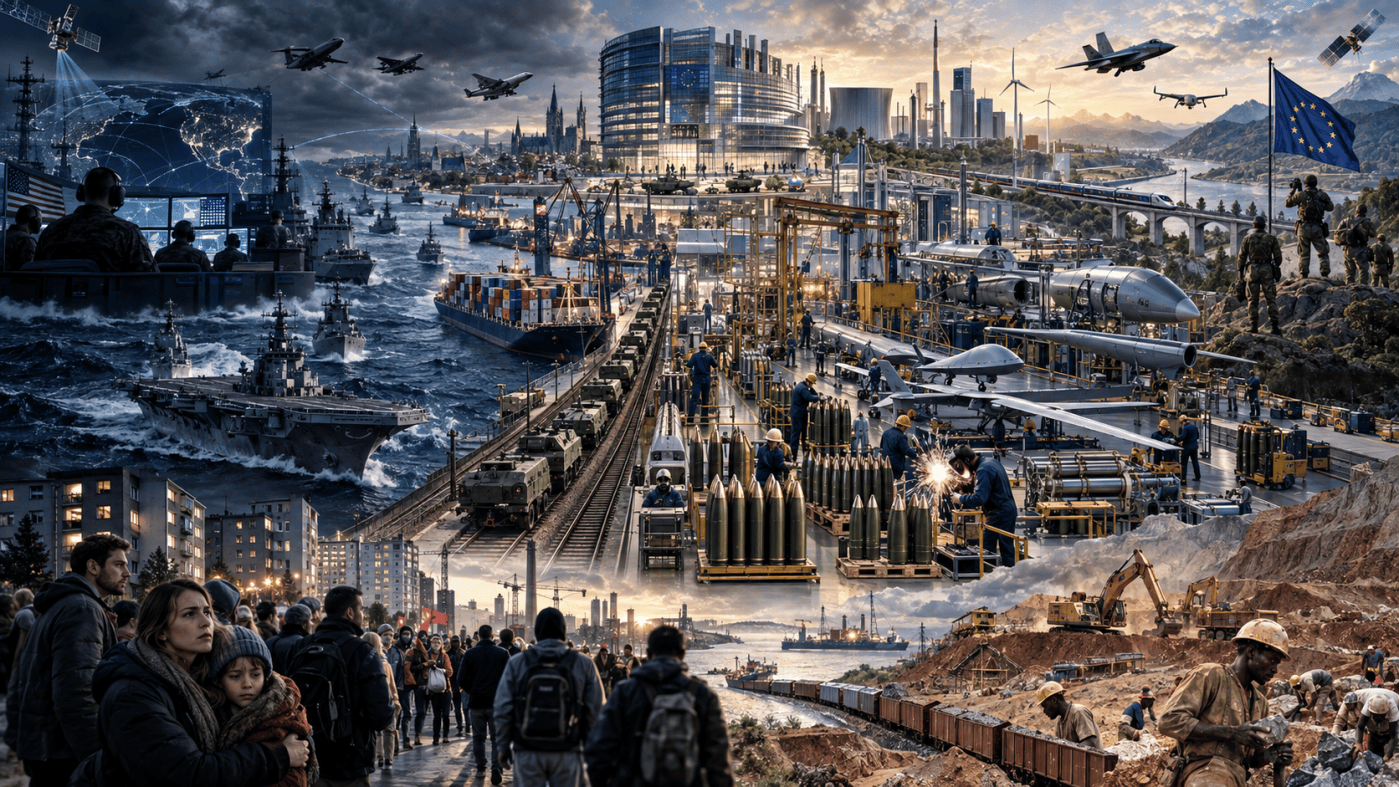
Europeans haven’t lost the ability to imagine a stronger continent; they’ve lost faith that an order built through divided national command and Atlantic dependency can actually deliver one. European integration and U.S.-centered imperial power grew together after the Second World War, producing enormous continental wealth and industry without producing an equally sovereign European command over the machinery beneath them. Now the crisis of imperial reproduction is forcing a recalibration: Europe is spending more, manufacturing more, militarizing more and carrying a larger share of the Atlantic burden, even as those same capacities give European states and capital greater room to maneuver against Washington. The fight ahead is therefore bigger than America versus Europe—it is over whether this new power belongs to workers or monopolies, serves social reproduction or the war economy, and breaks imperial dependency or merely pushes it further down the chain onto the Global South.
Prince Kapone | Weaponized Information | September 12, 2026
They Can Imagine Europe Just Fine
The Guardian’s September 9 report opens on what looks like a European crisis of faith. Sixty-eight percent of respondents describe the present in terms of deterioration or a loss of normality. Fifty-six percent think Europe’s future is in danger. Nearly three-quarters say the continent is handling its major problems badly. Then comes the fact that should blow up the easy story: these people haven’t stopped wanting Europe. Roughly three-quarters still describe a future built around greater unity, security, prosperity or political integration, while only a small minority want less Europe or outright dissolution. Europe’s people can imagine the destination just fine. What they don’t trust is the vehicle.
That contradiction comes from an ECFR study based on 5,834 interviews in France, Germany, Italy, the Netherlands, Poland and Britain. The respondents repeatedly name concrete failures: Europe moves too slowly, struggles to stand up to stronger powers, lacks sufficient autonomy and often seems incapable of turning its size into decisive action. Yet ECFR translates this material frustration into what study author Paweł Zerka calls an “imagination gap.” The Guardian follows him. Europeans know what they want, the story tells us, but they can’t picture a believable road from the present to the future.
There’s another layer tucked beneath the neat percentages. ECFR didn’t discover four ready-made political tribes wandering around Europe called the “Positives,” “Negatives,” “Uncertain” and “Disconnected.” Those are study-created categories assigned through AI-assisted coding of the interviews. That doesn’t make the research worthless. It does mean the categories are an interpretation of people’s answers, not social classes that announced themselves at the door. Once the categories are treated as political actors in their own right, actual relations of work, property, region, industry and power can disappear behind a psychological sorting machine.
The Guardian then gives the crisis its preferred political destination: the far right. Pessimism becomes “fertile ground” for parties promising restoration, national strength and a return to vanished normality. There’s truth there. Far-right parties clearly organize narratives of decline. But the framing quietly moves from the existence of a material grievance to the danger of who might exploit it. Europe’s weakness becomes most urgent when it threatens the political center rather than when people experience institutions promising power they can’t exercise.
That’s the ideological trick hiding in plain sight. The article asks why Europeans have stopped believing Europe can deliver. The respondents themselves keep pointing toward a harder question: what is it about the Europe that already exists that prevents its enormous continental scale from becoming effective collective power? What appears as a failure of belief may be the political surface of an order no longer reproducing what people were taught to expect from it. Before anybody diagnoses an imagination problem, somebody ought to open the hood.
The Continent Grew Faster Than Its Command
The machinery under Europe’s present crisis wasn’t assembled yesterday. After the Second World War, Western European reconstruction, continental integration and the Atlantic security system developed together. NATO’s own official history says the alliance was created not only to deter the Soviet Union, but also to maintain a North American presence in Europe and encourage European political integration. The continent that would later produce the Single Market, the euro and some of the world’s largest industrial firms didn’t grow outside the Atlantic order. Its postwar institutions took shape inside it.
For decades, that arrangement allowed Western European capitalism to rebuild enormous productive power while the United States carried a disproportionate share of the wider alliance’s military burden. NATO itself now acknowledges that European allies had become over-reliant on U.S. military power. European allies and Canada increased defence expenditure by nearly 20% in real terms during 2025, and NATO governments committed to a framework calling for defence and security-related spending equal to 5% of GDP by 2035.
The command structure still carries the marks of the older settlement. NATO’s Allied Command Operations remains headed by the Supreme Allied Commander Europe, traditionally an American officer who simultaneously commands U.S. European Command. Even that relationship is shifting. In February 2026, NATO announced that European officers would eventually lead all three Joint Force Commands, while the United States would retain SACEUR and the three theater component commands.
Europe is also building command capacity outside NATO. During the 2026 Rapid Deployment exercise, the EU’s Brussels-based Military Planning and Conduct Capability commanded about 2,500 troops from 13 member states. The force remains tiny beside NATO’s machinery, but autonomous European command is no longer only a speech about some distant future.
The spending behind it is much larger. EU defence expenditure reached roughly €418 billion in 2025, while the Readiness 2030 program creates mechanisms intended to enable as much as €800 billion in additional defence spending through the end of the decade. Yet much of the hardware still crosses the Atlantic. SIPRI found that the United States supplied 58% of major-arms imports by European NATO members during 2021–25, especially in combat aircraft and long-range air defence.
Europe isn’t an industrial shell waiting for American factories to fill it. European firms remain major arms exporters. The more precise picture is a continent with substantial military-industrial strength that still depends on U.S. suppliers for several strategic systems. Brussels is already trying to alter that balance through procurement rules favoring production inside Europe.
The European Round Table for Industry, whose members lead major European corporations, has called for stronger EU-level industrial policy, larger pools of investment, deeper integration of the Single Market and selective “European Preference” measures. Some of Europe’s biggest capitalists are telling governments that fragmented national markets and investment systems aren’t enough for the competition they face. The Commission has answered with measures such as the Industrial Accelerator Act, procurement reforms and technology policies aimed at keeping more strategic production and investment inside Europe.
Relations with Washington show how tangled that project remains. The 2025 EU-U.S. deal, still being implemented in 2026, removed EU tariffs on U.S. industrial goods while most European exports to the United States faced a 15% tariff ceiling; some steel and aluminium products remained exposed to much higher U.S. duties. Brussels defended the settlement as restoring stability and predictability, while BusinessEurope likewise called transatlantic stability the priority. European capital can seek greater room to maneuver without wanting to tear up one of the world’s largest trade and investment relationships.
Technology exposes another limit. The Commission identifies Amazon Web Services and Microsoft Azure as the two largest cloud services operating in the EU and now openly treats dependence on non-EU computing infrastructure as a sovereignty problem. Brussels can write regulations. Servers and cloud systems still have owners.
The social picture is just as uneven. Europe isn’t undergoing one clean economic collapse. Eurostat recorded historically high employment and a rebound in industrial sold production, while Eurofound documented continuing cost-of-living pressure and housing insecurity. The ETUC reports more than two million manufacturing jobs lost since 2007. A worker watching a plant close or a family watching rent outrun income can be living through deterioration while the continent’s employment rate rises on a spreadsheet.
The attempt to rebuild European industry also reaches far beyond Europe. Batteries, weapons, grids, electric vehicles and digital infrastructure require strategic minerals mined elsewhere, particularly in Africa. But European Parliament research acknowledges that the EU goal of processing 40% of strategic raw materials domestically can collide with African efforts to process minerals locally and capture more industrial value before exports leave the continent.
Europe is being remade on several fronts at once: spending more on war, assuming larger military responsibilities, shifting procurement toward European production, protecting strategic industries, contesting trade terms and securing supply chains. The old arrangement is changing. What still hasn’t been settled is who will command the new one.
The Missing Thing Is Command
Europe’s contradiction has become explosive because the imperial order that once made its divided command relatively cheap to live with is itself being forced to change. For decades, the Atlantic arrangement allowed Western European capitalism to accumulate enormous productive power while the United States carried a disproportionate military burden and sat at the center of the wider strategic architecture. So long as Washington could reproduce that command at comparatively low cost, Europe’s ruling classes could profit from the arrangement without having to answer the sovereignty question every morning before breakfast.
Those conditions are eroding. U.S.-centered imperial power hasn’t vanished, but maintaining it now demands more from the states gathered around it. Europe is being pushed to spend more, manufacture more weapons, secure more strategic inputs, take on larger command responsibilities and rebuild capacities weakened under the old division of labor. This is imperialist recalibration in concrete form: the system trying to preserve itself by redistributing the cost of preservation.
Europe is central to that recalibration because it is being rebuilt as a stronger Western rear of the Atlantic order. More weapons production, more military spending, more procurement inside Europe, more strategic industry, more responsibility for the surrounding theater. But a stronger rear isn’t simply the old rear with a fresh coat of paint. The capacities built so Europe can carry more of the Atlantic burden can also give European states and capitals greater room to maneuver independently of Washington. The machinery constructed to reinforce the hierarchy can become part of the material basis for loosening it.
European capital therefore isn’t an oppressed class waiting for liberation from Washington. Its corporations grew powerful inside the Atlantic order, remain deeply tied to American markets and technology, and have interests of their own across the world. They can demand more European industry, continental investment and bargaining room while still wanting the transatlantic accumulation machine to keep paying dividends. Capital likes sovereignty best when it improves the terms of business without disturbing the business itself.
The deeper European contradiction runs through the structure beneath that relationship. Production crossed borders faster than political authority did. Capital became continental while states remained national. Military power became integrated while strategic command remained partly Atlantic. Technology became indispensable while crucial infrastructure stayed in somebody else’s hands. Europe accumulated the muscles of a giant without settling who controls the nervous system.
The military build-up makes the contradiction visible in steel and circuitry. Europe is expanding production and taking on larger command responsibilities, creating genuine European capacity while also making itself a more capable pillar of NATO. Rearmament therefore sharpens the sovereignty question instead of answering it: capacity under whose command, for what purpose?
The same problem appears in industry and technology. Brussels can write regulations and governments can subsidize factories, but legal authority isn’t identical to material command. Somebody still owns the servers, cloud systems and production lines. Public money building European capacity also doesn’t determine who owns the result. A factory financed by workers’ taxes can remain under private command. Socialized risk and privatized control is an old capitalist trick wearing a new European badge.
Here the crisis of imperial reproduction meets the crisis of social reproduction. The system must finance the machinery required to preserve power abroad while maintaining enough security, housing, employment and public provision to stabilize consent at home. Those requirements can diverge. Governments can find hundreds of billions for armaments and strategic industry while workers face plant closures, expensive housing and squeezed budgets. The imperial machine can become better prepared for geopolitical competition while the social bargain underneath it starts throwing sparks.
That contradiction gives the far right its opening. It takes real experiences of lost security, institutional weakness and decline and reorganizes them through the promise of national restoration. What disappears is the harder question of who owns the factories, controls investment and decides where the wealth goes. The far right turns a crisis of command into a morality play about national betrayal.
Nationalist retreat carries its own contradiction. The productive forces don’t politely shrink themselves to fit the flag. Cloud systems, advanced weapons, energy networks, industrial supply chains and international finance operate at scales that can overwhelm individual European states. Fragmentation can restore pieces of national political authority while weakening the material capacity needed to resist larger concentrations of capital and power.
Brussels offers the opposite danger. Continental scale can overcome fragmentation without giving ordinary people more command over what gets built, funded or sacrificed. European monopoly capital wants continental industrial policy because modern competition rewards scale. Workers may also need factories, secure employment and productive investment, but the struggle remains over wages, ownership, public money and what production is actually for. A stronger Europe under corporate command is still capitalism with a larger administrative map.
European sovereignty also has an external side. The continent’s new industries need minerals, energy, technologies and markets. African states and workers want greater control over the chains running through their own mines and factories. Europe can reduce one dependency by pushing another down the hierarchy. It can become more sovereign at the top of a value chain while demanding that somebody else remain trapped near the bottom.
Multipolarity therefore changes the distribution of world power without settling the class question. A Europe capable of saying no to Washington would mark a real shift, but European workers could remain excluded from control over production, public wealth could remain tied to militarization, and unequal relations with the Global South could survive under a more independent European flag. Independence between ruling blocs and emancipation from class and imperial domination are different questions.
Now the Guardian’s “imagination gap” looks different. Europeans aren’t staring helplessly at a blank page. They can describe the Europe they want. What they’re living through is a crisis in the machinery supposed to produce it. The old Atlantic order is being recalibrated while the new capacities being built can strengthen that order, loosen it or help construct another imperial pole.
The missing thing, then, isn’t imagination. It’s command. Who owns the factory, chooses the investment and controls the weapons? Who pays, and who captures the value? Europe is already accumulating greater power. The historical fight is over the class and imperial relations that determine what that power becomes.
Take the Levers Before the Generals and CEOs Do
Imperialist recalibration is already allocating money, factories and strategic resources across Europe. Industrial subsidies, procurement rules, defence budgets and supply-chain agreements are deciding who will control the capacities now being rebuilt. Workers don’t have to choose between remaining subordinate inside the old Atlantic machinery and handing a stronger Europe to its own monopolies and generals. The fight begins where those resources are actually being commanded.
Industrial policy is one battlefield. The European Trade Union Confederation is pressing amendments to the Industrial Accelerator Act and demanding quality jobs, collective bargaining, regional investment and binding social conditions on public support. If taxpayers finance new plants and supply chains, unions have every reason to fight over wages, employment guarantees, worker participation and where production is located. Otherwise public money socializes the risk while private capital pockets the command.
The war economy is another lever. The Stop ReArm Europe mobilization has already brought unions, peace organizations and social movements into coordinated demonstrations, assemblies and decentralized actions against the continent’s rearmament trajectory. Budget fights, procurement decisions and industrial planning are where movements can demand that productive capacity serve housing, infrastructure, climate needs and social reproduction instead of allowing weapons production to become Europe’s default answer to strategic insecurity.
European sovereignty also can’t be built by pushing dependency down the supply chain. The new African Mining Network is building cross-border union coordination in mining, while African labor organizations demand local processing and value creation alongside living wages and stronger bargaining. European unions further up those same supply chains have concrete grounds for coordination: common corporate targets, procurement standards, due-diligence rules and contracts that protect workers while expanding African industrial capacity.
That’s solidarity stripped of charity language. A European worker fighting for control over publicly financed industry and an African miner fighting to keep more value where extraction happens confront different points on the same chain of accumulation. Linking those struggles makes it harder for corporations to solve one workforce’s demands by squeezing another.
The Guardian asks how Europe’s leaders can restore belief in the European project. Europeans don’t need another advertising campaign for the continent. They need organized power over what gets built, who owns it, where the money goes, what gets converted into weapons and what relationships Europe builds with the rest of the world. Europe is already acquiring more power. The decisive question is who gets their hands on the levers before the generals, bureaucrats and CEOs lock the control room from the inside.
 Weaponized Information
Leave a comment