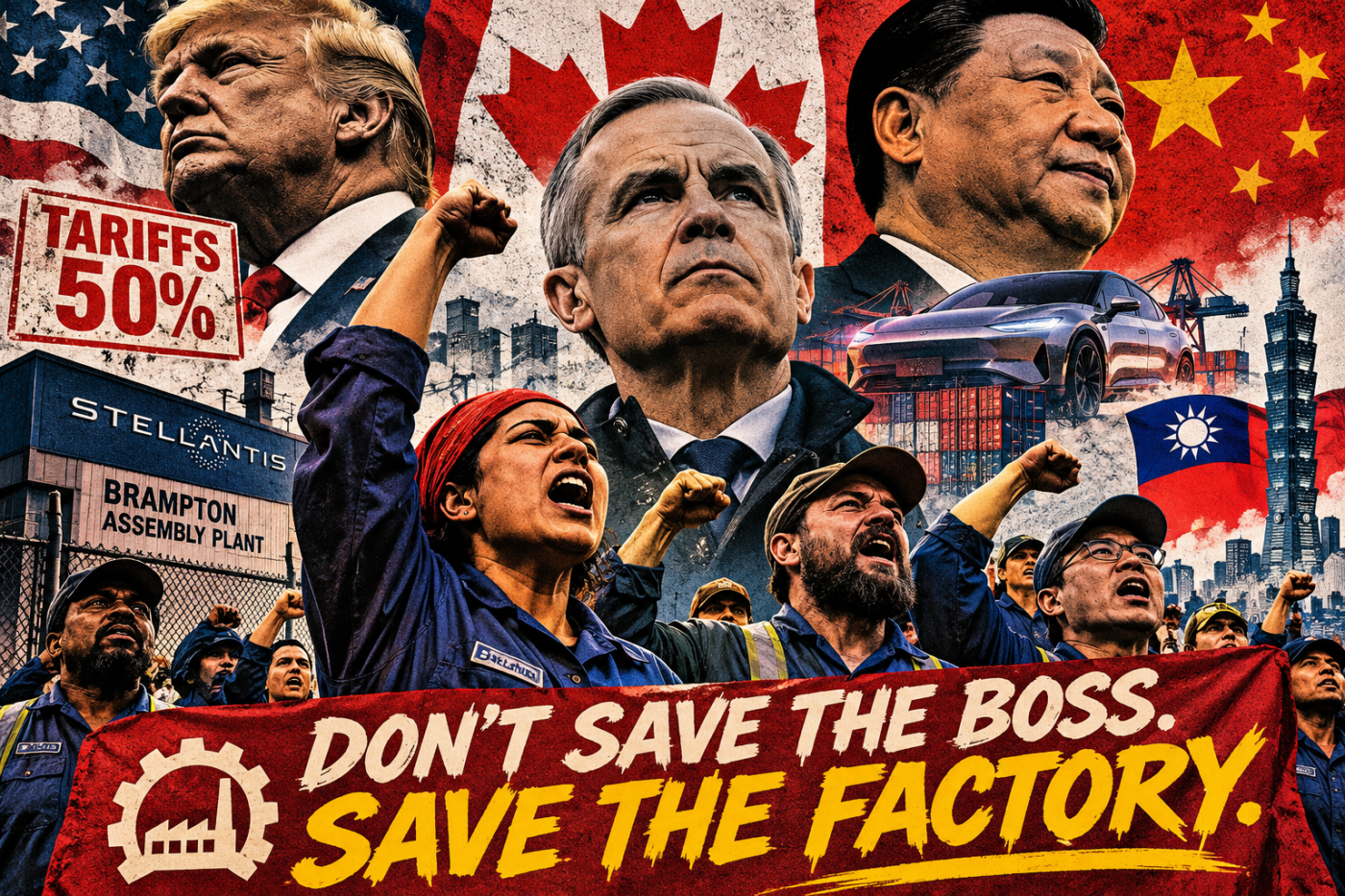
The Associated Press gives Taiwan’s deputy foreign minister a platform to warn Canada about Chinese economic coercion while Washington’s ongoing economic assault on Canadian industry fades conveniently into the background. Behind that warning lies an automotive industry battered by decades of continental integration, corporate abandonment, and trade arrangements that left Canadian workers defending factories they don’t control. The contradiction gets even more damning when Taiwan’s own signed, still-unratified trade agreement with Washington reveals an American framework for conditioning market access on technological alignment and restrictions affecting future economic relations with China. Real economic independence won’t come from swapping one foreign corporate master for another, but from breaking the power of capital to decide what gets produced, where investment goes, and whether working people get to keep the industries their labor built.Prince Kapone | Weaponized Information | November 24, 2026
I. The Warning with a Blind Spot
On November 21, 2026, Associated Press reporter Rob Gillies delivered a warning from Halifax dressed as a lesson in economic independence. Taiwan’s deputy foreign minister, Chen Ming-chi, told the wire service that Canadian Prime Minister Mark Carney risked exposing his country to Chinese economic coercion by expanding trade with Beijing. Taiwan had learned the hard way, Chen insisted. Canada ought to listen.
The trick begins with the order of the facts. Gillies acknowledges why Carney’s looking elsewhere: Donald Trump’s trade war, including a threatened 50 percent tariff on Canadian vehicles and auto parts. That’s no minor inconvenience. We’re talking about an industry whose factories and workers depend on access to the American market. Yet Washington’s concrete threat becomes background scenery, while the possibility that Beijing might someday punish Canada commands the headline. One government is already threatening to slam the factory gate; the other gets charged with owning a dangerous lock. That’s a hell of a hierarchy of danger.
Chen supplies the article’s political compass. He praises Carney’s warning that major powers weaponize interdependence, then questions whether Canada should deepen ties with countries that don’t share its democratic values. Notice how neatly the question changes. Instead of asking what Canada produces, who buys it, and who can shut the market, we’re invited to judge which trading partner deserves a certificate of democratic respectability. Apparently, dependency becomes less troubling once it’s dressed in the right flag.
Then comes the pile-on. The detention of the two Michaels, warnings about Chinese electric vehicles and possible surveillance, Taiwanese trade statistics, military operations around Taiwan, even a photograph of Xi Jinping alongside Trump and Putin—all enter the same parade of danger. Some are documented events; others are predictions, allegations, or political interpretations. The report gives them precious little space for independent examination. Their cumulative effect is unmistakable: every road through Beijing appears to end in a security crisis.
Taiwan’s declining shares of investment and exports directed toward China are presented alongside Chen’s account of political pressure. But changing percentages don’t explain, by themselves, why companies relocate capital or why different markets grow at different speeds. The numbers are made to testify before anyone examines the machinery that produced them.
And the workers? They appear as an industry Chinese competition might threaten, rather than people whose livelihoods depend on decisions made by corporations and governments. Chinese automakers become the prospective danger. The existing struggle over Canadian manufacturing barely gets a hearing.
The article even ends with Chen welcoming a trade arrangement between Taiwan and Canada. So trade itself apparently isn’t the problem. The problem is who gets to trade with whom, and who gets to define the danger. Behind all this hand-wringing lies the damn question Gillies leaves hanging: when does economic dependence become an instrument of coercion, and who possesses the power to make it one?
II. The Deals That Built the Trap
Canada’s dependence on American industry didn’t fall from the sky, and it sure as hell wasn’t created by Donald Trump. It was built through decades of trade agreements, corporate restructuring, and political decisions that gradually surrendered control over Canadian production to multinational capital.
The 1965 Auto Pact established a continental automobile industry while requiring American manufacturers to maintain production in Canada. Companies received privileged access to the Canadian market in exchange for producing vehicles on Canadian soil. Canadian factories specialized in particular models, assembled vehicles for both countries, and sustained an industrial workforce concentrated around Ontario’s manufacturing communities. Market access carried productive obligations.
Successive rounds of trade liberalization dismantled those guarantees. NAFTA and its successor, the USMCA, preserved continental integration while giving manufacturers considerably greater freedom to allocate production across borders. Research, engineering, investment decisions, and corporate headquarters remained heavily concentrated in the United States, while factories competed for future production contracts. Mexico attracted substantial investment, and Canadian plants increasingly depended on decisions made far beyond the communities whose livelihoods rested on their assembly lines.
Former Canadian Auto Workers research director Sam Gindin documents the consequences in his historical reconstruction of the industry. Canadian automotive employment fell from roughly 170,000 workers in the mid-2000s to approximately 120,000 in 2026. Twelve assembly plants became seven, and for the first time, most remaining facilities were nonunion. More than 90 percent of Canadian-assembled vehicles were destined for the American market. Trump’s tariffs struck an industry already weakened by two decades of corporate relocation and industrial contraction.
On November 9, 2026, Stellantis provided a particularly ugly demonstration. The multinational automaker sold its Brampton Assembly Plant to Roshel, a military-vehicle manufacturer. Unifor charged that the sale violated collective bargaining obligations and commitments made to Canadian authorities. Thousands of automotive jobs and additional employment throughout the supplier network were threatened. The company disposed of a major Canadian manufacturing facility while its workers and their union fought to preserve production. The sale’s eventual employment consequences remain uncertain, but the decision itself was already made.
Against that industrial background, Carney’s engagement with Beijing takes on a more concrete significance. In January 2026, Ottawa negotiated a quota allowing 49,000 Chinese electric vehicles into Canada at the ordinary 6.1 percent tariff. By November, the government’s trade backgrounder reported 16,211 vehicles imported under the arrangement, roughly half priced below C$35,000. Ottawa hoped these arrangements would eventually encourage Chinese joint ventures and Canadian manufacturing investment. Those factories, however, remained an expectation rather than an established result.
During Carney’s November visit to Shenzhen, the two governments expanded their agreement. China extended tariff relief for Canadian canola meal, peas, lobster, and crab through 2028 and agreed to remove additional tariffs affecting approximately C$400 million in other Canadian exports, including pork, shrimp, and seafood products. Canada reciprocated by extending selected tariff remissions on Chinese steel and aluminum products where Canadian supplies were insufficient or unavailable.
These were actual concessions involving farmers, fishing communities, importers, manufacturers, and established markets. Their economic significance arose from China’s immense productive development. Decades of industrial investment, technological upgrading, infrastructure construction, and state-directed economic coordination had enabled Chinese firms to become serious competitors in electric vehicles, batteries, and advanced manufacturing. As Tricontinental’s research documents, these capabilities emerged from a long historical development of China’s productive forces, rather than some miraculous discovery of cheap automobiles.
Taiwan’s changing economic relationships unfolded within that same development. Its exports to mainland China and Hong Kong declined from 43.9 percent of total exports in 2020 to 26.6 percent in 2025, while mainland investment fell to 3.8 percent of Taiwan’s outward investment. Yet Taiwan’s own 2025 trade statistics show exports to China and Hong Kong actually increased 13.2 percent in value, reaching US$170.5 billion. Their share declined because other markets expanded faster.
The causes extended beyond political confrontation. Straits Exchange Foundation spokesperson Li Pao-wen identified rising mainland labor and regulatory costs, growing Chinese industrial competition, slowing economic growth, and the American trade war as important factors in Taiwanese investment relocation. Semiconductor fabrication, electronics manufacturing, and component supply chains also continued linking Taiwanese firms to mainland production. Tricontinental’s East Asia study documents an industrial region whose economic integration with China persists alongside increasingly confrontational American security arrangements.
Then comes the American side of Taiwan’s diversification.
On February 12, 2026, Washington and Taipei signed an Agreement on Reciprocal Trade alongside earlier commitments promoting massive Taiwanese investment in American high-technology production. The package involved proposed private investment reaching US$250 billion, a separate US$250 billion framework of government-backed credit guarantees, and commitments to purchase American energy, equipment, and aircraft. Those figures represent different financial obligations and anticipated investments, rather than completed transfers of capital.
More revealing are the provisions of the signed trade agreement itself. Article 5.1 establishes a mechanism for Taiwan to adopt import restrictions having equivalent effects to certain American economic-security measures, subject to consultation and applicable law. Article 5.2 requires cooperation with American export controls, including restrictions involving advanced semiconductors and other critical technologies.
Article 4.3 permits Washington to terminate the agreement and restore applicable tariffs if Taiwan concludes a digital trade agreement with a legally defined “covered nation.” Article 5.4(6) provides similar authority for a new bilateral free trade or preferential economic agreement with such a nation. That statutory category includes China.
The agreement remained awaiting Taiwan’s legislative approval in November 2026, so these provisions hadn’t yet entered into force as treaty obligations. Their conditional powers were nevertheless written plainly into the signed text. Washington had negotiated a framework in which particular future Taiwanese economic agreements could carry an American tariff penalty.
That was the institutional record already sitting on the table when Chen Ming-chi arrived in Halifax to warn Canada about the dangers of economic dependence.
III. Dependence Has an Owner
Economic dependence doesn’t arrive carrying a Chinese passport. It takes shape through the ownership of factories, control over markets, command of technology, and the institutions capable of turning those relationships into political demands. A country can trade with half the planet and still find its economic future decided in somebody else’s boardroom. It can fly its own flag, elect its own parliament, and proclaim its sovereignty every morning while the people who actually produce its wealth remain subject to decisions made thousands of miles away. Political independence written into law and economic independence exercised through production are two very different things.
That’s the contradiction buried beneath Chen Ming-chi’s warning. He identifies a genuine feature of international economic relations: dependence creates vulnerability when one party possesses the power to dictate terms. But he presents that danger as though it inheres in relations with China rather than in the unequal distribution of economic power itself. Apparently, coercion becomes a matter of geography instead of property, institutions, and class rule. Change the flag above the customs office, and suddenly the same machinery of economic discipline becomes a partnership between democracies. What a marvelous little trick.
Canada’s automotive history demolishes that convenient fiction. The original continental arrangement gave American manufacturers access to Canadian consumers while obligating them to maintain Canadian production. That relationship was subsequently reorganized to give capital greater freedom over the location of factories and investment. The workers remained rooted in their communities. Their mortgages, families, schools, and futures depended on those industrial jobs. The corporations acquired greater freedom to move production wherever profitability and government policy made it attractive. Capital became increasingly mobile while the people producing its profits were left defending the ground beneath their feet.
That’s what the celebrated freedom of capitalist trade looks like from the factory floor. The corporation gains the freedom to relocate; the worker gains the freedom to become unemployed. Shareholders gain flexibility, governments compete to offer incentives, and communities are told to make themselves attractive to investors who can abandon them anyway. Then some politician arrives to explain that everybody must accept the demands of international competitiveness, as though those demands descended from heaven rather than emerging from particular arrangements of ownership and power.
Washington’s tariff offensive operates through precisely those arrangements. The American state controls access to the market upon which Canadian automotive production heavily depends. Multinational manufacturers control where investment goes and which factories receive future production. Tariffs change the commercial calculations confronting those manufacturers, and workers absorb the consequences through layoffs, insecurity, and diminished bargaining power. Washington doesn’t need to personally close every Canadian assembly plant. Its economic power operates through a productive system in which capitalist ownership has already placed the fate of Canadian factories beyond the democratic control of the people who work in them.
Stellantis’ disposal of Brampton exposes the class relation with particular brutality. Productive capacity doesn’t disappear simply because its owner decides that manufacturing vehicles there no longer serves corporate priorities. The machinery, accumulated skills, industrial infrastructure, and human capacity to produce remain material realities. What changes is the authority determining their use. A factory can become available for military production while the workers who sustained civilian manufacturing struggle to defend their livelihoods. The productive forces exist, but their social purpose remains subordinate to decisions over which the producers exercise little command.
China’s industrial development has begun changing the international conditions under which that power operates. Decades of coordinated investment, infrastructure development, technological advancement, and the expansion of productive capacity have created alternatives to the corporations and markets historically dominating North American manufacturing. Chinese electric vehicles represent the results of an industrial development process that Western capital can neither dismiss nor reproduce through another round of patriotic speeches about competition. Washington can threaten tariffs, but threatening a productive capability doesn’t magically create an equivalent one.
For Canada, those new capabilities create genuine possibilities. Access to Chinese markets can relieve pressure on exporters. Affordable vehicles can expand consumer choices. Industrial cooperation can potentially introduce new technologies and manufacturing investment. Yet the content of these relationships depends on their actual terms. Importing automobiles doesn’t amount to rebuilding Canadian automotive production. Attracting another foreign corporation doesn’t necessarily grant Canadian workers greater authority over their jobs. A new investor can enter the same property relations that allowed the old investor to walk away. Diversification opens possibilities; capitalist ownership determines how their benefits are distributed.
And that’s where the interests of Canadian workers diverge from the narrow ambitions of Canadian capital. An exporter seeking additional customers, an automobile manufacturer defending its market share, and a worker fighting to preserve production confront the same trade dispute from different positions. Their interests may overlap, but they aren’t identical. A government can negotiate a commercially advantageous agreement that leaves working people exposed to the same old corporate blackmail. National bargaining power can increase without increasing working-class power by a single damn inch.
Taiwan’s experience reveals another side of the same historical process. Its industrial development remains tied to regional production networks, even as its governing authorities pursue closer economic-security coordination with Washington. Changing export destinations and investment patterns can alter the distribution of dependence without abolishing it. Capital continues circulating through interconnected production chains, while political institutions attempt to redirect those relationships toward particular strategic objectives.
Now consider the American agreement Taiwan signed. Washington negotiated provisions connecting favorable trade treatment to technological restrictions, economic-security coordination, and conditions on particular future agreements with China. These provisions remained subject to ratification and implementation, but the proposed institutional relationship was explicit. American market access came attached to political and economic conditions. The government warning Canada against Chinese coercion had itself accepted a signed framework under which Washington could penalize specified future Taiwanese economic choices.
Chen may genuinely regard Chinese economic pressure as dangerous. That doesn’t erase the institutional contradiction. Taiwan’s government seeks greater freedom from one set of economic constraints while accepting new obligations within another. Washington’s restrictions acquire the respectable vocabulary of strategic cooperation, while China’s prospective leverage receives the language of economic coercion. The distinction reflects political alignment rather than a consistent principle for judging economic independence.
This is how imperialist recalibration works through existing international relationships. Washington possesses tremendous economic advantages, but China’s productive development has expanded the alternatives available to countries integrated into the American-centered order. Rather than relying exclusively on the commercial attractiveness of its own markets, the United States increasingly attaches conditions to access, investment, and strategic technologies. Its partners aren’t necessarily forbidden from conducting business with China. Their freedom to pursue particular relationships becomes conditional upon requirements Washington can seek to enforce.
The contradiction has a class foundation. American policy seeks to influence where advanced production is located, which corporations obtain access to strategic technologies, and which economic relationships remain compatible with its military and industrial priorities. Canadian and Taiwanese capitalist interests negotiate within that system, sometimes resisting particular demands and sometimes accepting them in exchange for commercial or strategic advantages. Their governments can seek greater room to maneuver without challenging the underlying authority of capital over production.
And there’s the limit of economic nationalism stripped of its patriotic decoration. A Canadian government can diversify trade while leaving factories under multinational corporate command. Taiwan can diversify exports while binding aspects of its economic policy more closely to American strategic requirements. Neither change necessarily transfers power to the workers whose labor makes those economies function. The choice of trading partners matters, especially when it reduces concentrated coercive power. But the deeper measure of independence lies in who controls the productive capacities upon which society depends.
The liberation of productive forces from imperial discipline cannot be separated from their liberation from capitalist command. Workers produce the vehicles, fabricate the components, operate the machinery, and sustain the industries that governments invoke whenever they speak about national prosperity. Yet those same workers are expected to accept the decisions of corporate executives as unavoidable economic necessities. The social character of production grows while authority over its direction remains concentrated in private hands.
That contradiction won’t be resolved by exchanging one foreign patron for another or by wrapping the same corporate property relations in a different national flag. Genuine economic independence requires the organized power to determine what society produces, where investment goes, and whose needs that production serves. Until working people acquire that power, the freedom celebrated in trade negotiations will remain painfully unequal: capital gets to choose its opportunities, while workers are left fighting for permission to keep producing.
IV. Don’t Save the Boss. Save the Factory.
The struggle for economic independence begins where capitalist power actually touches working people’s lives: on the factory floor, at the bargaining table, and wherever corporations threaten to carry away the machinery of production. In Brampton, thousands of autoworkers have already discovered what happens when their livelihoods depend on a multinational corporation’s willingness to keep its promises. Stellantis decided to abandon automobile production. The workers were expected to swallow the consequences.
Members of Unifor Local 1285 are fighting back, demanding that Stellantis honor its collective agreement and that governments defend the manufacturing capacity their communities helped build. Brampton City Council has already acted to protect the plant’s automotive manufacturing designation. That creates a concrete point of struggle. Workers and their allies can demand that municipal and provincial authorities enforce those protections instead of quietly accommodating another corporate retreat.
The Canadian Labour Congress has joined Unifor in demanding federal intervention. Ottawa possesses regulatory authority, purchasing power, and control over public industrial assistance. Those powers ought to serve the people producing society’s wealth. Every public dollar supporting automobile manufacturing should carry enforceable obligations concerning employment, domestic production, collective bargaining, and the preservation of industrial capacity. Corporations that take public assistance and abandon their commitments shouldn’t receive another goddamn subsidy and a polite farewell.
But defending existing factories cannot mean defending every privilege of the corporations that own them. Canadian workers have no obligation to sacrifice their futures so multinational manufacturers can preserve market share against Chinese competitors. Nor should cheaper imported vehicles become an excuse to surrender domestic production. Trade with China can expand Canada’s options, but workers need binding manufacturing commitments, technological development, and genuine authority over the investments made in their communities.
There’s already a historical precedent for thinking beyond corporate ownership. The Green Jobs Oshawa initiative developed a serious proposal to place threatened manufacturing capacity under public ownership and produce electric vehicles for public needs. Its campaign didn’t achieve that transformation, but it demonstrated that workers could formulate an industrial future beyond begging a corporation to stay. Postal vehicles, buses, and essential transportation equipment aren’t fantasies. They’re products society needs and possesses the technical capacity to manufacture.
That struggle also requires solidarity across borders. Canadian, American, Chinese, and Taiwanese workers shouldn’t be turned against one another to defend competing corporate profits. Their common interests lie in secure employment, collective organization, technological advancement, and production directed toward human needs rather than the unrestricted movement of capital.
Organize behind the workers defending Brampton. Demand enforceable public control over publicly supported industry. Build the political power to preserve factories, develop new productive capabilities, and decide what those factories produce. And reject the bullshit proposition that economic sovereignty means choosing which foreign capitalist gets to hold the keys.
A country won’t become economically independent merely because its government signs a new trade agreement. That independence must be built by the people whose labor keeps its industries alive. The factories belong in their future, and the decisions governing those factories belong in their hands.


Leave a Reply