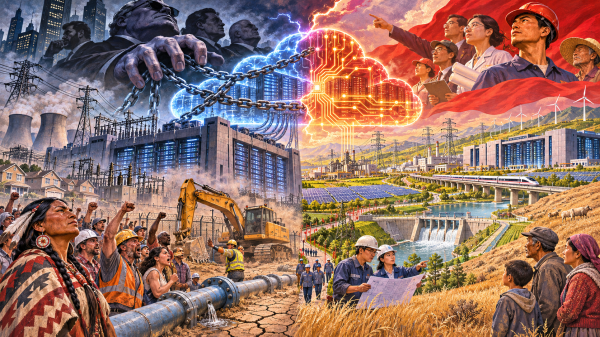
The Cloud Has a Landlord: America's AI Rebellion and China's Socialist RoadAmerica's technology monopolies promise an artificial-intelligence revolution while working people confront the electricity demands, water pressures, public costs, and corporate power required to build it. Across the United States, resistance to data centers exposes a contradiction Silicon Valley would rather conceal: the most advanced... Continue Reading →
Beware Beijing’s Leash, Sign Washington’s Contract: Taiwan, Canada, and the Price of Economic Independence
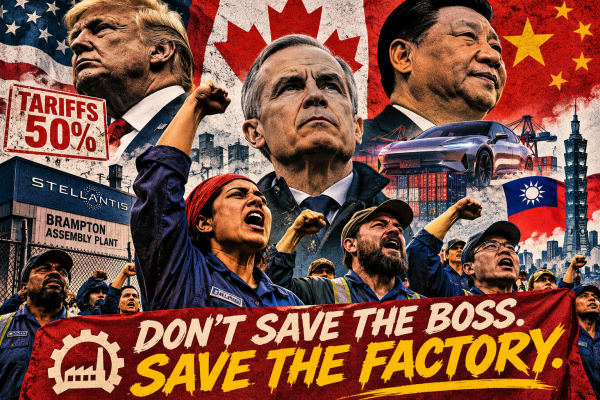
The Associated Press gives Taiwan's deputy foreign minister a platform to warn Canada about Chinese economic coercion while Washington's ongoing economic assault on Canadian industry fades conveniently into the background. Behind that warning lies an automotive industry battered by decades of continental integration, corporate abandonment, and trade arrangements that left Canadian workers defending factories they... Continue Reading →
Big Brother, Meet the Working Class: Who Actually Rules Under Socialism?
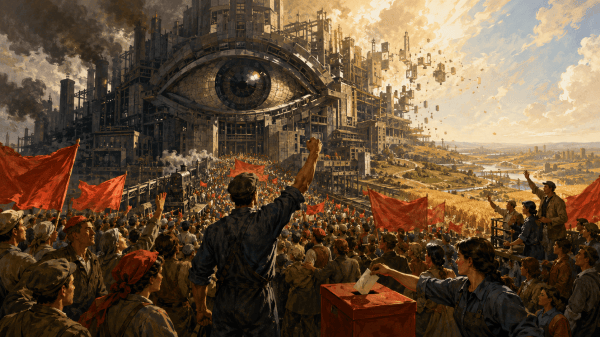
Capitalist democracy, while appearing politically equitable, safeguards bourgeois interests by leaving the means of production in elite hands. The proletarian revolution aims to dismantle this class dominance, yet it often gives rise to a new set of tensions within the ruling apparatus. Historical examples from Lenin's Soviet Union to Mao's China show that the transfer of power must be constantly defended against bureaucratic detachment. Yugoslavia's self-management experiment illustrates the struggle for genuine worker control, revealing that even radical reforms can’t bridge gaps between individual workplace democracy and broader economic coordination. Ultimately, socialism must evolve toward a society where its ruling structures diminish as proletarian power matures.