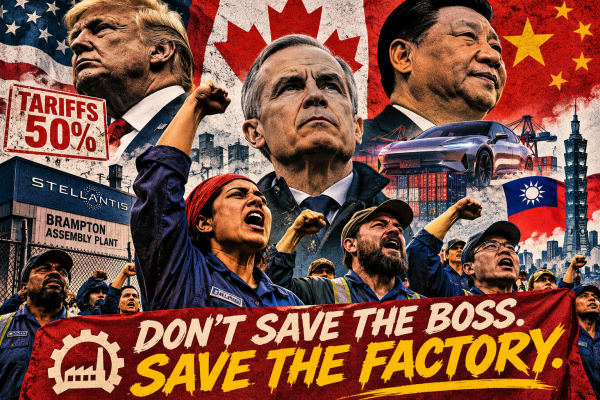
The Associated Press gives Taiwan's deputy foreign minister a platform to warn Canada about Chinese economic coercion while Washington's ongoing economic assault on Canadian industry fades conveniently into the background. Behind that warning lies an automotive industry battered by decades of continental integration, corporate abandonment, and trade arrangements that left Canadian workers defending factories they... Continue Reading →
The Crime Is Development: Friedman’s Factory Tour and the New Cold War Against China
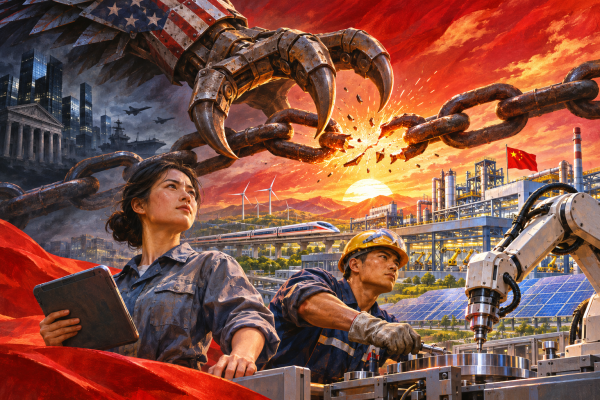
Thomas Friedman tours China’s factories, admires what he sees, and calls for rebuilding Western power to compel Beijing’s obedience. Behind the machinery stands a revolutionary history of socialist construction that’s helped break the imperial centers’ grip on advanced production. Washington’s technological restrictions defend the power to decide who develops, on whose terms, and for whose... Continue Reading →
Containment Makes Its Own Escape Routes: China, Iran, and the Rare-Earth Contradiction
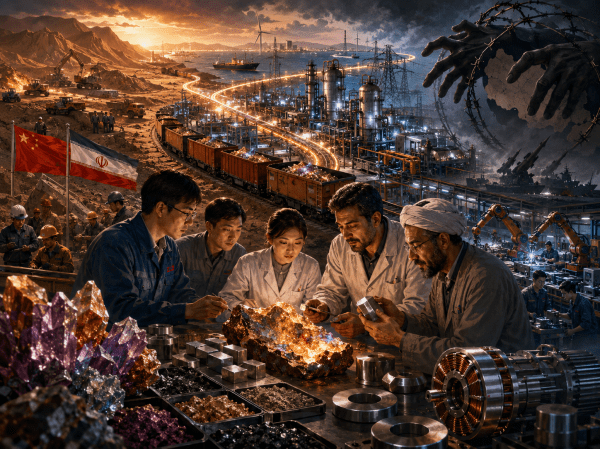
The narrative surrounding a modest scientific workshop between China and Iran is sensationalized into a geopolitical crisis, primarily through the lens of U.S. concerns. It's ironic: while Washington frantically condemns this cooperation, the real battle revolves around who controls the rare-earth supply chain. Both countries face sanctions that push them to create independent scientific and industrial pathways. The focus should pivot from mere diplomatic theatrics to whether this partnership enhances Iran's productive capacity or merely perpetuates dependency. Ultimately, this cooperative effort holds the potential to disrupt traditional power dynamics—unless it devolves into another avenue for exploitation under foreign dominance.
The Crime of Making Too Much: China and the Empire’s Monopoly on Abundance
The Economist's recent critique of China's industrial prowess reveals a deeper hypocrisy within Western narratives. While it acknowledges China's efficiency, it vilifies state-driven competition when it disrupts Western hegemony. The real issue is not overproduction but an imbalance of purchasing power, presenting an ugly tableau of warehouses filled with goods while people lack access. As China strives for self-reliance, the West's response is to impose tariffs and sanctions, prioritizing monopoly over equitable distribution. This conflict isn’t a mere economic dispute; it’s a struggle for who controls productive capacity. The question is whether to align production with human need or maintain the status quo of inequality.