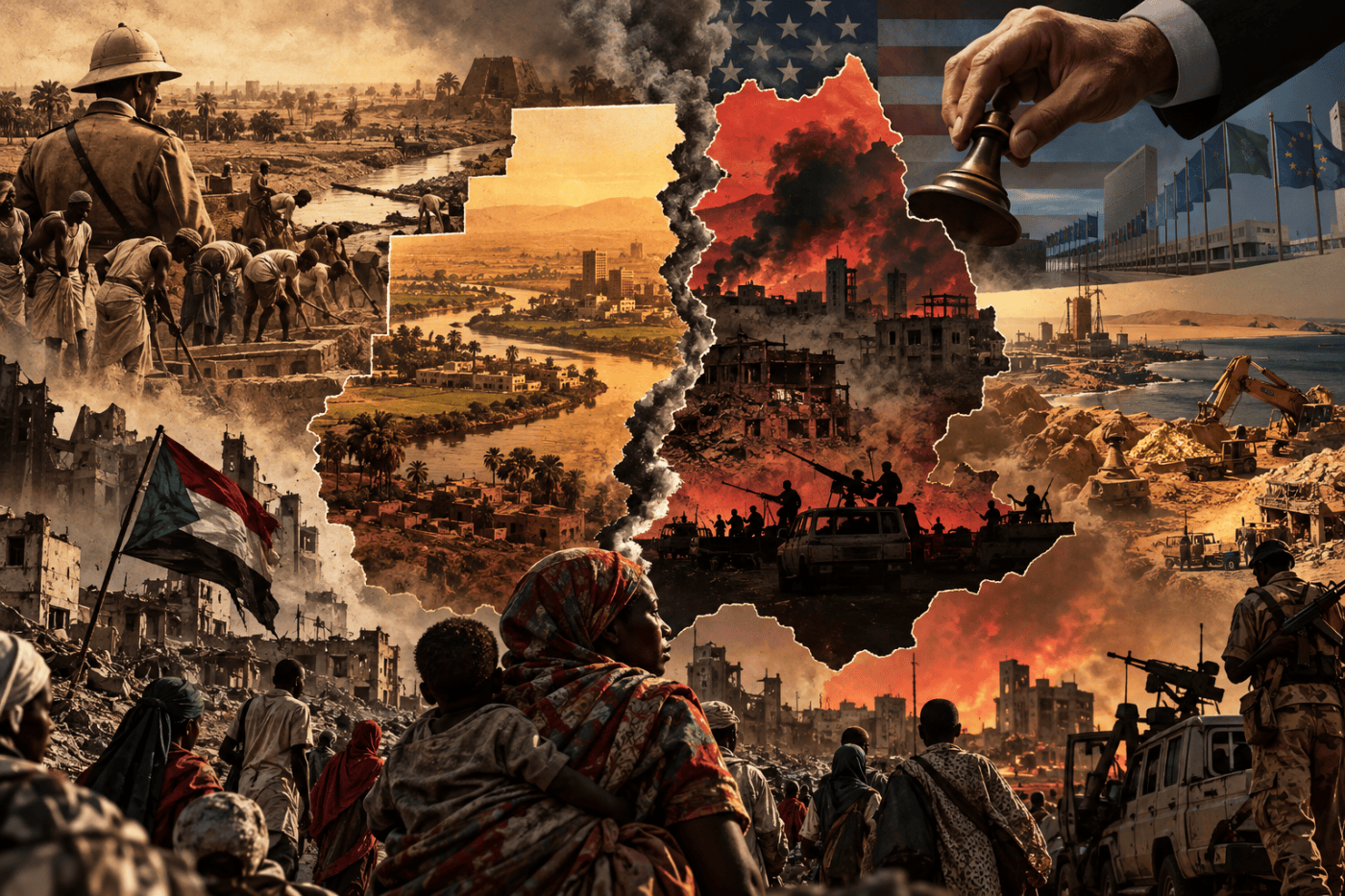
Reuters presents Sudan’s possible partition as a danger waiting inside Washington’s ceasefire proposal, but the machinery of division was already running long before the diplomats arrived. British colonial extraction, Western creditor power and decades of unequal development built the terrain on which Sudan’s armed ruling classes accumulated wealth, land and coercive power while the country’s peripheries paid the price. The December Revolution challenged that order, but the barracks survived, SAF and RSF turned their guns on each other, and war began hardening military front lines into rival economies and institutions. Beneath the armies and the imperial peace process, Sudanese workers, neighborhood organizers, women and civilian networks continue fighting to keep sovereignty rooted in the people who actually reproduce the country.
Prince Kapone | Weaponized Information |September 30, 2026
The Partition That Arrives Before the Ceasefire
Reuters correspondent Khalid Abdelaziz opens his September 30 report with a warning sharp enough to stop the eye: Washington’s proposed 90-day ceasefire could push Sudan toward a “Libya-style partition.” The warning comes from Amjad Farid, adviser to army chief Abdel Fattah al-Burhan, who argues that U.S. envoy Massad Boulos is pressing Sudan’s army-led authorities toward an arrangement that could leave the Rapid Support Forces holding territory and bargaining from the institutions they’ve built there. Reuters also reports that Washington withheld Burhan’s visa while he had not yet accepted the proposal. So much for the picture of the United States standing outside the quarrel with a clipboard and a concerned expression. Washington has leverage, and Washington is using it.
But Reuters makes its first important choice before the reader has time to notice. Sudan’s present war effectively begins in April 2023, when SAF and RSF supposedly “fell out” over military integration and the promised return to civilian rule. Two little words, fell out, carry an enormous historical load. Decades of colonial rule, unequal development, counterinsurgency, military accumulation, gold, sanctions, foreign creditors and popular revolt vanish behind them. Two heavily armed formations step onto the page already built, already wealthy, already powerful and suddenly hostile to one another, as if history had assembled them offstage.
That’s the usefulness of starting the clock late. Reuters doesn’t need to fabricate the ceasefire dispute. It only needs to begin after the machinery that produced the dispute is already running. Washington can then enter carrying a peace proposal instead of carrying the weight of the imperial order that has long shaped Sudan’s room to breathe. The United States becomes the mediator after the catastrophe has begun, while the history that gave Western governments power over Sudanese finance, sanctions, debt and diplomatic recognition slips quietly out the side door.
The article distributes political agency the same way. Burhan’s adviser gets to warn. Washington gets to declare that neither armed camp represents “legitimate, constitutional governance.” The RSF appears as a military force trying to convert territorial control into political survival. Sudanese people appear mainly as victims of a “massive humanitarian crisis.” Workers, neighborhood organizers, women, professional associations and the revolutionary forces that had already fought military rule barely enter the room. Generals and foreign envoys act; ordinary Sudanese bleed.
Then Reuters performs the inversion that matters most. It acknowledges that the RSF has appointed ministers and activated police under a parallel authority. It acknowledges that Sudan has long been drifting toward territorial division. Yet partition still arrives mainly as something the American ceasefire might produce. The reader is pointed toward tomorrow: Will this peace deal divide Sudan? The harder question lies buried under the floorboards: what had already been done to Sudan for a temporary ceasefire to possess the power to freeze a partition in the first place?
The State Split Before Anyone Drew the Border
To answer that, we have to go back further than Bashir, further than the RSF, and certainly further than April 2023. British colonial rule built Sudan as an economy of extraction. Investment, irrigation, administration and transport were concentrated around the Nile valley and the Gezira Scheme, while Darfur, the South, Blue Nile, South Kordofan and other peripheral regions were left underdeveloped and subordinated. African scholarship on Sudan’s colonial political economy shows a state whose center accumulated roads, bureaucracy and commercial power while the peripheries supplied labor, land, resources and soldiers.
Independence removed the colonial flag. It didn’t bulldoze the structure underneath it. Political administration passed overwhelmingly into the hands of northern and central elites, while regions that had been treated as colonial hinterlands remained weakly represented and starved of investment. The new rulers inherited a country already organized around a privileged center and an exploited periphery. They didn’t invent that geography. They inherited it, governed through it and, again and again, reproduced it.
Under Bashir, this old inequality met the newer religion of neoliberalism. IMF- and World Bank-backed restructuring cut agricultural support, accelerated privatization and pushed greater pressure onto communal land. A Pan-African reconstruction of Darfur shows how ecological stress collided with dispossession, blocked pastoral routes and state-backed militia violence. Drought mattered, but drought didn’t privatize land. The climate didn’t recruit militias. Rainfall didn’t hand rifles to men and tell them whose villages to burn. People with power made those decisions inside definite property relations.
The Janjaweed grew inside this machinery of peripheral counterinsurgency and were later reorganized into the RSF. Over time the force built an economic base of its own through gold, trade routes and cross-border commerce. The regular military wasn’t some innocent public institution watching all this from afar. Sudan’s armed establishment sat inside a web of companies, land, infrastructure and strategic enterprises. Long before SAF and RSF began shooting at each other, guns and property had already learned to sleep in the same bed. The war-economy record shows that the present conflict expanded a military economy that already existed.
Colonial administration ended, but Western power found newer clothes. Debt, sanctions, foreign exchange shortages and dependence on international credit gave outside institutions enormous influence over Sudanese economic policy. After Bashir fell, the civilian transition tried to re-enter the Western-led financial system after years of isolation. Debt relief and donor money came attached to IMF and World Bank programs demanding exchange-rate reform, subsidy removal and other restructuring. Sudanese economists have shown how civilians were expected to stabilize the country under creditor discipline while the military institutions they were supposedly meant to subordinate kept their guns, companies and independent streams of wealth.
Europe had already discovered another profitable use for Sudanese coercion. Under the Khartoum Process, European governments pushed their border southward, paying African states to stop migrants before they reached the Mediterranean. Bureaucrats called it “migration management,” because empire has always admired a clean phrase for a dirty job. African researchers have shown that the policy strengthened and legitimized Sudanese security institutions, including the RSF’s role in border enforcement. Europe didn’t invent the Janjaweed. It found an existing machinery of repression useful and plugged that machinery into Fortress Europe. The Khartoum Process turned Sudanese guns into part of Europe’s immigration fence.
This was the order the December Revolution rose against. Sudanese people weren’t fighting merely to replace Omar al-Bashir with a smoother administrator. Resistance committees, unions, professional associations, women and neighborhood organizers demanded civilian rule and political power rooted below. Their Revolutionary Charter challenged the military’s grip on political life and demanded a state answerable to the people who actually make the country run.
The compromise after Bashir’s fall left the armed economy standing. Burhan and Hemedti sat inside the transition while the institutions beneath them kept their coercive and commercial power. In October 2021, the military leadership crushed the civilian transition it had supposedly been sharing. Foreign diplomats talked endlessly about democracy while continuing to treat armed men as the indispensable gatekeepers of Sudanese politics. In that system, the gun didn’t disqualify you from the negotiating table. It bought you a better seat.
When SAF and RSF finally turned their weapons on each other, destruction itself became an economy. Gold mines, markets, checkpoints, border crossings, livestock, fuel, smuggling routes and informal taxes became revenue. Territory became income; income financed more armed control. A front line stops being merely a military line when somebody can charge rent on everything that crosses it.
By 2026, the division had moved beyond trenches and roadblocks into institutions. RSF-aligned authorities created a Transitional Monetary Council and appointed their own central-bank governor as they confronted liquidity problems inside territory under their command. Gold routes shifted too, with more official exports moving through Egypt while Gulf markets remained central to the wider trade. The route changed faster than the underlying extraction.
By August, Sudanese researchers were already warning that war was becoming partition. Nobody had yet drawn a new internationally recognized border, but separate administrations, revenue systems, armed jurisdictions and foreign relationships were hardening behind the front. Countries don’t wait for diplomats to find a ruler and a map before they begin coming apart. By the time Washington arrived with its latest ceasefire formula, pieces of division were already standing on the ground.
When the Barracks Survive the Revolution
The immediate war is between SAF and RSF. Nobody living under artillery fire needs a lecture telling them otherwise. But two generals fighting over the state isn’t where the history begins. Beneath them sits a colonial order built for extraction, a postcolonial ruling class that inherited and reproduced the center’s domination over the periphery, and an imperial system that kept its hands on Sudan through debt, sanctions, foreign markets and control over access to finance.
Formal independence changed who sat in the government buildings. It didn’t free Sudan from the world economy colonialism had built around it. Empire no longer needed a British governor in Khartoum. A creditor could do part of the work. So could the dollar. So could a sanctions list, an aid package, an IMF program or the simple power to decide whether a country gets access to international credit. Imperialism changed clothes. The extraction survived.
Sudanese military elites weren’t innocent captives inside that system. They learned how to profit from it. SAF-linked institutions accumulated companies, land and state resources. The RSF grew from peripheral counterinsurgency into an armed-commercial power tied to gold and transnational trade. Gulf capital developed its own appetite for Sudanese land, livestock, minerals, ports and routes. None of these actors needs to be reduced to a marionette dancing at Washington’s command. Exploitation works perfectly well when local ruling classes collect their own cut.
That is why the central Sudanese struggle runs through the question of popular sovereignty against armed economic power. The December Revolution threatened more than the political careers of generals. It raised the dangerous question every ruling class hates to hear asked plainly: who gets to command the guns, the budget, the companies, the land and the wealth? The transition changed the face of government without breaking the independent material power of the armed institutions underneath it.
SAF and RSF could cooperate when the immediate danger was civilian control over the armed order. They could then slaughter one another once the question became which armed center would dominate that order. There is no mystery here. Their alliance and their war belong to the same history. The revolution challenged the barracks. The barracks survived. Once the civilian challenge had been driven away from the commanding heights, the fight inside the armed system burst into the open.
War then started producing interests of its own. Territory became revenue. Revenue fed armies. Armies built administrations. Administrations created officials, traders, commanders and middlemen whose power depended on those arrangements surviving. The war drew the front line, but the war economy began pouring concrete into it.
This is where partition stops being merely the possible result of war and becomes one of war’s engines. Fragmented authority creates separate revenue systems, separate trade circuits and separate armed jurisdictions. Those structures acquire beneficiaries. Beneficiaries defend what feeds them. A temporary battlefield division begins to harden into everyday political economy. A border doesn’t need recognition at the United Nations before it starts deciding which money circulates, who collects taxes and which armed men answer the door.
The Libya comparison becomes useful only here. Sudan isn’t Libya with a costume change. Sudan has its own colonial history, its own revolution, its own class structure and its own road into war. The warning from Libya is simpler and more dangerous: once rival authorities command territory, guns and revenue long enough, division itself can become a material interest. Reunification then threatens people whose careers, fortunes and armed power were built by fragmentation.
That is why the ceasefire contradiction is real. Continued war is actively deepening Sudan’s partition. Every month of fighting gives rival armed structures more time to dig themselves into territory and revenue. But silence at the front doesn’t automatically rip those structures out by the roots. A truce can save lives while leaving the political economy of division standing. The shooting stops. The ledgers remain. The checkpoints remain. The armed administrations remain. Peace can become only a quieter shift for the same machinery unless the machinery itself is confronted.
Washington therefore enters this moment with a ceasefire proposal, but Washington doesn’t enter Sudanese history from some innocent place beyond empire. This particular proposal didn’t create the war. The imperial system the United States leads helped shape the terrain long before Boulos arrived: colonial underdevelopment, sanctions, creditor power, externally conditioned economic restructuring, Europe’s use of Sudanese security forces to police African migration, and diplomatic arrangements that repeatedly treated armed rulers as indispensable partners. Washington didn’t issue every order Burhan or Hemedti ever gave. Empire doesn’t need that kind of micromanagement. It needs a system in which Sudanese land, labor, resources and political choices remain exposed to the power of outside capital and outside states.
This is also why “geopolitics” by itself explains almost nothing. We’re told the UAE wants influence, Egypt wants security, Washington wants leverage. Fine. Influence over what? Security for whom? Leverage over which wealth? The real answers run through gold, livestock, land, ports, foreign exchange, debt, military command and trade routes. Once those things disappear from the explanation, geopolitics becomes aristocratic gossip with flags.
Nor can class be used as a broom to sweep Sudan’s racialized and regional oppression out of sight. Darfur and the other peripheral regions weren’t simply poorer neighborhoods inside a neutral national state. Colonial and postcolonial rulers organized exploitation unevenly, and military violence repeatedly fell hardest on peoples pushed furthest from the centers of wealth and political command. Land dispossession, ethnic domination and class exploitation weren’t separate boxes on a chart. They grew through one another.
And outside the armed camps remains the force Reuters mostly loses from view: the Sudanese people who challenged military rule before SAF and RSF began killing each other. Their organizations don’t presently possess the biggest arsenals. That is a material weakness, not a reason to write them out of history. They already proved that Sudanese politics contains another claim to sovereignty beyond choosing which armed hierarchy gets the palace: the claim that people who work the land, staff the clinics, organize neighborhoods, raise children and reproduce the country with their labor should have power over the institutions built on their backs.
This is what Reuters’ late clock hides. Partition appears as a danger that a badly designed American peace proposal might create tomorrow. The history underneath runs in the opposite direction: colonial extraction, imperial dependency, domestic military accumulation, revolutionary challenge, counterrevolution, fracture inside the armed order and finally a war that turns territorial division into an economy. The ceasefire matters because the partition process is already underway. Sudan’s deeper problem is whether sovereignty can be rebuilt while the local ruling classes and international structures that hollowed it out remain powerful enough to do the job again.
The Country Beneath the Armies
If Sudan is reduced to Burhan, Hemedti and the diplomats orbiting them, then Sudanese people disappear twice: first beneath the guns, then beneath the peace process. But civilian Sudan is still there, organizing in the wreckage, feeding people, moving the wounded, keeping water running and refusing the idea that a country belongs to whoever has the most artillery.
The Emergency Response Rooms show one material pressure point. Volunteers run kitchens, medical support, shelters, water systems and evacuation networks in places where the state has collapsed or become a battlefield. The Mutual Aid Sudan Coalition helps channel resources toward these locally controlled structures. The contradiction is plain: war destroys civilian life while armed authorities swallow money and territory. Putting resources directly into civilian survival strengthens the social capacity the war is trying to pulverize without handing another gunman the keys to the pantry.
Women’s Response Rooms show another front inside the struggle itself. Women doing some of the hardest work of keeping communities alive have also fought for a greater voice over funding and decision-making. That isn’t a ceremonial question about “representation.” Money is power. Whoever controls the budget decides whose injuries get treated, whose needs become urgent and whose work remains invisible. A civilian alternative worthy of the name has to fight domination inside its own house as well as domination imposed from outside.
The Resistance Committees carry another kind of strength. They preserve an organized political current that refuses rule by either military camp and demands that the armed institutions be driven out of political and economic command. Nobody needs to pretend these committees currently possess the force of an army. Their importance is that they keep another political horizon alive. Every time Sudan’s future is reduced to a bargain among generals, their continued existence says: no, there are still people here who remember what the revolution was for.
At the continental level, the African Union position joins an immediate humanitarian truce to civilian politics, territorial integrity and an end to outside military support. The AU can’t substitute for Sudanese grassroots power, and a communiqué has never stopped a bullet by itself. Its value lies in refusing to grant continental legitimacy to the idea that military partition should simply become the starting price of peace.
The lesson is not complicated. Sudanese sovereignty will not be rebuilt only in conference rooms where armed elites divide ministries and foreign powers negotiate the size of everybody’s chair. Sovereignty also lives in kitchens, clinics, water stations, neighborhood committees and assemblies where ordinary people keep society alive despite the people destroying it. The armies have more guns. Empire has more money. But neither can reproduce Sudan without the workers, farmers, women, medical staff and organizers whose labor makes a country possible in the first place. Any peace that treats those people as spectators will simply drag the old hierarchy from the battlefield into the conference hall and call the result a settlement.


Leave a comment