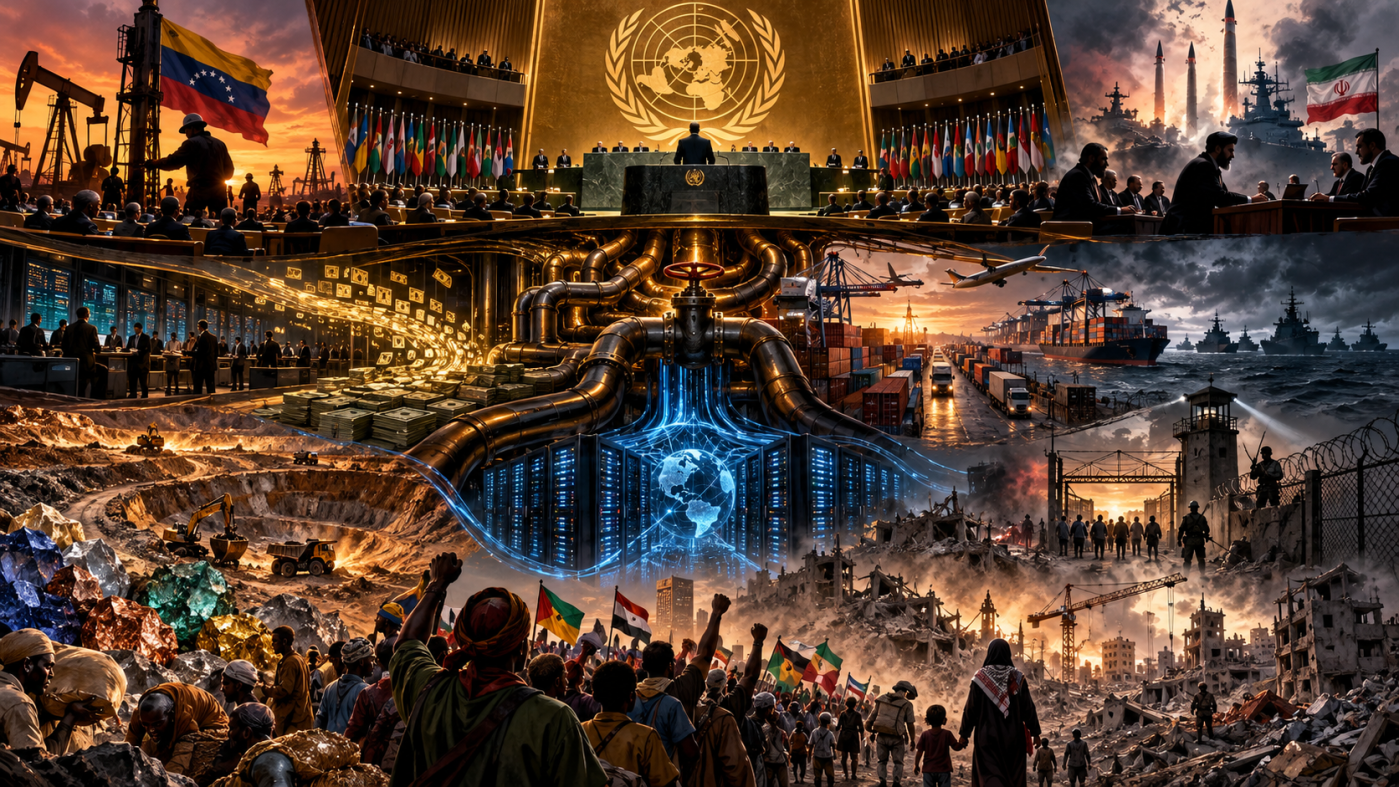
The United Nations General Assembly spoke the language of sovereign equality while the week’s biggest conflicts exposed how unevenly the means of exercising sovereignty are still distributed. From Gaza’s reconstruction regime and Venezuela’s oil revenues to Iran’s coercive diplomacy and the unequal infrastructure of artificial intelligence, the decisive struggles ran through property, finance, military power and technology long before they reached the microphone. Al Jazeera captured many of the confrontations but broke them into separate stories, leaving the material relation between them harder to see. UNGA 81 revealed a world where nearly every state has a flag and a vote, but far fewer possess equal command over the forces that determine what those rights can actually do.
September 29, 2026
Five Takeaways, One Missing Relation
Edna Mohamed’s September 29 Al Jazeera explainer opens UNGA 81 with a sharp proposition. António Guterres tells the General Assembly that humanity faces four tests—war, inequality, climate change and artificial intelligence—and that beneath them sits the same issue: power over force and money, energy, technology, rules and the future. Then the article cuts that connected picture back into five separate news stories.
Palestine becomes speeches about statehood, the Board of Peace, Netanyahu and the delegates who walked out on him. Venezuela enters through Trump boasting about military victory and an oil agreement. Iran appears first through Trump’s threats and then through the diplomatic traffic around Pezeshkian and Araghchi. AI becomes a disagreement among world leaders over cooperation and regulation. China arrives beneath the headline that Xi Jinping “skips the UNGA,” even though the section itself is mostly about what Vice President Han Zheng said. The reader gets the podium, the personalities and the diplomatic theater. The relations connecting them stay backstage.
The historical clock helps produce that effect. Mohamed begins overwhelmingly inside UNGA week, where presidents make statements, foreign ministers hold meetings and announcements pile up. That’s natural for a summit explainer, but it also makes the summit look like the container of the politics being discussed. History gets a visitor’s badge and is escorted back outside the hall. Wars, sanctions, occupation, reconstruction and technological rivalry enter mainly when a speaker mentions them, so processes already moving through years of conflict arrive as items on the week’s diplomatic agenda.
The source hierarchy reinforces the frame. Presidents, prime ministers, foreign ministers and the UN secretary-general do most of the acting. Governments recognize, condemn, negotiate, threaten and propose. Ordinary people enter mainly as those being bombed, displaced, governed or reconstructed. Institutions appear by name more often than by the powers they exercise. Even the article’s strongest language doesn’t break that pattern. It calls Gaza a genocidal war, describes escalating settler violence and says Washington’s unilateral foreign policy has undermined the UN. This isn’t State Department stenography wearing an Al Jazeera badge.
That’s why the framing matters. The article says plenty about who confronted whom, but power repeatedly appears in diplomatic costume. Guterres begins with four linked tests, yet inequality and climate disappear as takeaways while the remaining subjects are organized around presidents, wars and negotiations. The piece doesn’t have to falsify the parts to obscure the relation among them. Five accurate photographs can still leave the wiring outside the frame. If all of this is about power, the unanswered question is what that power actually operates through.
The Power Under the Podium
Guterres had already pointed toward an answer. His four tests of power tied inequality to concentrated wealth and finance, climate to energy and resources, and artificial intelligence to increasingly concentrated control over data, computing capacity and algorithms. Those relations don’t sit above the summit as theory. They appear inside the concrete disputes Al Jazeera selected.
Palestinian participation itself carried the contradiction before anyone reached the microphone. On September 17, the General Assembly voted 152 to 3 to permit President Mahmoud Abbas to address UNGA virtually after the United States denied visas to the Palestinian delegation. Washington, Israel and Paraguay opposed the measure. The Assembly created a procedural route around a decision made by the host state, showing that the struggle over Palestinian representation was already embedded in the rules governing access to the institution discussing it.
Gaza reconstruction reaches still deeper into administration and security. The July Gaza Roadmap sets out a National Committee for the Administration of Gaza, an International Verification Committee and an International Stabilization Force, with movement between phases tied to verified commitments. Palestinian civilian administration sits inside a wider structure that sequences withdrawal, security and reconstruction. The Security Council’s Resolution 2803 also gives the Board of Peace a transitional administrative role, authorizes operational entities for governance and reconstruction, and places funding and international security inside the same framework. The announced rebuilding package is therefore part of a political and administrative settlement, not a pile of construction projects floating free of authority.
The dispute over UNRWA exposes another limit of administrative replacement. The Board of Peace has publicly excluded the refugee agency from its future architecture, yet continued contacts have taken place with Palestinian administrators because UNRWA still carries a large workforce, field infrastructure and service network in Gaza. The political decision to push an institution aside doesn’t instantly reproduce the schools, clinics, water systems, staff and accumulated knowledge it already operates. Even institutional exclusion therefore runs into the stubborn weight of material capacity.
Venezuela puts property and revenue directly on the table. PDVSA president Héctor Obregón has defended Productive Participation Contracts that expand private operators’ role in petroleum production and commercialization in exchange for a negotiated state share. He also acknowledged that export earnings are being deposited in U.S.-controlled accounts before funds are released back to Caracas. The exact legal horizon remains disputed: Venezuelan officials describe 25-year contracts that can be renewed, while Washington has described a much longer arrangement. What the Venezuelan officials defending the deal do acknowledge is enough to make Trump’s “spoils” rhetoric concrete: oil production, commercialization and the movement of revenue have all become part of the settlement.
That settlement also carries a domestic class conflict. Acting President Delcy Rodríguez has presented the agreement as a road toward “welfare and prosperity”, arguing that reserves must be turned into healthcare, education and development. Venezuelan grassroots groups organized through the Popular Anti-Imperialist Front have protested the same arrangement and demanded a review of measures adopted under U.S. pressure. The state’s development argument therefore sits beside an organized struggle over what terms Venezuela should accept and who should command the resource.
Iran shows another form of the same pressure. During UNGA week, Iran’s Foreign Ministry said Tehran conveyed conditions for renewed diplomacy to Washington through Qatari mediation, including an end to fighting, the naval blockade and economic pressure. Those contacts unfolded while Trump publicly threatened further destruction of Iran. The exact duration and format of the talks remain contested; the material point doesn’t depend on either. Diplomacy was taking place inside an active field of military and economic coercion.
South Africa also brought the summit’s missing inequality lane down to the level of debt. Its statement described governments forced to choose between domestic needs and creditors, criticized borrowing costs that squeeze fiscal space, and tied climate action to financing that developing countries can actually afford. That matters to the article’s opening frame because “money” means hard obligations here. Debt service can decide whether a government funds schools, infrastructure and adaptation or sends scarce revenue outward first. The diplomatic language of partnership sits on top of those financial obligations.
The AI dispute rests on another set of hard capacities. A February 2026 South Centre study treats AI policy in developing countries as a question of digital transformation, labor, industrial development and national capacity as well as regulation. South Africa carried that material question into its UNGA 81 statement, linking constrained climate finance to Africa’s position in critical-mineral production and calling for beneficiation, research capacity and participation in AI innovation rather than continued reliance on raw-material export.
Once those relations are restored, the summit floor looks different. Behind the speeches are oilfields and accounts, security bodies and administrative rules, mineral processing and computing capacity, visas and institutional authority. The diplomats remain visible, but now so do the material arrangements that give their words different weight.
Sovereignty on Paper, Command in Practice
Strip away the summit choreography and the five stories begin to converge on one historical contradiction. The twentieth century shattered formal colonial rule across much of the planet. Nations that had been governed as possessions entered an international system of sovereign states, carrying flags, votes, constitutions and legal equality. That victory was real: anticolonial struggle changed who could claim national authority and turned self-determination from an imperial concession into a right asserted by peoples who had been ruled from abroad. But independence didn’t redistribute the accumulated command over factories, banks, armies, technology, energy systems and capital at the same speed. The flag changed hands faster than the material power beneath it.
That unfinished transformation runs through UNGA 81. Sovereignty has a material body. A government that can’t finance development without punishing conditions has less room to maneuver than one that commands enormous pools of capital. A country that owns minerals but can’t process them remains dependent on those who can. A state that helps write technological rules while importing the infrastructure that makes the technology work enters the room formally equal and materially unequal. A people whose national rights are recognized while others still shape access, security and reconstruction confront the contradiction in its sharpest form.
Venezuela shows how imperial command becomes durable through property and finance. The deeper issue isn’t that Washington “wants influence.” Control over a resource becomes political power when somebody can shape who operates production, who commercializes the commodity and how the revenue moves. The gunboat doesn’t need to sit permanently offshore if coercion can be translated into contracts and accounts that keep working after the cameras leave.
Yet Venezuela also prevents the argument from collapsing into nationalism. State managers can defend foreign investment as necessary for rebuilding production while popular forces contest the terms under which it enters. National sovereignty therefore carries class content. A state can gain room against foreign pressure while workers and poor people gain little control over accumulation, or concede ground internationally while defending the bargain at home as necessary for survival. Multipolarity can widen the field of maneuver without telling us who gets the harvest.
Gaza pushes the contradiction into the colonial-national question. Reconstruction sounds humanitarian when reduced to money pledged and projects announced. In material terms, rebuilding means authority over administration, security, sequencing and the conditions under which Palestinian social life can be reproduced after destruction. A neighborhood reduced to rubble isn’t an empty canvas for outside planners. It is land, homes, memory and social relations damaged by war. Control over reconstruction therefore reaches into the conditions of national life itself.
Palestinian agency still matters inside that unequal field. Resistance changes the choices available to stronger powers, uses openings inside institutions and prevents domination from becoming automatic command. That’s why the structures of verification, security and administration matter: power has to be reproduced against people who resist it. The asymmetry remains real, but asymmetry isn’t passivity.
Iran exposes the same problem through coercive diplomacy. When negotiations unfold beside blockade, economic pressure and the possibility of renewed attack, the bargaining table already carries the battlefield into the room. Formal equality remains legally important, but military and financial power shape the cost of refusal. Diplomacy and coercion can therefore operate together as parts of the same relation.
The AI debate brings the contradiction into the productive forces of the present century. International participation means less when some states command computing infrastructure, industrial capacity and capital while others export raw materials and import higher-value technology. The country that supplies the minerals while somebody else processes them, owns the platforms and captures the more profitable stages of production occupies a different material position no matter how equal the microphones look.
This is where the easy geopolitical reading breaks down. America seeking dominance, China seeking influence, Iran seeking security and everyone else maneuvering for leverage tells us what states appear to want. It doesn’t tell us what is being moved. Beneath the diplomatic language lie petroleum, accounts, territory, industrial capacity, military force and institutions that regulate access to all of them. Geopolitics is the surface movement. Political economy tells us what is actually being moved.
The United Nations sits inside that contradiction. Its formal equality matters because colonized and subordinated peoples fought to enter a world in which their states could speak, vote and invoke universal rules. Its limits matter because votes don’t equalize finance, technology, military capacity or control over territory. The result is neither a world parliament standing above power nor an empty stage where nothing matters. It is contested terrain: legal rules can give weaker states and oppressed peoples room to fight, while the unequal world outside the chamber presses back through money, weapons and institutional command.
Multipolarity sharpens that contest without settling its social content. Additional centers of production, finance and technology can make U.S. imperial command more costly and create greater room for states to maneuver. But more poles don’t automatically mean more power for workers, peasants or oppressed peoples. A national ruling class can use new room to accumulate for itself. A state can resist foreign domination while reproducing exploitation at home. The struggle over sovereignty therefore has two fronts: against unequal international command and over who controls whatever space is won inside each society.
Now Al Jazeera’s five takeaways look different. Palestine, Venezuela, Iran, AI and China are separate concrete struggles, but they all expose the unfinished distance between sovereignty as a legal promise and sovereignty as a lived capacity. The summit records the argument in speeches. The deeper history turns on who controls the land, the account, the weapon, the resource and the productive capacity that determine whether a right written on paper can govern material life.
Where Rights Acquire Weight
The analysis becomes politically useful only where formal claims meet real leverage. Palestinian trade unions have issued a November worker-action call urging unions to use procurement and investment policies, contract pressure and peaceful collective action against institutional relationships they identify as complicity. The contradiction is plain: Palestinian rights may be affirmed in declarations while military and commercial supply chains continue operating. The unions’ chosen leverage lies in workplaces, contracts and purchasing power, with the stated aim of reducing those material links.
The Palestinian Youth Movement has pushed the same problem into logistics. Its arms-embargo campaign reports at least 280 military cargo shipments leaving Oakland airport for Israel since January 2025 and has organized a coalition around that transport node. Research makes the route visible; public and institutional pressure then targets the airport’s role in the supply chain. The intended effect is specific: end the identified flow of military cargo through that channel.
Venezuela demands a different kind of organization. The Popular Anti-Imperialist Front, a coalition of Venezuelan grassroots groups, has organized demonstrations and neighborhood activity against the oil arrangement even while the Rodríguez government defends it. Their leverage lies in domestic political organization around resource policy, pressing the argument over sovereignty back into the society whose oil is being negotiated.
On AI and data governance, the leverage point is the rulebook and the capacity behind it. The South Centre supports developing countries in international negotiations, while its AI research argues for policy frameworks fitted to Global South development and industrial needs. IT for Change has convened Global South civil-society actors around structural AI governance, and its participation in the UN data-governance process carries that work into an institutional arena where rules are negotiated. These forces work differently, but both target the gap between formal inclusion and the power to shape standards, data rules and development policy.
None of these struggles offers a universal lever, and none guarantees victory because it has found a pressure point. Their importance lies in matching organization to the actual place where policy becomes material: a contract, an airport, an oil agreement, a negotiating rule. That is the distance between solidarity as sentiment and solidarity as organized force. The leverage differs because the institutions differ, but the method is concrete in every case: identify where the relation is reproduced and organize around that point. Rights acquire weight when people can reach the institutions that reproduce the relation and force a change in what states and corporations are able to do.


Leave a comment