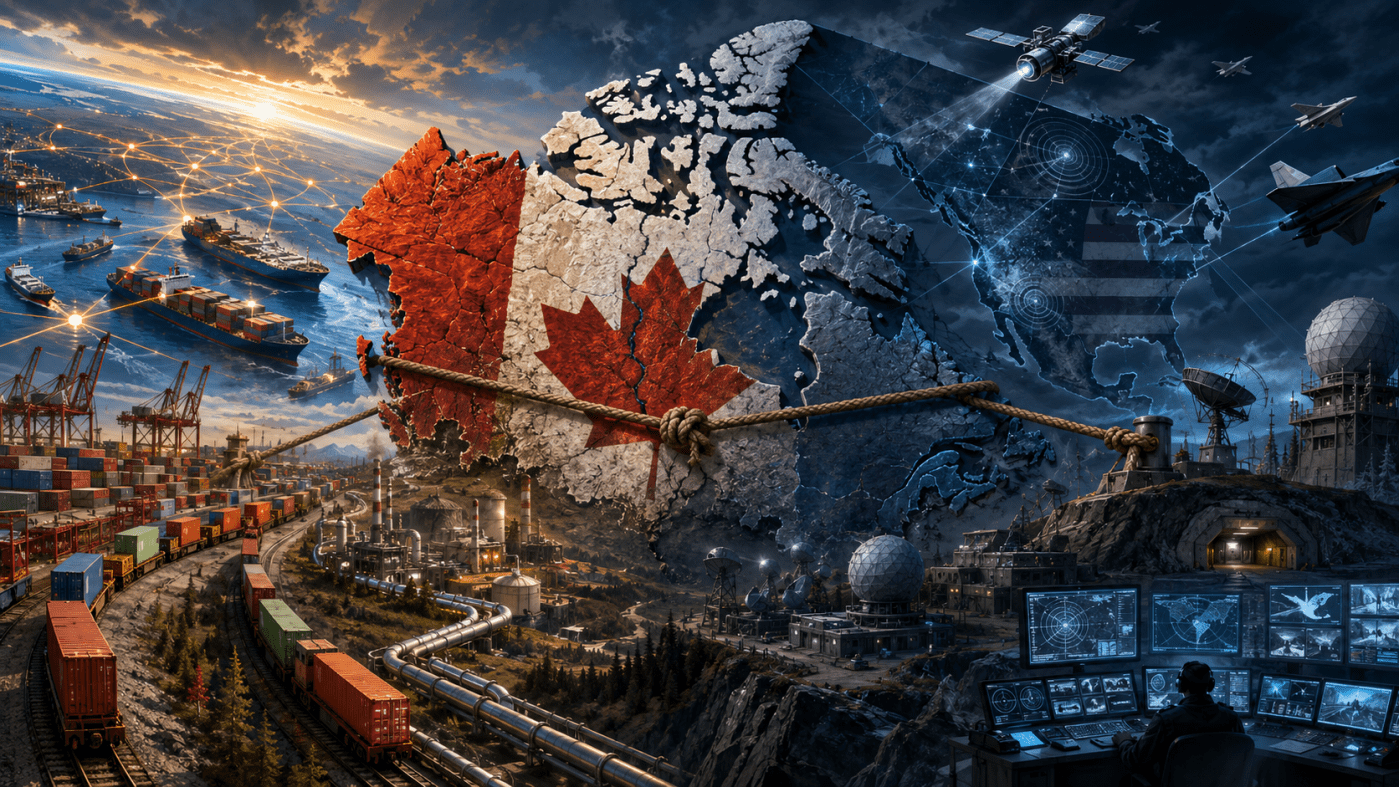
Canada’s century-old continental bargain with the United States built factories, pipelines, profits, and military integration into the same structure that Washington can now turn into leverage. Yet Canada was never merely an American dependency: its banks, mining firms, pension funds, and corporations grew into a secondary imperial power capable of exercising domination abroad even while constrained from above. U.S. pressure is now accelerating a material diversification already visible in Pacific infrastructure, wider trade routes, renewed relations with China, and the struggle to turn new markets into actual productive capacity rather than another branch-plant dependency. But the deepest contradiction remains unresolved: freight can move toward a multipolar world while finance, intelligence, and military command stay Atlantic—and neither path becomes popular sovereignty unless workers and Indigenous nations gain power over what gets built, who owns it, and whose future Canadian autonomy serves.
Prince Kapone | Weaponized Information | August 26, 2026
I. A Country Moving in Two Directions
Canada is doing something the old geopolitical map has trouble explaining. One of Washington’s closest allies is fighting a trade war with the United States, reopening economic relations with China, courting other non-U.S. centers, and talking openly about “strategic autonomy” and a “third path.” At the same time, the federal state is deepening NORAD, pouring more money into NATO, and staying wired into Five Eyes intelligence. If this is a pivot, it’s a peculiar one. The freight is beginning to move in one direction while the radar screens still point in another.
The rupture has moved well beyond rhetoric. Beginning in February 2025, Washington imposed additional tariffs on Canadian goods and energy, and subsequent White House measures made the industrial purpose harder to disguise: companies were openly encouraged to shift production into the United States. Ottawa answered with counter-tariffs. By August 2026, after negotiations broke down, Carney was invoking Canada’s “flexibility, independence, and sovereignty” while announcing retaliation against U.S. tariffs affecting roughly C$28 billion of Canadian goods. The same border that carried profits, parts, and investment for generations was now carrying punishment back across it. Market access, factory location, and continental dependence had become weapons at the bargaining table.
At almost the same moment, the economic map began loosening at the edges. Statistics Canada recorded Canadian merchandise exports to the United States falling in 2025 while exports to non-U.S. destinations rose. One turbulent year can’t erase a century of continental gravity, but direction matters before dominance changes. The old current still runs south with enormous force. It just isn’t the only current anymore.
Ottawa is widening the field too. In January 2026, Carney traveled to Beijing and announced a renewed Canada-China partnership, while the federal government kept building economic relationships beyond North America. Its language of strategic autonomy and a “third path” reveals a changed calculation inside the Canadian state. Concentrated dependence is starting to look less like common sense and more like a bill that can suddenly come due. Ottawa is searching for additional markets and partners because Washington has made the old arrangement more expensive to trust.
The military map has barely followed. Ottawa is modernizing NORAD, accelerating defense spending inside NATO, and Canadian intelligence remains operationally embedded in Five Eyes cooperation. The same federal state looking for greater economic independence still shares radar, intelligence, weapons planning, and strategic assumptions with the U.S.-led Atlantic system. The contradiction isn’t buried in some obscure policy paper. It sits inside the same state.
The easy story falls apart right there. Canada’s turn toward China is real but limited; its Atlantic military commitments remain deeply rooted. Trump accelerated the confrontation, but the dependence he’s exploiting was built long before him. Canadian capital also had overseas ambitions long before Washington started tightening the screws. What’s happening now is more specific: an old continental structure is colliding with a world economy that offers Canadian capital more alternatives than it once had, just as U.S. imperial power is making concentrated dependence more costly.
Two geographies are now pulling at the same state. One is old and heavy, built through factories, banks, pipelines, intelligence networks, military command, and a border across which Canadian capitalism has accumulated for generations. The other is younger and uneven, taking shape through wider commercial relationships and routes into a world where non-U.S. centers offer options on a scale Canada didn’t previously possess. Whether that second geography remains insurance, becomes durable economic multipolarization, or hardens into something approaching strategic autonomy will depend on what Canadian capital and the Canadian state can actually build and defend.
But the present rupture only makes sense once we descend into the older bargain underneath it. Canadian dependence on the United States was never just imposed from outside. Powerful Canadian interests helped build it because, for a very long time, it paid.
II. The Continental Bargain
The dependence that now looks like a trap wasn’t built because generations of Canadian capitalists somehow forgot where the border was. Canadian capitalism had long grown through staple exports—timber, wheat, minerals, and other commodities—and Statistics Canada’s historical data shows Canadian exports remained heavily resource-based even as the country industrialized. The old British imperial connection faded unevenly, but trade, investment, and production kept turning south. The border became more than a line between two states. It became an artery carrying machinery, energy, parts, finished goods, investment, and profits back and forth.
Industrialization rebuilt that dependence on a larger scale. By the twentieth century, foreign ownership ran deep through Canadian manufacturing, especially through the branch-plant system. A corporation headquartered somewhere else could own a factory in Canada while the big decisions—investment, technology, product lines, expansion, closure—were still made somewhere else. Statistics Canada records foreign-controlled firms producing about half of Canadian manufacturing output in the 1970s, with foreign control remaining especially strong in scale-based industries thereafter. Canada could have the plant, the workers, and the smokestacks while somebody across the border still held the steering wheel.
The 1965 Auto Pact drove that arrangement deeper. The agreement liberalized automobile and auto-parts trade between Canada and the United States, and production spread itself across the border instead of reproducing complete national industries on each side. The Bank of Canada notes the economies of scale, specialization, and productivity gains that came with continental integration. For Ontario manufacturers, parts suppliers, governments hungry for investment, and workers whose towns depended on the plants, the arrangement delivered something concrete: orders, jobs, production, tax revenue. Continental integration didn’t arrive wearing jackboots. It arrived carrying purchase orders.
An unequal relationship can still make money for the weaker capitalist partner. Canadian industrial capital gained privileged access to a market several times larger than its own. U.S.-based corporations brought investment, technology, and production networks. Canadian plants gained scale. Whole communities came to depend on industries organized across the border. The cost was built into the same arrangement: practical control over investment, technology, and industrial development narrowed as continental dependence deepened. The bargain lasted because the profits were real—and because enough workers and communities were tied to the system to make any rupture brutally expensive.
The Canada-U.S. Free Trade Agreement of 1989 and NAFTA after 1994 spread that logic across more of the economy. Statistics Canada records Canadian manufacturing becoming increasingly integrated into U.S. markets after the free-trade agreements of the late 1980s and 1990s. Tariffs fell. Supply chains thickened. A component could cross the border two or three times before anybody called the final product Canadian or American. By the early twenty-first century, Canada’s dependence on the U.S. market was the accumulated result of decades spent organizing production around continental scale. Efficiency had acquired a geography.
CUSMA kept that structure in place when it replaced NAFTA. The agreement entered into force on July 1, 2020 and retained detailed North American rules governing sectors such as automobiles and regional content. By then “free trade” meant a hell of a lot more than lower tariffs. It meant factories, suppliers, investment decisions, and entire industries built around privileged access to the continental market. Capitalists love to call a dependency “efficiency” when it’s paying.
Energy followed the same southward pull. Canada could sit on enormous oil and gas reserves, but possession of the resource didn’t decide where it could be sold profitably. Before the recent Pacific expansion, Canada Energy Regulator data showed nearly all Canadian crude-oil export volumes and almost all exported natural gas going to the United States, overwhelmingly through pipelines. Oil can lie beneath Canadian soil and still depend on a pipe pointed almost entirely at one foreign market. Abundance means very little when the profitable route ends at one buyer.
Those pipelines, mines, rail corridors, and transmission routes were built through the territorial power of the Canadian settler state. They crossed Indigenous lands while Ottawa and provincial governments claimed the authority to survey, permit, expropriate, regulate, and move capital through territories where Indigenous peoples maintained their own rights, governments, and jurisdiction. Even the federal energy regulator now treats Indigenous participation, land matters and Crown consultation as part of the governance of federally regulated pipeline infrastructure. Continental integration therefore required more than a bargain between Canadian and U.S. capital. It also depended on a settler state powerful enough to turn Indigenous territory into corridors for continental accumulation.
Security was built into the same continental order. Canada and the United States established NORAD in 1958 as a binational command for monitoring and defending North American airspace, later expanding shared warning, surveillance, and operating systems. Canada kept its armed forces and formal sovereignty, while continental defense increasingly relied on shared machinery, command relationships, and infrastructure that Ottawa didn’t reproduce independently. The arrangement gave Canada military capacities it would’ve paid far more to build alone. Dependency could be useful. That was part of its strength.
The continental consensus endured because the system distributed enough gains upward and outward to keep reproducing itself. Manufacturers got scale. Energy capital got a vast buyer. Federal and provincial governments got investment and revenue. U.S.-based corporations got Canadian labor, resources, and production capacity. Washington got a deeply integrated northern economic and military partner. Workers still fought bosses, but millions of livelihoods became tied to industries that needed continental access to survive. Constrained autonomy wasn’t some defect discovered after the warranty expired. It was built into the bargain from the start.
And that bargain produced more than dependence. It helped enlarge Canadian corporations, concentrate capital, deepen finance, and push Canadian ownership outward into the world economy. The country that could be squeezed from the south was also producing banks, mining firms, pension funds, and corporations capable of squeezing others elsewhere. Continental subordination and outward Canadian power grew together.
III. Empire in the Shadow of Empire
There’s a familiar way of telling the story of Canadian capitalism: foreign capital comes in, American corporations buy, continental supply chains tighten, and Ottawa learns to call dependence partnership. That history is real. It becomes bullshit when the camera stays pointed only northward. Canadian capital also moves outward in enormous quantities, buying companies, mines, financial claims, and other assets across the world. A balance sheet can’t settle the theory of imperialism by itself, but it can tell us who owns what. And Canada owns plenty beyond its borders.
At the end of 2025, Statistics Canada recorded C$2.43 trillion in Canadian direct-investment assets abroad, compared with C$1.60 trillion in foreign direct investment inside Canada. More than C$513 billion of Canadian direct investment sat in Europe, roughly C$341 billion in the Caribbean, C$176 billion in Asia and Oceania, and C$111 billion in South and Central America. These aren’t crates passing through a port. They’re durable ownership claims. Behind the numbers are companies, workers, land, machinery, debt, dividends, and profits flowing toward Canadian owners.
Finance makes the structure even harder to hide. Finance and insurance accounted for roughly C$845 billion, or 34.8 percent, of Canadian direct investment abroad in 2025. Canadian capitalism reproduces wealth through more than lumber, petroleum, machinery, or automobiles. Banks, insurers, holding companies, and other financial institutions own claims across borders and collect profits generated far beyond Canada. Follow the money and the portrait of a helpless northern dependency starts falling apart fast.
Mining puts dirt under the numbers. Natural Resources Canada reports that 1,344 Canadian mining and exploration companies held C$352.6 billion in mining assets in 2024. Of those firms, 747 held C$240.6 billion in assets abroad across 95 countries—roughly two-thirds of the total. Latin America and the Caribbean accounted for C$123.5 billion; Africa another C$45.9 billion. A “mining asset” sounds wonderfully clean on a spreadsheet. On the ground it means land, water, machinery, workers, permits, roads, ports, blasting, waste, and a struggle over who gets to decide what happens to all of it.
Cobre Panamá ripped away the accounting language and exposed the property relation underneath. The giant copper mine was operated by a subsidiary of Canadian-based First Quantum Minerals. In 2023, Panamanian unions, Indigenous organizations and other popular forces mobilized against the new mining contract, challenging its consequences for territory, the environment, and national sovereignty. The dispute left the conference room and hit the streets. Panama’s Supreme Court declared the law approving the contract unconstitutional in November 2023, and the mine was shut down. First Quantum then moved toward formal international arbitration against the Panamanian state. The relation is plain enough: a Canadian corporation holds the claim, workers and communities resist, a national court intervenes, and capital reaches for transnational legal machinery to defend the value of its property.
So the “American colony” shorthand breaks down at exactly the point where Canadian ownership crosses somebody else’s border. It captures a real continental subordination and then stretches that truth until it hides another one. A Canadian corporation operating abroad arrives as an owner. Canadian capital can be constrained by U.S. power while exercising power of its own over workers, resources, and territory elsewhere.
The scale still matters. At the end of 2025, Statistics Canada recorded 49.5 percent of Canadian direct investment abroad in the United States, while U.S. investors held 46.1 percent of the foreign direct-investment stock inside Canada. Those figures sit on top of the continental production, market, and security systems already built through the bargain. Canada has substantial capitalist power, but Washington commands a far larger imperial system. A smaller capitalist can get squeezed by a bigger monopoly and still exploit workers beneath him. Nobody becomes a proletarian merely because a richer man has his hand around his throat.
Canada is best understood as a secondary imperial-core capitalist formation: a state whose ruling class commands substantial outward capital, internationally powerful corporations, and real imperial privilege, while remaining heavily constrained by U.S. imperial power. Those two relations operate at the same time. Canada sits below Washington in a wider imperial order and above workers, communities, and poorer states where Canadian capital owns, extracts, lends, and collects.
That changes the political meaning of Canadian autonomy. A bank, mining company, pension fund, or internationally invested capitalist fraction can want greater freedom from Washington for a perfectly capitalist reason: it wants greater freedom to make money somewhere else. More independence for Ottawa can therefore strengthen Canadian capital without strengthening workers at home or peoples confronting Canadian corporations abroad. Change the flag above the negotiating table and the property deed can remain exactly where it was.
Canadian capitalist power also predates U.S. dominance. It grew through an older British imperial inheritance, settler-colonial accumulation, and domestic class development. The U.S.-centered continental order later enlarged and internationalized major sections of Canadian capital while binding those gains to a system Canada never commanded. Now that same structure is showing its other face. The networks that helped Canadian capital grow rich and reach outward can also be used by Washington to discipline it.
The continental bargain didn’t produce an innocent victim. It produced a smaller imperial power living profitably inside the shadow of a larger one. Once Washington starts turning that inherited dependence into a weapon, the shadow gets harder to ignore.
IV. When Integration Becomes Leverage: Fortress America Turns North
The border didn’t become a cage in 2025. The bars had been welded into place over generations. What changed was how Washington started using them. Factories, markets, pipelines, and continental supply chains that Canadian capital had built for profit could also carry punishment in the opposite direction. Integration worked because firms counted on the border staying open enough for parts, energy, investment, and finished goods to keep moving. Once Washington showed it was willing to squeeze that flow, yesterday’s efficiency started looking like somebody else’s hand on the valve.
Tariffs hurt through the structures already built underneath them. An auto plant can’t replace a continent’s worth of suppliers between Monday and Friday. A steel mill can’t conjure new buyers because Ottawa gives a patriotic speech. Energy is even less sentimental about flags: in 2025, 90.8 percent of Canadian hydrocarbon exports went to the United States, including 90.1 percent of crude-oil exports. Workers encounter that dependence as threatened shifts, delayed investment, and the fear that the plant or refinery holding up the family budget could disappear. Wells and pipelines, inconveniently for nationalist speeches, can’t turn around and face another ocean on command.
Washington has been pressing directly on those weak points. By August 21, 2026, Carney’s office said U.S. tariffs of 50 percent were hitting roughly C$28 billion in Canadian exports and announced dollar-for-dollar retaliation. At the same time, the U.S. state was pulling more industrial inputs under the heading of national security. A January 2026 proclamation treated processed critical minerals and their derivatives as an import-security problem requiring negotiations and possible trade measures. Metals, autos, minerals, and market access were being drawn more tightly into U.S. strategic command. Commerce was becoming a disciplinary tool.
That’s the material core of the present rupture. Tariffs can shift the next factory south. Market access can be made conditional on political concessions. Strategic minerals can be folded into security demands. Washington already had the power to do this because generations of continental integration had concentrated so much Canadian production and circulation through the United States. The border stayed where it was on the map. Politically, somebody installed a tollbooth.
You can see the change in the language coming out of Ottawa. In August, Carney called Washington’s terms “unfair” and “uneconomic”, declared that “America has changed,” and named “flexibility, independence, and sovereignty” as Canadian objectives. Months earlier at Davos, he’d described the international conjuncture as “a rupture, not a transition” and warned that deep economic integration could itself become a source of subordination. Speeches don’t create independence, but they reveal a change in ruling-class calculation. What Ottawa once praised mainly as efficiency is now being booked as strategic vulnerability.
This is imperial discipline inside an alliance. Washington doesn’t need a blockade or an occupation when so much Canadian production, trade, energy, and investment already run through systems tied to the United States. The punishment can travel through the benefits themselves: access, scale, supply chains, investment, the enormous U.S. market. Canada remains an imperial-core state with privileges of its own. That makes the mechanism more revealing, not less. The velvet glove stays on. Washington just keeps making sure everybody notices the fist inside it.
Canadian capital is hardly united on what comes next. Manufacturers can curse U.S. pressure while still needing U.S. customers and suppliers. Energy firms can demand Pacific routes while fighting to preserve their biggest existing market. Ottawa can retaliate in trade and remain deeply integrated with Washington in military and intelligence affairs. The state is trying to keep the advantages of continental integration while reducing Washington’s ability to turn those advantages into obedience. That is a narrower ambition than rupture, but a more consequential one than rhetorical nationalism.
Fortress America names that hardening of the continental relation. The U.S.-centered system already gave Washington unusual power because so much production, strategic material, market access, and military planning had been organized around it. The present imperial recalibration uses more of that inherited power openly: pull production inward, secure strategic inputs, discipline allies, reduce the cost of refusal for Washington and raise it for everyone else. Canada’s response begins inside that squeeze. State managers and competing fractions of capital are looking for enough redundancy that saying no to Washington doesn’t automatically mean shutting a plant, losing a buyer, or watching investment head south.
Pressure can still force Canada back into a repaired continental bargain. It can also make every alternative route, customer, and partner more valuable. Both tendencies are alive at once. That is where the old bargain reaches its limit: the same dependence that gives Washington the power to squeeze also raises the value of escaping exclusive dependence on Washington.
From here, speeches matter less than steel, concrete, contracts, and cargo. If Canadian capital is really building a wider field of action, it has to appear in pipelines, ports, railways, and markets that move goods without first passing through the imperial tollbooth.
V. Building the Exits: Pipelines, Ports, Markets, and Variable Geometry
An independent foreign policy with only one practical customer is a speech. A second customer without a route to reach it is a wish. If Canadian capital wants to make saying no to Washington less economically punishing, the change has to show up on the ground: where commodities can go, which ports can load them, which pipelines can carry them, which railways can move them, and which buyers can take them without first passing through the United States. Strategic independence begins with something much less glamorous than diplomatic language. It begins with another way to move the goods.
The first sign is already visible in trade. Statistics Canada recorded the U.S. share of Canadian merchandise exports falling from 75.9 percent in 2024 to 71.7 percent in 2025; exports to the United States declined 5.8 percent while exports elsewhere increased 17.2 percent. Some of that jump came from exceptional precious-metals flows, so strip them out and look again: after gold, silver and platinum-group metals were excluded, non-U.S. exports still increased by roughly C$14 billion while shipments to the United States fell by almost C$31 billion. The continental market still towers over everything else. But the flow is starting to spread.
Trade figures can swing. Concrete and steel are harder to fake. The Trans Mountain Expansion raised system capacity to roughly 890,000 barrels per day and sharply increased Canadian crude shipments to non-U.S. destinations. The full-year numbers make the shift plain: crude exports outside the United States rose 132.6 percent in 2025 and reached 10.9 percent of total crude exports, compared with an average of 2.8 percent from 2016 through 2024. Washington still buys most Canadian crude by a mile. That’s precisely why the Pacific route matters. Bargaining power changes before dominance disappears. One pipeline can reproduce dependence. A second direction gives the seller somewhere else to go.
LNG Canada opens another Pacific corridor. After exports began from Kitimat in June 2025, all of the facility’s Canadian LNG exports that year went to East Asia. Canadian gas that once faced overwhelmingly south now reaches buyers across the Pacific. The significance is brutally physical: gas enters a terminal on the west coast, loads onto ships, and reaches a market Washington doesn’t control. The old dependence remains. The route around it now exists.
Ottawa is putting public money behind that widening network. The 2025 budget created a C$5 billion Trade Diversification Corridors Fund for ports, railways, roads, airports and other infrastructure intended to expand access to overseas markets, alongside a goal of doubling Canadian exports outside the United States by 2035. Ports aren’t scenery behind trade statistics. Railways aren’t lines somebody draws after the economy has already happened. A producer can have ten willing buyers and still be trapped if only one practical corridor connects the factory, mine, farm, or wellhead to market. A wider set of routes gives Canadian producers something rhetoric never could: the ability to redirect goods when one buyer starts dictating terms.
Carney’s language of “variable geometry” starts making sense once you can see the infrastructure underneath it. In Mumbai in February 2026, he described a Canadian “strategic stack” involving food and energy, critical minerals, semiconductors, artificial intelligence, sovereign cloud capacity and other capabilities while presenting diversification across multiple regions as a response to dangerous concentration. The same strategy points toward India, ASEAN states, Mercosur, China, Indonesia, and the United Arab Emirates. Ottawa is trying to build an economy that can move in several directions when Washington decides the old route comes with political conditions.
Those directions don’t all carry the same political weight. More trade with Europe, Japan, or South Korea can reduce bilateral dependence on the United States while leaving the wider Atlantic order perfectly comfortable. India, ASEAN, Gulf economies, Mercosur, and other centers spread Canadian commercial ties across a more politically mixed world. Canada and India, for example, set a goal of concluding a Comprehensive Economic Partnership Agreement by the end of 2026 and raising two-way trade to C$70 billion by 2030, alongside cooperation in energy, critical minerals, and technology. Every new partner doesn’t pull Canada toward the same geopolitical destination. Collectively, they make exclusive dependence on one market harder to reproduce.
Diversification now has pipes, terminals, ports, railways, contracts, and buyers behind it. More Canadian commodities can move without first entering the U.S. market. Ottawa is spending money to widen those corridors. Canadian firms are looking for customers across a larger field. Washington still holds the dominant position, but dependence starts weakening wherever an alternative stops being theoretical and starts carrying cargo.
None of these routes appeared because Trump fired off a tariff proclamation. Trans Mountain was already being built. LNG Canada was already underway. Canadian capital had been hunting for overseas markets long before the present fight. What changed was the political value of the infrastructure. A pipeline once sold mainly as a way to fetch a better price now doubles as protection against concentrated U.S. pressure. A port acquires strategic weight when the old customer starts threatening to close the gate.
China pushes this movement beyond circulation. Europe can widen Canadian trade without crossing the deepest line in Washington’s present strategy. India and ASEAN can broaden the field without occupying the same place in U.S. containment policy. Beijing does. Once the route reaches China, selling more is no longer the whole problem. The harder issue moves inside the factory itself: whether another major center of production and technology merely buys Canadian goods, or helps change what Canada can actually build.
VI. China and the Difference Between Selling More and Producing More
China matters here because it pushes the argument past circulation and into production. Selling more goods into another giant market can reduce the damage Washington can do by squeezing access to the United States. Productive power goes further. It lives in factories, tooling, engineering, supplier networks, research, software, technical knowledge, and the ability to reproduce all of that without waiting for somebody else’s permission. A ship leaving Vancouver proves Canada has another customer. Industrial strength is measured by what workers can build before the next ship ever leaves the dock.
The opening became concrete in January 2026. Ottawa announced a renewed strategic partnership with China covering energy, agri-food, trade and other fields, alongside reduced Chinese barriers affecting Canadian agricultural exports and a Canadian target of increasing exports to China by 50 percent by 2030. Beijing described the relationship in terms of sovereignty, equality, mutual respect and mutual benefit. That is the Chinese government’s own language. The commercial movement can be measured separately: Canadian exports to China in June 2026 were roughly 41 percent higher than a year earlier. The Chinese market is once again becoming materially more important to Canadian producers.
Market diversification, however, can leave the productive structure almost untouched. Canada could sell more canola, petroleum, minerals, and other commodities to China for years and still remain dependent on foreign industry for high-value machinery, technology, and finished manufactures. Sam Gindin puts the harder issue plainly: reducing dependence requires changing what Canada produces and rebuilding productive capacity rather than treating alternative export markets as sufficient. More buyers strengthen bargaining power. More productive capacity changes the economy itself.
The electric-vehicle opening therefore matters more than another imported brand appearing in Canadian dealerships. Ottawa’s automotive strategy says the new arrangement will permit a fixed volume of Chinese EV imports while seeking Chinese joint-venture investment in Canadian automotive production. The word seeking matters because industrial policy becomes real only when steel goes up, workers get hired, suppliers form, and technical knowledge stays behind. Imported EVs change the showroom. A plant that builds vehicles, develops local suppliers, trains workers, and deepens engineering capacity changes what Canada can actually produce.
Canada has already lived through the cheaper version of industrialization. The branch-plant system put factories on Canadian soil while ownership, technology, product decisions, and corporate strategy remained somewhere else. Statistics Canada’s historical work documents the extraordinarily high degree of foreign control that characterized Canadian manufacturing through much of the twentieth century. That history now becomes a test for any new Chinese investment. Swap an American corporate logo for a Chinese one while the design, technology, supplier decisions, and strategic command stay abroad, and Canada has reproduced the old weakness under different ownership.
Productive capacity means more than assembly. It means tooling, engineering, supplier depth, research, technical learning, and workers who can repair, modify, and improve what they build. It means institutions capable of carrying knowledge from one production cycle into the next. Without that, a modern factory can still function like a rented workshop: Canadian hands on the tools, somebody else holding the keys.
Workers have already forced this distinction into the open. Unifor Local 222 opposed simply opening the Canadian market to China-built vehicles and argued that automakers seeking access to Canadian consumers should also build vehicles in Canada. The demand cuts through a lot of bullshit. Importers want sales. Multinationals want market share. Governments want investment headlines. Workers have to live with what remains after the ribbon-cutting: union jobs or temp work, technical skill or simple assembly, a supplier base or an empty shell, a plant that lasts or one that disappears when corporate strategy changes.
Two very different futures can therefore hide inside the same rising trade numbers. One leaves Canada selling more commodities into China and buying more finished manufactures back. The other uses Chinese investment and industrial knowledge to deepen factories, supplier networks, engineering, research, and technical learning inside Canada. In the first, circulation widens. In the second, the country begins acquiring new productive capabilities.
Beijing’s importance follows from that distinction. China offers Canadian capital a vast alternative market, but it also represents a major center of industrial production and technology outside the U.S.-led system. Economic cooperation with China can therefore reduce exclusive U.S. pressure without turning Canada into a Chinese ally or replacing one dependency with a preordained new one. So far, commerce has moved faster than the deeper industrial transformation. The factories, skills, supplier networks, and technological capacities will tell us how far the opening really goes.
And that brings the limit into view. A country can diversify buyers and even deepen parts of its industrial base while finance, advanced technology, intelligence, and military command remain tied to older centers of power. The factory can change faster than the bank vault, the code, or the command room.
VII. Where the Exit Narrows: Finance, Technology, and the Atlantic Security State
Finance is where that unevenness becomes impossible to miss. Canada may find new buyers, new industrial partners, even new sources of technology while the institutions closest to power stay wired into the old system. Trade can turn outward. Finance, intelligence, and military command move much more slowly.
Canadian capital is powerful abroad, but huge amounts of Canadian wealth still run through U.S.-centered markets. Even as trade started shifting, Canadian investors made C$112.5 billion in net acquisitions of U.S. securities in 2025, C$29 billion more than in 2024. Merchandise was spreading across more destinations while portfolio capital kept pouring south. A Canadian corporation can own assets on several continents and still depend heavily on financial markets whose scale, liquidity, and center of gravity sit in the United States. More buyers widen commerce. They don’t move the bank vault.
Technology creates another kind of dependence. Ottawa’s own language gives away what matters. In Mumbai, Carney described a modern “strategic stack” involving semiconductors, artificial intelligence, critical minerals, sovereign cloud capacity and other advanced capabilities. Strip away the policy jargon and the material standard is straightforward. Technological power rests on command over design, chips, code, repair, adaptation, and reproduction. A plant on Canadian soil can still depend on foreign patents, foreign software, foreign machinery, and technical knowledge controlled somewhere else. If Canadian workers and institutions can operate a system but can’t reproduce or redesign it, a major part of the productive chain still answers to somebody else.
The military side is harder still. Ottawa has committed C$38.6 billion over twenty years to NORAD modernization, including new surveillance, command-and-control systems, weapons, and northern infrastructure. That money goes into radar, sensors, command networks, weapons, and bases designed for continental military integration. Canada can sell more oil and gas across the Pacific while its northern warning systems, command structures, and military planning remain tied to the United States. Economic diversification has reached the docks. Military command is still inside the bunker.
Europe gives Ottawa more options for weapons and procurement without carrying Canada outside that military world. In June 2026, Canada became the first non-European country to conclude an agreement for participation in the European Union’s SAFE defence instrument. That can reduce exclusive reliance on U.S. arms suppliers and give Canadian military industry a wider market. It also deepens capacity inside the Atlantic bloc. Ottawa can loosen one supplier dependency while strengthening the larger war-making system it belongs to. History rarely bothers to make the contradiction polite.
Intelligence tightens the wiring further. In May 2026, CSIS joined its Five Eyes partners in issuing a common warning concerning alleged foreign targeting of their nationals. Whatever judgment one makes about the specific threat claim, the institutional fact is plain: Canadian intelligence still works through a deeply integrated Anglophone network. At the same time, Canada’s defence establishment continues to frame China as a strategic-security concern while other arms of the same federal state expand economic relations with Beijing. Trade officials can pursue business with China while security agencies classify China through the language of threat. Both lines run through the same state.
This is what differentiated sovereignty looks like in practice. Canada possesses formal state sovereignty, but its actual capacity varies sharply from one field to another. Pacific infrastructure has increased the ability to redirect trade. Industrial policy is trying to deepen production. Finance remains heavily tied to U.S.-centered markets. Advanced technology still contains serious dependencies. Military command and intelligence remain overwhelmingly Atlanticist. A maple leaf over the factory gate doesn’t settle who financed the plant, owns the code, supplied the chips, feeds the intelligence network, or writes the war plan.
Tricontinental has described an East Asian “double bind” between deep economic integration with China and U.S.-centered military dependence. Canada is developing its own version. Its older economic and security structures both faced overwhelmingly south. U.S. economic punishment is now pushing part of the commercial system outward while the military and intelligence system remains anchored in the Atlantic bloc. Capital can diversify customers much faster than states rewire command.
That difference sets the real threshold for strategic autonomy. Trade missions, pipelines, and joint ventures can widen economic options. A deeper break would have to reach NORAD, Five Eyes, NATO strategy, procurement, intelligence cooperation, and the state’s willingness to preserve non-Western relationships when Atlantic security priorities demand discipline. So far, the economic opening has moved far ahead of any comparable shift in military or intelligence alignment.
Owen Schalk’s description of Carney’s course as “militarism over multipolarity” catches a real danger, but the phrase doesn’t erase the economic changes already underway. The commercial structure is becoming less exclusively continental. The apparatus of surveillance, intelligence, procurement, and military command remains deeply Atlanticist. Canada is learning to diversify where capital moves while staying far more disciplined where weapons, intelligence, and strategic planning live.
And once sovereignty splits apart like this, the problem becomes political rather than merely national. A Canadian state with greater bargaining power over trade can still leave investment decisions in corporate hands. More industrial capacity can strengthen employers before it strengthens workers. More freedom from Washington can enlarge the power of Canadian capital without enlarging the power of the people who produce the wealth.
That is where sovereignty stops being a flag and becomes a fight over who actually gets to command.
VIII. Sovereignty for Whom?
Once sovereignty comes down off the flagpole and lands on the factory floor, the question gets a lot less ceremonial. Who decides what gets built? Who owns the mine, the plant, the pipeline, the port? Who controls investment when profits fall? Who gets to say no when a corridor is pushed across somebody else’s land? Ottawa can get harder for Washington to push around without workers gaining one damn inch of power over the places where they spend their lives producing wealth. A state can win greater freedom of action while the people underneath it win nothing. That’s the class question hiding inside all the patriotic talk about “Canadian sovereignty.”
The forces trying to loosen Canada’s dependence on the United States aren’t all pulling in the same direction. Canadian Manufacturers & Exporters has reported that more than 90 percent of surveyed manufacturers supported renewing CUSMA for a longer term. Their factories, suppliers, and customers were built around the continental market. Prairie agriculture lives inside a different set of routes: Saskatchewan’s government has been rebuilding commercial relations with China around canola, peas and other exports. Energy firms want Pacific outlets. Auto producers need continental supply chains. Farmers need buyers Washington can’t shut off with a customs order. There aren’t two neat Canadian bourgeois camps lined up on opposite sides of a geopolitical fence. There are overlapping blocs of capital with different profits, routes, and vulnerabilities.
Ottawa is trying to hold those interests together. The federal state wants to preserve the profits and productive advantages Canadian capital still gets from North American integration while reducing the danger of relying so heavily on one market. Ports, trade corridors, industrial policy, and wider diplomacy all serve that effort. The class content is plain: give the Canadian state and Canadian capital more ability to protect and reorganize accumulation when Washington’s interests clash with their own. That increases state capacity. It says nothing by itself about who controls the power being gained.
Labor makes the contradiction impossible to hide. Unifor has opposed U.S. tariffs without simply begging for the old continental arrangement back. Its tariff submission called for counter-tariffs and protection of Canadian productive capacity, alongside efforts to reroute supply chains away from U.S. sources where alternatives exist. Workers have obvious reasons to want less exposure to Washington’s economic punishment. When an integrated industry gets squeezed, the damage doesn’t land on a spreadsheet. It lands on shifts, mortgages, groceries, pensions, and whole towns built around plants. A worker doesn’t stop caring about a factory closing because the factory was capitalist yesterday too.
But labor’s real test starts exactly where flag-waving nationalism usually stops. Who owns the surviving plant? Does new investment mean secure union jobs, or another public subsidy for a corporation that can pack up later? Does new technology build workers’ skill and power, or just give management a sharper whip? Does the surplus build public capacity, or disappear into dividends and executive pay? A Canadian-owned factory capable of selling to six continents can still be a dictatorship eight hours a day. National-capitalist autonomy gives domestic capital and state managers greater freedom to act. Popular sovereignty means workers and communities gain power over investment, production, infrastructure, and the surplus they create. Public ownership, democratic planning, and stronger labor organization change what sovereignty actually means.
Canadian capital’s power abroad sharpens the point. The banks, mining firms, pension funds, and corporations whose international reach is already established can use less dependence on Washington to expand their own freedom to make money elsewhere. A mine doesn’t become emancipatory because the boardroom giving the orders sits in Toronto instead of New York. Reduced U.S. command over Canadian capital can weaken one form of subordination while giving that same capital more power to dominate somewhere else. Workers don’t have to choose between foreign domination and domestic class rule. Capital is perfectly capable of delivering both.
Then there’s the land underneath the Canadian state. Pipelines, LNG terminals, critical-mineral projects, and Arctic military infrastructure don’t cross some empty northern wilderness waiting for Ottawa to put it to use. Inuit Tapiriit Kanatami emphasizes that Inuit Nunangat constitutes roughly 40 percent of Canada’s land mass, most of its coastline and its entire Arctic. ITK argues that Arctic sovereignty, security and development must be organized through Inuit rights, governance and self-determination. Ottawa may want greater strategic command over the Arctic, but that territory is also homeland. Canadian sovereignty and Indigenous sovereignty aren’t two names for the same authority.
Indigenous sovereignty also doesn’t dictate one automatic economic answer. Cedar LNG shows a different ownership relation: the Haisla Nation is the majority owner of the LNG project being constructed on its territory. At the same time, the Assembly of First Nations insists that accelerated critical-mineral development must respect First Nations’ inherent and treaty rights affirmed through the UN Declaration on the Rights of Indigenous Peoples. Ownership matters. Jurisdiction matters. Consent matters. Revenue matters. Ecological risk matters. Throwing all of that into the bureaucratic blender called “Indigenous participation” doesn’t make the underlying relation disappear. A project where an Indigenous nation owns and governs is materially different from extraction imposed after somebody checks the consultation box. “National interest” becomes a suspiciously useful phrase when the nation whose land is being crossed suddenly vanishes from the sentence.
This is where Canadian autonomy hits bedrock. Less U.S. exclusivity creates possibilities, but it can’t decide who turns those possibilities into power. The opening can strengthen Canadian capital, state planners, organized labor, Indigenous governments, or some combination of them—but none of those outcomes arrives automatically. Possibility isn’t power until somebody organizes enough force to seize it.
So the decisive line doesn’t run between abstract “sovereignty” and abstract “dependence.” It runs between competing social projects inside a real loosening of U.S. exclusivity. One project gives Canadian capital more freedom to move. Another would give workers and Indigenous nations more power over the material conditions of life itself. Canada may be gaining capacity to act more independently. What gets built from that capacity will depend on who controls it.
IX. What Canada Is Becoming
We can finally return to the contradiction that opened this essay. Canada is being pulled by two geographies built at different speeds. One is old, dense, and deeply institutionalized: continental production, U.S.-centered finance, NORAD, Five Eyes, NATO, and more than a century of capitalist integration with the United States. The other is newer: Pacific corridors, wider markets, renewed relations with China, new industrial partnerships, and a state strategy increasingly organized around reducing concentrated dependence. The freight is moving faster than the radar screens. Now we know why.
Canada is trying to build capitalist breathing room inside an alliance it still hasn’t broken from. Its trade routes are widening. More commodities can reach non-U.S. markets. New industrial relationships are becoming possible. Ottawa has more ways to bargain, more buyers to court, and more infrastructure that points beyond the continental circuit. That is real economic multipolarization. But the parts of the state nearest to command—finance, advanced technology, intelligence, military planning—remain much more tightly anchored to the Atlantic system. The commercial structure is loosening faster than the institutions that decide where money is raised, where critical technology comes from, and where the guns point.
That uneven movement makes a more diversified Atlanticism the likeliest path through 2030–35. Canadian capital can spread trade across Europe and Asia, deepen Pacific infrastructure, pursue more domestic production, and reduce the damage Washington can inflict through one market while preserving most of the political and military arrangements that already serve the ruling class. Banks can stay plugged into U.S.-centered finance. Manufacturers can keep the continental supply chains that remain profitable. Ottawa can buy from more allied arms suppliers without abandoning NATO or NORAD. Canadian corporations can chase profits across a more multipolar economy while remaining comfortably inside the Atlantic club. It’s a significant change in dependence, but a limited change in alignment.
The next possibility goes further. Canadian capitalism could begin defending important relationships outside the U.S.-led bloc even when Washington demands tighter discipline. The real threshold appears when diversification gets expensive. Trade missions are easy. So are speeches about autonomy. The harder test comes when Washington threatens tariffs, investment, market access, or security consequences and Ottawa keeps the relationship anyway. If Canada repeatedly absorbs real costs to preserve ties with China, India, ASEAN states, Gulf economies, Latin America, Africa, or other centers Washington wants subordinated to its own strategy, then the present widening will have hardened into a deeper capitalist strategic autonomy. The material basis now exists for that path. The political break required to sustain it still hasn’t been made.
Non-alignment lies farther away because commerce alone can’t carry Canada there. A state that trades widely across a multipolar world while remaining tied into NORAD, Five Eyes, NATO strategy, allied procurement, and U.S.-centered military planning is still operating inside an Atlantic security order. Genuine non-alignment would require Ottawa to resist discipline where weapons, intelligence, and war planning are organized—not only where tariffs are negotiated. Nothing in the present trajectory shows a comparable military break. The economic structure has begun moving outward. The security state has barely moved.
An anti-imperialist or popular-sovereign turn is less likely still, for a different reason. The forces driving diversification today are trying to strengthen Canadian capitalism, not overthrow it. Canadian banks, mining firms, energy companies, manufacturers, and state managers want more protection from U.S. pressure because concentrated dependence has become risky. Greater independence from Washington can therefore be perfectly compatible with more freedom for Canadian capital to operate elsewhere. A smaller imperial power can resist domination from above while preserving domination below. There’s no mystery in that. Capital has never required ideological consistency to collect profits.
A popular break would need another social force to take hold of the opening and change what autonomy means. Popular sovereignty begins when workers and Indigenous nations gain power over the decisions that organize material life. Without that shift, the current project remains primarily a struggle over how independently Canadian capital and the Canadian state can operate inside world capitalism.
None of these futures is locked in. A repaired U.S.-Canada bargain could make continental concentration profitable enough to pull capital south again. Canadian exports could re-concentrate in the U.S. market. Ottawa could back away from China under heavier security pressure. New corridors could stall. Joint ventures could remain assembly operations instead of building deeper productive capacity. A domestic political reversal could make submission look cheaper than friction. The opposite movement is equally possible: continued U.S. economic punishment could drive more investment into alternative routes, markets, and partnerships than the current evidence yet supports.
The indicators are material. Watch where trade flows. Watch where firms invest. Watch which factories actually get built and what Canadian workers learn to produce inside them. Watch whether Ottawa preserves non-U.S. relationships when Washington raises the price. Most of all, watch whether diversification ever reaches the bank vault, the intelligence network, and the command room. That is where strategic autonomy stops being a slogan and becomes a change in power.
Fortress America sits inside this contradiction. Deep continental integration gave Washington extraordinary leverage because the pipelines, factories, markets, and security systems were already concentrated around the United States. Harder U.S. discipline raised the value of alternatives. It also gave Washington new reasons to try to crush them. Pressure can generate resistance or enforce obedience. The fortress doesn’t magically manufacture its own escape tunnels. It merely makes the price of having no exit harder to ignore.
Canada, then, is neither escaping empire nor standing still inside it. It remains a secondary imperial-core capitalist power, still heavily constrained by U.S. imperial power in key fields, while building real economic capacity to operate across a more multipolar world. That movement is incomplete, uneven, and reversible. It can weaken U.S. exclusivity without weakening Canadian capital. It can widen trade without freeing military policy. It can create possibilities without deciding who will own them.
The old map no longer explains everything, but the new one hasn’t been drawn. The routes are opening before the power relations governing them have been settled.
The map has opened. The struggle is over who gets to draw what comes next.


Leave a comment