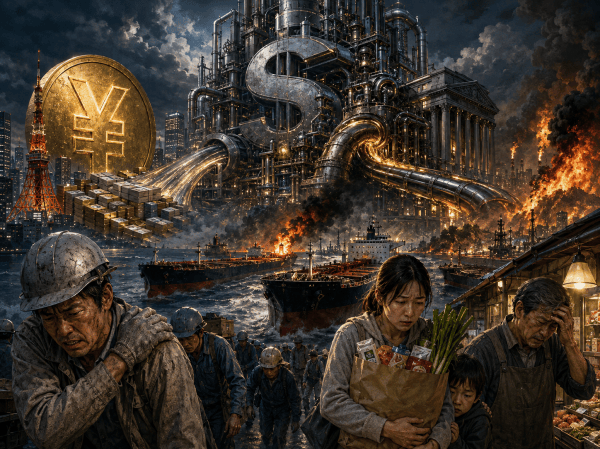
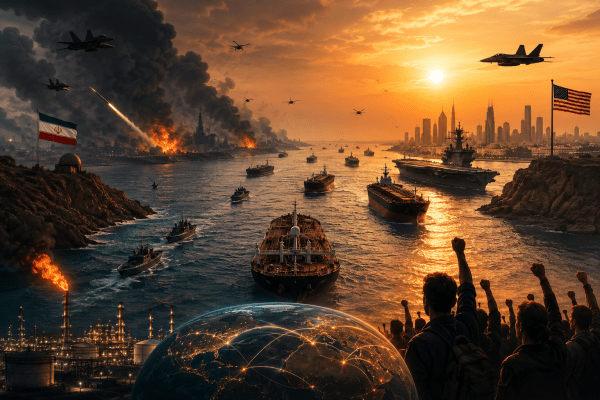
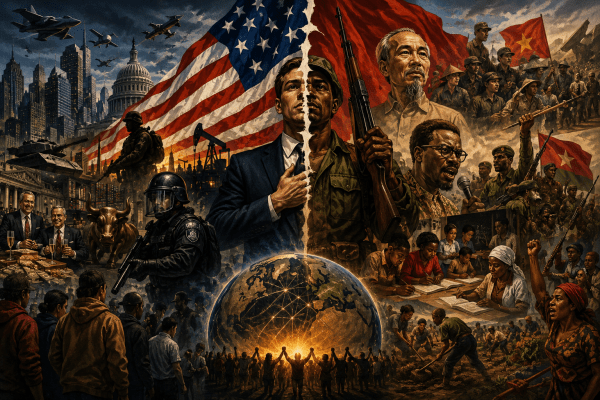
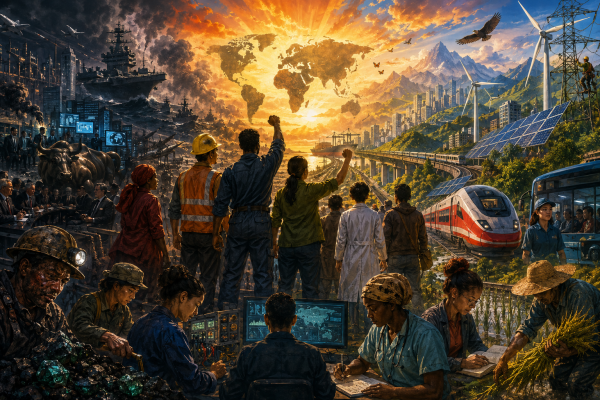
The Atlantic neoliberal order is disintegrating, revealing the ravages inflicted on workers and the environment by a relentless pursuit of profit. As BRICS+ nations seek to reclaim industrial sovereignty and labor rights, they face a chaotic multipolar reality where exploitation continues under different guises. Amid profound instability, the laboring class must transition from mere instruments of production to conscious political actors capable of reshaping development. This moment offers a critical opportunity: to reclaim the narrative and construct a world centered on human dignity and ecological balance. The question now is whether history will be rewritten by workers or remain dominated by elites.
Empire Under God: Trump, Christian Nationalism, and the Sacred Theater of American Decline
Trump’s Rededicate 250 rally lays bare a decaying empire desperately clinging to religion, nationalism, and nostalgia to maintain its grip amid deepening inequality and institutional rot. This spectacle, masquerading as prayer and unity, reveals an alarming alliance of executive power and Christian nationalism, while ignoring the historical ties between faith and American imperialism. Corporate media, such as USA TODAY, frame the event through a lens of inclusivity, obscuring the deeper crisis of legitimacy driving such theatrics. The ruling class stokes anxiety and myth to sustain its rule, but beneath the surface, an urgent resistance emerges, challenging the manufactured cohesion of a crumbling empire.
Apples to Apples: Superexploitation from Orchards to iPhones
What appears to be a comparison between two unrelated commodities—apples picked in U.S. orchards and Apple devices assembled across the Global South—is in fact a comparison between two forms of the same capitalist-imperialist labor regime. In U.S. agriculture, superexploitation is organized through settler-colonial land relations, racialized migrant labor, H-2A dependency, deportability, and the broader coercive... Continue Reading →
Inside the House of Cards: How Empire Manages Crisis Through Memory, Civility, and Myth
Four former presidents gather under corporate media lights to present democracy as a shared moral inheritance, grounded in unity, civility, and participation. Beneath that performance lies a material history of deregulation, war, surveillance, and repression that produced the very crisis now being discussed. The interview reveals not reflection, but a ruling-class effort to manage legitimacy... Continue Reading →
The War Over Totality: Engels, Science, and the Limits of Western Marxism
An uncompromising review of Sven-Eric Liedman’s The Game of Contradictions, tracing his reconstruction of Engels’s engagement with Hegel, science, and ideology while testing whether his critique clarifies the contradictions of dialectical materialism or disarms the communist struggle for totality. By Prince Kapone | Weaponized Information | Weaponized Intellects Book Review | April 12, 2026 Against... Continue Reading →
From Imperial Plunder to Socialist Possibility: Capitalism, Dependency, and the Road to Sovereign Development
Development is not a neutral path but a historical process forged through conquest, extraction, and domination. Underdevelopment is not a failure to advance, but the condition produced by integration into a world system structured by imperial power. As the crisis of global capitalism deepens and the space for sovereign maneuver widens yet destabilizes, nations are... Continue Reading →
The BBC, Zelensky and the Price of Primacy: When Hegemony Calls Itself Defense
This essay excavates the BBC’s framing of the Ukraine war to reveal how catastrophe rhetoric and moral personalization manufacture consent. It reconstructs the documented record—NATO expansion, U.S. strategic doctrine, Minsk diplomacy, sanctions, and militarization—to widen the frame beyond headline urgency. It then situates the conflict within the deeper contradiction between imperial hegemony and national sovereignty,... Continue Reading →
Assata Shakur and the War Against Black Liberation: Insurgency, Counterinsurgency, and the Long Exile of a Revolutionary
Insurgency inside the empire exposed the structure of repression. Her prosecution revealed counterintelligence as domestic warfare. Her escape redefined political struggle as international. Her exile confirmed that revolution does not end at the prison gate. By Prince Kapone | Weaponized Information | Black History Matters Series | February 10, 2026 When the Ghetto Became a... Continue Reading →
Mutulu Shakur and the Crime of Healing Under Empire
A New Afrikan revolutionary whose life fused care with struggle. A political prisoner held not for what he did, but for what he represented. A case study in how the U.S. state disciplines liberation through time, cages, and memory. His legacy forces a question the system cannot answer: what happens when the oppressed organize to... Continue Reading →
How to Kill a Nation: Michael Parenti and the Imperial Instruction Manual — Humanitarian War, Economic Siege, and the Machinery of Regime Destruction
This review reads Michael Parenti’s To Kill a Nation as a field manual for modern empire, tracing how Yugoslavia was destroyed not by accident or ancient hatred but through a disciplined sequence of epistemological warfare, economic siege, political fragmentation, demonization, humanitarian pretext, and infrastructural annihilation, culminating in privatization, permanent dependency, and historical amnesia. By following... Continue Reading →