The Beijing summit epitomizes the unraveling of American supremacy, as Donald Trump arrived not merely as a president, but as a messenger of an empire in disarray. The spectacle of diplomatic niceties belied a crumbling global landscape, where the U.S. seeks containment while its capital cravenly craves access to China's vast markets. The summit revealed profound contradictions: America, armed yet impotent, involved in a tech war while reliant on the very infrastructure it seeks to undermine. As the Atlantic order falters, a multipolar era teeters on the edge, with ideological fractures foreshadowing a future fraught with uncertainty—yet, fertile for revolutionary possibilities.
Starve the Island, Blame the Victim: How Empire Turns Siege into “Defiance”
The New York Times repackages economic warfare as diplomatic tension, presenting Cuba’s resistance as irrational defiance rather than a response to material coercion. A reconstruction of the facts reveals a deliberate strategy of energy strangulation, financial restriction, and calibrated pressure designed to destabilize Cuban society from within. When these conditions are placed back at the... Continue Reading →
The Gazafication of Cuba: Economic War and the Genocidal Siege on Sovereignty
This review of The Economic War Against Cuba by Salim Lamrani excavates the historical architecture of the U.S. blockade and reinterprets it through the present conjuncture, revealing it not as a failed Cold War relic but as an evolving system of imperial economic warfare. Moving from trade embargo to extraterritorial coercion to full-spectrum energy siege,... Continue Reading →
Cuba Will Not Kneel: Trump, The New York Times, and the Contradictions of the American Pole
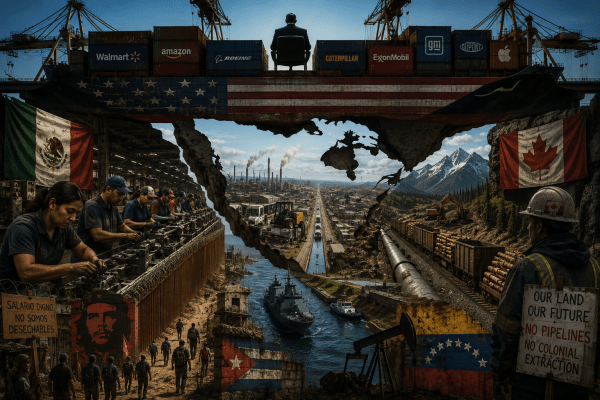
The New York Times launders U.S. regime-change demands into the language of negotiation, masking domination as diplomacy. Beneath the narrative, a coordinated campaign of economic strangulation—especially through energy chokepoints—reveals deliberate coercion, not Cuban failure. This pressure is part of a broader imperial recalibration: the consolidation of Fortress America as a hemispheric bloc under U.S. control.... Continue Reading →
NBC’s Cuba Narrative and the Siege It Refuses to See
NBC’s coverage frames Cuba’s economic adjustment as a dramatic crisis, but a close reading of the article reveals the narrative techniques and framing devices used to construct that impression. Beneath the headline lies a far denser economic terrain shaped by sanctions, energy shortages, inflation, and the long search for productive stability under siege. When these... Continue Reading →
Cathedrals and Carriers: Marco Rubio’s Civilizational Manifesto for a New Western Century
In Munich, the language of heritage, sovereignty, and renewal cloaks a program of bloc consolidation, industrial recalibration, hardened borders, and unilateral force. Beneath the hymn to Western civilization lies a disciplined strategy to reassert Atlantic primacy in a multipolar world. The question is not whether the West will act — but who benefits from how... Continue Reading →
The American Pole in Session: How Congress Normalizes Hemispheric Domination
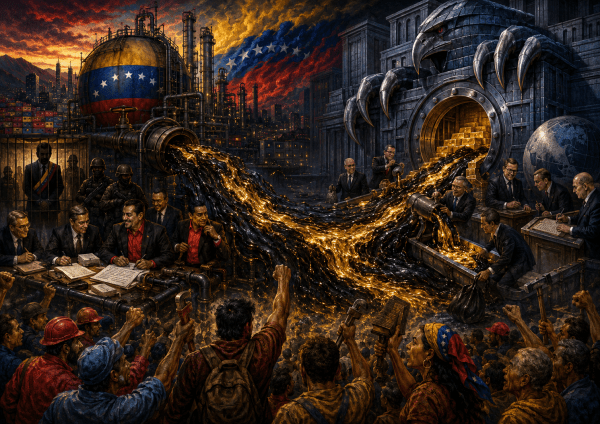
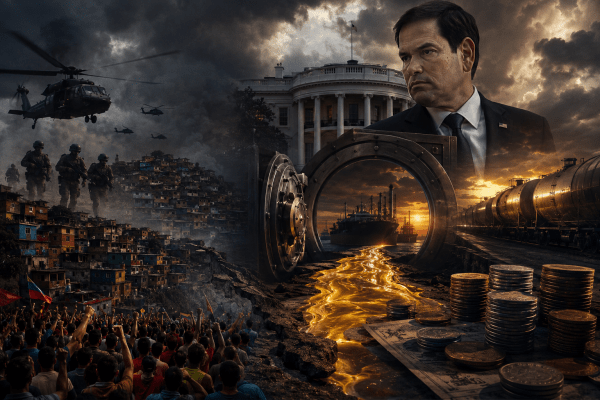
This hearing revealed empire speaking in its managerial voice, not its moral one. Venezuela was treated not as a nation, but as a logistical and political control problem. Bipartisan oversight functioned as maintenance of imperial authority, not restraint upon it. For revolutionaries North and South, the American Pole names the structure we must learn to... Continue Reading →
Reuters’ “Market Story” and the American Pole: PetroChina, Venezuelan Oil, and the Siege That Calls Itself Trade
Reuters sells custodial plunder as a pricing issue, turning blockade into “market caution.” We restore the missing record: seizures, supervision, and the re-routing of Venezuelan oil revenue through imperial hands. We reframe the contradiction as doctrine—Fortress America tightening hemispheric command as multipolar escape routes multiply. We close with a call to organize: break the information... Continue Reading →
Capital’s Emergency Exit: Michael Parenti, Fascism, and the War on Class Memory
Fascism is not an aberration but a rational instrument deployed when capital loses democratic control. Socialist revolutions expanded freedom for the many and were met with siege, sabotage, and counterrevolution. The restoration of capitalism in the East revealed the market as a system of plunder, repression, and social decay. Anti-communism and class denial function as... Continue Reading →
Posting Empire: Trump 2.0 and the Open Turn to Colonial Rule
How Trump’s Social Media Declarations Signal the Geopolitical, Economic, and Strategic Architecture of Fortress America and the American PoleBy Prince Kapone | Weaponized Information | January 12, 2026When Empire Posts Its Intentions There are moments when the empire speaks in polished paragraphs—through white papers, summit communiqués, and the priestly language of “shared values.” And then... Continue Reading →