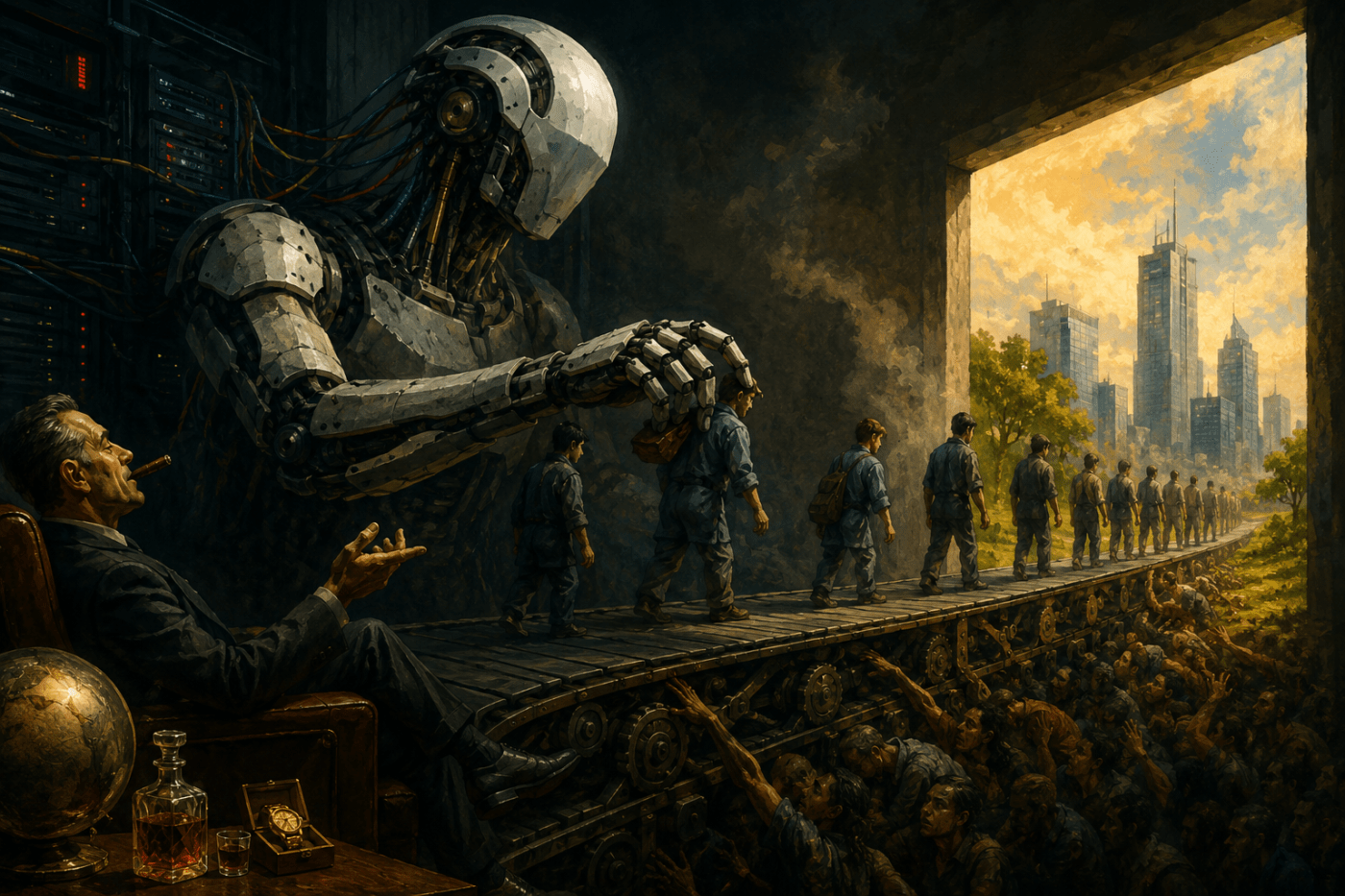
Bill Gates has begun saying out loud what capital would rather treat as a technical problem: AI and robotics may allow corporations to buy less human labor while workers still need wages to eat, pay rent and survive. That contradiction is already taking material form through mountains of fixed capital, thinner staffing, suppressed hiring, algorithmic control and a working class being recomposed rather than simply erased. As secure employment weakens, the same capitalist state accelerating automation is also expanding the digital machinery that verifies eligibility, administers insecurity and could, under deeper crisis, become part of a technofascist system for governing populations capital needs less as workers but must still contain as human beings with material claims. The real promise of automation begins where capitalism’s solution ends: if society can produce more with less necessary labor, the struggle is over whether the time the machine saves becomes profit and unemployment—or collective freedom from work imposed merely to earn the right to live.
Prince Kapone | Weaponized Information | August 26, 2026
The Jobs Capital No Longer Needs, The Workers Who Still Need Jobs
Bill Gates has spent most of his adult life on the winning side of technological displacement. Microsoft helped turn software into one of the commanding heights of modern capital, and Gates became one of the richest men alive in the process. So there is something historically revealing about hearing him warn that artificial intelligence may now present a “structural challenge” to the economy itself. He isn’t talking about another round of office software making secretaries faster or industrial machinery eliminating one occupation while another expands down the road. Gates is contemplating a productive apparatus capable of replacing portions of human cognition and, as robotics advances, increasingly performing physical labor as well. The problem, as he admits, is that capitalism still requires most people to get the money they need to live by working for somebody who owns the means of production.
There is the contradiction, sitting almost naked in the billionaire’s own argument. Capital is developing machinery that may allow corporations to purchase less human labor, while workers remain dependent on selling their labor-power to purchase food, housing, healthcare, transportation and everything else required to remain alive. Gates imagines accountants replaced by software and twenty-dollar-an-hour workers competing with ten-dollar-an-hour robots. He expects new occupations to appear, but warns that without intervention there may be “fewer good jobs” than the economy now provides. Unlike an ordinary recession, he argues, those jobs wouldn’t simply return when demand recovered. Once capital can perform the work more cheaply through machinery, the old labor requirement may be gone for good.
That future hasn’t arrived… yet. A 2026 Census Bureau study found AI adoption already substantial, especially among larger firms, but most businesses using it still reported augmenting existing work rather than cutting employment. Early labor-market research has found warning signs in some highly exposed occupations, but nothing yet resembling an economy-wide automation collapse. That distinction matters. Gates isn’t describing an accomplished future. He is looking ahead at a contradiction that a section of the ruling class can now see forming in front of it.
His proposed remedies make that recognition even clearer. Gates wants stronger social protection for displaced workers, taxes on AI and robots, new institutions capable of coordinating the transition, and even a protected category of occupations he calls “Human Reserved”—jobs society would deliberately keep in human hands even when machines could technically perform them.
Think about what that means. Capital has always tried to cheapen, discipline and replace the labor it buys. Workers, in turn, have fought over wages, hours, conditions and control because capital still needed their labor to keep production moving. Gates is preparing for a different possibility: society may someday preserve particular jobs not because production still requires the worker, but because the worker still requires the job. Capitalism could become productive enough to dispense with portions of necessary human labor while remaining socially organized around the rule that people must work for wages to secure the means of life. The machinery would be capable of liberating time. The property relation would convert that liberation into insecurity.
That is why the usual argument over whether “AI will take our jobs” starts in the wrong place. AI doesn’t own the factory. Corporate owners decide whether productivity gains become larger profits, lower staffing, higher wages or shorter hours, while competitive pressure punishes firms that fail to cut costs when rivals can. States build the legal and infrastructural terrain. Workers resist where they possess the organization to do so. Gates sees the social wreckage that could follow from increasingly labor-saving production, but his remedies leave ownership of that productive power untouched. The machine gets taxed. Some jobs get fenced off as human preserves. The state cushions people pushed out of production. Private capital keeps the machine.
Before deciding whether that future is approaching—or what kind of state might be built to govern it—we have to explain something Gates quietly assumes: why technological progress ever became associated with secure mass employment in the first place. There was nothing inside the assembly line, the computer or the robot that guaranteed workers rising wages, benefits, stable jobs or a claim on productivity. Those relations were fought into existence under specific historical conditions. Capital had already spent decades tearing much of that settlement apart before today’s AI models ever learned to write a sentence.
The Bargain Was Never in the Machine
The contradiction Gates now worries over began long before artificial intelligence. Capital has always tried to squeeze more output from less labor. What changed during the twentieth century wasn’t the machine’s disposition toward workers. It was the balance of forces around the machine. Under historically specific conditions, rising industrial productivity became temporarily bound to mass employment, stronger unions, expanding consumption, public provision and wages capable of reproducing a large industrial working class. That bargain never incorporated the whole working class on equal terms. Race, gender, region and occupation still divided who entered stable employment and on what terms, and the settlement developed during an exceptional period when U.S. industry stood near the center of the postwar capitalist world. Nothing inside the assembly line guaranteed any of it. Workers fought for those gains, capital conceded what it had to, and the state institutionalized enough of the compromise to keep mass production socially reproducible.
Fordism worked because the factory did more than manufacture cars, refrigerators and steel. It organized an entire social relation around the mass worker. Capital packed thousands of workers into giant plants, broke production into repeatable tasks, mechanized the labor process and drove productivity upward. That organization gave management enormous power over the shop floor, but it also concentrated workers physically and economically. Strikes could stop production at its throat. Unions could bargain over wages, hours and benefits because capital still required enormous numbers of workers to keep the machinery moving. The much-romanticized postwar “middle class” grew out of that contradiction: capital wanted labor disciplined and cheap, while organized workers had enough power to force part of rising productivity back into wages and social provision.
That relationship was historically specific. It didn’t survive because machines naturally create good jobs, and it didn’t disappear because factories stopped producing useful things. U.S. manufacturing employment reached roughly 19.6 million workers in June 1979 and then entered a long decline. Corporations automated production, closed plants, shifted work abroad, rebuilt supply chains across lower-wage labor markets and reorganized the labor process to cut costs and weaken the leverage workers had accumulated inside the old industrial order. Capital kept producing and accumulating. It simply became less dependent on employing the same mass of workers in the same places under the same conditions.
Labor’s institutional power eroded with it. By 2025 only 5.9 percent of private-sector workers belonged to unions. That figure matters because technology never enters an abstract “labor market.” It enters workplaces where one side owns the machinery and the other side must sell its labor to live. A unionized workforce capable of shutting down production confronts automation differently from an isolated worker staring at an algorithm, a subcontracting notice or a restructuring email alone. The technical capacity to eliminate a task can be identical while the social outcome differs radically.
The same period also transformed how the state dealt with workers outside the workplace. The welfare-to-work genealogy ran through state experiments, the 1988 JOBS program and finally the 1996 replacement of Aid to Families with Dependent Children by Temporary Assistance for Needy Families. TANF allowed states to require employment or approved work-related activity and sanction recipients who failed to comply. Its caseload-reduction structure could also reward states for shrinking assistance rolls even when people leaving the program hadn’t necessarily found work.
The political-economic function is hard to miss. The state was tightening the bond between survival and labor-market participation at the same time capital was making secure employment less dependable. Workfare didn’t create wage dependence, but it reinforced it by making access to parts of the social wage increasingly conditional on proving employment, job search, approved activity or exemption. The contradiction deepened from both sides: capital weakened the job while public policy increasingly demanded attachment to the labor market as evidence of deserving assistance.
Employment still carries an enormous share of social reproduction. In 2024, 53.8 percent of the U.S. population received health insurance through an employer. Losing a job can therefore mean more than losing a paycheck. It can threaten healthcare, retirement contributions, housing stability, creditworthiness and a household’s ability to support children or other dependents. Capital can reorganize a production line in a quarter. A household can’t reorganize its need for insulin, rent or groceries because a firm found a cheaper way to complete a task.
This is the historical ground beneath Gates’s anxiety. The twentieth-century bargain linked productivity to mass incorporation only because workers had enough collective power, and the state enough reason, to force that mediation into wages, benefits and social provision. Neoliberal restructuring spent decades severing those links while leaving wage dependence largely intact. By the time generative AI arrived, millions of workers were already entering the next technological transition with weaker unions, thinner employment security and a welfare system that often treats paid work not merely as one way of contributing to society, but as proof that a person has earned a claim on society’s resources.
The real historical issue, then, is whether expanding productive capacity still requires the broad incorporation of workers on terms that let them reproduce their lives. That relationship was never guaranteed by technology, and capital had already been breaking it apart long before the newest machine entered the shop floor and the office. What matters now is what capital is actually building in its place: mountains of fixed capital, oceans of compute, new energy infrastructure—and, in some of the most advanced nodes, remarkably few permanent hands.
More Capital, Fewer Hands: The New Machine Takes Material Form
Artificial intelligence is usually sold as something weightless: code floating in the cloud, intelligence summoned by a prompt, software that appears to materialize out of nowhere. The material reality runs in the opposite direction. Frontier AI is being built out of chips, server racks, datacenters, transmission lines, cooling systems, power plants, concrete, land and staggering quantities of capital. Alphabet reported $80.6 billion in capital spending during the first half of 2026. Amazon reported $96.3 billion in cash capital expenditures over the same period. Nvidia, sitting at one of the most profitable chokepoints in the new productive apparatus, reported $75.2 billion in quarterly data-center revenue in the first quarter of fiscal 2027.
This is what the so-called cloud looks like once the marketing language is stripped away: fixed capital piled on fixed capital. And it is hungry. Lawrence Berkeley National Laboratory estimated that U.S. datacenters consumed roughly 4.4 percent of national electricity in 2023, with scenarios reaching 6.7 to 12 percent by 2028. Those later figures are projections, not certainties. The physical direction is already plain. AI accumulation is digging deeper into the grid, the power plant, the semiconductor supply chain and the land beneath the server farm.
That concentration matters because frontier AI increasingly rests on infrastructure that only the largest corporations and states can finance at scale. Ownership of chips, cloud capacity, datacenters and energy access becomes part of the power to deploy the technology itself. The Silicon Valley fairy tale imagines a neutral tool floating freely through society. The actual system arrives behind fences, utility contracts, proprietary models, billion-dollar balance sheets and corporate property rights.
The state is helping build the damn thing. In July 2026, the Department of Energy announced a Paducah redevelopment partnership expected to attract more than $100 billion in private data-center and energy investment. The project forecasts roughly 8,000 construction jobs but only about 600 permanent jobs. Those jobs haven’t yet materialized at the promised scale, so the figures remain projections. But the proposed structure is revealing: an enormous burst of fixed-capital construction followed by a much thinner permanent workforce once the infrastructure is operating.
Washington State offers a harder retrospective. Legislative auditors found that an urban data-center tax preference produced an estimated $42.4 million in tax savings while participating companies reported 53 permanent family-wage jobs and nearly 300 temporary construction jobs. Auditors couldn’t determine how much of that investment would’ve happened without the tax break, and no entirely new data center was built under the pilot. The familiar development pitch—subsidize capital today and jobs will rain down tomorrow—looks much less impressive when tens of millions in public tax expenditures terminate in a few dozen permanent positions.
The same tendency is beginning to appear inside corporate labor strategy. Amazon CEO Andy Jassy has said that as generative AI and agents spread through the company, Amazon expects to need “fewer people” in some existing jobs and anticipates a lower total corporate workforce over the next several years. That’s a management forecast, not an accomplished employment result. Its significance lies elsewhere: one of the world’s largest corporations is already planning around the possibility that greater productive capacity will require fewer corporate workers.
Salesforce shows how labor reduction can happen without a spectacular layoff announcement. The company says its AI customer-service system handled millions of support conversations while it redeployed hundreds of support workers and controlled headcount by declining to backfill some vacated positions. A worker retires, quits or transfers; the vacancy disappears; output keeps moving. Labor requirements can fall through attrition long before they show up as a mass firing.
Microsoft presents a more ambiguous case and an important limit. The company reported enormous AI-related infrastructure spending while overall headcount declined, but Microsoft hasn’t established that AI caused that employment reduction. Its fiscal 2026 third-quarter results showed $31.9 billion in quarterly capital expenditure, roughly two-thirds devoted to GPUs and CPUs, alongside lower year-over-year headcount. Correlation is not a confession. What the figures do establish is that one of the corporations building the AI economy can expand revenues and pour tens of billions into machinery while employing fewer people overall.
The present economy is still far from a generalized jobless regime. A Census Bureau survey found that most firms adopting AI used it primarily to augment existing workers; only 2 percent reported AI-related employment decreases. The new apparatus still needs engineers, electricians, construction workers, technicians, chip-fab workers, maintenance crews and energy workers. Living labor hasn’t disappeared behind the server rack.
What is changing is the relation between the machinery capital accumulates and the labor it must continue to buy. At some advanced nodes, more fixed capital can coexist with thinner permanent staffing, suppressed replacement hiring and reorganized workflows. That shift can deepen long before unemployment statistics register a social rupture. And because millions of workers remain inside production, the transformation can’t be understood as simple expulsion. Some workers are displaced, some intensified, some complemented, some denied entry, and some newly hired to construct the infrastructure making other labor cheaper or unnecessary. The machine is changing not only how much labor capital buys, but what kind of working class it requires.
The Worker Doesn’t Disappear—The Working Class Is Recomposed
The machinery does more than subtract workers from payroll. It rearranges the working class around new lines of usefulness, vulnerability and control. Some workers become more productive because AI complements their skills. Others get fewer openings, faster quotas or narrower tasks. Some remain indispensable but increasingly managed through software they can’t see or challenge. Capital can eliminate vacancies instead of employees, automate the bottom rung of an occupation, squeeze more output from smaller teams or turn workers into supervisors of systems they don’t own. The working class doesn’t vanish. It is recomposed.
The International Labour Organization finds that most occupations exposed to generative AI still contain enough nonautomatable work that transformation is more likely than wholesale replacement. That matters because “augmentation” can conceal radically different class outcomes. A machine can reduce drudgery, or management can use the same productivity gain to raise quotas, cut staffing and capture the extra output. The technology tells us what tasks can change. Ownership and bargaining power determine who gets the benefit.
The Philippines makes that contradiction concrete. Research from the Department of Labor and Employment’s Institute for Labor Studies found minimal workforce displacement among surveyed firms using AI in IT-BPM, finance and manufacturing, alongside growing demand for new AI-related occupations. Yet workers also reported more labor spent checking, correcting and verifying machine output. A subsequent Philippine policy discussion found only 6 percent of firms reporting AI-related staff reductions while employees described heavier verification burdens. Automation can remove one task and create another at the same desk.
That can leave the worker firmly inside production while changing who commands the labor process. The employee who once performed the task may now monitor the system performing it, correct its mistakes, feed it data, meet a faster quota and absorb responsibility when the output fails. Capital can automate through the worker before it automates the worker away.
Indian platform labor shows the same relation without the futuristic sales pitch. Research by the National Law School Centre for Labour Studies and IT for Change documents workers governed through ratings, algorithmic targets, continuous data collection and platform control over access to jobs. These workers aren’t technologically obsolete. They’re technologically subordinated. The courier still rides the bike. The driver still turns the wheel. The worker still performs the service. What changes is how management reaches them. The boss can disappear from sight while command is buried inside code.
For younger workers, the pressure may appear before anyone gets fired. Stanford payroll research found pronounced employment weakness among workers aged 22 to 25 in occupations where generative AI can substitute for entry-level tasks, driven mainly by reduced hiring rather than mass layoffs. The causal case remains unsettled: LinkedIn’s 2026 analysis found entry-level hiring falling broadly with the wider labor-market slowdown, though it fell more sharply in several AI-intensive occupations. What matters is the mechanism. Capital can thin an occupational pipeline simply by deciding that the junior position no longer needs to exist.
That creates a contradiction inside labor reproduction itself. Senior workers don’t descend from the heavens fully trained. They become senior by doing the routine work beneath them, learning systems, making mistakes and acquiring judgment. If firms automate the apprenticeship layer first, they may cut labor costs today while weakening the pipeline that produces skilled workers tomorrow. The ILO’s “aggregation paradox” captures the broader limit: faster completion of individual tasks doesn’t automatically become equivalent productivity gains across firms or the whole economy. Workflows, supervision, demand, organizational bottlenecks and complementary labor stand between the demo and the balance sheet.
And the machinery enters a working class already segmented long before the first prompt is typed. Occupational segregation places women disproportionately in clerical and administrative jobs that the ILO identifies as highly exposed to generative AI. Racial inequality works through a different channel. Black workers aren’t uniformly the most technically exposed, but vulnerability to disruption is shaped by the unequal labor market they already occupy: Black unemployment averaged 6.9 percent in 2025 compared with 3.7 percent for white workers, while Urban Institute research finds Black workers within highly exposed occupations can face greater displacement risk. Older workers face still another pressure through skills mismatch and age discrimination; Chinese policy researchers have warned that automation can shrink traditional positions faster than older workers can realistically retrain, recommending employment-impact assessments and stronger transition protections. The machine inherits divisions capital and the state built long before AI arrived, then reorganizes labor through them.
The category emerging from this process isn’t a homogeneous army of technologically useless people. It is a fractured relation to accumulation. Some workers become more valuable because machinery complements their skills. Some are intensified. Some are deskilled. Some lose bargaining power because management can credibly threaten substitution. Some are pushed toward worse jobs. Some never enter the occupation at all. Others move between wage labor, gig work and unemployment as capital’s demand for their labor rises and falls. “Surplus” describes their relation to capital’s need for labor-power, not their worth as human beings.
Once secure wage incorporation weakens, the contradiction can no longer remain inside the workplace. Workers whose labor becomes intermittent, precarious or unnecessary to one accumulation process still have to reproduce themselves outside it. Production has reorganized their relation to capital; the institutions governing healthcare, income and survival now have to deal with the consequences.
When the Wage No Longer Guarantees Life
Rent still comes due. Children still need food. Bodies still get sick. Electricity still has to stay on. Capital can decide that a position is redundant; the worker can’t decide that insulin, groceries or shelter are redundant too. Once wage labor stops reliably reproducing a household, the contradiction moves beyond the workplace and into the institutions that distribute the social wage. Those institutions don’t simply transfer resources. They decide who qualifies, what must be proven, which records count and when assistance can be withheld.
The machinery for making those judgments predates today’s AI boom. Workfare had already tied parts of public provision to employment, job search, approved activity and exemption. Computerization added another layer. Caseworkers increasingly made decisions through databases, scoring systems and software rules that could structure or constrain human judgment. Administrative discretion didn’t disappear when the paper file became digital. The rules governing access to public resources became easier to standardize, automate and apply across large populations.
Arkansas shows what that can mean when a formula sits between human need and public provision. In Arkansas v. Ledgerwood, Medicaid recipients with severe disabilities challenged the state’s use of a computerized methodology to calculate attendant-care hours. Plaintiffs alleged cuts averaging 43 percent, with one reaching 56 percent, after the new system was introduced. The Arkansas Supreme Court upheld a temporary injunction against the reductions. Those percentages were plaintiffs’ allegations rather than final adjudicated findings, but the underlying relation was already visible: software could materially shape how much care a disabled person received while making the logic behind the decision harder for the recipient to contest.
Michigan’s MiDAS unemployment system went further. The state automated major parts of fraud detection and adjudication, then falsely accused thousands of people of unemployment fraud. The machinery helped trigger seizures of wages, tax refunds and other property. Michigan eventually agreed to a $20 million settlement over the resulting civil-rights case. Long before generative AI entered the welfare office, governments were already turning fraud policing and eligibility control into software capable of imposing economic punishment at scale.
The present development adds something more: the growing ability to make separate databases useful to one another. Medicaid community-engagement requirements make that process unusually concrete. Federal law now establishes an 80-hour monthly work requirement for certain nonpregnant adults ages 19 through 64, with qualifying activities and exemptions defined by law and regulation. CMS issued its interim final rule in June 2026. States generally must implement the requirement by January 1, 2027, though they may move earlier. The regime is therefore enacted and under construction, not yet a mature nationwide system operating everywhere.
CMS is already helping states build the verification machinery. Its implementation program supports new data sourcing, integration and automated verification, including expanded access to federal education and veterans’ records. The administrative objective is straightforward: verify qualifying activity from existing data when possible and demand documentation when the systems can’t confirm it. A statutory work condition thereby creates demand for an infrastructure capable of translating scattered records into decisions about healthcare eligibility.
Private capital is moving directly into that administrative market. A CMS vendor roster includes Deloitte, Maximus, Gainwell, GDIT, Equifax, Experian, TransUnion, ID.me, Google and other companies offering states tools for community-engagement implementation. CMS stresses that these are voluntary vendor pledges rather than federal endorsements or proof that every product has been deployed. The offerings themselves are revealing. Deloitte has proposed systems linking Medicaid and SNAP verification across multiple data sources; Maximus offers mobile tools for documenting qualifying activity; Gainwell advertises verification engines and APIs; GDIT offers analytics and AI-enabled policy enforcement. Corporations are positioning themselves to profit from the technical work of deciding whether poor people have satisfied conditions attached to healthcare.
“Surveillance” captures only part of what is happening. Watching matters, but information becomes more powerful when it can make something happen. A database entry can trigger a request for documents, send a claim into review, establish compliance or contribute to a loss of coverage. The decisive capacity is administrative actionability: turning records about identity, income, education, disability or work into decisions that alter a person’s access to material resources.
The system is still fragmented and error-prone. A GAO investigation identified more than 100 federal data sources that could help verify benefit eligibility, then found data-quality problems in all nine sources it examined closely and inconsistent rules across most of them. No government-wide authority currently imposes a single interoperability regime. That friction places a limit on administrative integration, but it also reveals who pays when the machinery fails. A stale record or mismatched identity can become paperwork, delay, appeal, suspension or wrongful denial for the person standing on the other side of the database.
What is taking shape is a distributed administrative system built from agencies, contractors, identity services and verification databases that can increasingly exchange enough information to make concrete decisions. Its power doesn’t depend on seeing everything. Partial interoperability can be enough when the fragments being connected determine whether somebody receives healthcare or must prove compliance again.
That changes the meaning of labor insecurity. A worker pushed out of secure employment doesn’t disappear from capitalist society. The person may enter unemployment insurance, Medicaid or other benefit systems whose administrators must determine income, work status, qualifying activity, disability or exemption. Capital’s demand for that person’s labor can weaken while the state’s need to classify the resulting claim on social resources grows stronger.
This is the material basis of a commercially augmented data state. Technology firms sell identity, verification, analytics and decision-support infrastructure; public agencies use those systems to enforce rules created through law and policy; recipients bear the material consequences when the records or rules fail them. On one side of the contradiction, capital is building machinery that can reduce labor requirements. On the other, survival remains tied to wages and increasingly data-mediated proof of eligibility. The same capitalist state is being pulled into both processes: helping expand labor-saving productive capacity while building administrative machinery to govern the social relations that expansion may unsettle.
The State Catches the Contradiction
By the time the contradiction reaches the state, it has already passed through the workplace and the household. Capital is pouring money into productive systems that can reduce labor requirements at particular nodes. Workers still depend on wages and public provision to reproduce their lives. The state confronts both sides at once. It clears land, power and permitting for datacenters; funds research; buys AI for federal agencies; trains workers for disrupted labor markets; administers benefits; and incorporates the same computational infrastructure into military planning. The state isn’t standing outside the transformation with a clipboard. It is helping construct the terrain on which the transformation unfolds.
The clearest official statement is the White House’s America’s AI Action Plan. Its language is blunt. Washington treats artificial intelligence as a struggle for economic and military power and declares that the United States must achieve “global dominance” in AI. The plan calls for faster datacenter construction, expanded energy supply, semiconductor production, research infrastructure and commercial adoption while stripping away obstacles that might slow the buildout. The same government telling workers to adapt is accelerating the machinery to which they are expected to adapt.
This is state-backed capitalist development, not some free market spontaneously assembling itself in the cloud. AI corporations need electricity grids, transmission lines, semiconductor supply chains, land, research institutions and enormous amounts of physical infrastructure. Washington is helping provide those conditions while private firms keep ownership of the productive assets and the profits they generate. Public policy absorbs part of the enabling cost; private capital keeps the property.
The official labor response reveals the class terms of that arrangement. Federal strategy emphasizes retraining, apprenticeships, technical education and better labor-market information. Those programs may help individual workers move into new jobs. They leave the basic direction of adaptation untouched. Capital reorganizes production; the worker is retrained to fit the new labor demand. Shorter working time, worker control over deployment and social ownership of labor-saving machinery barely enter the official horizon. The problem is defined as producing workers suited to the machine, not deciding collectively what the machine should do for workers.
The state is also becoming a customer. A GAO review found that reported AI use cases across eleven federal agencies nearly doubled between 2023 and 2024. Federal procurement has spread across administrative work, veterans’ services, airport facial recognition and military applications. That doesn’t mean every agency is automated or that one AI system links them together. It means commercial AI capacity is moving into government through separate purchases, missions and legal authorities, giving private technology firms an expanding role in the machinery through which the state performs its ordinary functions.
The military side is even more explicit. The AI Action Plan directs the Defense Department to identify workflows that can be automated and move successful systems into routine operation. It proposes an AI and Autonomous Systems Virtual Proving Ground and calls for mechanisms that could give the government priority access to privately controlled cloud and compute capacity during national emergencies or major conflict. The server farm and the war machine increasingly share hardware, firms, energy systems and technical labor.
Washington also treats advanced chips and compute as instruments of power beyond U.S. borders. The same strategy ties semiconductor capacity, export controls and access to advanced computing to economic and military competition. Federal AI strategy therefore gives the state another reason to accelerate development even when the domestic labor consequences remain unsettled. Slowing down can appear socially prudent while speeding up appears strategically mandatory. Capitalist competition pushes firms from below; imperial competition pushes the state from above.
The administrative systems examined earlier develop beside this accumulation strategy, not inside one seamless command center. Benefit agencies are building better verification tools. Federal departments are buying AI for their own missions. Military institutions are automating selected workflows. Police, border agencies, welfare offices and tax authorities remain governed by different laws, databases and bureaucracies. They may buy from some of the same vendors or adopt similar computational methods, but shared contractors and compatible technology aren’t the same thing as demonstrated operational integration.
That distinction matters because the state doesn’t need omniscience to become more technologically capable. Separate institutions can accumulate powers piecemeal. An agency buys identity software because it needs identity verification. Another buys analytics because it wants fraud detection. The military purchases autonomous systems for war. Commercial firms build each tool for profit. Interoperability, where it develops, still depends on law, common identifiers, data standards, contracts, APIs and political decisions. The same population moving through different institutions creates an incentive to connect records; it doesn’t magically connect them.
The technofascism question begins on this material ground. The evidence establishes a capitalist state actively accelerating privately owned automation, expanding digitally mediated administration, and integrating AI more deeply into military and national-security functions, while monopoly technology firms supply crucial infrastructure across those domains. The pieces are becoming more compatible inside the same state, but they haven’t fused into one operational system linking labor displacement, welfare administration, policing, borders and military power to govern an AI-generated surplus population. Technofascism therefore appears here as a developing state-form tendency: under U.S. conditions, labor-saving accumulation, weakened worker power, corporate-built administrative systems and expanding military technology could be drawn into tighter integration by a deeper crisis of wage employment and social reproduction, hardening the state’s defense of property and social order. That possibility is grounded in institutions and capacities that already exist; the completed regime is not.
The absence of a master plan doesn’t make the structure politically neutral. States develop unevenly because ruling classes confront different problems through different institutions, budgets and legal powers. What matters now is that the productive transformation has become inseparable from state strategy. Yet the machinery still doesn’t dictate the social outcome. Governments can mediate automation differently, and organized workers can force capital to surrender control over how it is deployed. The contradiction has reached the state without being resolved there.
The Machine Has No Politics of Its Own
If artificial intelligence mechanically produced technofascism, history would unfold like software executing code. Better models would reduce labor demand; weaker labor demand would produce instability; instability would harden the state. But the evidence breaks that chain. Similar productive technologies are being developed under different institutions, and organized workers have already forced employers to limit forms of automation that were technically possible. The machine establishes a field of possibility. Social power decides what happens inside it.
China provides the clearest comparative test. The Chinese state is pushing AI across industry while moving embodied intelligence and humanoid robotics out of laboratories and into production. A 2026 program from the Ministry of Industry and Information Technology and the State-owned Assets Supervision and Administration Commission called for testing embodied-intelligence systems across industrial, service and specialized settings, developing more than one hundred high-value scenarios and building deployment capacity on the scale of ten thousand units. China isn’t preserving employment by freezing the productive forces.
At the same time, national policy directs institutions to treat employment as something that technological development must account for. The State Council’s “AI+” strategy calls for creating new occupations, augmenting existing work, prioritizing AI in dangerous or labor-short settings, expanding retraining and conducting employment-risk assessments as adoption spreads. Those directives don’t guarantee successful protection from displacement. They establish a more important point for this argument: robotization doesn’t arrive carrying its own employment policy. Governments can decide to accelerate the technology while also imposing political requirements on how its labor consequences are managed.
Workers can impose limits from below as well. During the 2023 writers’ strike, the Writers Guild of America forced studios to accept contractual rules governing AI use: literary material can’t be treated as if a machine were a writer, companies can’t require writers to use AI, and employers must disclose when material supplied to writers has been generated by AI. The technology remained technically capable of producing text before and after the contract. What changed was the power relation governing its use.
DHL Teamsters pushed the same principle into physical automation. After workers authorized a strike, they ratified a 2026 agreement containing protections against AI-driven routing systems that could undermine seniority and restrictions on autonomous vehicles threatening bargaining-unit jobs. Communications Workers of America members at Frontier Communications likewise won a contract establishing a process for addressing AI implementation while tightening restrictions on outsourcing. The Frontier agreement matters because employers may own the software, servers and networks, but ownership doesn’t become uncontested command when workers possess enough collective power to stop production.
That is the variable missing from every forecast that leaps directly from technical capability to social outcome. Capital can calculate that a language model, autonomous vehicle or automated workflow will cut labor costs. A union can still strike. A government can regulate. Workers can demand staffing guarantees, disclosure, retraining on their terms or limits on substitution. Public institutions can steer automation toward dangerous or labor-short work instead of simply allowing firms to use it wherever the wage bill looks easiest to cut. Silicon determines none of that.
The productivity gain itself is therefore an object of struggle. Capital wants to turn it into lower labor costs, tighter control and higher profit. Workers can fight over whether some portion returns as wages, job security, public provision or fewer required hours. The existence of labor-saving machinery creates the possibility of reducing necessary work; it doesn’t decide who receives the benefit.
That distinction also fixes the technofascism argument where it belongs. The U.S. tendency developed earlier arises from concentrated private ownership, weakened labor power, wage-dependent social reproduction, expanding administrative capacity and imperial pressure to accelerate technological development. Robotics alone produces none of those relations. They are historical conditions created through property, state policy and class struggle.
Once that contingency is visible, Gates’s “Human Reserved” proposal changes meaning. It is no longer the self-evident answer to an autonomous technological future. It is one class resolution among others: preserve selected jobs so people can keep earning claims on wealth that society may increasingly be capable of producing with less labor. The technology has opened a struggle over productivity. Ownership decides who enters that struggle with the power to command, and organization decides whether workers can command anything back.
Who Gets the Time the Machine Saves?
We can now return to Gates with the contradiction turned right-side up. His proposal to create a “Human Reserved” sphere of employment sounds humane because it begins from a real danger: workers can lose livelihoods when machinery performs tasks more cheaply than human labor. But after tracing the productive relation beneath that danger, the idea takes on a stranger meaning. Gates is proposing that society preserve certain jobs even when human labor is no longer technically necessary because people still need employment to obtain claims on the wealth society produces. The machine may make the labor unnecessary. Capitalism makes the job necessary anyway.
That is an extraordinary inversion of technological progress. Humanity spends centuries accumulating science, engineering, skill and collective knowledge until machinery can perform more work with fewer human hours. What should appear as a victory over necessity returns as a threat to survival. The productive force created by society confronts the worker as somebody else’s property. The worker doesn’t receive the hours the machine saves. The corporation receives the productivity gain, and the worker receives another demand to become more “adaptable.” Social intelligence becomes fixed capital, and fixed capital stands across the shop floor from the people whose collective knowledge made it possible.
Gates’s proposed robot and AI taxes recognize another side of the same contradiction. If automation cuts payrolls while increasing the number of people who need support, the state must redirect part of the surplus toward social reproduction. That could materially help displaced workers. But the circuit remains intact. Private capital owns the automated productive apparatus and captures the initial gain. The state then taxes part of that gain to retrain, support or otherwise stabilize people pushed aside by the same process. Private automation, public compensation.
The same logic runs through Gates’s call for a new architecture of state coordination. He compares the challenge to the post-9/11 reorganization of the U.S. government and argues that AI will require something much broader in scope, touching employment, taxation, education, energy, national security, law enforcement, finance and health. That proposal doesn’t establish a technofascist program. It does show that elite capital increasingly understands labor-saving technology as a problem that can spill across the whole state rather than remain inside the firm.
Technofascism becomes historically intelligible at that point, but only if the evidence boundary stays sharp. The United States is already accelerating privately owned automation, expanding digital systems that classify and administer access to public resources, and integrating AI more deeply into military and national-security functions. Those capacities exist. Their operational fusion into one system designed to govern technologically displaced or surplus populations hasn’t been demonstrated.
The danger lies in the direction a future crisis could push them. If secure wage incorporation continues to weaken while monopoly ownership remains intact, the capitalist state may face growing pressure to manage more of the reproduction problem outside stable employment. Under those conditions, tighter links among labor administration, benefit systems, commercial data infrastructure and existing coercive institutions could become one ruling-class response to instability. That is a conditional state-form tendency, not a technological destiny and not evidence of an already completed regime.
Capital doesn’t possess uncontested command simply because it owns the machinery. Workers can impose limits. States can mediate automation differently. Productivity gains can be fought over. That premise is enough here. The conclusion turns on ownership.
If society can produce the same goods and services with fewer hours of necessary labor, then the fundamental question is no longer how to manufacture enough jobs to keep wage dependence functioning. It is who owns the machinery, who commands the productivity gain and who gets the liberated time. Under private ownership, automation can appear as redundancy for the worker and profit for the firm. Under different social relations, the same increase in productivity could mean fewer required hours, stronger public provision and more control over one’s own life.
That is the possibility capitalism continually turns inside out. Instead of asking how much necessary labor humanity can eliminate, it asks how many jobs must be preserved so people can remain eligible to live. Instead of treating free time as a social gain, it treats free time as unemployment unless somebody owns enough property to survive it. “Human Reserved” names the contradiction more perfectly than Gates intends. The question isn’t whether a few occupations should be fenced off from machines like endangered species. It is why human beings should remain chained to unnecessary labor because the machinery that could free them remains private property.
Capital may increasingly be able to dispense with particular workers. Human beings can’t dispense with the means of life. Between those two facts lies the struggle over the future of automation. One possible resolution would preserve monopoly ownership while using an increasingly capable state to manage the insecurity that ownership produces. Another would attack the property relation itself: social ownership, worker control, planned deployment, universal material security and a shorter working day. The same productive force can deepen domination or enlarge freedom depending on who commands it.
The machine can save time. The class struggle decides who gets it.

