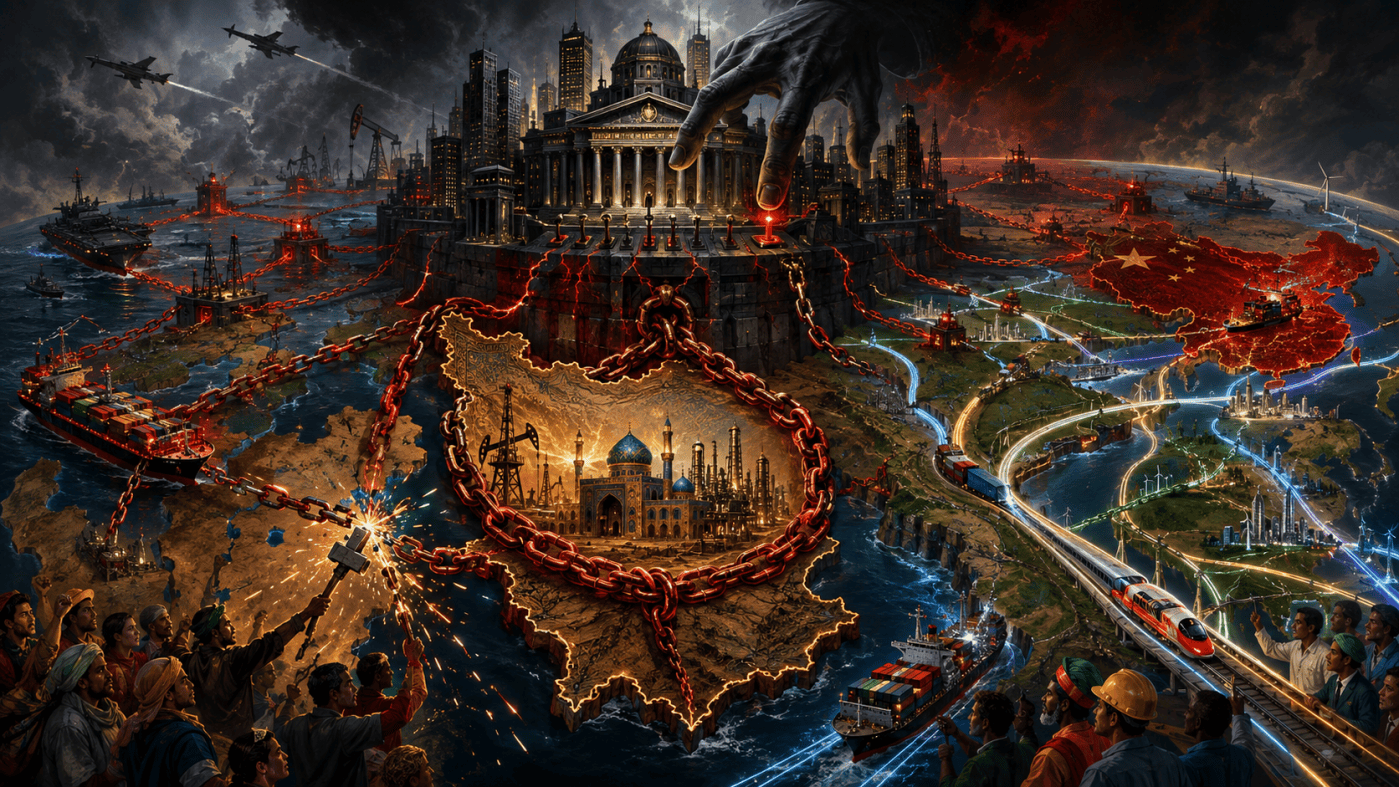
Scott Bessent calls it a defense of the “global financial system,” but Operation Economic Outcast reveals Washington openly converting dollar dominance into orders for the governments, banks, ports, airlines, and firms of other nations. Behind the ultimatum lies a longer history of intervention, sanctions, war, negotiated alternatives, counter-jurisdiction, and the growing effort of states such as China to build economic relationships that cannot simply be switched off by the U.S. Treasury. What emerges is not an American empire quietly fading away, but an Imperialist Recalibration in which the loss of cheap command drives harder coercion even as every act of coercion gives oppressed nations another reason to build the productive, financial, technological, and political capacity to refuse it. For workers and anti-imperialist movements inside the imperial center, the task is to expose economic siege as warfare, break the domestic consent that makes extraterritorial punishment cheap, and make Washington pay a political price every time it tries to turn the world economy into an American chain of command.
Prince Kapone | Weaponized Information | August 24, 2026
The Global System With an Owner
Scott Bessent did not unveil Operation Economic Outcast like an accountant adjusting a sanctions schedule. He announced it like a field marshal opening a front. D-Day, he reminded the press, began a campaign to drive an enemy from its positions, including positions “in third countries.” Then came the translation: Washington would now launch an “economic onslaught” against Iran’s financial connections around the globe. There it is. A refinery buying oil becomes an enemy position. A bank moving money becomes an enemy position. A port, an airline, a shipping registry, an exchange house—ordinary machinery of international commerce—becomes hostile terrain the moment it refuses an order from Washington.
Bessent then performs the oldest trick of empire: he starts history exactly where empire becomes convenient. Iran, he says, has been “at war against America” for forty-seven years. Forty-seven. Not seventy-three. Not a history of intervention, domination, revolution, retaliation, and war. The clock simply begins in 1979, with Iran already standing in the dock and the United States arriving later as the exhausted policeman of world civilization. Empire has always preferred history with the first chapters torn out.
Then comes the choice that is not a choice. Iran, Bessent declares, has “only two paths”: “complete global isolation and a subsistence economy,” or “normalcy” and readmission to the global economy. A few breaths later, he announces that Washington intends to “foreclose every other option.” That is an extraordinary definition of freedom. First close every door but one; then congratulate the prisoner for choosing the exit you selected.
But the most revealing language is directed not at Iran. Bessent announces “no gray spaces”. Countries buying Iranian petroleum, receiving Iranian flights, maintaining ship registries, moving payments, or otherwise permitting economic relations become “enablers.” Trump is calling world leaders with “specific requests.” Treasury, State, and the U.S. military are dispatching teams. Every country gets a “defined timeline.” Obey, or Washington acts. This is not the language of sovereign states negotiating with one another. It is the language a boss uses when the shop floor has been informed that management has revised the rules.
And then Bessent gives away the whole game. Asked why this supposed economic D-Day does not begin with immediate maximum sanctions, he replies: “Why would I want to blow up the global financial system?” Yet minutes earlier he warns countries not to expect the rewards of “our system,” and says those who refuse Washington’s expectations should prepare to leave “the dollar system.” The words march neatly into formation: global system, our system, dollar system. Universal when everyone obeys. American when someone refuses. The market wears the mask of humanity right up until the empire reaches for the switch.
The Ultimatum Meets a Region in Motion
Washington’s ultimatum to Iran does not travel by magic. It moves through banks, ministries, ports, refineries, shipping companies, payment systems and governments that the United States expects to fall into line. Bessent says foreign states are being given deadlines, presidential “requests,” and follow-up instructions from Treasury, State and the U.S. military. The immediate target may be Iran, but much of the actual work must be performed somewhere else. A government closes the branch. A bank rejects the payment. A refinery drops the supplier. A carrier cancels the route. Iran’s Foreign Ministry has called this an assertion of “extraterritorial sovereignty”: institutions operating under one country’s laws are threatened by another government until they enforce Washington’s policy for it.
China has already turned that pressure into a conflict between legal commands. On May 2, Beijing issued a blocking order instructing Chinese organizations not to recognize or comply with specified U.S. sanctions imposed over petroleum dealings with Iran. Three days before Bessent announced Economic Outcast, China’s Foreign Ministry again rejected unilateral sanctions and economic pressure against Iran. Washington tells a Chinese firm to obey American sanctions. Beijing tells the same firm not to obey them. What Bessent calls a universal system is already being contested jurisdiction by jurisdiction.
The forty-seven-year history Bessent uses to justify this campaign also depends on cutting the earlier conflict out of the frame. Iran traces a decisive rupture to the struggle over national control of oil and the 1953 Anglo-American overthrow of Prime Minister Mohammad Mossadegh. Iranian students later seized the U.S. embassy in 1979 and held 52 Americans for 444 days. Iraq invaded Iran the following year, while Washington later backed Baghdad during the Iran-Iraq War. Direct confrontation followed in the Gulf, culminating in 1988 when the USS Vincennes shot down Iran Air Flight 655 and killed all 290 people aboard. The history is not one of Iranian innocence. It is a history of intervention, revolution, war, retaliation and sanctions that Bessent compresses into a story beginning only when Iran becomes the aggressor.
Nor had diplomacy exhausted itself before Washington declared that Iran faced only isolation or “normalcy.” In June, Qatar announced that Washington and Tehran had reached an Islamabad Memorandum of Understanding dealing with outstanding disputes, cessation of military operations and navigation through the Strait of Hormuz. Qatar and Pakistan subsequently documented working groups on nuclear questions, sanctions, monitoring and dispute resolution. Pakistan later said the MoU remained an enduring framework for returning to peace. Economic Outcast did not appear because negotiation had disappeared. It appeared alongside an existing negotiated channel.
What has changed most sharply since then is the regional response. In two independent reports published on August 23, journalists and analysts with sources in Iran and Pakistan described Field Marshal Asim Munir’s Tehran mission and parallel discussions surrounding the Makkah defense framework as part of a wider effort to deepen relations around Iran rather than isolate it. According to that reporting, Iranian leaders are considering an invitation connected to the Pakistan-Saudi-Türkiye defense arrangement; Bahrain is exploring an additional defense relationship through Pakistan; and Pakistan and Iran are discussing a dramatic expansion of bilateral trade, with greater reliance on local currencies rather than the dollar.
The significance is material. Pakistan is not simply opening another diplomatic channel. It is being reported as simultaneously mediating between Washington and Tehran, expanding trade with Iran, anchoring a new regional defense arrangement with Saudi Arabia and Türkiye, maintaining its strategic relationship with China, and offering Iran access to overland routes and ports. Iran, meanwhile, is being reported not as waiting passively for Bessent’s sanctions to bite, but as widening its commercial, diplomatic and security relations while preparing additional responses if economic pressure intensifies.
The dollar still gives Washington extraordinary reach. International trade and finance remain organized through an architecture in which dollar settlement, credit, reserves and deep U.S. financial markets occupy an exceptional position. Bessent himself has said reserve-currency status reduces U.S. borrowing costs, deepens American capital markets and strengthens sanctions power. In June he declared that access to American markets, dollar finance, technology and related security benefits was “no longer unconditional”.
But the states under pressure are building additional channels. BRICS governments have formally backed greater use of local currencies, stronger correspondent-banking networks and expanded cross-border payment cooperation. China’s Cross-Border Interbank Payment System processed RMB175 trillion in cross-border payments in 2024. Pakistan-Iran trade, Chinese financial channels, Russian commerce, new transport routes and emerging regional security arrangements now appear less as separate developments than as different parts of the same changing environment around Iran.
Bessent has already acknowledged the danger built into repeated coercion. He warned that excessive sanctions could undermine dollar supremacy by encouraging targeted states to adapt, comparing sanctions to antibiotics against which targets eventually “become immune and mutate.” Operation Economic Outcast arrives just as the states Washington intends to discipline are building more ways to trade, move, finance, negotiate and secure themselves without waiting for Treasury’s permission.
The Gray Space Is Where Empire Starts Losing Control
Operation Economic Outcast is not just Washington trying to squeeze Iran. It is Washington trying to prove that the United States still has the right to decide who may trade with whom, which bank may move whose money, which ship may enter which port, and which government is permitted to disobey. Bessent calls this defense of the “global financial system.” Of course he does. The landlord always discovers the universal sanctity of property at the exact moment the tenant stops paying him tribute.
The command itself is simple. Iran must be isolated. But Iran cannot be isolated by Washington alone. Pakistan must cooperate. China must cooperate. Gulf governments must cooperate. Banks must freeze. Refiners must retreat. insurers must panic. Shipping companies must reroute. Ports must close their gates. The United States therefore needs the institutions of other countries to implement American policy inside their own borders. That is what “no gray spaces” really means: no independent room for judgment, no sovereign ambiguity, no relationship Washington cannot veto.
Empire prefers obedience dressed as procedure. The Treasury Department publishes a notice. A compliance office updates a spreadsheet. A bank cancels a transfer. A supplier walks away. Somewhere far from Washington, a factory loses an input, a clinic loses medicine, a worker loses a shift, a government loses revenue. The violence arrives wearing a necktie and carrying forms.
For decades, this machinery worked best precisely because it did not look like machinery. Dollar dominance, U.S. markets, Western banking, military alliances, insurance networks, technology controls and corporate law became so deeply embedded in international exchange that their political character could disappear behind words like “normal,” “rules-based,” “risk,” and “market confidence.” The empire became most efficient when it no longer had to announce itself as empire.
That is why Bessent’s speech matters. He tears the curtain down himself. Access is conditional. Partnership carries obligations. Trade relations can be punished. Banks can be expelled. Governments will receive deadlines. The polite fiction of a neutral world economy gives way to the language of the foreman: do what you are told or lose your place on the line.
Weaponized Information has called this Imperialist Recalibration. The United States is not becoming powerless. It is losing the luxury of getting obedience cheaply. Productive power, technology, trade and finance have spread across a wider geography, while the institutions of global command remain far more concentrated in American hands. Washington therefore reaches more aggressively for the weapons accumulated during its period of greatest predominance. The weaker the assumption of obedience becomes, the louder the threat must become.
But the people and states on the receiving end are not sacks of flour waiting to be weighed by the imperial merchant. They respond. A threatened bank creates pressure for another bank. A threatened shipping route makes another corridor valuable. A sanctioned market makes another buyer necessary. A military threat makes another security relationship worth building. The very act of closing one door increases the political value of constructing another.
This is where the new regional movement becomes historically important. Pakistan does not need Washington’s permission to deepen relations with Iran. Iran does not need to remain confined to the commercial routes Washington prefers. China does not need to accept that U.S. sanctions law governs Chinese trade. Gulf states do not need to treat American military protection as the only imaginable security arrangement. None of these developments abolishes imperialism by itself. But each one reduces the number of switches Washington can flip with guaranteed results.
And that is the beginning of what we can call multipolar recalibration. Not some fairy tale in which the old empire collapses on Tuesday and liberation arrives on Wednesday. Something harder and more material: targeted states begin stitching together enough trade, finance, transport, diplomacy, technology and military protection that saying “no” becomes less suicidal.
That is sovereign capacity. Not sovereignty as flag-waving ceremony. Not sovereignty as diplomats congratulating one another inside the United Nations. Sovereignty means the capacity to feed people when Washington sanctions you, keep factories running when banks refuse you, move oil when insurers threaten you, buy medicine when finance capital closes its doors, develop technology when export controls descend, and defend the political decision that made refusal necessary in the first place.
Colonial rule did not disappear merely because the flag changed. The old relation survives wherever one people produces, trades, borrows, ships and builds under conditions set elsewhere; wherever the wealth created by labor at one end of the system remains vulnerable to decisions made by financiers, ministries and military commands at the other. Formal independence means little if another power can still close the market, freeze the payment, choke the port, block the technology or punish the government for choosing a different road.
Bessent’s dollar war shows that relation in modern dress. Workers in Iran, Pakistan, China, the Gulf and far beyond produce goods, load ships, refine oil, build infrastructure, maintain networks, run factories and reproduce the world economy with their labor. Yet a relatively small concentration of imperial institutions still claims the power to decide which portions of that globally produced wealth may circulate. Humanity does the work. Washington keeps its hand on the circuit breaker.
That is why this cannot be reduced to a contest between currencies. A yuan payment system means little if there is nothing to buy, no port to unload it, no rail line to move it, no industry to use it, no government willing to defend it. Money is one link in the chain. Production, labor, logistics, energy, technology and political power make the chain real.
And here the empire meets its contradiction. Every time Washington turns dependence into punishment, it advertises dependence as a problem. Every bank bullied into submission becomes an argument for another clearing system. Every sanctioned shipment becomes an argument for another corridor. Every government threatened for trading with Iran receives a lesson more useful than any seminar on sovereignty: if another state can shut down your economic life by administrative decree, you are independent on paper and dependent in practice.
Washington may still win many of these confrontations. It can destroy businesses. It can bankrupt firms. It can frighten governments. It can make workers and ordinary families pay terrible costs for decisions taken in ministries thousands of miles away. Imperial power is not imaginary simply because resistance is growing.
But every act of coercion carries a second result. It strengthens the political case for building around the weapon.
This is why multipolar transition will not necessarily arrive as two neat camps with flags planted on opposite sides of the globe. It can develop through messy overlap. Pakistan can bargain with Washington and trade with Iran. Gulf states can retain American ties while seeking other security relations. Iran can remain vulnerable to dollar power while expanding channels that reduce that vulnerability. Gray space is not diplomatic confusion. Under imperial pressure, gray space becomes a material form of resistance to exclusive command.
That is exactly why Bessent wants it abolished. The empire can tolerate difference more easily than it can tolerate independence. A state may have its own flag, anthem and parliament so long as the important switches remain somewhere else. The trouble begins when that state acquires another bank, another port, another corridor, another buyer, another military partner, another source of technology—another way to survive the imperial “no.”
The struggle over Iran therefore exposes a larger historical movement. Washington is trying to harden imperial discipline at the same moment that the states it disciplines are weaving together more ways to escape exclusive dependence. Imperial bloc consolidation produces counter-integration. Counter-integration provokes harder discipline. The pressure intensifies on both sides.
The decisive question is not whether the United States remains powerful. It plainly does. The question is whether that power can continue functioning as a veto over the development of whole peoples.
Bessent wants a world without gray spaces because gray space is where that veto begins to fail. It is where another ship sails, another bank clears the payment, another border opens, another government refuses the order, another worker keeps the factory running. Empire wants obedience to remain cheaper than resistance. The history now being made will turn on whether the oppressed nations of the world can reverse that equation.
Make the Empire Pay for the Command
Economic warfare survives partly because it is made to look bloodless. A bomb leaves a crater; a blocked payment leaves paperwork. The political task is to destroy that illusion. Black Alliance for Peace has organized against the U.S. war on Iran from an explicitly anti-imperialist position, linking military aggression, sanctions and attacks on national sovereignty. That work should be pushed wherever the empire expects silence: union halls, neighborhood meetings, campuses, churches, political-education spaces and movement media. Workers should know what “secondary sanctions” means in practice. Washington is not simply refusing commerce with Iran. It is threatening banks, governments and companies across the world until they enforce Washington’s policy on Washington’s behalf.
That machinery also depends on political permission at home. CODEPINK’s Iran rapid-response campaign already gives people tools for constituent pressure, demonstrations, teach-ins and demands for sanctions relief and diplomacy. Those tools should be aimed directly at the mechanism Bessent is expanding: secondary sanctions, executive threats against third countries and the replacement of negotiated channels with economic ultimatum. Members of Congress should be forced to answer a plain question: by what right does the United States decide which sovereign countries may trade with one another? “National security” is not an answer. It is the label pasted over the command.
The lie that sanctions are the humane alternative to war also needs to be broken where it carries special authority. The Veterans For Peace Iran Working Group organizes education, petitions, workshops and mobilization against both military and economic aggression. Veterans can expose what Bessent himself has already made difficult to hide: Treasury warfare and military warfare are not rival strategies. They are coordinated instruments of the same state. The bomb destroys directly. The sanction orders others to tighten the screws. Calling one violence and the other “economic policy” is merely a division of labor in vocabulary.
Movement media has another front. The phrase “Iran’s enablers” should be treated as enemy propaganda, not repeated as neutral description. A country buying oil from Iran is not “enabling” Iran merely because Washington dislikes the transaction. A bank moving lawful commerce is not an accomplice because the Treasury Department says so. Antiwar organizers, socialist media, unions and community educators should name the actual relation: third-country institutions are being threatened with punishment unless they surrender part of their sovereign decision-making to the United States.
The point is not to issue another moral appeal to an empire that already understands what it is doing. The point is to organize against the domestic consent that lets it do so cheaply. Make secondary sanctions politically visible. Make congressional complicity costly. Defend humanitarian and remittance channels. Defend diplomacy against economic siege. Strip imperial language of its respectable clothing. Washington wants the world to experience obedience as ordinary administration. Our task is to make the command visible—and make enforcing it harder.


Leave a Reply