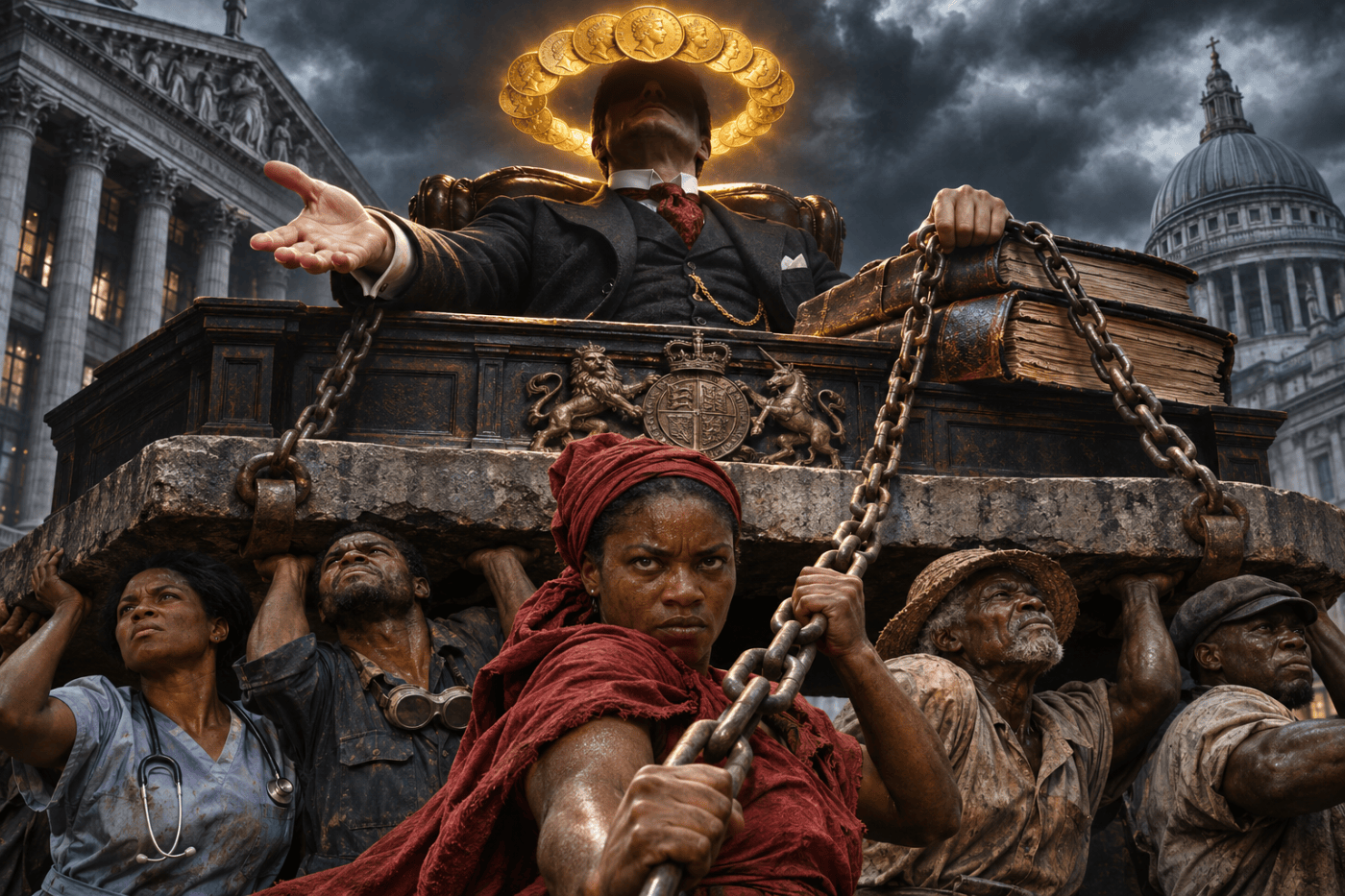
Britain steps forward to rescue indebted countries with the creditor’s authority tucked safely beneath its humanitarian robes. Behind the promises of relief, contracts and lending conditions turn claims on future labor into pressure on wages, hospitals, and household budgets. London invokes slavery while keeping the discussion of justice seated at the repayment table. Breaking that grip requires organized workers and peasants to seize command over the wealth they produce and the future already pledged against it.
Prince Kapone | Weaponized Information | November 6, 2026
The Creditor Arrives Wearing a Halo
First comes the debt. By the second paragraph, the British rescue party has arrived. In Heather Stewart’s November 5, 2026 Guardian report, developing countries owe a record $9.4tn, the poorest are being hammered by interest rates, and governments struggle to invest. Before a single debtor gets to make a demand, Britain is preparing a “new drive on debt.” The suffering happens over there. The wisdom arrives from London.
Look at who gets to speak and who gets spoken for. Countries shouldering the debt enter as borrowers, interest rates, and repayment problems. British officials arrive with names, plans, and a place in history. Andy Burnham confronts slavery’s legacy. Gordon Brown examines the machinery. Ed Miliband proposes a new deal. Three British statesmen take the floor while the people whose labor must pay the bill are left outside the room.
The World Bank delivers the expert diagnosis. Its officials explain that borrowing costs leave governments with less money for development. Its research connects debt with the struggle to afford a healthy diet when global shocks hit. These admissions matter: paying the creditor can mean going hungry. But the Bank gets to explain the suffering without having its own place among the creditors examined. We learn what governments must go without to keep paying. We learn much less about the institutions with the power to collect.
The headline bundles different countries together as “the poorest,” though the opening sentence describes developing-country debt more broadly. Private bondholders turn up later, mainly as a complication for reform. Who owns the claims, and what power does that ownership give them? Those questions get less attention than the headache they cause the officials arranging relief. A fight over wealth and power is handed to the reader as a paperwork problem.
Then slavery is brought onstage. Burnham’s reference gives the initiative the glow of a historic reckoning without making the article spell out what Britain would actually have to give up. A cheaper repayment schedule dresses itself in the robes of justice. What a damn convenient wardrobe.
The article does acknowledge demands from African Union heads of state and initiatives under Brazil’s and South Africa’s G20 presidencies. It saves them for the final paragraph, once British leadership has been given flesh, purpose, and momentum. Their demands get no such hearing. Others have been asking; Britain will act. The old imperial arrangement is still in fine working order: the South supplies the wound, London supplies the prescription.
The report lets the suffering into view, then puts the creditors in charge of deciding what it means and how to fix it. Readers are asked to judge how well Britain might ease repayment. The power to demand repayment gets to keep its seat, untouched. Before applauding the collector for loosening his grip, ask how he won the right to hold another people’s future in his fist.
How the Claim Becomes a Cut
The World Bank’s International Debt Report puts external debt across low- and middle-income countries at roughly $9.4tn. About $1.3tn belongs to countries eligible for its concessional lending. The reported 8.2% average applies to new private-creditor commitments to public borrowers in that poorer group. These distinctions matter. Under the headline’s mountain of debt are different creditors, different contracts, and different terms deciding who gets paid, how much, and when.
The accounts also demand more care than a story of money flowing endlessly outward. Long-term net debt transfers, meaning disbursements minus principal repayments and interest, turned positive at $45.4bn in 2025 after running negative in 2024. More new financing came in than went out in payments, even as the debt pile grew. Gross debt service includes repayment of principal; calling every dollar creditor profit would muddle the account. Exchange-rate changes also pushed up the dollar value of outstanding debts. Money arriving today and claims piling up against tomorrow are connected, but they are different things. We need to know both to understand what the collector holds over the debtor.
The history begins long before the latest repayment crisis. Tricontinental’s African debt dossier describes newly independent states inheriting economies built to ship out raw materials, with weak industrial foundations and too little control over their own resources. They had countries to build with economies organized to serve somebody else. Building domestic production required money, while dependence on foreign markets and finance narrowed their room to move. IMF conditions were already at work before debt exploded in the 1980s. Senegal’s repeated programs show how the lender arriving with temporary assistance could settle into a permanent seat at the table. Agreement followed agreement. External supervision renewed itself; the weaknesses driving governments back to the lender remained.
In Kenya, the IMF program approved in 2021 tied financing to deficit reduction and changes affecting public enterprises. Further money depended on periodic reviews of the government’s performance. Public spending became a recurring negotiation with the lender: meet the conditions, pass the review, unlock the next disbursement. The Kenyan government carried the program home, where workers and people relying on public services had to live with the decisions.
Commercial creditors bring their own armor. Kenya’s October 2025 bond prospectus specifies that money raised through dollar-denominated securities would finance repayment, including purchases of existing notes, with the remainder available for the budget and other obligations. Part of the new borrowing went to service the old borrowing. English law governs the bonds; London arbitration handles disputes. In specified circumstances, if Kenyan tax deductions would reduce noteholders’ receipts, the terms require additional payments to make up the difference. The investor gets protection from the tax collector. Kenya gets the job of finding the dollars.
At home, the bill takes another form. A Kenyan public-services study documents wage restrictions, pressure on public provision, and rising costs paid straight from people’s pockets. When an underfunded health facility can’t supply medicines and basic materials, patients must buy them, put treatment off, or go without. The same report identifies tax incentives benefiting multinational companies alongside pressure to collect more revenue and hold down spending. There are choices here about whose income deserves protection and whose illness can wait. What the government saves on its books can become another expense a working family must somehow cover.
Britain’s proposed intervention steps into this machinery. Miliband’s October debt speech calls for more time to repay, cheaper refinancing, and greater use of multilateral development-bank balance sheets, alongside economic reform by borrowers. It also calls for deeper restructuring where necessary and action against individual private lenders obstructing relief. In the same speech, public financial institutions are urged to share risks and help create investments attractive to pension funds, insurers, and banks. Relief for the debtor and fresh opportunities for finance appear in the same program. Those commitments belong together in the analysis, though the available record doesn’t establish a finalized British financing contract.
Existing instruments show why the small print deserves our attention. The World Bank’s October 2019 credit-guarantee product note describes protection for private lenders backed by sovereign indemnity. If the Bank pays, the government must reimburse it. The private lender receives protection; the debtor can be left owing the public guarantor. But the Bank’s Risk Mitigation Facility explicitly operates without sovereign indemnity. Calling everything a guarantee tells us too little. Follow the actual agreement and find out who must pay when the protection is called in.
Reparative demands go further than rearranging the payment calendar. CARICOM’s reparations program connects cancellation with health, education, technology transfer, and reconstruction after slavery and colonialism. These demands concern what was taken, what must be rebuilt, and what resources that work requires. A cheaper repayment schedule leaves those obligations standing.
Indebted peoples have also demanded that the collector open the books. Ecuador’s 2007–08 public-debt audit grew out of social-movement demands and examined decades of borrowing. Among the arrangements it investigated was the nationalization of private debts: obligations incurred privately were passed onto the public. The findings informed government decisions on commercial debt. In Kenya, mass resistance to austerity challenged attempts to squeeze more revenue from people already carrying too much. The people expected to pay were contesting the terms imposed on them.
Even Britain has put legal limits on collection. The 2010 Debt Relief Act restricted recoveries on specified debts associated with the heavily indebted poor countries initiative. Its reach was narrow, but the fact remains: Parliament changed what creditors could collect. The contract has lawmakers behind it. The creditor’s entitlement rests on political decisions, and political decisions can be fought over and changed.
The Bondholder’s Future Is Made From Our Labor
A bondholder buys a claim on money somebody still has to produce. Taxes gather it, exports bring in the foreign currency, and refinancing pushes the obligation down the road. Underneath the whole operation are people planting food, fixing machinery, hauling freight, teaching children, and tending the sick. The bondholder’s title never lifts a crate or changes a bedpan. It gives its owner the right to collect from a world kept running by other people’s hands. Finance then performs its favorite street hustle: pocket the proceeds and tell everyone the money did the work.
The contract gives that hustle the force of institutions. An investor’s promised payment becomes an obligation the government must honor. A hospital becomes an expense the government must defend. Both draw on society’s resources, but the investor arrives with an enforceable claim while the patient arrives with a human need. Give repayment first place and that ranking works its way into vacant nursing posts, bills dumped on families, and treatment put off until somebody can find the money. The property right leaves the lawyer’s desk and puts its hands on somebody’s body.
Public debt fastens private claims to the machinery of public power. Creditors hold the paper; governments reach across society to gather the payment. Taxes can take from profits and property or bite into wages and every purchase a household makes. Budgets can sustain public services or send people shopping for what those services once provided. “The country must pay” throws a national flag over a class struggle. Which people must surrender their wages, their security, their medicine? The collector’s patriotic vocabulary gets mighty thin when the bill reaches the kitchen table.
The state helps decide who gets shelter and who gets soaked. A contract can protect an investor’s receipts from taxation while households swallow rising costs. Debts run up by private owners can be loaded onto the public, turning somebody else’s obligations into everybody’s burden. Public institutions hand out protection with one hand and sacrifice with the other. An official signature binds the country, but it doesn’t spread the proceeds or the pain equally. The whole neighborhood gets the bill for a party held behind somebody else’s locked gate.
Domestic owners have their own stakes in this arrangement. Those whose assets and returns enjoy protection have every reason to defend the machinery protecting them. Businesses needing affordable credit and functioning public infrastructure can be squeezed by the same machinery. The owning classes can quarrel among themselves and still send the adjustment downstairs. Their command over property and political influence helps decide which losses bring the government running and which hardships get written into the budget. A rich man’s loss becomes a national emergency; a worker’s empty cupboard becomes fiscal discipline.
These fights take place inside an international hierarchy built into production and finance. Formal independence leaves governments confronting economies organized around external markets. Foreign-currency debts must be paid in money those governments can’t create. They have to secure foreign exchange, giving the institutions controlling access to finance a grip on decisions made at home. The flag flies over the ministry while the means to carry out its decisions remain subject to outside pressure. Neocolonial power works that gap between having a country and commanding the resources to build it.
Borrowing can keep that gap open even when it pays for something useful. New equipment and infrastructure can expand production while leaving the next stage waiting on another external advance. Follow the productive connections: who owns the new capacity, whose needs it serves, and who commands what it earns. More output can flow through an economy whose direction is still set elsewhere. The engine gets bigger while somebody else keeps a hand on the wheel.
Creditor discipline also gnaws at its own foundation. Collection requires people producing, goods moving, and public institutions gathering revenue. Squeezing payment out of that society can weaken the very capacities keeping the money coming. Investment gets postponed, household purchasing power shrinks, and costs stripped from public budgets land on private doorsteps. The collector wants a dependable harvest while cutting into the roots. Finance needs the worker alive and working, then treats the conditions keeping that worker alive as fat to be trimmed.
Refinancing manages this contradiction. More time, lower costs, and restructuring can keep services running and ease immediate suffering. They can also put the collection machinery back on its feet. Creditors have a material interest in keeping their source of payment alive. A concession gives people breathing room and gives finance another chance to accumulate. Organized class power decides what gets built in that opening: stronger foundations for popular development or a fresh runway for the next collection round. Getting the boot off your neck matters. So does acquiring the strength to stop it coming back.
Public financial institutions help organize these relations. A guarantee can move the liability while keeping the investor’s claim protected. Calling the arrangement public tells us who administers it. Follow the risk, ownership, and decision-making power to find out whom it serves. A state institution can keep private accumulation humming with every form completed and every procedure observed. Capital can give the orders perfectly well with a public official holding the pen.
That is the ground beneath the Guardian’s rescue story. Britain’s power to offer solutions appears scrubbed clean of the history that concentrated financial and institutional authority in creditor centers. Accumulated power puts on a clean shirt and introduces itself as expertise. Countries under pressure supply the suffering; those equipped to manage that pressure get another turn at world leadership. A beautiful racket: administer dependence, then take a bow for administering relief.
Bring slavery into this performance and the obscenity deepens. Historical responsibility gets squeezed into a conversation about repayment terms. Reparations concern the resources owed for rebuilding after dispossession. Creditor reform concerns what happens to existing financial claims. Put reparations under creditor reform and the collector gets to chair the hearing on justice. Britain can’t settle that conflict by congratulating itself for booking the room. Turn the damn ledger around. There are debts on the other side.
Popular resistance drags the decisions behind these supposedly impersonal obligations into daylight. Audits establish who borrowed, who pocketed the benefits, and how private debts were strapped onto the public’s back. Collective opposition challenges the government’s power to make people carry them. Cancellation can then do more than settle an argument across a negotiating table. It can strengthen the people fighting to command public resources and decide what those resources are for.
Carrying that struggle through requires working-class power over investment, public finance, and productive property. Workers and peasants must have the authority to put collective needs ahead of financial claims and stop domestic owners from grabbing the resources freed by popular struggle. That’s the socialist content of debt emancipation: changing ownership, changing who makes the decisions, and organizing the economy around the lives it must sustain. The people whose labor keeps society standing must acquire the power to run it.
Organize Against the Claim
Get the collector’s paperwork into the hands of the people expected to pay. Open the contracts, guarantees, payment records, and budgets. Establish who borrowed, who pocketed the benefits, what the creditors collected, and which public needs went hungry to keep the payments moving. Carry that evidence into the unions and community organizations fighting wage restraint, gutted services, and bills that swallow the paycheck before the week begins. The financial obligation must answer to the people carrying it. A contract is no holy scripture, and the collector is overdue for questioning.
Brazil’s Auditoria Cidadã da Dívida offers a concrete place to begin. Its participation program invites people to form groups in unions, schools, universities, and communities, investigate public debt, and connect the accounts to their consequences. Bring research skills, technical knowledge, and the experience of living under the cuts into that work. A union audit group can follow an obligation from the financial document to the missing public service, then put the evidence before members who can organize around it. Drag the debt out of the expert’s briefcase and onto the assembly floor.
Follow the money through the owners at home as well as the creditors abroad. Publish the terms. Name the beneficiaries. Establish whose receipts were protected while everybody else was told to tighten a belt already down to its last hole. Build demands to cancel illegitimate obligations, with assemblies of workers and affected communities deciding which claims to challenge and which resources to defend. Researchers must put evidence at the struggle’s disposal. Authority over the demands belongs to the people doing the fighting.
Across borders, Jubileu Sul’s organizing network provides a route for popular organizations to connect struggles for cancellation and reparations. Its membership process prioritizes movements and popular entities committed to its principles. Use those relationships to exchange findings, coordinate demands, and confront creditors together. Internationalism needs people who know one another’s fights, share what they uncover, and sustain common work. The creditors can organize across borders. So must the people they expect to pay.
In Britain, bring the machinery of collection before union branches and community meetings. Demand binding limits on what private creditors can recover and rules compelling lenders to participate in cancellation. Pass resolutions with those demands, send delegations to legislators, and make them answer publicly for the claims their laws protect. Build pressure where the collector gets his legal muscle. Ministers parading as champions of debt relief must face an organized movement demanding that they strip away the advantages protecting collection. If they want credit for confronting the racket, make them put its privileges on the table.
Then organize over every resource cancellation frees. Audit groups and unions must demand published spending commitments, track whether the money reaches public services and productive investment, and bring broken commitments back before their assemblies. Representatives must answer to collectively agreed priorities, with members able to challenge them when they depart. Without that power, domestic elites can scoop up the breathing room won by everybody else’s struggle. The people who fought to lift the burden must command what becomes possible once it is lifted.
Measure every settlement against what organized people gain the power to secure: staffed clinics, functioning public services, stronger productive capacity, and less of society’s wealth handed over to financial claims. Build organizations with the strength to defend those gains and the ambition to push beyond them. Workers and peasants already supply the labor that keeps the economy standing. Organize that strength into the power to decide what it builds, whom it serves, and where the wealth goes.


Leave a Reply