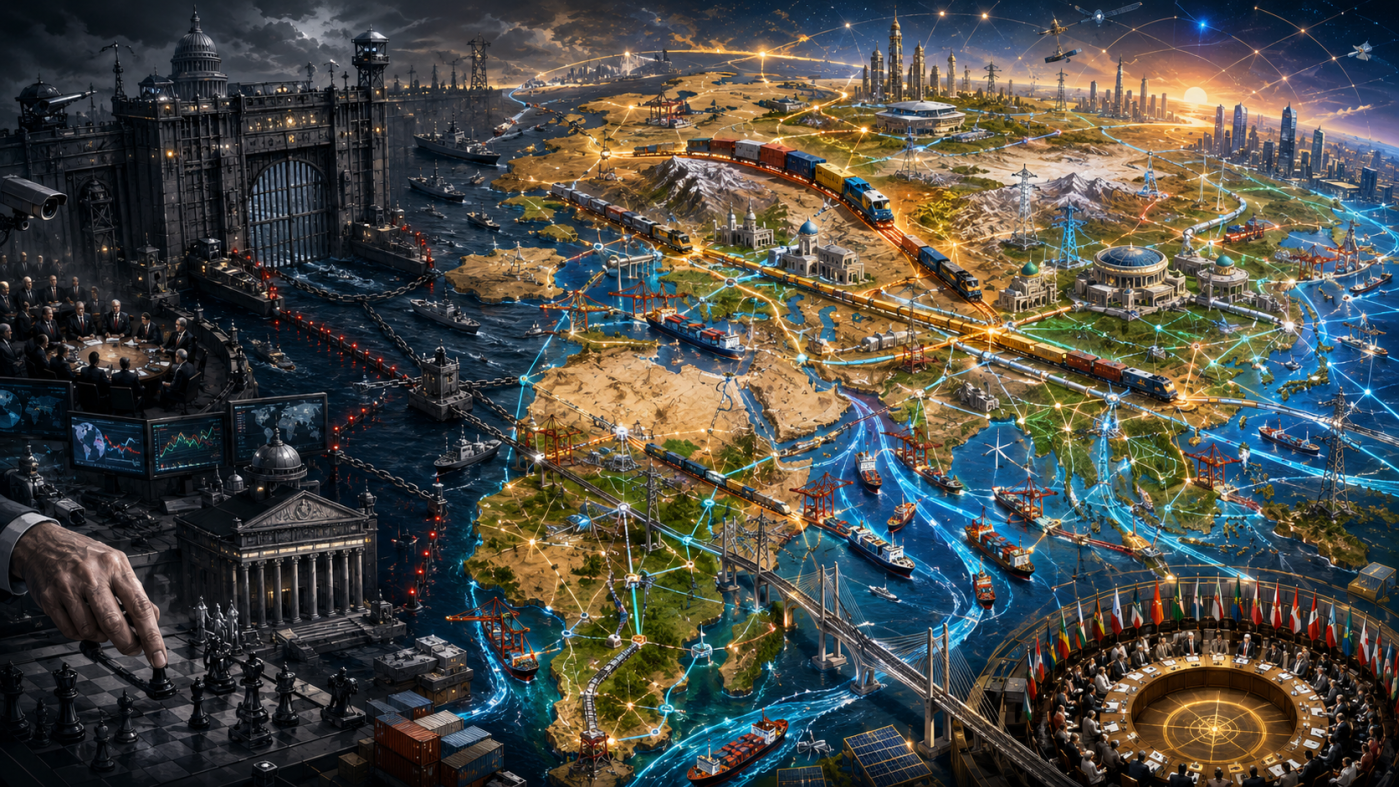
Multipolarity is becoming material not because the Global South has assembled a new empire to replace the old one, but because states are building more ways to finance development, settle trade, move goods, acquire technology and cooperate without passing every vital connection through a single commanding center. From Bandung’s unfinished struggle for economic sovereignty to the productive transformations of globalization, the central contradiction has become sharper: imperial power still commands decisive financial, technological and institutional chokepoints even as alternative banks, payment systems, transport corridors and political formations multiply around them. BRICS, the SCO, ASEAN and a widening web of regional institutions do not form one rival bloc; together they reveal a more uneven process in which sovereignty grows through usable alternatives without abolishing dependence, hierarchy or capitalist exploitation. The world is becoming harder to seal—but whether that expanding room serves workers, national bourgeoisies, socialist development or another cycle of extraction remains a question of class power.
By Prince Kapone | Weaponized Information | September 2, 2026
The Summit That Refuses the Map
On September 1, 2026, the usual geopolitical map became strangely useless in Bishkek. The SCO Plus meeting, held alongside the Shanghai Cooperation Organisation’s twenty-fifth-anniversary summit, gathered the organization’s ten member states around a table that refused to stop at the organization’s borders. Mongolia sat there as the SCO’s observer state. Azerbaijan, Armenia, Egypt, Laos and Türkiye participated as dialogue partners. Vietnam and Togo came as guests of the Kyrgyz chair. Senior representatives of the United Nations, the Eurasian Economic Union, the Collective Security Treaty Organization, the Conference on Interaction and Confidence Building Measures in Asia and the Commonwealth of Independent States joined them. None of those categories meant the same thing. An observer was not a member. A dialogue partner had not assumed the obligations of a full member. A guest had entered the meeting, not the organization. Yet there they were, occupying the same political space without belonging to the same institutional camp.
That scene is hard to squeeze into the familiar cartoon of a world dividing neatly into two hostile blocs. Türkiye remains a full NATO member while maintaining dialogue-partner status with the SCO. Egypt is a full BRICS member while participating in the SCO only as a dialogue partner. Vietnam is a full member of ASEAN and a BRICS partner country, yet arrived in Bishkek simply as an invited guest. Mongolia has remained close enough to the SCO to hold observer status while stopping short of accession. If this is a new “Eastern bloc,” someone forgot to tell the states involved that they were supposed to remain inside their boxes.
But the opposite conclusion would be just as lazy. A crowded summit hall does not prove the arrival of some harmonious new world order. Governments have always attended conferences with states they distrust, traded with states they dislike and signed declarations destined to spend eternity aging gracefully on ministry websites. Diplomatic attendance is cheap. A handshake cannot clear a payment. A communiqué cannot move a container across a closed border. Observer status cannot finance a railway, and a dialogue partnership cannot keep a bank operating when access to an indispensable financial channel disappears. If Bishkek matters, its significance cannot rest on the number of flags arranged behind polished tables.
The puzzle lies in the coexistence of relationships that the bloc map treats as mutually exclusive. India can sit inside both BRICS and the SCO while maintaining strategic cooperation with the United States, Japan and Australia. Türkiye can remain inside NATO while cultivating political and economic relations across Eurasia. Vietnam can deepen ASEAN-centered regional integration while dealing extensively with China, Russia, India, Japan and the United States. None of these arrangements proves that the states involved are escaping dependency, much less joining a common anti-Western project. What they do show is that one institutional relationship no longer tells us everything about the others.
The SCO itself sharpens the problem. At Bishkek, the organization approved deeper cooperation with existing bodies, including an SCO–CSTO–CIS roadmap, continued engagement with the Eurasian Economic Commission and a decision to establish a formal link between the SCO Secretariat and the African Union Commission. These institutions do not possess the same memberships, powers or purposes. The EAEU regulates a deeper economic integration project among a smaller group of states. The CSTO is a collective-security organization. The African Union operates on an entirely different continental terrain. The United Nations claims universal membership. Their appearance around the SCO does not create one political organism. It creates a harder question about what happens when institutions built for different functions begin touching one another without surrendering their separate identities.
If every country drawing closer to the SCO were simply leaving one camp for another, the process would be familiar. Washington would lose partners while Beijing or Moscow acquired them, and the architecture of domination would survive with different colors painted on the map. Bishkek does not prove that something more profound has already replaced it. It reveals that the old categories are becoming less capable of describing what states are actually doing. Cooperation can deepen in one sphere while remaining shallow in another. Governments can share a security forum and disagree over war, trade through one set of arrangements and borrow through another, or engage China economically without accepting Chinese political command. The contradiction is not noise surrounding the system. It may be telling us something about the system itself.
Perhaps this really is little more than diplomatic promiscuity: states collecting summits, partnerships and institutional relationships while the decisive circuits of money, technology, shipping, credit and production remain concentrated elsewhere. Perhaps the new map has more lines drawn across it while the same hands still own the railroad. The meaningful question, then, is not how many rooms a state can enter or how many organizations will print its flag. It is what happens when that state needs something indispensable and the usual road is blocked. To know whether the strange geography visible in Bishkek represents a change in world power rather than a change in diplomatic choreography, we have to leave the summit hall and ask who built the roads, who controls the banks, who clears the payments, who owns the technology—and who can still turn the connection off.
Connected to the World, But Not in Command of the Connection
The power to close a road matters only because somebody has already been forced to travel it. That problem is older than SWIFT, semiconductor export controls or secondary sanctions. Colonialism did not keep Africa, Asia and Latin America outside the world economy; it dragged them into it on violently unequal terms. Mines fed foreign factories. Plantations produced for distant markets. Ports and railways often connected extraction zones to the sea more efficiently than they connected people and production inside the colony itself. Land was reorganized, labor compelled, resources priced and shipped according to priorities established elsewhere. The colonized world was therefore anything but disconnected. Its tragedy was that it was connected through relations it did not command. This is the historical force behind Samir Amin’s unequal-development critique: underdevelopment was not simply the absence of capitalism’s blessings at the periphery, but a condition reproduced through the way peripheral economies were incorporated into accumulation on a world scale.
Political independence attacked one side of that relation. The great decolonizing wave transformed subjects into citizens and colonies into internationally recognized states. The 1960 UN declaration gave juridical expression to a struggle already being won in streets, jungles, plantations, prisons and liberation wars across the colonial world: peoples had the right to determine their own political status. That was no small victory. A government in Accra, Dar es Salaam or Jakarta could legislate in its own name, appoint ambassadors, negotiate treaties and claim authority over a defined territory in ways a colonial administration never could. But the flag changed faster than the material structure beneath it. Many newly independent states inherited economies concentrated in a handful of primary commodities, weak domestic industrial bases, severe technological dependence and an urgent need for imported machinery, fuel, medicines and manufactured goods. The old colonial governor could leave while the requirement to earn foreign exchange remained standing at the door.
That contradiction unfolded inside a postwar economic system whose rules had already been written before most colonies achieved independence. At the Bretton Woods Conference in July 1944, representatives of forty-four countries created the institutional foundations of a new monetary order, including the International Monetary Fund and what became the World Bank. The official purpose was reconstruction, monetary stability and international economic cooperation after depression and world war. The IMF supervised an exchange-rate system linked to the U.S. dollar, while the World Bank initially concentrated on reconstruction before expanding development lending across the newly decolonizing world. This architecture did facilitate trade, investment and rebuilding. It also placed the currency of the postwar capitalist superpower at the center of international settlement while giving financial weight, rather than simple sovereign equality, a major role in institutional decision-making.
The polite language of international governance can obscure what that meant. The IMF has always been a quota-based institution: a member’s quota helps determine how much it contributes, how much it can ordinarily borrow and, crucially, its share of voting power. The World Bank likewise does not operate on one-country-one-vote principles; voting power in the International Bank for Reconstruction and Development is tied substantially to capital share ownership. Newly independent countries therefore entered organizations called international without entering them as materially equal participants. A state might possess one vote in the United Nations General Assembly while confronting an entirely different arithmetic when it needed foreign exchange, development credit or access to capital. Sovereignty had become universal in law faster than command over the institutions necessary to reproduce an economy.
The imbalance ran deeper than boardroom votes. A country exporting cocoa, copper, coffee, oil or bauxite had to sell those commodities into markets it did not control in order to obtain the foreign currency required to purchase machinery and industrial inputs it often could not yet produce. Price collapses could wreck a national budget. Capital could leave faster than factories could be built. Imported technology arrived carrying patents, licensing arrangements and dependence on foreign suppliers. None of this meant every postcolonial state occupied the same position, or that commodity exports themselves condemned a country to permanent dependency. But the structure was stubborn enough to survive decades of formal independence. Even today, UN Trade and Development reports that two-thirds of developing economies remain commodity-dependent, a persistence rooted partly in historical trade patterns, limited productive capacity and restricted access to finance and technology. The old relation changed form without simply evaporating.
Money was only one pillar. The postwar order also acquired a military skeleton. The North Atlantic Treaty of 1949 bound the United States and Western European powers into a collective-defense system in which an attack on one could trigger assistance from all. Beyond NATO, Washington developed bilateral security treaties, military facilities and defense relationships across strategic regions of the world. The point is not that every unequal economic relation required a U.S. soldier standing beside the customs desk. Capitalism usually prefers the invoice to the bayonet because the invoice is cheaper. The point is that the supposedly impersonal world market developed inside an international order backed by states possessing radically unequal military capacities. Contracts, currencies and property rights did not float above history. Behind them stood navies, bases, alliances, intelligence services and governments capable of deciding which forms of economic or political independence they were prepared to tolerate.
A realist account can see part of this world and still miss its deeper geometry. Hanna Samir Kassab’s Globalization, Multipolarity and Great Power Competition correctly insists that globalization never abolished state rivalry: governments remain economically interdependent while competing over security, resources and the rules of the international system. But “interdependence” can become a dangerously democratic word when it treats unequal relations as though everyone were holding the same rope. The country issuing the principal settlement currency and the country scrambling to acquire that currency for essential imports are both connected to the same system. They are not positioned identically inside it. The industrial power controlling advanced machinery and the raw-material exporter purchasing that machinery are mutually involved in trade. That does not tell us who can refuse the transaction longer, dictate its terms more effectively or survive when the relationship is severed.
Imperial command becomes visible inside connection itself. Its power has never rested solely on conquest, nor can it be reduced to controlling one bank or one currency. Ownership matters. Productive capacity matters. Monopoly capital, technology, military force, resource extraction and the international division of labor matter. But command becomes especially powerful when access to something necessary passes through channels concentrated beyond the sovereignty of the state that needs it. Credit can carry conditions. A currency can become a gatekeeper. A shipping route can become a chokepoint. A patent can turn technological development into rent paid abroad. Military protection can acquire political obligations. The problem is not connection. No serious project of sovereign development proposes that every country retreat into economic monasteries and manufacture every tractor, medicine and microchip behind its own border. The problem is dependence upon connections whose continuation can be priced, conditioned or ultimately denied by somebody else.
That was the unfinished contradiction of decolonization. The colonized peoples had broken the legal claim that Paris, London, Brussels or Lisbon possessed the right to govern them. Yet political independence did not automatically reorganize the circuits through which their economies reached the world. A parliament could declare sovereignty; it could not print the foreign exchange needed to import an entire industrial base into existence. A new flag could rise over the port while the ships, insurance, credit, machinery and markets beyond that port remained organized through structures built elsewhere. The empire no longer needed to own every government directly if the reproduction of national life still depended on relations the new state could not easily replace. Political independence had created the state. The unresolved question was how that state could become materially sovereign without attempting the impossible task of disconnecting itself from the world.
Bandung Had the Politics Before It Had the Plumbing
Long before anyone spoke of BRICS, the Shanghai Cooperation Organisation or a “multipolar world,” the formerly colonized were already trying to solve that problem. In April 1955, delegations from twenty-nine Asian and African governments gathered in Bandung, Indonesia, carrying wildly different ideologies, social systems and relationships with the great powers. They did not arrive with a blueprint for a unified bloc. They arrived with something more elemental: the refusal to accept that independence from colonial rule should merely deliver their new states into somebody else’s Cold War camp. The Bandung Conference affirmed sovereign equality, territorial integrity, non-interference, peaceful settlement of disputes and cooperation among countries emerging from colonial domination. But the final communiqué also dealt with economic cooperation. Political sovereignty and development were already being posed as parts of the same unfinished struggle.
The countries at Bandung understood something the mythology of the Cold War still manages to bury. The world wasn’t populated only by two great camps staring across Europe at one another through missile sights. Cairo had its own problems. Jakarta had its own revolution. Delhi had its own developmental project. Accra, once independent, would not exist simply to furnish another square on somebody else’s chessboard. When the Non-Aligned Movement formally emerged at Belgrade in 1961, drawing directly on Bandung’s principles, nonalignment was never merely the art of standing equidistant between Washington and Moscow with a diplomatic ruler. Its members insisted on national independence, decolonization, economic development and the right to pursue relations with different powers without surrendering political command to any one of them.
That produced a form of international maneuver that looks strikingly familiar from the vantage point of 2026. Jeremy Friedman’s Ripe for Revolution reconstructs a Third World whose governments did not simply receive models and instructions from great powers. Newly independent states solicited aid from the Soviet Union, China, Yugoslavia, Cuba and other socialist countries while bargaining with Western states and institutions at the same time. They borrowed ideas, rejected advice, altered projects and tried to fit outside assistance to political economies that bore little resemblance to Moscow or Beijing. Tanzania was not China. Indonesia was not the Soviet Union. Egypt was not Yugoslavia. Even governments experimenting with socialist development guarded the sovereignty they had only recently wrested from empire. The apparent bipolar world already contained a messier reality underneath it: weaker states learning to use competing external relationships to enlarge their room for action.
The radical wing of that internationalism went further. The 1966 Tricontinental Conference in Havana brought together revolutionary movements and states from Africa, Asia and Latin America, connecting unfinished wars of national liberation with struggles for socialism and economic sovereignty. The network did not stop at governments. Liberation movements, communist parties, guerrilla organizations and solidarity committees moved ideas, cadres, publications and material aid across continents. The Tricontinental Revolution reconstructs a political world in which Vietnamese revolutionaries, African liberation movements, Cuba, Algeria and other actors attempted to build common strategy across borders without pretending that their struggles were identical. The political imagination was already transcontinental. The problem was that the material base capable of sustaining that imagination remained brutally uneven.
Newly sovereign governments could diversify diplomatic partners far more easily than they could manufacture machine tools, stabilize commodity prices or replace a lost export market. Some could obtain Soviet tractors, Chinese technical assistance, Western industrial equipment or credits from several competing sources. That mattered. It prevented the Cold War from becoming the perfectly sealed two-camp system of later textbook memory. But the available alternatives rarely formed anything close to a complete material infrastructure through which a postcolonial economy could reproduce itself. A government might acquire a steel mill from one partner and financing from another while still needing dollars for essential imports, access to markets in the capitalist core, foreign shipping, outside technology and revenues from one or two primary commodities. Political room had widened faster than the productive base underneath it.
Nonalignment also ran directly into class power at home. The postcolonial state did not belong automatically to workers and peasants because a colonial flag had been lowered. Some governments attempted land reform, public ownership, planning and socialist transformation. Others were ruled through national bourgeoisies whose development ambitions coexisted with private accumulation, foreign capital and fear of popular mobilization. Still others hardened into authoritarian systems whose elites learned to negotiate both anti-colonial rhetoric and profitable integration into the world market. The category “Third World” named a common historical position under colonialism and unequal development; it did not erase the struggle between workers, peasants, bureaucrats, landlords, merchants, capitalists and revolutionary movements inside the states that claimed it.
The harder political-economic question was therefore not whether a government could trade with several countries. It was whether those external relations could be subordinated to a development strategy determined from within. Samir Amin would later describe that problem through the language of delinking: not withdrawal from the world economy, but reversal of the hierarchy between domestic priorities and the demands of global accumulation. A country that changed trading partners while leaving its productive structure organized around raw-material exports had diversified its relationships without necessarily transforming its dependency. A government that borrowed from two lenders instead of one had more bargaining room, but if both loans reproduced the same extractive economy, plural finance had not yet become sovereign development.
The international debt crisis of the 1980s exposed that weakness with merciless clarity. Rising global interest rates, deteriorating terms of trade, recession in industrial economies and accumulated foreign debts pushed developing countries across several regions into repayment crises. The IMF’s own institutional history records how the crisis that erupted in 1982 forced debtor after debtor into adjustment and made Fund-supported policy reform central to the international response. World Bank lending moved in the same direction. Its own account of policy reform and adjustment lending describes programs built around cuts in public spending, opening economies to competition, price liberalization and institutional changes intended to create market-oriented economies. The language was modernization. The material relation was that governments desperate for foreign exchange were negotiating reforms while creditors controlled access to desperately needed finance.
The political network built from Bandung through Belgrade and Havana had therefore encountered its historical ceiling. Its states could coordinate resolutions, support liberation movements, demand a New International Economic Order and sometimes play rival powers against one another. What they generally lacked was enough collective command over credit, production, technology, currency, industrial supply chains and infrastructure to prevent the world market from disciplining national projects when external conditions turned hostile. The South had built diplomatic bridges before it possessed enough banks, factories, payment systems and transport networks to carry its sovereignty across them. The politics had arrived. The plumbing had not.
Globalization Built Capacities Its Command Structure Couldn’t Contain
The material weakness that haunted Bandung did not disappear because the Third World finally won an argument about sovereignty. It was transformed by the very globalization that was supposed to bury the argument forever. From the 1980s onward, factories, supply chains, ports and industrial districts were reorganized across borders on a scale capitalism had never before achieved. Corporations headquartered in the old imperial centers chased lower labor costs, larger markets, weaker unions, favorable tax regimes and new production zones. Governments opened economies under pressure from debt, structural adjustment and the promise that export-led integration would deliver development. The neoliberal sermon was simple enough: surrender more control to the market and prosperity would arrive on schedule. Capital, however, had a habit of producing consequences its priests did not order.
Production moved. Industrial capacity accumulated in places that had once been treated mainly as suppliers of raw materials and cheap labor. East and Southeast Asia became central to manufacturing networks stretching from mineral extraction and component production to assembly, shipping and consumer markets. No transformation was larger than China’s. By 2025, World Bank data placed Chinese manufacturing value added at roughly $4.8 trillion, making the country the world’s largest manufacturing economy by a wide margin. This was more than the statistical rise of another large GDP. It meant machine tools, steel, chemicals, electronics, batteries, solar panels, vehicles, telecom equipment, ships and industrial supply chains existed at a scale outside the old Atlantic core that earlier generations of postcolonial governments could scarcely have imagined.
None of this made neoliberal globalization egalitarian. The factory that moved from Ohio to Guangdong did not abolish capitalist exploitation; it relocated and reorganized it. Workers across Asia entered global production under conditions shaped by state policy, transnational corporations, domestic capital, public enterprises and ferocious competition over wages and investment. Western firms retained enormous power over intellectual property, finance, branding, software and high-end technologies even as manufacturing capacity shifted geographically. The productive forces were becoming more geographically dispersed while many institutions capable of financing, licensing and policing those productive forces remained heavily concentrated.
The 2008 financial crisis exposed another side of that contradiction. The shock began inside the financial system at the center of the supposedly self-correcting neoliberal order and spread outward through trade, credit and investment. Governments that had spent decades being lectured about fiscal discipline suddenly watched Washington, London and European capitals mobilize enormous state resources to rescue banks and stabilize financial markets. The religion of the minimal state turned out to have an emergency exit marked “public money.” The crisis did not dethrone the dollar or abolish Wall Street, but it weakened the ideological claim that the institutions governing the world economy represented some neutral summit of historical competence. At the same time, several large emerging economies had accumulated enough reserves, productive capacity and political weight to contest how the system was governed.
But productive redistribution did not build alternative institutions by itself. Factories do not found development banks, and export surpluses do not automatically become a political project. States made choices. Governments carrying the memory of colonial subordination, developmental struggle and unequal representation began converting newly accumulated economic capacity into institutions they could actually use. The crisis of 2008 strengthened that impulse. So did the experience of an international order in which formal sovereign equality still coexisted with concentrated command over credit, currencies and technology. Productive change created the material possibility. Political struggle determined whether that possibility would be organized.
BRICS gained importance on precisely this terrain, but it was never the whole terrain. Brazil, Russia, India, China and South Africa entered the grouping with different political systems, class structures, regional interests and relationships with the United States and Europe. Their cooperation nevertheless created a platform through which major states outside the traditional core could press for changes in global governance and eventually establish the New Development Bank. China launched the Belt and Road Initiative, mobilizing enormous construction and financing capacity across multiple regions. The Asian Infrastructure Investment Bank added another source of development finance. Regional institutions elsewhere deepened their own projects. None of these mechanisms emerged from a single command center, and none performed the same function. They reflected a new material fact: capacities once too weak or fragmented to sustain significant alternatives now existed at enough scale for governments to institutionalize them.
Then the channels of globalization became weapons more openly. Sanctions had long belonged to imperial statecraft, but twenty-first-century financial and technological integration gave them a larger field on which to operate. Banks could be threatened with exclusion from dollar clearing. Assets held abroad could be frozen or immobilized. Secondary sanctions could punish firms in third countries for transactions Washington sought to prohibit. Advanced technologies and industrial inputs could be placed behind export licenses controlled by the United States and its allies. The same system corporations had built to move capital and components efficiently across borders could be turned against states once political conflict reached the settlement network, the correspondent bank or the technology license.
Globalization had told governments that efficiency required dependence on integrated international systems. Imperial power reminded them that dependence was never politically neutral. A payment mechanism organized overwhelmingly around one currency could become a sanctions weapon. A semiconductor supply chain stretched across continents could still contain legal and technological bottlenecks controlled by a handful of states. A country might possess factories, resources or export markets and still discover that some indispensable connection between them lay beyond its control. The efficiency of the system in ordinary times became vulnerability when access was politicized.
Governments did not respond uniformly because they were not confronting these conditions from identical positions. India did not become China. ASEAN did not become BRICS. Kazakhstan did not abandon Russia for Europe, or Europe for China. States acted through their own geography, productive structures, alliances, domestic ruling blocs and development strategies. Some expanded local-currency settlement. Some sought additional lenders. Some built transport corridors. Some joined new institutions while remaining inside older ones. Some did all of these at once. The common impulse was narrower and more concrete than ideological alignment: if access to one bank, market, supplier, currency or route could be denied, having another became materially valuable.
Here lies the historical break with the earlier Third World project. Bandung-era governments had already understood the politics of non-subordination. They had built movements, diplomatic coalitions and development programs against an international hierarchy they did not choose. What they generally lacked was enough independent productive, financial and technological weight to make refusal sustainable when credit dried up, commodity prices collapsed or external support disappeared. By the early twenty-first century, that underlying material relation had changed. Industrial capacity, state finance, infrastructure-building power and regional markets outside the traditional core were now substantial enough to support institutions capable of doing more than issuing declarations.
Yet history still refused the tidy answer beloved by strategists drawing colored blocs on maps. No single replacement institution appeared. No new Bretton Woods announced itself from Beijing, Delhi, Brasília or Moscow. Instead came development banks, regional unions, security forums, transport corridors, local-currency arrangements, infrastructure initiatives and political coalitions with different members, different powers and different purposes. Production had shifted enough to make alternatives possible. Imperial command remained concentrated enough to make them necessary. What had not yet been determined was whether this multiplication of mechanisms amounted to another pile of organizations—or whether, through their relations with one another, they were beginning to form something materially larger than any of them alone.
No One Institution Owns the New Map
What emerged was not another Bretton Woods waiting to be inaugurated. There was no conference at which the rising states of Asia, Africa and Latin America sat down, designed a replacement world system and assigned each institution its department. The new machinery accumulated unevenly. One formation became useful for political coordination, another for regional trade, another for security, another for infrastructure, another for credit. Their memberships overlapped without matching. Their rules differed. Some possessed courts and regulatory authority; others barely possessed permanent bureaucracies at all. From a distance this could look like an “Eastern bloc” taking shape. Up close, it was something much less tidy: different institutions doing different jobs without a single institution commanding the rest.
The Shanghai Cooperation Organisation makes the distinction unusually clear. It is a formal treaty organization with permanent security machinery, ministerial structures and a Secretariat in Beijing, but that Secretariat contains only 36 officials seconded by the member states according to country quotas. Its Secretary-General rotates among member-state nationalities. The SCO coordinates governments; it does not govern them. Its own twentieth-anniversary declaration explicitly rejected transformation into either a military-political alliance or an economic integration union with supranational management institutions. That institutional thinness has obvious costs: common economic projects can move slowly, consensus can fail and national conflicts remain national conflicts. But the absence of a commanding center is also part of what allows states with different foreign policies, economic systems and rivalries to remain inside the same organization without handing their armies, currencies or development strategies to an SCO government that does not exist.
The Eurasian Economic Union operates at a different depth. Its integration framework establishes free movement of goods, services, capital and labor alongside coordinated, harmonized or common policies in specified sectors. Its Eurasian Economic Commission exercises supranational regulatory functions, and the Union has its own court. Some states belong to both the EAEU and SCO, but the organizations are not interchangeable. The SCO can coordinate Kazakhstan and Russia on regional security while the EAEU regulates dimensions of their common economic space. The same government can therefore inhabit different layers of cooperation without requiring those layers to fuse into one Eurasian authority.
BRICS sits somewhere else again. It possesses enormous political weight and an increasingly dense network of ministerial, technical and sectoral cooperation, but it remains far less formally centralized than either the SCO or the EAEU. It has no constitutive treaty creating a BRICS supranational government and no permanent Secretariat comparable to the SCO’s. Its presidency rotates and its political decisions are taken by consensus. Siphamandla Zondi and his collaborators were already wrestling with this contradiction when they examined how deeper intra-BRICS cooperation could be institutionalized without pretending that Brazil, Russia, India, China and South Africa possessed identical interests or one unified political project. The group can amplify demands for reform of global governance and coordinate economic and developmental initiatives across major states of the South. It does not follow that every bank, railway, trade agreement or payment mechanism involving a BRICS country belongs institutionally to BRICS.
This is why imagining BRICS as the future headquarters of the entire multipolar transition misses the historical form taking shape. The SCO developed permanent security institutions that BRICS does not possess. The EAEU built supranational economic authority that the SCO explicitly rejects. Development banks emerged with memberships that do not simply reproduce the political formations associated with their creation. Infrastructure projects spread through the Belt and Road Initiative without turning BRI into a treaty organization whose participants become members of anything. Capacity is accumulating, but not through one institution swallowing every function.
ASEAN makes the point harder to dismiss as an accident of Eurasian politics. Its 2045 Community Vision confronts major-power rivalry, protectionism, supply-chain insecurity, technology competition and development gaps while insisting on ASEAN centrality and a more deeply interconnected regional and global order. ASEAN has its own economic community, political-security architecture, connectivity agenda and web of external partnerships. Its member states can maintain dense economic relations with China, security relationships with the United States, participation in BRI projects and engagement with other regional forums without ASEAN itself becoming an annex of any of them.
The relationships among the institutions matter as much as their overlapping memberships. The ASEAN and SCO secretariats signed a cooperation memorandum in 2005 covering transnational crime as well as economic, financial, environmental, social and energy cooperation. The document is not legally binding; it did not create a common authority. It created a channel through which two distinct regional formations could exchange information, consult and expand sectoral cooperation while each remained institutionally separate. ASEAN stayed ASEAN. The SCO stayed the SCO. The connection existed because neither had to become the other.
Farther west, the Eurasian Economic Commission and SCO Secretariat signed a cooperation memorandum in 2021 covering finance, trade facilitation, transport, digitalization, customs, energy, industry and agriculture. The SCO did not thereby acquire the EAEU’s regulatory powers. Instead, a sovereignty-heavy political and security organization gained another institutional connection to a deeper economic union. At Bishkek in 2026, that connective tendency widened through an SCO–CSTO–CIS roadmap and a decision to establish a formal memorandum between the SCO Secretariat and the African Union Commission. The organizations remained distinct. Their points of contact multiplied.
Even those connections are beginning to cross one another. At the June 2026 ASEAN–Russia summit, ASEAN and Russia agreed to strengthen ASEAN–EAEU linkages, promote ASEAN–SCO cooperation and explore possible cooperation with BRICS. That formulation is more revealing than another declaration announcing the arrival of a multipolar age. It names three different institutional relationships without proposing to merge them. Trade agreements already linking Vietnam and Singapore to the EAEU can coexist with ASEAN regional architecture, SCO engagement and BRICS cooperation because each relation carries a different function and level of obligation.
Vietnam has begun articulating that logic with unusual clarity. At the 2026 SCO Plus summit, Vice President Võ Thị Ánh Xuân said Vietnam was ready to deepen cooperation with the SCO in security, trade, investment, artificial intelligence, semiconductors and other technological fields while offering Vietnam as a bridge between ASEAN and the SCO, Southeast Asia and Central Asia, and the wider Eurasian space. Vietnam is not abandoning ASEAN for the SCO. It is trying to make its position inside one regional architecture useful in connecting with another. The node acquires value through the links it can carry.
What these relations form is a multipolar institutional ecology: organizations with different memberships, powers and purposes increasingly interacting without being subordinated to one common authority. An ecology is not harmony. It can contain rivalry, duplication, unequal power and institutions that exist more convincingly on paper than in practice. Nor does the term imply that every organization involved is anti-imperialist, socialist or even effective. It identifies something more concrete: international capacity is being distributed across institutions that overlap and connect while retaining their distinct identities.
The political form developing through that ecology can be called networked multipolarity. Blocs have not disappeared, and military alliances plainly still exist. But participation in one institution increasingly fails to determine every other political, economic or security relationship a state can maintain. Different functions can be organized through different combinations of states and institutions rather than one hierarchical center prescribing the entire package. That is a genuine change in form. It is not yet proof of a new material sovereignty.
Governments can sign memoranda until the translators retire and still discover, in a crisis, that the bank they need will not lend, the payment will not clear, the railway cannot carry the freight or the technology remains locked behind somebody else’s export license. An institutional ecology becomes historically transformative only when its overlapping relationships produce capacities that work outside the conference hall. The new map has acquired junctions. What remains unanswered is whether the lines connecting them can actually carry the weight.
A Second Road Matters Only When the First Can Be Closed
A second flag at a summit gives a government another photograph. A second bank, railway or payment channel can give it another choice. Here the institutional ecology stops being diplomatic scenery and enters political economy. If a country can borrow only from creditors capable of dictating terms it cannot refuse, settle trade only through a currency system another state can weaponize, or reach its markets only through infrastructure vulnerable to one political chokepoint, then a dozen new partnerships may leave the underlying dependency untouched. The serious measure of an alternative is not whether it exists on an organizational chart. It is whether somebody can actually use it when the familiar route becomes unavailable.
India’s trade with Russia provides one of the clearest contemporary tests because the alternative was built under pressure rather than in the comfort of a conference declaration. The Reserve Bank of India created a framework allowing imports and exports to be invoiced and settled in rupees through Special Rupee Vostro Accounts held by correspondent banks. The RBI has been careful about what this means. Its April 2026 guidance describes rupee settlement as an additional arrangement that works alongside settlement in freely convertible currencies as a complementary system, not the birth certificate of a new international monetary order. Redundancy usually begins beside the dominant channel before it can ever challenge it.
The system then encountered the sort of test that makes institutional plumbing more interesting than summit rhetoric. Western sanctions against Russia complicated banking, insurance, shipping and ordinary dollar- and euro-linked settlement. Early attempts to expand rupee-ruble trade also ran into an obvious material problem: India bought far more from Russia than Russia bought from India, leaving Russian exporters with rupee balances that were difficult to reuse on the same scale. Yet by September 2026, Sberbank’s India chief told Reuters that national currencies were facilitating roughly 96 percent of bilateral trade through a network involving twenty-two Russian and seventeen Indian banks. The percentage is Sberbank’s estimate, not an independent audit. But the underlying transformation is harder to dismiss: a settlement route that had been awkward and partial became sufficiently operational to carry consequential commerce after sanctions made the familiar channels less dependable.
India did not thereby escape the dollar system. The rupee itself remains managed in relation to global currency markets, India holds enormous foreign-exchange reserves and its firms continue deep economic relations with the United States, Europe, Japan and other Western-centered markets. Nor did participation in BRICS or the SCO mechanically create the payment solution. India is a full member of both while simultaneously belonging to the Quad and refusing to endorse China’s Belt and Road Initiative. What changed was more concrete. Its banks and central bank acquired another settlement mechanism that could be activated across one important trade relationship. The strategic value lay not in choosing a new camp but in making one old route less indispensable.
Development finance follows the same material test. The New Development Bank, founded by the original BRICS states, now includes Bangladesh, the United Arab Emirates, Egypt, Algeria and, since June 2026, Uzbekistan. Access to the bank is therefore no longer coterminous with full BRICS membership. Uzbekistan did not need to become a BRICS member to become the NDB’s first Central Asian member and gain another institution capable of financing transport, energy, water and other development projects. Another lender does not erase debt or guarantee sovereign development. It changes the field in which borrowing decisions are made.
The Asian Infrastructure Investment Bank reveals another form of redundancy because its financing can cut across the supposed geopolitical camps rather than replace one with another. In October 2025, AIIB approved a Turkish-lira-denominated loan worth up to the equivalent of $100 million for Enerjisa Enerji to expand and modernize electricity networks. The local-currency denomination reduced foreign-exchange exposure. But the package was not some sealed “Eastern” financial operation: it was arranged alongside the International Finance Corporation, the Dutch development bank FMO and the Green for Growth Fund. The new capacity does not destroy the old system. It gives a borrower additional capital, another currency option and another institutional combination inside a still-integrated world economy.
Africa’s Pan-African Payment and Settlement System pushes the principle into payments from a different institutional direction. PAPSS was not built by BRICS or the SCO. It is an African mechanism developed through Afreximbank and African continental integration efforts to allow cross-border transactions to settle in local currencies rather than requiring every transaction to make a costly detour through a foreign reserve currency. In February 2026, PAPSS connected with Kenya’s Pesalink instant-payment network, linking more than eighty Pesalink participants to more than 160 participating PAPSS banks. It does not abolish Africa’s need for dollars or euros. For transactions the system can carry, however, two African economies no longer necessarily need a third-country currency merely to pay one another.
Infrastructure makes the process visible in steel, ports and customs posts. Türkiye’s Middle Corridor strategy links China and Central Asia through Kazakhstan or Turkmenistan, across the Caspian Sea to Azerbaijan and Georgia, and onward through Türkiye toward Europe. It overlaps with parts of China’s Belt and Road Initiative, but Ankara does not describe the Middle Corridor as a branch office of Beijing. Türkiye promotes it as its own connectivity project, with its own railways, ports, customs arrangements and regional partnerships. An alternative corridor matters politically when it multiplies the routes through which goods can move between productive centers and markets.
Kazakhstan sits directly inside that contradiction. Its government openly calls its foreign policy multi-vector, pragmatic and proactive. The country belongs to the SCO, the EAEU and CSTO, cooperates extensively with China through infrastructure and trade, and simultaneously develops the Trans-Caspian corridor toward Azerbaijan, Türkiye and European markets. That portfolio creates real room to maneuver because Kazakhstan is not limited to one institutional route in any direction. Yet the material economy imposes a brutal check on romanticism. In the first half of 2026, Kazakhstan’s official trade statistics showed Russia supplying 30.9 percent of imports and China another 29.1 percent, while crude oil and related crude petroleum products made up 46.5 percent of exports. The map is diversified. Dependence has not vanished with the addition of more lines.
Mongolia makes the point from the opposite end: sometimes the useful option is participation without accession. Landlocked between Russia and China, Mongolia has deliberately retained observer status in the SCO while participating in security discussions and maintaining extensive relations with both neighboring powers. At the same time, its foreign-policy concept seeks to avoid excessive reliance on any one country and cultivates “third-neighbor” relationships with states including the United States, Japan, India, South Korea, Türkiye and European countries. Full membership would create one kind of relationship. Observer status gives Mongolia something else: access, information and political contact without assuming the obligations of accession. Sometimes the spare line is valuable precisely because it is not welded permanently to the main track.
None of this warrants the childish arithmetic in which every new bank plus every new corridor plus every local-currency agreement equals another unit of “multipolar sovereignty.” Alternatives possess different capacities. Some can move billions of dollars. Some handle only limited transaction categories. Some depend on infrastructure that remains unfinished. Thin currency markets and trade imbalances can cripple payment arrangements. An alternative railway may cost more, move less freight or cross more borders than the established route. A development bank may offer another lender while remaining too small to replace global capital markets. Redundancy becomes politically meaningful only when the alternative possesses enough scale, liquidity, physical capacity, technology and institutional durability to survive the moment it is actually needed.
This gives the emerging relation a more precise name: selective sovereignty through usable redundancy. Sovereignty here is not autarky, and redundancy is not duplication for its own sake. A state gains room to maneuver when it can perform an essential function through more than one politically available route. If one lender refuses, another can finance. If one payment channel closes, another can settle at least part of the trade. If one transport corridor is blocked, another can carry enough freight to prevent paralysis. The sovereignty is selective because no state acquires all of these capacities equally, and the redundancy is usable only when the spare route works outside the brochure.
That is already a material advance beyond Bandung’s predicament. The earlier Third World project possessed political networks that often outran the banks, factories and transport systems beneath them. The contemporary ecology increasingly contains mechanisms capable of carrying something heavier than declarations. But every spare line still enters a world shaped by unequal power. A local-currency payment may escape one clearing system while depending on another large economy. A new railway may bypass one territory while delivering its freight to a market controlled elsewhere. An alternative development bank may reduce dependence on one creditor while increasing exposure to another. The existence of a second road answers the question of whether the first road is absolutely indispensable. It does not answer who owns the junction, who sets the tolls, or whether the new road leads out of dependency rather than merely toward a different center of it.
The Network Is Not Flat
A second road can weaken a chokepoint without abolishing the mountain. The multiplication of banks, payment systems, corridors and institutions does not produce a world of equal states simply by giving the map more lines. The emerging network contains its own centers and peripheries while much of the older architecture of imperial command remains standing underneath it. A state may acquire another lender and still need dollars. It may gain another export market while depending on imported technology. Redundancy reduces the danger of having only one door. It does not guarantee that every door belongs to you.
China presents the contradiction in its sharpest form. Its rise supplied much of the productive weight that made the current institutional proliferation materially possible. World Bank manufacturing data place Chinese manufacturing value added at roughly $4.8 trillion in 2025. That productive scale sits behind enormous trade relationships, infrastructure construction, industrial supply chains, renewable-energy manufacturing and growing use of the renminbi. The Belt and Road would not possess its reach without Chinese construction capacity and state finance. China is therefore not simply another equal-sized node in a pleasant diagram of sovereign states. It is the most important productive and infrastructural center inside much of the emerging ecology.
Centrality, however, is not command. A country can become indispensable to a supply chain without acquiring the institutional authority to dictate another state’s entire political orientation. Dependence can deepen in one sector without becoming generalized political subordination. Financial influence can grow without producing control over another government’s budget, military or foreign policy. The distinction becomes visible inside institutions associated with the same multipolar transition. At the New Development Bank, Brazil, Russia, India, China and South Africa each hold 18.72 percent of subscribed capital. China’s economy dwarfs South Africa’s, but that material inequality is not reproduced as majority Chinese control of the bank.
The Asian Infrastructure Investment Bank is structured differently. China holds about 30.5 percent of subscribed shares and roughly 26.4 percent of voting power, far more than any other individual shareholder. India, the second-largest regional shareholder, holds much less. This does not make AIIB a Chinese ministry with foreign flags attached: more than a hundred approved members participate, including major European states, and the bank routinely cofinances projects with older multilateral lenders. But “multilateral” does not erase the distribution of power written into its capital structure. The network is polycentric. It is not flat.
The old monetary hierarchy is even harder to wish away. As of the first quarter of 2026, the dollar still represented 57.13 percent of official foreign-exchange reserves. In the Bank for International Settlements’ April 2025 survey, it appeared on one side of 89.2 percent of foreign-exchange trades. By March 2026 it still accounted for roughly 81 percent of global trade-finance messages, despite rapid growth in renminbi use. De-dollarization is therefore real as a tendency and absurd as a premature obituary. The old monetary center has lost exclusivity in some relationships without losing commanding scale.
Scale becomes political power because access can be punished. In August 2026, the U.S. Treasury’s Financial Crimes Enforcement Network proposed prohibiting U.S. correspondent accounts for Banque Misr UAE over alleged processing of Iranian transactions. The rule had not yet become a completed cutoff. But the mechanism was naked enough: Washington could threaten a bank in the United Arab Emirates because that bank still depended on access to the U.S. financial system. Secondary sanctions work through the same material advantage. American jurisdiction reaches far beyond American territory because banks and firms elsewhere still need channels the United States can deny.
Technology adds another layer. China possesses world-leading capacity across numerous industrial sectors, yet some advanced semiconductor equipment and related technologies remain subject to U.S. export jurisdiction. In February 2026, the Commerce Department announced a $252 million penalty against Applied Materials and its Korean affiliate over equipment shipped onward to China without required licenses. Washington does not control every semiconductor or every piece of industrial equipment. It does control enough critical legal and technological chokepoints to impose real costs. Productive multipolarity and imperial command can occupy the same supply chain at the same time.
Egypt exposes how these layers coexist inside one state. Cairo is a full BRICS member, an NDB shareholder, an AIIB member and an SCO dialogue partner. Those relationships give it political and financial options unavailable during the high unipolar moment. Yet in July 2026 the IMF completed another review of Egypt’s Extended Fund Facility program, unlocking roughly $1.8 billion in additional EFF and resilience financing while calling for continued fiscal discipline, exchange-rate flexibility, energy-price adjustment, state divestment and further reduction of the state’s economic footprint. Egypt can sit at BRICS while still negotiating macroeconomic policy with Washington-based creditors. The contradiction is not theoretical. It has a budget, an exchange rate and a fuel price.
Its newer relationships are not therefore meaningless. Another development bank can finance projects the IMF was never created to finance. BRICS participation can widen diplomatic coordination. New trade relationships can reduce reliance on particular markets. But sovereignty accumulates unevenly. A government can gain development-finance options without gaining monetary independence, diversify diplomacy while remaining exposed to foreign-currency debt, and build infrastructure with several partners while its balance of payments still determines how much room it has to refuse a creditor. Multipolarity advances through particular sectors and relationships, not through some magical midnight when the old order expires.
The United Arab Emirates presents the contradiction from a wealthier position. Abu Dhabi is a full BRICS member, an SCO dialogue partner, a member of the NDB and AIIB, part of the Gulf Cooperation Council and an ASEAN sectoral dialogue partner. It has cultivated extraordinary economic relations with China while retaining deep financial, military and technological ties with the United States. Yet access to the most advanced U.S. artificial-intelligence semiconductors remains tied to security conditions negotiated with Washington. In January 2026, the two governments reaffirmed the U.S.–UAE AI Acceleration Partnership, under which advanced chips can be exported to approved American and trusted Emirati entities subject to enhanced security requirements. Diversification can be extensive while dependence remains concentrated in one technology powerful enough to shape state choices.
Iran shows the harder edge of the same relation. Tehran has developed extensive economic connections with China, Russia and other non-Western partners and participates fully in both the SCO and BRICS. Those relationships help keep trade moving despite U.S. sanctions. Washington, meanwhile, continues targeting banks, shipping companies, exchange houses and intermediaries that make such transactions possible. The persistence of commerce under sanctions proves that alternatives exist. The continuing effort required to keep that commerce alive proves the sanctions still bite. Redundancy is not immunity.
“China is replacing the United States” therefore explains too much and too little at once. China’s productive centrality is real, and individual states can become heavily dependent on Chinese markets, lenders, inputs or infrastructure. Those relations have to be examined concretely. But generalized Chinese command over the emerging ecology has not been established. India remains outside the Belt and Road while belonging to BRICS, the SCO and AIIB. ASEAN insists on its own institutional centrality. NDB governance does not grant Beijing unilateral control. African payment systems such as PAPSS arise from African institutions rather than Chinese ones. Some governments cooperate with China while simultaneously building relationships intended to prevent excessive dependence on any single partner—including China.
The order forming beneath the old unipolar map is therefore neither sovereign equality nor a simple transfer of the imperial crown from Washington to Beijing. It is a set of polycentric but asymmetrically centered networks. New centers have acquired enough productive, financial and infrastructural weight to create usable alternatives. The old centers retain enough monetary, technological, military and market power to punish defection. Smaller states can exploit the openings between them, but from radically unequal positions. A government may gain genuine room in one sphere, bargaining power in another and little more than diplomatic symbolism in a third.
That exposes the limit of sovereignty measured only at the level of states. Suppose the additional roads work. Suppose a government gains another market, another currency channel and another source of finance. Suppose Washington can no longer shut the entire economy down by closing one gate, and Beijing cannot dictate terms merely because it has become the largest commercial partner. The state has unquestionably gained room. But the state is not a classless vessel floating above society. Someone owns the mines connected to the railway. Someone signs the loan. Someone works in the factory. Someone carries the debt, receives the dividend, controls the technology and decides where the surplus goes. Once the network is no longer flat, the harder question is no longer only how much room the nation has gained—but who inside the nation gets to occupy it.
More Room for the State Is Not Power for the People
The state may gain room abroad while capital keeps command at home. A country can become harder to sanction while its workers remain easy to exploit. It can bargain with several foreign investors while leaving ownership of the mine, refinery or plantation untouched. It can settle trade outside the dollar while wages stagnate, land concentrates and profits leave through a different bank. External room to maneuver changes the conditions under which development occurs. It does not decide who commands development once that room has been won.
Africa makes the distinction impossible to evade. The continent now operates through a far wider field of external relationships than during the high neoliberal period: Chinese infrastructure finance, Gulf capital, European and U.S. markets, BRICS cooperation, the New Development Bank, the Asian Infrastructure Investment Bank, traditional multilateral lenders and expanding ties with Russia, India, Türkiye and other powers. African institutions themselves are also constructing continental mechanisms rather than merely choosing among foreign patrons. The African Union’s Agenda 2063 places self-determination, continental integration, productive transformation and collective prosperity at the center of its development program. The question is no longer whether Africa has more partners. It plainly does. The question is whether those relationships increase African command over production itself.
The African Continental Free Trade Area attacks one part of the problem by attempting to enlarge intra-African markets and strengthen the continent’s common position in global trade. The Pan-African Payment and Settlement System attacks another. PAPSS allows cross-border African payments to originate and arrive in local currencies rather than requiring every transaction to pass first through a foreign reserve currency. Its settlement architecture links banks and central banks while using Afreximbank for net settlement between monetary authorities. That is a real capacity. But a payment system cannot decide what is being traded, who owns the firms trading it, whether minerals are processed before export or whether the worker loading the container receives a larger share of the wealth inside it.
Here lies the difference between diversification and development sovereignty. If a copper-producing country gains three buyers instead of one, the competition may improve its bargaining position. If another development bank finances the railway to the mine, the state has gained a financing option. If PAPSS reduces dependence on an external currency for regional transactions, one layer of monetary subordination has weakened. But if the ore still leaves largely unprocessed, the machinery remains imported, the concession is controlled elsewhere and the social surplus escapes instead of financing industrialization, healthcare, housing or education, the structure of accumulation has not been transformed merely because the partners have changed. More bidders at the auction are not the same thing as taking the country off the auction block.
Africa’s own Agenda 2063 understands this contradiction more clearly than much of the geopolitical commentary celebrating a “pivot” toward the Global South. Among the African Union’s flagship objectives is an African Commodities Strategy aimed at moving beyond raw-material supply through value addition, higher resource rents, local content and integration into value chains on stronger terms. That is qualitatively different from attracting more investment into extraction. The material test is what African states and societies can compel capital to do: build domestic productive capacity, transfer technology, train workers, source locally, pay taxes, respect labor rights and leave enough surplus behind to reproduce development from within.
The new SCO connection to Africa should be judged by precisely that standard. At Bishkek in September 2026, SCO leaders decided to establish a memorandum with the African Union Commission. The decision matters because it creates a formal bridge between a major Eurasian organization and Africa’s continental body. It is not yet evidence that African productive sovereignty has increased. A memorandum can open channels for cooperation. What follows will determine its material content: which projects are financed, whose firms participate, what ownership structures are created, what technology moves, what debts are incurred and what authority African institutions retain over the terms. The bridge has been authorized. Who controls the traffic remains a political-economic question.
The class problem is visible inside the SCO itself. Business did not wait twenty-five years for an invitation. The SCO Business Council dates to 2006 and was created to organize representatives of member-state business communities, deepen contacts among business and financial circles and promote trade and investment projects. Banking cooperation developed alongside it. Capital acquired a routine transnational seat at the table early.
Organized labor arrived much later. The first SCO trade-union leaders meeting was held in Beijing only in May 2025 at the initiative of the All-China Federation of Trade Unions. Its agenda included workers’ welfare, workers’ rights and social justice. The meeting matters and should not be dismissed. But the chronology is difficult to miss: the Business Council had already been institutionalized for nineteen years before an SCO-wide trade-union gathering appeared. That does not prove workers had no influence inside member states, nor does it flatten China, Russia, India, Iran or the Central Asian republics into one class formation. It establishes something narrower: the SCO’s transnational economic machinery gave business an institutional form long before organized labor acquired a comparable cross-border forum.
The same infrastructure can therefore serve radically different social projects. A socialist-oriented state can use wider access to trade, finance and technology to strengthen planning, public ownership and productive development. A capitalist state can use the same room to improve the position of a national bourgeoisie. A monarchy can diversify away from one security or investment partner while preserving concentrated private wealth and the exploitation of migrant labor. An oligarchic ruling bloc can resist foreign command and still command its own workers with enthusiasm. The railway does not interrogate the class character of the government before the train departs.
Vietnam clarifies the mediation. Hanoi explicitly frames its foreign policy around independence, self-reliance, diversification and multilateralization. Wider access to markets, technology, investment and diplomatic institutions can enlarge the external space within which a socialist-oriented development strategy operates. But the network outside the country cannot substitute for struggles inside it over planning, public ownership, private capital, labor power and distribution. The same payment rail available to Vietnam can be used by a very different state for a very different class project. Multipolarity changes the instruments available. Social forces determine what those instruments are made to do.
This returns us to Samir Amin’s more demanding conception of delinking. Delinking never meant building an economic hermitage and refusing international trade. It meant reversing the hierarchy between internal social priorities and the demands imposed by global accumulation. Usable redundancy can make such a reversal more possible because a government with several lenders, markets, suppliers and payment routes has greater capacity to reject terms that would otherwise be unavoidable. But redundancy is only a condition. Delinking begins when that enlarged external room is subordinated to a development project rooted internally—when production, finance, land, resources and technology are reorganized according to social priorities rather than merely routed through different external partners.
There is therefore no contradiction in saying that multipolarity can expand national sovereignty while capitalist exploitation continues inside the nation. In fact, that may be one of its most common immediate forms. A ruling class can want freedom from Washington because it wants greater freedom for itself. But the external transformation still matters to workers. A state less vulnerable to one foreign creditor or sanctions channel may possess greater capacity to nationalize resources, finance public investment, regulate capital or pursue industrial policy—if organized social forces can compel it to use that capacity in those ways. The opening is real even when the ruling class occupying it is hostile to the people who created the country’s wealth.
That is what finally gives the strange institutional geography visible at Bishkek its material significance. The overlapping memberships, dialogue partnerships, development banks, payment systems and transport projects matter where they become usable enough that exclusion from one center no longer means exclusion from the world. This is the infrastructure of multipolarity: not a replacement empire headquartered somewhere else, and not a diplomatic census of how many states attend which summit, but the uneven construction of alternative means through which countries can finance development, settle trade, move goods, acquire technology and maintain political relations without every indispensable function passing through one commanding center. Some of those pathways are already substantial. Others remain weak, partial or symbolic. Together they make the world harder for any single power to seal.
But making the world harder to seal does not settle what happens inside the space that opens. The same infrastructure can carry public investment or private accumulation, socialist planning or bourgeois enrichment, industrial transformation or another cycle of extraction. A nation with more ways to refuse imperial command has gained something historically real; it has not solved the struggle over who owns production, commands labor and controls the social surplus. That struggle does not disappear with multipolarity. It moves onto wider terrain. Multipolarity can loosen the external grip. It cannot make the people sovereign for them.


Leave a Reply