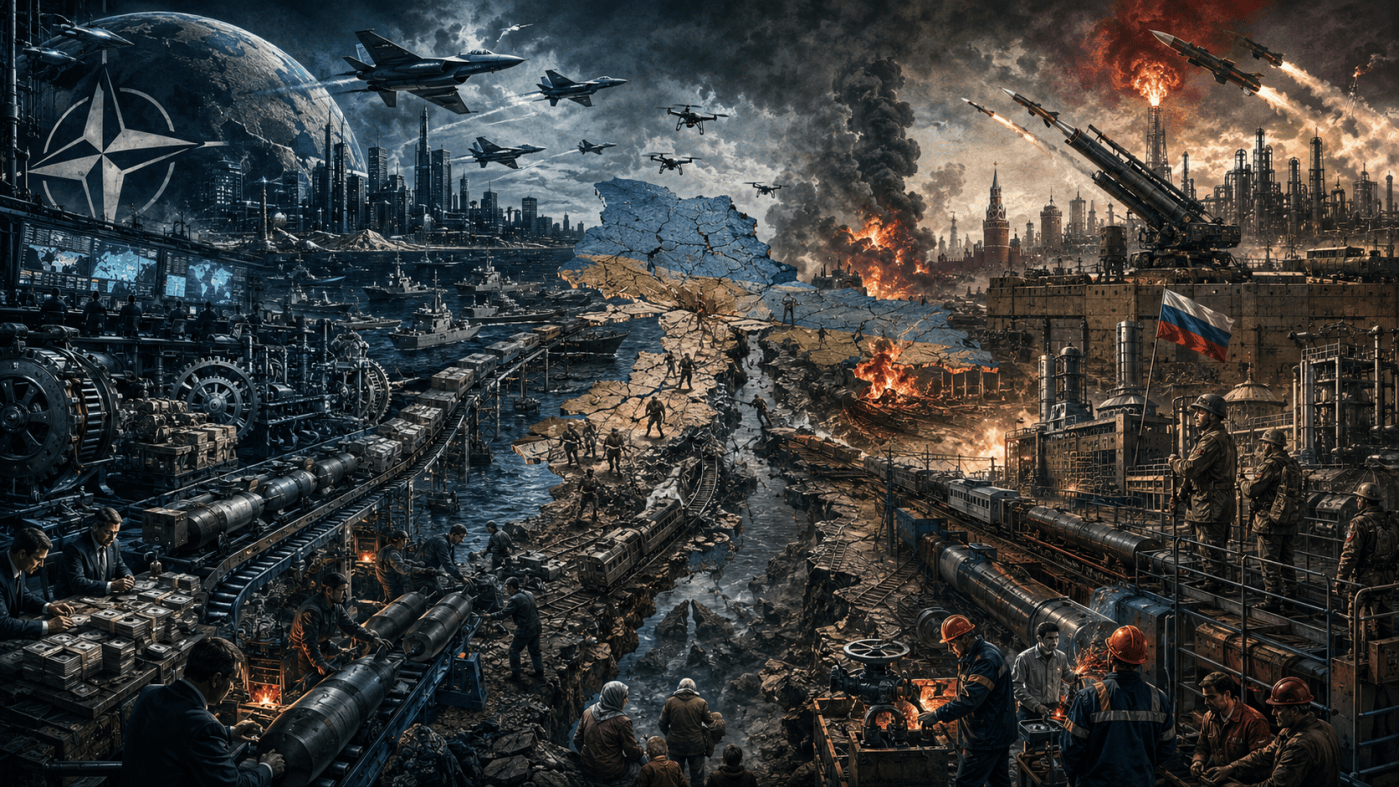
The Economist turns thirty-five years of post-Soviet history into a personality disorder, casting Vladimir Putin as the gangster whose fear of defeat supposedly explains an escalating war. Restore the missing chronology and another picture emerges: capitalist restoration shattered Russia, Washington openly pursued primacy, NATO moved east, Ukraine became the decisive fault line, diplomacy failed, and the war expanded into a direct struggle over Russia’s capacity to act independently. Beneath the clash of states lies a harder material contradiction, as Atlantic militarization converts public money into arms accumulation while Russian capitalism tightens state command over strategic property in the name of sovereign survival. For workers in the imperial core, the task is neither to romanticize Moscow nor police Russia for Washington, but to break our own ruling bloc’s machinery of escalation, defend sovereignty against imperial subordination, and fight for the socialist possibilities that multipolarity alone cannot deliver.
Prince Kapone | Weaponized Information | September 2, 2026
The Cornered Man and the Missing Thirty-Five Years
On August 30, 2026, The Economist published an unsigned article announcing that a “cornered” Vladimir Putin had decided to escalate the war in Ukraine. The headline delivers the verdict before the evidence arrives; the subhead supplies the motive: “His refusal to back down is rooted in Russia’s gangster politics.” Military pressure, casualties, Ukrainian deep strikes, European security incidents, elite anxiety, and public fatigue all enter afterward, arranged around one governing idea: Russia has reached a dead end because Putin has.
The article opens with an animal fable. Putin tells university students about killer whales and polar bears while talking about the food chain and the world in which Russia is fighting. The Economist immediately promotes the aside into evidence of a “predatory worldview.” Zoology becomes psychology; psychology becomes statecraft. A strange metaphor about predators prepares the reader for a Russia supposedly governed by predators.
The sourcing grows murkiest exactly where the explanation grows grandest. “Sources close to the Kremlin,” a “longtime associate,” an “insider,” unnamed Russian sources, and Western intelligence officials tell us what Putin supposedly believes. He sees weakness. He fears retreat. His system punishes failure. One anonymous source even attributes to him the line, “They will hang me.” The article briefly admits that “no one can know what is inside Mr Putin’s head,” then proceeds to furnish the apartment.
That mind-reading establishes causality. The decisive sentence arrives almost casually: Putin’s reasons for escalating, “like the decision to invade in the first place, are internal.” Once that premise is accepted, the world outside Russia becomes scenery. Ukrainian attacks hurt Russia; European governments tighten security; NATO states prepare. But the cause has already been placed inside the gangster’s skull.
The chronology finishes the job. Finland requests more surveillance. Germany prepares an accusation. Romania encounters a maritime drone. Slovakia disrupts an arson plot. Each event is folded into the atmosphere of an approaching Russian escalation. Western states prepare; Moscow escalates. Ukraine applies pressure; Russia lashes out. Only Moscow possesses verbs with teeth.
The ideological payoff is enormous. Thirty-five years of political and military history disappear, and the vacuum is filled with personality. Russian economic strain, battlefield losses, and public fatigue become evidence of an internally generated regime crisis. The possibility that those pressures were produced inside a wider confrontation barely enters the frame. Once history has been amputated, militarization outside Russia looks prudent, even natural.
The Economist doesn’t need to fabricate every fact. It only needs to decide where causation begins. If thirty-five years must disappear before the gangster theory makes sense, then those thirty-five years are precisely what have to be restored.
From the Wreckage of 1991 to the Deep-Strike War
The missing history begins before Putin governed anything. The Soviet collapse was followed by a rapid restoration of capitalist property: prices were liberalized, state enterprises privatized, and enormous public assets transferred into private hands while production and living standards crashed. IMF data recorded roughly a 35 percent GDP collapse between 1991 and 1994 alongside falling real incomes, rising poverty, and worsening mortality. Western governments and international financial institutions actively backed the transition; the U.S. Treasury later described Washington as taking a leading role in supporting Russian market reform.
The strategic order built around that weakened Russia was equally deliberate. A 1992 Pentagon planning draft made preventing the re-emergence of a peer competitor a central U.S. objective and identified the former Soviet space among the regions whose consolidated resources could generate global power. That concern survived changing administrations. The 2017 National Security Strategy identified Russia and China as challengers to American power and influence; the 2018 defense strategy made long-term strategic competition with both states the Pentagon’s central priority.
Zbigniew Brzezinski supplied the geopolitical logic in unusually plain language. Writing about how the United States should preserve its position in Eurasia, he treated sovereign Ukraine as a “critically important component” of that strategy and argued that an ethnically fragmented Russia would have less capacity for renewed “imperial mobilization.” Brzezinski wasn’t issuing presidential orders, but his argument belonged to an establishment debate in which limiting the reconstitution of Russian power was openly discussed rather than secretly imagined.
The Warsaw Pact disappeared; NATO expanded. Poland, Hungary, and the Czech Republic entered in 1999, followed by seven more Eastern European states in 2004. Whatever legal weight one assigns to assurances made during German reunification, the post-Cold War settlement enlarged the existing U.S.-led alliance instead of replacing the old blocs with a common security structure. NATO crossed another threshold in 2008 when its Bucharest declaration stated that Ukraine and Georgia “will become members of NATO.”
Russia itself was changing. The capitalism created in the 1990s remained intact, but the federal state rebuilt capacity and imposed firmer political limits on the autonomy oligarchs had enjoyed during the Yeltsin years. Strategic firms and state corporations assumed greater weight; private wealth remained enormous, while sovereignty and centralized state authority became increasingly important to the way the system operated. Putin inherited the capitalist restoration. He didn’t restore socialism. He presided over a stronger capitalist state than the one that emerged from the Soviet wreckage.
Ukraine became the sharpest point of the confrontation in 2014. Viktor Yanukovych lost effective power without completion of the constitution’s formal impeachment process; parliament instead declared that he had withdrawn from his duties in a “non-constitutional manner.” Washington had spent years funding Ukrainian political and civic institutions—Victoria Nuland publicly put cumulative U.S. support since 1991 at more than $5 billion—and the leaked Nuland-Pyatt call exposed senior U.S. officials discussing preferred opposition figures and prospective governing arrangements. That record establishes active political intervention without reducing the whole Maidan movement to an American puppet operation.
The rupture also exposed divisions inside Ukraine that long predated 2014. Maidan brought together a broad opposition movement in which far-right nationalist formations also played a material role; early UN reporting documented both the wider protest movement and the presence of radical nationalist forces. In Crimea and the Donbas, the new authorities collided with regional identities, language politics, and competing national orientations already rooted in Ukrainian society. Armed resistance in the east therefore had indigenous political roots, while Russian material support increasingly internationalized and sustained the war. Neither half of that history cancels the other.
Minsk was supposed to contain the conflict. The 2015 settlement framework tied ceasefire and heavy-weapons withdrawal to elections, special status, constitutional measures, and reintegration. It was never fully implemented. Years later Angela Merkel acknowledged that the agreement had also given Ukraine time to become stronger. That doesn’t prove the negotiations were fraudulent from their first day. It establishes that Minsk functioned both as a failed peace mechanism and as a pause during which the military balance changed.
The strategic logic of imposing costs on Russia was also being studied openly. A U.S.-Army-sponsored RAND project, Extending Russia, examined economic, military, and political measures that could stress Moscow and induce costly overextension. Greater support for Ukraine appeared among the options, alongside an explicit warning that such pressure could provoke dangerous Russian counter-escalation. RAND didn’t dictate U.S. policy, but the study shows that using Ukraine to raise Russia’s strategic costs was already a legitimate policy question inside the American security establishment.
By December 2021 Moscow was trying to renegotiate the security architecture directly. Its draft security agreements demanded an end to further NATO enlargement, explicitly including Ukraine, along with restrictions on missiles and military deployments. Washington and NATO offered talks on arms control, exercises, transparency, and risk reduction, but rejected Russia’s central demand that the alliance close its door to Ukrainian membership. U.S. officials publicly described that demand as a non-starter. The negotiations failed over competing visions of the European security order, not because diplomacy was never attempted.
On February 24, 2022, Russia transformed the existing conflict into full-scale interstate war. Moscow invoked the Donbas, collective self-defense, and the NATO security confrontation in its formal UN justification. Those legal arguments remain contested, and Russian forces initiated the full-scale attack. But “unprovoked” is not a neutral chronology. It is a causal judgment that erases the security confrontation, the Donbas war, and the failed negotiations that preceded the invasion.
The first months of fighting still contained a diplomatic off-ramp. At Istanbul, Kyiv proposed permanent neutrality backed by international security guarantees, and negotiators continued exchanging drafts afterward. There was no completed peace treaty waiting only for a signature: territory, military arrangements, guarantees, battlefield calculations, Bucha, and profound distrust remained unresolved. Ukrainian reconstructions nevertheless confirm that the negotiations were serious, while later participant accounts show that Western opposition to accommodation was one factor narrowing the space for settlement rather than the single cause of its collapse.
The war that survived those talks has increasingly become an explicit contest over Russia’s capacity to act. In April 2022 U.S. Defense Secretary Lloyd Austin said Washington wanted to see Russia “weakened” so it couldn’t repeat operations like the invasion. By summer 2026, twelve European NATO states have committed $50.66 billion over ten years to Deep Precision Strike integrated into alliance planning, while Britain has enabled Ukrainian assembly of the SCALP missile.
European rearmament is also becoming industrial policy. Britain has tied its 2026 defense buildup to jobs, domestic production, exports, and a £50 billion export facility, while the E5 governments have called for financial mechanisms to “unlock capital and investment” for military capability. The build-up is no longer a matter of moving existing weapons from one warehouse to another. European states are committing money and productive capacity to a longer war horizon.
Ukraine is now carrying that war deeper into Russia. By late August, refinery strikes have reduced Russian gasoline output to roughly 70 percent of domestic demand. Moscow is answering with retaliation, recruitment, and tighter control over strategic infrastructure. Three days before The Economist declared that Putin had chosen a new escalation, Dmitry Peskov publicly said Russia saw no need for one while promising a powerful response to attacks on economic targets. A public denial can’t disprove secret planning. It does make the magazine’s anonymous certainty a contested claim.
Several surrounding accusations remain less settled than the article suggested. Romania has confirmed an explosive maritime drone near an offshore platform but has not identified it as Russian or said the platform was deliberately targeted. Slovak police have confirmed a serious arson plot against a drone facility but have reported no evidence Russia ordered it. On the day the article appeared, a NATO official likewise said the alliance saw no imminent direct attack.
Russia itself is under real strain. Levada found 62 percent favoring negotiations while 66 percent still supported the armed forces. On August 24 Putin signed Decree No. 604, allowing temporary state management of inadequately protected critical private infrastructure. The war is reaching inward: into public opinion, fuel supply, recruitment, property management, and the relation between private ownership and state command.
That is the terrain hidden by the image of a frightened gangster trapped at the end of the road. As of August 2026, the war has become the latest stage of a conflict already embedded in post-Soviet capitalism, American primacy strategy, the enlargement of NATO, the struggle over Ukraine, failed settlements, and increasingly permanent military preparation. Whatever Putin plans next will enter a confrontation that was already moving long before The Economist declared that escalation had begun inside his head.
The Restoration Produced the Resistance
The Russia now confronting the Atlantic bloc was born inside the very post-Soviet order it later learned to resist. Capitalist restoration shattered Soviet property relations, concentrated wealth in private hands, and left the Russian state economically weakened and strategically exposed. At the same historical moment, Washington treated its new predominance as something to preserve. U.S. planners openly discussed preventing the emergence of rival centers of power, while NATO expanded through the space opened by Soviet collapse. These weren’t two unrelated stories. They developed against each other.
Putin inherited that contradiction. He didn’t reverse capitalist restoration; he reorganized it. Private property, profit, wage labor, oligarchic wealth, and class inequality have survived, while the state has recovered administrative authority, strategic capacity, and greater power over capital. The Russia that has emerged is neither the shattered capitalism of the Yeltsin years nor a restored socialist state. It is sovereign-statist capitalism: private accumulation operating inside a stronger state increasingly determined to defend its ability to act independently.
That reconstruction has collided with an Atlantic order whose strategists repeatedly treated the preservation of U.S. primacy and the containment of rival power as legitimate policy goals. NATO enlargement has given that strategy institutional form across Europe. Ukraine has become especially explosive because its alignment alters the military geography on Russia’s western frontier and therefore the balance of the whole post-Soviet space. The struggle has never been just about which flag flies over another diplomatic conference. It concerns who will command the security architecture surrounding Russia and how much strategic independence Moscow will retain inside it.
Ukraine entered that confrontation through its own contradictions. The country contained competing political movements, regional identities, linguistic divisions, national projects, and different orientations toward Russia and the West. In 2014 those conflicts ruptured the state, drew outside powers deeper into the struggle, and turned the Donbas into the armed meeting point of domestic fracture and international rivalry. Ukraine has had agency throughout this process. But agency doesn’t require pretending that a state being armed, financed, politically cultivated, and progressively integrated into a larger military bloc stands outside the power structure doing the integrating.
Minsk showed the contradiction in diplomatic form. A settlement could halt firing for a time, but it couldn’t reconcile the security orders struggling underneath it. Ukraine used the pause to strengthen. Russia watched NATO integration continue. By 2021 Moscow tried to force the underlying issue onto the negotiating table: the military architecture itself. Washington and NATO were prepared to bargain around missiles, exercises, and transparency while preserving the alliance’s open door. Diplomacy reached the boundary neither side was willing to cross.
Russia answered that failure with military force in February 2022. The operation was tactically offensive: Russian forces crossed Ukraine’s borders and widened the conflict into full interstate war. Its strategic position has developed through a longer defensive struggle against an Atlantic military system moving steadily closer to Russia’s perimeter. Those two determinations belong together. Treating the tactical offensive as proof that the preceding strategic contradiction never existed is propaganda. Treating the strategic contradiction as a blank check for every Russian battlefield decision would be equally useless.
Since the war expanded, it has been producing institutions and interests beyond the intentions of the people who started each individual move. Washington openly embraced weakening Russia as an objective. European states are converting long-term military preparation into industrial policy, linking public money, arms production, investment, employment, and export capacity. Ukraine’s growing deep-strike capability is carrying the war further into Russian economic infrastructure. Russia is answering by tightening state control over strategic assets and adapting private property to wartime requirements.
Here the geopolitical struggle becomes a class relation. On the Atlantic side, governments pour public money into weapons contracts; contracts sustain factories, investment, skilled employment, and firms whose future profits depend upon continued procurement. Militarization becomes accumulation. The arms industry doesn’t need to secretly dictate every foreign-policy decision for this relation to matter. Once governments organize capital and labor around permanent military preparation, powerful material interests emerge around keeping that preparation alive.
Russia is moving through a different capitalist transformation. Strategic private property remains private, but sovereign survival increasingly conditions how that property may be controlled. When refineries, logistics networks, and critical infrastructure become targets, the state claims greater authority over managers whose assets have become part of the military terrain. Capital keeps ownership while losing some freedom of command. The war therefore deepens Russian statism without abolishing Russian capitalism.
Workers carry the contradiction on their backs. Russian workers have a concrete interest in preventing their country from being broken, subordinated, or returned to the strategic helplessness produced in the 1990s. Their class interests reach beyond the needs of the Russian ruling bloc: wages, social reproduction, political freedom, and freedom from endless military sacrifice remain their own terrain of struggle. Sovereignty protects the space in which that struggle can continue; capitalist sovereignty doesn’t settle the struggle in labor’s favor.
The same contradiction cuts through Europe. Workers supply the taxes, labor, engineering skill, and social consent required to turn militarization into durable productive capacity. Arms production can preserve employment while binding whole communities to military demand. What appears as national “security” therefore carries a second material content: public finance reorganizing production around weapons, with capital accumulating through the confrontation it helps equip.
Russia’s wider significance follows from this relation. The country remains capitalist, but its capacity to resist Atlantic command obstructs the consolidation of a single U.S.-led security order across Eurasia. That creates more room for states to maneuver outside Western strategic discipline and strengthens the broader movement toward a multipolar world. The opening is historically progressive because it weakens monopoly command, not because capitalism suddenly becomes emancipatory when conducted from Moscow. Multipolarity opens the field. It doesn’t decide who will rule inside it.
This is also why the escalation of 2026 reproduces itself so easily. NATO expands military capability in response to Russia. Russia hardens its posture in response to NATO. Ukraine strikes deeper to raise the cost of Russian war-making; Moscow retaliates and tightens domestic command; European governments point to the retaliation as proof that more military capacity is necessary. Each new response becomes evidence for the threat that justified the previous one.
The cycle is reciprocal now, but its history isn’t symmetrical. The U.S.-led primacy project and NATO enlargement preceded Russia’s recovery as a serious challenger to that order. Washington’s strategists were writing about preventing rival Eurasian power long before Western journalism discovered Putin’s personality as a universal explanation. Russian resistance has developed inside a structure already built around American predominance.
That’s the trick in The Economist‘s gangster story. Putin really is powerful. Russia really is under pressure. War fatigue, economic strain, military loss, and elite fear can shape decisions. But the magazine takes those late products of a decades-long historical process and promotes them into the original cause of the process itself.
It points to one gear and tells us the gear built the factory. The harder truth is that the factory keeps producing pressure no matter which personality stands beside the machinery. Until the underlying relation changes, replacing the manager won’t stop the line.
Defend Sovereignty, Break the War Machine
If this war reproduces itself through budgets, weapons contracts, military alliances, factories, and political consent, workers in the imperial core already know where much of their leverage lies. The first responsibility of an American or European antiwar movement is to confront the governments, militaries, corporations, and parties operating in our own names and with our own money.
In the United States, Veterans For Peace and activists in the Peace in Ukraine Coalition have used congressional visits, constituent calls, demonstrations, letters, and media pressure to demand diplomacy instead of another turn of the escalation screw. Congress controls appropriations, oversight, and major elements of the political authorization sustaining U.S. military support. Those are pressure points, not abstractions.
In Britain, the Stop the War Coalition has put the class contradiction directly into its “Cut War Not Welfare” campaign. Local organizing, demonstrations, public meetings, youth work, and trade-union pressure can force military spending back into the same political argument as wages, housing, hospitals, and public services. The question isn’t whether workers deserve security. It is whose security gets funded, and what working people are expected to surrender to pay for it.
The confrontation also sits beneath nuclear arsenals. The Campaign for Nuclear Disarmament has opposed NATO expansion and argued for a different European security settlement alongside its long fight against nuclear weapons and bases. That work matters because every deeper strike, retaliation, and military deployment takes place inside a confrontation between nuclear-armed powers.
Then comes the oldest blackmail in the military-industrial book: accept permanent weapons production or watch industrial jobs disappear. The Campaign Against Arms Trade answers that trap by arguing for shifting public support, industrial capacity, and skilled labor from arms production toward socially useful sectors such as renewable energy. WI should push that principle further through worker-protecting conversion: no community should be sacrificed because an arms contract ends, and no worker should have to choose between a paycheck and permanent war.
For anti-imperialists in the West, internationalism begins with weakening our own ruling bloc’s machinery of escalation. That means fighting deeper NATO militarization while defending Russia against imperial defeat without surrendering working-class independence to Russian capital. Multipolarity opens political space; organized workers still have to decide what fills it.
Cut the money and consent that keep the escalation cycle moving. Fight for a negotiated European security order based on sovereignty rather than endless bloc expansion. Break the dependence of jobs and industry on war production before the confrontation turns today’s deep-strike frontier into tomorrow’s direct NATO-Russia war.
Oppose empire. Defend sovereignty. Advance socialism.


Leave a Reply