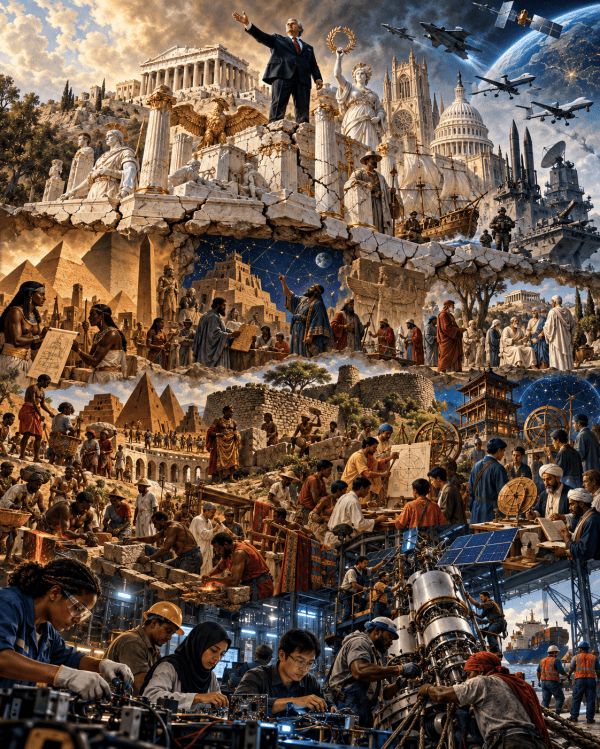
Marco Rubio's celebration of Western civilization conceals a history written through African and Asian scientific achievement, colonial conquest, capitalist exploitation, and revolutionary resistance. From ancient Greece to modern NATO, his manufactured civilizational inheritance transforms imperial domination into historical destiny while erasing the peoples whose labor built the world. Drawing on anti-colonial and Marxist scholarship, this investigation exposes how the political West was constructed through imperial rivalry, socialist revolutions, and struggles for national liberation. Beneath Rubio's mythology lies an American-led imperial bloc seeking renewed command over technology, finance, resources, and military power—and a continuing struggle to reclaim humanity's future.
Humanity Built Civilization: Empire Claims the Title Deed