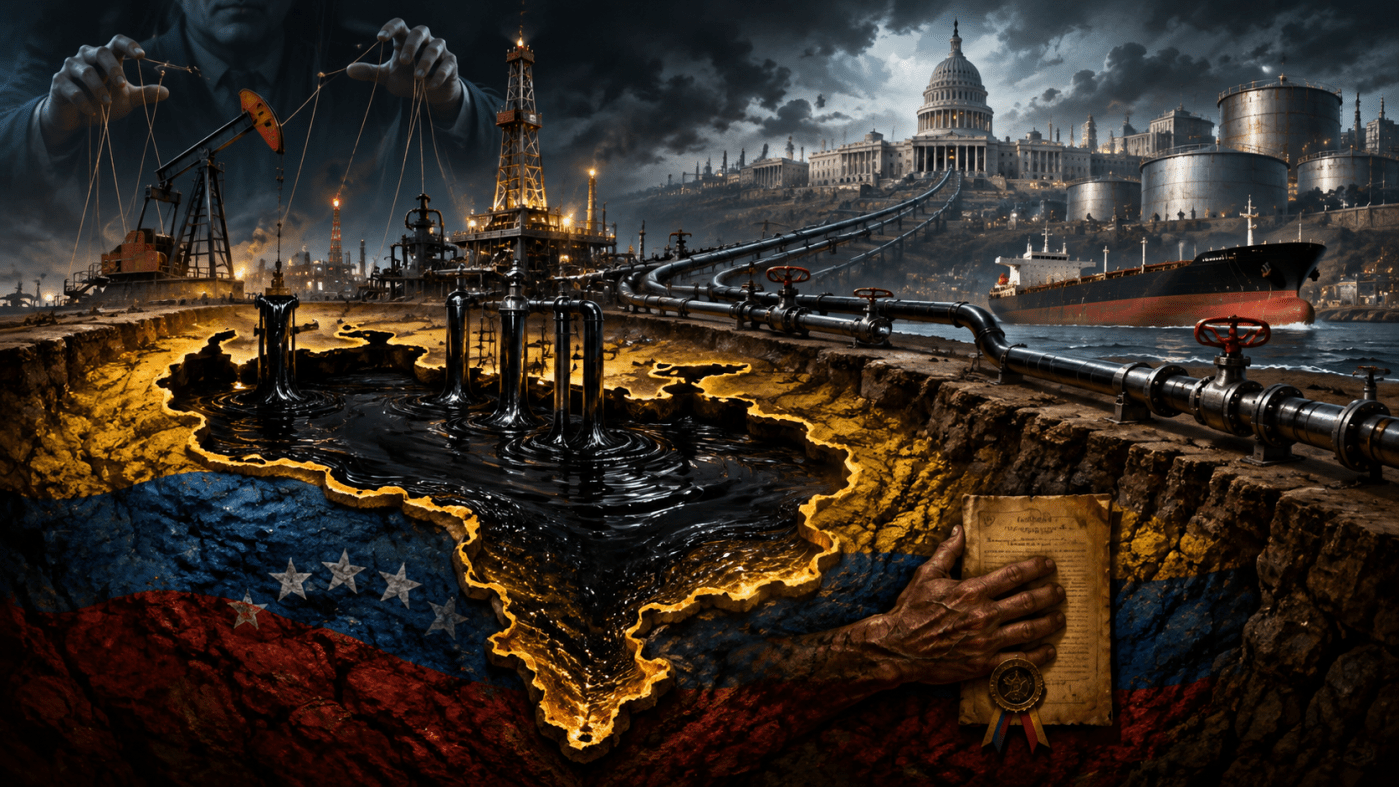
The Guardian sees Delcy Rodríguez’s spectacular U-turn, but the betrayal drama begins too late to explain the petroleum order she inherited. Venezuela’s opening to private operators began under Maduro, as internal decay and U.S. sanctions pushed an oil-dependent state toward emergency forms of capitalist reconstruction before Washington ever captured its president. What followed is more dangerous than a simple foreign purchase: Venezuela keeps legal ownership while powers over production, commercialization, finance, pricing and strategic destination are increasingly pulled apart and exercised through private capital and U.S. command. The fight now moves from speeches about sovereignty to the contracts, wells, workplaces and communities where Venezuelans are demanding to know who controls the oil, who captures the rent and who gets to decide what reconstruction is for.
Prince Kapone | Weaponized Information | August 30, 2026
I. The U-Turn That Explains Too Little
In an August 30 report for The Guardian, Tom Phillips builds the story around a contradiction so sharp it practically writes the headline for him. Delcy Rodríguez, once one of Chavismo’s loudest defenders of national control over Venezuela’s petroleum, is now praising what she calls the “endless” benefits of an oil agreement negotiated with Donald Trump’s government. She insists Venezuela retains “ownership and sovereignty” over its resources. Trump, meanwhile, boasts that Washington has secured majority control over petroleum associated with roughly 65 billion barrels and says Venezuelan crude will help refill the U.S. Strategic Petroleum Reserve. The oil, apparently, remains Venezuelan right up until the moment the American president starts describing what he plans to do with it.
The contradiction is real, and The Guardian deserves credit for refusing to sand off its ugliest edges. Phillips calls Nicolás Maduro’s January seizure an “abduction”, recalls Trump’s threats against Rodríguez, quotes critics describing the agreement as neocolonial, and reports demonstrations by Chavistas and social movements furious at the deal. This isn’t one of those imperial bedtime stories where American commandos fall from the sky as neutral technicians and everybody wakes up enjoying “market access.” Force remains visible.
But the article’s explanatory clock starts dangerously late. Its most powerful chronology is personal: Rodríguez once denounced Venezuelan politicians who, she said, wanted to hand the country’s oil to Washington; Maduro is removed; Rodríguez succeeds him; Rodríguez now thanks Trump and Marco Rubio while defending an enormous U.S.-Venezuela petroleum pact. The reader is pushed toward an obvious conclusion: look at the anti-imperialist who became what she condemned. That reversal matters. What it doesn’t explain is the political-economic process that made the reversal possible.
The narrowing works through source hierarchy as much as chronology. Trump and Rodríguez dominate because they announce and defend the arrangement. Opposition figures, former officials and street protesters supply judgment from the flanks. Yet the material meaning of the word control remains largely offstage. The article tells us Venezuela claims ownership while Washington claims control, but it doesn’t establish what powers that control actually contains or how they are exercised. A loaded political word arrives before the underlying petroleum relation has been reconstructed.
The same compression shapes Rodríguez’s argument for foreign investment. Her case is straightforward: barrels underground don’t repair hospitals, raise wages or rebuild infrastructure by magic; extracting them requires money, machinery and technology. The Guardian records that argument, but because the story is organized around her ideological reversal, economic necessity appears mainly as the justification offered by a politician who changed sides. The harder terrain—the pressures that narrowed Venezuela’s choices, the institutions already altered before this deal, and the concrete limits of the sovereignty Rodríguez says remains intact—stays mostly outside the frame.
The Guardian doesn’t hide the coercion. It personalizes the transformation. A historical struggle over petroleum command becomes, above all, the astonishing U-turn of Delcy Rodríguez. The hypocrisy is easy to see because it has a face. The structure underneath it doesn’t. And until that structure is reconstructed, the most important question remains unanswered: not simply why Rodríguez changed her position, but what changed in the material conditions of Venezuelan sovereignty that made her new position possible.
II. The Opening Began Before the Capture
The history The Guardian compresses into Delcy Rodríguez’s political reversal began decades before she entered the presidential palace. Venezuela helped found OPEC in 1960, with oil minister Juan Pablo Pérez Alfonzo among its architects, as producer states fought for greater control over the rent generated from resources beneath their own territory. In 1975, Carlos Andrés Pérez signed the petroleum nationalization law, and state control took effect the following year. Chávez inherited a country where oil sovereignty was already bound to national power.
What Chavismo changed was the political use of that power. State command over petroleum helped finance redistribution and gave Caracas more room to build relations outside Washington’s preferred orbit. But oil remained both the engine and the trap. Venezuela never escaped dependence on petroleum exports, while the industry accumulated underinvestment, managerial failures, corruption, technical losses and deteriorating infrastructure. The U.S. Energy Information Administration’s own Venezuela analysis treats the collapse as multi-causal, identifying domestic deterioration alongside sanctions and investment constraints.
Washington then tightened pressure around an already weakened system. Firm-level research from the Orinoco Basin found large additional output losses among companies that had relied on international credit, estimating that sanctions explained roughly half of the post-sanctions decline in those exposed firms. The study doesn’t claim sanctions caused every barrel of lost production. It establishes that they were a material cause rather than atmospheric background. Venezuela’s petroleum crisis can’t be blamed entirely on Washington, and Washington can’t be written out of it.
Caracas had already begun adapting before Rodríguez took power. In 2020, Maduro’s government enacted the Anti-Blockade Law, giving the executive extraordinary authority to alter economic rules, bring private capital into strategic activity and offer investors stronger protections when sanctions made existing arrangements harder to sustain. By 2024, Venezuelan investigative outlet Armando.info documented PDVSA contracts with private vehicles tied to Harry Sargeant III and Venezuelan businessman Alejandro Betancourt. Under one documented NABEP arrangement, the private participant could receive a large share of production value and market its portion directly.
The opening moved further into ordinary law in January 2026. Venezuela’s revised Hydrocarbons Law preserved existing CPPs while widening routes for private Venezuelan-domiciled companies to operate fields, receive production-based compensation, market crude under authorized structures and exercise technical management. The Republic still retained legal ownership of the deposits. The law also expanded executive discretion over fiscal terms, the same terrain on which Rodríguez now says eight Orinoco greenfields will carry a 16% minimum royalty and 34% income tax.
Then January changed the balance around an opening that already existed. U.S. forces captured Nicolás Maduro, but Washington didn’t abolish PDVSA or dissolve the surviving Venezuelan state. The machinery remained because the oil industry can’t be operated by a Truth Social post. Wells need engineers, terminals need crews, contracts need legal authority, ports need administration and somebody has to keep the electricity running.
At the same time, Washington had already built direct control into petroleum circulation. The U.S. government began marketing Venezuelan crude with proceeds settling first in U.S.-controlled accounts, while OFAC continued deciding which otherwise prohibited transactions could proceed. On August 27, Treasury explicitly tied Venezuelan reinvestment to U.S. hemispheric security even as it loosened selected restrictions.
The August agreement therefore arrives after two histories have already converged. Rodríguez says it lasts 25 years and will rebuild production while preserving Venezuelan ownership. U.S.-side reporting, still unsupported by a published contract, describes a reported government interest combined with at-cost oil rights, while Trump says Venezuelan crude will help refill the Strategic Petroleum Reserve. Rodríguez didn’t invent the private opening. She inherited it after Washington had dramatically increased its power over the conditions under which that opening would develop.
III. The Oil Stays Venezuelan. The Command Doesn’t Stay in One Place.
The Guardian’s U-turn story works because something real has turned. Venezuela spent decades concentrating petroleum ownership, operating authority and rent inside national institutions; today private operators occupy a larger place inside the machinery that extracts and sells that petroleum. Rodríguez really is defending arrangements an earlier Chavista government would’ve described very differently. But restored history changes the meaning of that reversal. The problem is no longer simply that a politician changed sides. It is that the powers once bundled together inside Venezuelan petroleum sovereignty are being pulled apart.
Nationalization gave Venezuela command over the resource beneath its territory. Chavismo pushed that command further politically, using petroleum rent to expand redistribution and widen the country’s room to act outside Washington’s preferred order. Yet the state never escaped the deeper dependence underneath that achievement. It still needed oil to flow, foreign exchange to enter, machinery to function and revenue to reproduce everything from public services to the wider social order. Petroleum sovereignty created power because Venezuela controlled the rent. Petroleum dependence created vulnerability because so much of the state depended on keeping that rent moving.
Internal decay weakened the industry; U.S. sanctions drove pressure into those weaknesses. That asymmetry matters. Corruption, bad investment and failing infrastructure created vulnerabilities. Washington exploited them through restrictions on credit, transactions and petroleum activity, then altered the political balance by removing Maduro. The private opening that followed wasn’t invented from nothing: Maduro’s own government had already turned toward private operators as a survival strategy under sanctions. January changed who had the stronger hand over where that opening could lead.
That brings the central contradiction into focus. Venezuela still owns the deposits. But ownership is only one working part of petroleum sovereignty. Private firms can operate fields and receive shares of production. Commercial rights can move outside direct PDVSA control. Washington still decides which otherwise prohibited transactions receive permission. Venezuelan petroleum money can move through U.S.-controlled channels. Reported U.S. rights to acquire part of the output at cost would push the separation further, giving Washington a privileged claim on the barrel without transferring the subsoil beneath it.
This is disaggregated sovereignty: the deed stays in Caracas while operation, sale, finance, pricing and strategic destination no longer have to stay there together. Imperial command in the twenty-first century doesn’t need a colonial governor standing beside every pumpjack. It can work through contracts, licenses, bank accounts and purchasing rights. Washington doesn’t need to own the geology if it gains enough power over the process that turns geology into commodity, revenue and strategic supply.
The fiscal terms show why the struggle can’t stop at the title deed. Rodríguez points to a 16% minimum royalty on eight Orinoco greenfields and a 34% income tax as proof that Venezuela still captures substantial value. Those terms are materially better than some of the giveaway arrangements of the old Apertura, but the January reform also widened executive discretion over the fiscal bargain. The question is therefore not whether Venezuela receives money. It plainly expects to. The question is how the rebuilt surplus is divided between the state, private operators and the foreign power now claiming privileged access to production.
The reported “at-cost” provision sharpens that problem. Cost isn’t a neutral word carved into stone. Somebody has to decide which expenses count, how they’re calculated and what value is assigned to the oil moving through the contract. If pricing rules determine where petroleum value appears, then the accounting sheet becomes part of the sovereignty struggle. That doesn’t prove Venezuela is being cheated; the unpublished terms won’t support that claim yet. It does show that command over a resource can reach all the way into the arithmetic that divides its rent.
The same process explains why reconstruction itself can become a vehicle of domination. Washington first helped constrict Venezuela’s access to credit, markets and petroleum activity. Now the same imperial state can loosen permissions, encourage selected investment and position Venezuelan crude for the U.S. Strategic Petroleum Reserve. A ruined oil industry can’t fill American storage caverns. The emerging movement is therefore more complex than blockade alone: sanction, weaken, license, reopen, finance, reconstruct, redirect. That is coercive reconstruction—productive capacity restored after coercion has changed the terms under which restoration takes place.
And that is where the American Pole stops being a slogan and becomes a material relation. Washington’s own sanctions machinery ties Venezuelan reinvestment to U.S. hemispheric security, while Trump openly folds Venezuelan crude into American strategic reserves. The issue is bigger than one company chasing profit or one state seeking vague “influence.” It is an effort to organize energy, finance and market access across the hemisphere around a more secure U.S.-centered rear, while Venezuelan institutions remain necessary to run the wells, collect the taxes and keep the system functioning.
That arrangement is powerful, but it isn’t complete. Venezuela retains legal ownership. PDVSA remains indispensable. Workers still run the physical system. Infrastructure still has to work. Private capital still needs a functioning Venezuelan state, and every external claim still has to be reproduced through a society capable of bargaining, resisting and changing course. The struggle, then, is not between sovereignty and its total disappearance. It is over how much sovereign command remains attached to Venezuelan ownership as the oil moves from the wellhead to the bank account—and how much of that command is being exercised somewhere else.
IV. If the Oil Is Venezuelan, the People Have to See the Contract
The first fight is over secrecy. Rodríguez says the petroleum remains Venezuelan and will finance national recovery. Trump says Washington has secured extraordinary control over future output. Yet the contracts defining who operates the fields, how production is divided, what the reported “at-cost” provision actually means and where the rent goes still aren’t public. The Movimiento Revolucionario Tupamaro, part of the Bolivarian political camp itself, has demanded transparency over the legal structure and over who controls production, commercialization, technology and petroleum rent. That demand hits the agreement where secrecy becomes material power. Publishing the contracts would give workers, popular organizations and Venezuelan society something concrete to inspect and contest before private and foreign rights harden into accomplished fact.
The same problem exists at the level of political authority. Decisions over strategic petroleum reserves are being negotiated from the top while organized Chavista currents below are asking what role the people themselves have in deciding the terms. The Frente Popular Antiimperialista has taken that contradiction into the streets, opposing U.S. tutelage while continuing to identify Washington as the principal coercive force. Protesters have also demanded popular consultation over agreements of this magnitude. That isn’t procedural decoration. It is a struggle over whether decisions governing generations of petroleum wealth belong only to executives and corporate negotiators or must answer to an organized public.
The workers who actually keep the wells, terminals and refineries running already have their own demands. Independent currents in the FUTPV labor struggle have centered wages, pensions, collective bargaining and union independence while criticizing abuses by PDVSA, contractors and foreign operators alike. Those demands become more important, not less, if private management expands and billions in investment begin moving through the industry. Higher production can strengthen the Venezuelan state and private capital while workers remain politically weak. Organized labor’s leverage lies in making petroleum recovery answer to the people whose labor reproduces it instead of treating wages and pensions as costs to be contained after everybody else has divided the barrel.
The field map is another point of power. Nobody can judge the territorial consequences of seventeen oil projects without knowing where the fields are. PROVEA has demanded disclosure of the locations precisely because Indigenous territories, protected areas and surrounding communities may carry consultation and environmental rights that can’t be exercised against a secret map. Publishing the fields and their territorial footprint would let affected communities determine whether their land and rights are implicated before extraction begins moving faster than public scrutiny.
The government’s own supporters have also created a standard they will eventually have to answer to. The PSUV leadership backs the agreement as a route toward rebuilt services, employment and workers’ incomes, and calls for “patriotic vigilance” over its benefits. That promise matters, but its concrete mechanism remains unclear. If petroleum reconstruction is defended in the name of the people, the political test will be whether the promised social gains become visible in material life rather than disappearing into higher production figures, contractor profits and government assurances.
The organized communard response remains an open question. So far, no attributable statement from Unión Comunera or El Maizal on this specific agreement has entered the verified record. Their absence shouldn’t be filled in from outside. But the communal project itself poses a hard question that the petroleum bargain cannot avoid: does restored oil rent simply rebuild the fiscal state and private accumulation, or does it expand organized popular power over production and social wealth?
The immediate orientation is therefore concrete: make the contracts public, identify the fields, open decisions of this scale to popular scrutiny, defend petroleum workers’ wages and bargaining power, and expose who commands production, commercialization, technology and rent. Venezuelans shouldn’t have to choose between an industry strangled by Washington and one rebuilt through agreements they aren’t allowed to inspect. If the oil is truly Venezuelan, sovereignty has to exist somewhere more material than a speech. It has to be visible in who can see the terms, contest them, work the industry and decide what happens when the well starts pumping.


Leave a Reply