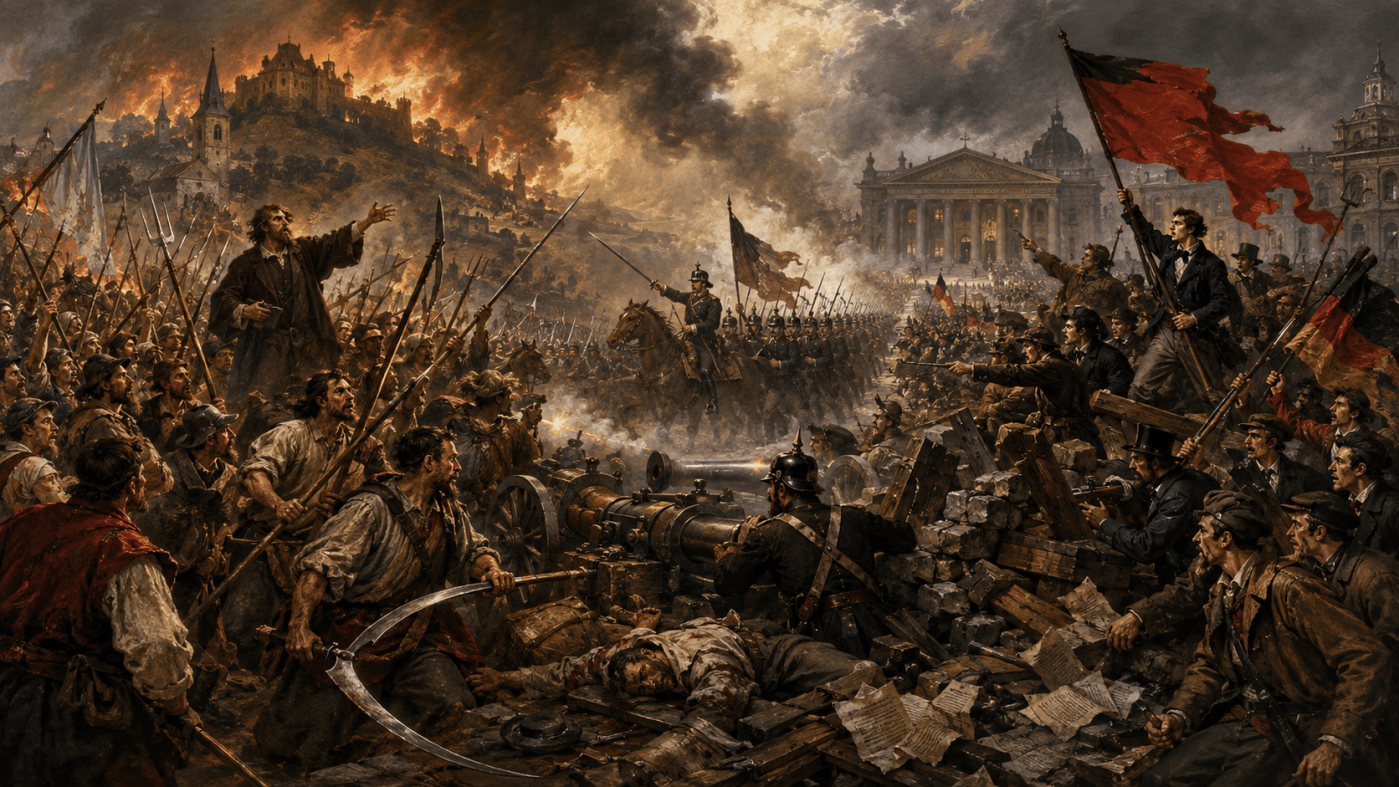
Engels went beneath the barricades of 1525 and 1848 to show that revolutions rise from material relations but survive only when exploited classes can turn grievance, consciousness, and organization into power. His peasants prayed, armed, federated, and imagined new orders, exposing the weakness of every theory that mistakes historical defeat for proof that the defeated were never capable of ruling. In 1848, constitutions collided with armies, liberal allies recoiled from social revolution, and counterrevolution rebuilt command through the state machinery the revolution had shaken but failed to seize. Yet Engels sometimes betrayed his own materialism by turning unequal historical capacities into a timetable of “ripe” classes and dying nations—a developmental verdict his own revolutionary method gives us the weapons to destroy.
Prince Kapone | Weaponized Information | Weapinized Intellects Book Review |August 30, 2026
A Revolution Can Win the Street and Still Lose the World
Friedrich Engels begins Germany: Revolution and Counter-Revolution from the place where polite histories usually stop: after the flags have come down, the barricades have been cleared, the prisons have filled, and the people who briefly called themselves governors are learning the geography of exile. “The first act of the revolutionary drama on the continent of Europe has closed,” he writes. The old powers are again “the powers that be,” while yesterday’s provisional rulers issue solemn proclamations from London and America like governments ruling territories that no longer exist. Yet Engels refuses the easy conclusion. “A more signal defeat” could hardly be imagined, he admits, before adding the line that establishes the problem of the whole book: “But what of that?” (Germany: Revolution and Counter-Revolution, p. 123).
That question is harder than it sounds. Revolution had happened. Crowds had forced concessions. Governments had fallen back. Assemblies had been elected. Constitutions had been demanded. Old authority had cracked badly enough that Germans could plausibly imagine building something in its place. None of that was imaginary. But revolutionary rupture and revolutionary rule turned out to be different achievements. The people could make the old order retreat without yet possessing the material machinery needed to prevent it from returning. That gap—between breaking political obedience and constructing a power capable of reproducing a new order—is where Engels plants his feet.
His first move is to refuse the cheapest explanation of defeat. When counterrevolution triumphs, he says, everybody suddenly discovers a traitor. “Mr. This or Citizen That” betrayed the people. Perhaps he did. Engels doesn’t deny betrayal, incompetence, cowardice, or stupidity. He says something more devastating: even when the accusation is true, “under no circumstances does it explain anything.” A revolutionary politics whose whole wisdom consists in knowing that “Citizen So-and-so is not to be trusted” has learned almost nothing about why millions could rise, why their enemies survived the rising, and why yesterday’s defeated rulers could take command again (Germany: Revolution and Counter-Revolution, pp. 123–24).
This is Engels at his strongest. He takes the moral complaint and forces it back into history. If a leader betrayed the revolution, what social force made that betrayal effective? If a parliament surrendered, why did surrender remain available to it? If millions wanted change, what prevented that desire from becoming durable command? He therefore insists that the causes of both the outbreak and the defeat have to be sought in “the general social state and conditions of existence” of the nations thrown into revolution. He wants “rational causes, based upon undeniable facts,” capable of explaining the movement rather than merely assigning blame after the bodies are counted (Germany: Revolution and Counter-Revolution, pp. 124–25).
Frankfurt makes the problem brutally concrete. The National Assembly was no hallucination. After the March victories, representatives from across the German Confederation met as a national parliament, and a Provisional Central Authority established ministries and claimed executive responsibility for German affairs. Engels’s mockery can sometimes make the whole thing sound like political cosplay, but the institution was real. Its sovereignty was the unstable part. The Assembly could speak in the name of Germany while Austria, Prussia, and the lesser states still commanded the armies, officers, administrations, treasuries, and territorial machinery through which obedience became something more substantial than applause.
Engels sees the contradiction immediately. If Frankfurt meant to become sovereign, he writes, it had to dissolve the old Federal Diet, constitute a federal government, declare itself the legal expression of popular sovereignty and, “above all,” secure “an organised and armed force in the country sufficient to put down any opposition on the part of the Governments” (Germany: Revolution and Counter-Revolution, pp. 168–69). Modern evidence sharpens rather than weakens the point. The central authority possessed formal claims over military affairs, but Prussia and Austria refused the subordination needed to turn those claims into independent command. Frankfurt could legislate a Germany it didn’t yet have the material means to govern against the states already occupying its territory.
A constitution is a document until institutions enforce it. Sovereignty is a declaration until somebody can make refusal costly. A parliament can represent millions and still depend on generals who obey another government. A revolution can therefore possess enormous legitimacy while its enemy retains barracks, artillery, tax offices, courts, administrators, telegraphs, and chains of command. Bourgeois politics likes to pretend legitimate authority somehow floats above all this machinery. Engels drags it back to earth. Someone still has the keys to the damn arsenal.
But Engels refuses the opposite stupidity too. Material conditions don’t abolish decisions. When the Prussian Constituent Assembly surrendered its position in November 1848 rather than force the monarchy to fight for Berlin, Engels tears into it. He openly concedes that resistance might have failed, the city might have been bombarded, and hundreds might have died without preventing the ultimate Royalist victory. Then he makes a distinction fatal to mechanical determinism: “A well-contested defeat is a fact of as much revolutionary importance as an easily-won victory” (Germany: Revolution and Counter-Revolution, p. 206). Conditions limit what revolutionaries can achieve. They don’t make every choice inside those conditions equivalent.
This matters because Engels’s book never quite permits revolution to become either miracle or machinery. He won’t explain defeat through bad men alone, but he also won’t let leaders hide behind structure when they surrender positions they might have defended. He wants to know what forces existed, what they controlled, what alliances they could assemble, where their limits came from, and what actors actually did when the crisis exposed those limits. That tension—between inherited conditions and political action—is already far richer than the cardboard historical materialism later generations sometimes manufactured in his name.
The unfinished ending of Revolution and Counter-Revolution makes the problem almost painfully visible. After the collapse of the southwest German insurrection and the dispersal of the Frankfurt Parliament, Engels announces that he will now “cast a parting glance upon the victorious members of the counter-revolutionary alliance” (Germany: Revolution and Counter-Revolution, p. 239). Then the text stops. No subsequent article has been found. The history that begins by demanding an explanation of counterrevolution ends just before the promised full anatomy of the victors.
But Engels had already been pursuing that anatomy from another direction. Two years earlier, writing The Peasant War in Germany while the defeat of 1848–49 was still burning, he admitted that the parallel with 1525 was “too obvious to be left entirely without attention” (The Peasant War in Germany, p. 3). He went backward three centuries because Germany had posed the same savage question twice in radically different social worlds: how can enormous popular upheaval break existing authority and still leave its enemies better able to organize the power that follows?
That question can’t be answered from the barricade alone. Before anyone can explain why a revolution fails to rule, they have to know what kind of society produced the forces fighting over rule in the first place—who owned, who labored, who paid, who commanded, who could organize beyond the village or the city, and why people who seemed to belong to one revolutionary camp were never fighting for quite the same future.
Engels Goes Beneath the Barricade
Engels tells us exactly what he thinks he’s doing in the preface to The Peasant War in Germany. He intends to explain “the origin of the peasant wars,” the positions of the contending parties, the political and religious theories through which they understood those positions, and finally the outcome “as determined by the historical-social conditions of life.” Then he plants the flag. The political and religious theories of sixteenth-century Germany were “not the causes, but the result” of a definite stage in the development of agriculture, industry, land and waterways, commerce, and finance (The Peasant War in Germany, pp. 2–3). It’s the sort of sentence that has been used ever since to reduce historical materialism to an idiot’s machine: put economy in one end, pull politics out the other.
Engels’s actual history is much better than that sentence.
He doesn’t descend beneath the Reformation looking for one economic lever secretly operating Luther, Müntzer, the princes, the towns, and the peasants like puppets. He finds a Germany in which the development of production has already begun tearing at inherited feudal arrangements but hasn’t produced anything resembling one integrated national society. Industry and commerce are uneven. Towns possess different privileges and economic interests. Political authority is scattered across princes, ecclesiastical territories, imperial cities, knights, nobles, and local jurisdictions. The monarchy that calls itself imperial sits above a country whose material life remains fragmented below it. Modern historical work still stresses this enormous regional unevenness.
What matters in Engels is what he does with the fragmentation. The princes aren’t simply residues of feudal backwardness waiting to be swept aside by economic development. They occupy a contradictory position inside that development. Engels describes them as agents of centralization within their own territories while simultaneously deepening the political dismemberment of Germany as a whole (The Peasant War in Germany, pp. 20–22). Provincial state power grows inside national political weakness. The same process that breaks older feudal particularisms can therefore strengthen new territorial particularisms. History doesn’t march from fragmentation toward unity in a straight line. One form of concentration reproduces another level of division.
That’s already a materialism more serious than the caricature. It asks what institutions economic development strengthens, which classes gain room to move, and at what territorial scale their power can operate.
Engels treats class with similar concreteness when he stays close to the ground. At the bottom of the sixteenth-century order he places “the huge exploited mass of the nation, the peasants,” burdened by princes, nobles, clergy, monasteries, towns, and local jurisdictions (The Peasant War in Germany, pp. 28–30). But the forces above and beside them don’t fall into two neat camps. The urban plebeian opposition itself contains remnants of declining guild society alongside what Engels calls “budding proletarian elements.” Town patricians, guild burghers, impoverished citizens, artisans, clergy, knights, territorial nobles, and princes occupy different positions within the same collapsing arrangement. The category class matters because those relations differ materially—not because Engels needs a set of labels to paste onto characters before the story starts.
He finds the same uneven political formation when he approaches 1848. In Prussia and the smaller German states, Engels describes a “heterogeneous mass of opposition, springing from various interests,” including bourgeois forces, parts of the landed nobility, petty traders, peasants under feudal and creditor pressure, and urban workers increasingly touched by socialist and communist ideas (Germany: Revolution and Counter-Revolution, pp. 147–48). Austria reaches the crisis through a different structure but arrives at a similarly explosive result. Engels walks through peasants ground down by lordly exactions, factory workers under police-backed employer power, journeymen blocked by corporate restrictions, merchants and manufacturers fighting regulation and privilege, and educated layers suffocating under clerical and bureaucratic command. “In short,” he writes, “there was not a single class satisfied” (Germany: Revolution and Counter-Revolution, p. 155). Revolution develops across Germany through different local relations, not because one national contradiction presses every class in exactly the same way.
Engels does the same thing when he examines the petty trading and shopkeeping strata. They receive pages of analysis because their political vacillation has a material basis. They own something, but not much. Their customers may depend on courts, garrisons, bureaucracies, and aristocratic consumption. They dream of joining the wealthy while living under constant threat of falling into the proletariat. Engels therefore expects them to swing between liberalism, democracy, and fear as the forces above and below them change position (Germany: Revolution and Counter-Revolution, pp. 127–29). Whether every later political judgment he draws from that position survives scrutiny is another matter. The method itself is clear: political conduct has to be connected to how people actually reproduce their lives.
Modern social history strengthens the need for that method while warning against making the categories too clean. Mid-century German society remained sharply differentiated by region. The Bürgertum included merchants, manufacturers, professionals, officials, masters, and older urban strata whose immediate interests didn’t always coincide. The developing working population included factory laborers but also enormous numbers of journeymen and artisans still living inside forms inherited from preindustrial production. Engels sees much of this himself. His Germany isn’t populated by completed classes walking onto the historical stage fully conscious of their scripts.
That is why his description of the German working class in 1848 is so revealing. He calls it socially and politically less developed than the English or French proletariat because German industrial production itself remains less concentrated. Many workers still labor for small masters rather than great industrial capitalists; some respond to capitalist disruption by demanding restoration of guild protections instead of the abolition of wage labor (Germany: Revolution and Counter-Revolution, pp. 128–30). Engels may later push this developmental comparison too far, but here he is doing something indispensable: consciousness develops inside specific forms of labor, property, association, urban concentration, and conflict.
By 1844, however, the Silesian weavers have already shown that another relation is emerging. Workers rise directly against employers. Socialist and communist agitation spreads. By 1848, Engels says, the workers of the larger towns still possess no perfectly settled program, but they know that “the programme of the Constitutional bourgeoisie did not contain all they wanted” (Germany: Revolution and Counter-Revolution, p. 142). That sentence matters because it catches class formation in motion. The workers don’t become a political class because Engels calls them the proletariat. They begin separating politically because their experience tells them that the coalition fighting absolutism doesn’t contain the whole of their emancipation.
Engels carries this method all the way to the outbreak of 1848. The French February Revolution matters, but he refuses to make Paris the magician that conjured Germany into rebellion. “Germany was, in the beginning of 1848, on the eve of a revolution,” he writes, and the collision “was sure to come” even had the French upheaval not accelerated it (Germany: Revolution and Counter-Revolution, pp. 142–43). The distinction is crucial. A trigger isn’t a cause. French events can compress time because the German social contradiction already exists: bourgeois opposition to bureaucratic and feudal restrictions, peasant grievances, proletarian discontent, an unstable petty bourgeoisie, financially strained governments, and political structures increasingly unable to contain them.
This is what Engels means, at his best, by going beneath political events. The constitution doesn’t become unreal because property and class stand beneath it. Engels asks what makes constitutionalism attractive to one class, insufficient to another, threatening to a third, and tolerable to an old ruling power under some conditions but not others.
And there the method encounters a problem of its own making. Material interests don’t speak. Agriculture can’t preach. Commerce doesn’t write manifestos. A tax burden doesn’t organize an army, and an exploited class doesn’t become a revolutionary force merely because exploitation exists. Somewhere between the conditions Engels excavates and the battles he wants to explain, people must turn social experience into a language of right and wrong, obedience and revolt, heaven and earth. In sixteenth-century Germany, that language was theology—and once peasants and preachers began using the Bible against the world that claimed the Bible sanctified, the struggle beneath the sermon entered the sermon itself.
God Enters the Class Struggle
Engels opens the religious battlefield with a provocation that still cuts against the liberal habit of treating belief as a private cloud floating above material life. The wars of the Reformation, he writes, involved “very positive material class-interests”; if those struggles carried “religious earmarks,” that reflected the historical world in which they had to be fought (The Peasant War in Germany, p. 34). Church doctrine didn’t hover politely beside property and political authority. The clergy monopolized much of intellectual life, while law, politics, education, and legitimate rule had been organized through Christian categories for centuries. A sixteenth-century peasant couldn’t simply step outside that world, invent the vocabulary of a nineteenth-century socialist, and announce his demands in terms Engels would find theoretically convenient. Revolt had to speak a language people actually possessed.
The Twelve Articles make the point better than any abstract argument could. The rebels demanded relief from serfdom and excessive labor obligations, restoration of woods, waters, game, and other communal resources, limits on rents and tithes, and the right of communities to choose their pastors. But they didn’t formulate those demands by setting Christianity aside. They repeatedly appealed to the Gospel as the standard by which worldly authority, property, obligation, and freedom had to justify themselves. Christian law supplied the insurgents with a language for deciding when existing authority had ceased to be legitimate.
That is where Engels’s own account becomes richer than his language of a “religious screen.” Once social struggle enters theology, theology starts doing political work. The Bible can sanctify obedience, but it can also become ammunition against the people who claim a divine title to obedience. Engels sees this transformation through Luther. Early Lutheran opposition could gather together forces whose interests had not yet openly collided: lesser nobles, burghers, princes hostile to ecclesiastical power, peasants, and plebeian elements could all hear something useful in an attack on Rome. The conflict hadn’t yet forced every participant to answer the dangerous question hiding underneath the common religious enemy: reform for whom, and how far?
When the peasant uprising answered that question with armed revolt, the coalition split. Engels’s sentence is merciless: “Burgher and prince, noble and clergyman, Luther and the pope united” against the peasants (The Peasant War in Germany, p. 42). Yesterday’s theological enemies suddenly discovered that they shared a much more urgent earthly interest. Luther had initially blamed princely oppression for helping produce the uprising and urged accommodation. But as the movement spread beyond controlled reform, he denounced the rebels as murderous hordes to be stabbed, strangled, and crushed. Engels then catches the ideological transformation in one of the strongest passages in the book: Luther had handed the peasants the Bible as a weapon against feudal Christianity, then “turned the same weapon against the peasants,” extracting from it “a veritable hymn to the authorities ordained by God” (The Peasant War in Germany, pp. 42–43).
That isn’t simply hypocrisy dressed in a cassock. Engels treats the changing theology as the political expression of a changing social relation. Moderate reform could attack ecclesiastical authority while the popular movement remained useful against Rome. Once peasants and plebeians began attacking lordship itself, the boundaries of respectable reform hardened. Scripture didn’t change. The class struggle changed which scriptures had to be emphasized, what obedience suddenly meant, and who now counted as the enemy of Christian order. Luther’s Bible could become revolutionary and counterrevolutionary without changing a word because the struggle over what the Bible authorized had become inseparable from the struggle over who would rule.
Thomas Müntzer pushes that contradiction until theology itself begins threatening the architecture of worldly authority. Engels describes him first as a religious radical whose doctrine breaks through conventional Christianity, then as “a direct political agitator” (The Peasant War in Germany, pp. 45–46). Heaven, in Engels’s reconstruction of Müntzer, is no longer postponed safely beyond death. The believer has a worldly obligation to establish God’s kingdom here. Authority therefore loses its automatic sacred protection. In the Sermon to the Princes, Müntzer pushes the logic toward open insurrection: rulers retain the sword only if they act against the ungodly; if they refuse, the right to wield it can pass elsewhere. The theological dispute has become a fight over who possesses legitimate coercive power.
Engels catches the social edge perfectly when he reproduces Müntzer’s attack on rulers who had taken “the fishes in the water, the birds in the air, the plants in the soil” into private possession while preaching “Thou shalt not steal” to the poor (The Peasant War in Germany, p. 48). The sarcasm writes itself. The lord privatizes creation and then lectures the peasant about property crime. Müntzer doesn’t need to stop believing in God before material exploitation becomes visible. His theology gives him a language through which the theft of common life can appear as sacrilege by the powerful rather than disobedience by the poor.
Then Engels goes too far.
He says Müntzer’s political program “touched upon communism,” but immediately expands that cautious formulation into something much larger. Müntzer’s kingdom of God becomes, in Engels’s telling, “a state of society without class differences, without private property, and without superimposed state powers,” with common work, common property, complete equality, and an international revolutionary union prepared to overthrow resistant rulers (The Peasant War in Germany, pp. 46–47). The radical tendency is real. The attribution of a developed communist program to Müntzer is much harder to sustain.
The surviving record narrows it sharply. Friedemann Stengel’s study of Müntzer shows that the famous omnia sunt communia—“all things are common”—appears only once in the surviving corpus, in the disputed record of Müntzer’s final confession, while the rest of his writings don’t supply the developed doctrine of common property later attached to him. Engels also acknowledged Wilhelm Zimmermann as his principal factual source for the Peasant War. Zimmermann’s own account of Mühlhausen describes practical common goods far more modestly: feeding the poor and sharing grain, food, and clothing in a primitive-Christian sense. Engels takes a genuine revolutionary current and pushes its latent social direction beyond what Müntzer’s surviving words securely establish.
That correction doesn’t shrink Müntzer. It makes him historically more interesting. We don’t need to dress a sixteenth-century revolutionary in a nineteenth-century communist uniform to recognize what he was doing. His theology undermined the divine monopoly of existing rulers, legitimized resistance, organized followers, interpreted social misery, and turned the coming judgment of God into a demand for action in the present. Religion here isn’t a mist that disappears once the Marxist historian walks in with the correct material explanation. It is one of the means through which material antagonism becomes conscious, legitimate, organized, and dangerous.
But even the fiercest theology eventually meets a harder material test. Müntzer could tell peasants that princes had forfeited the sword. He could help turn obedience into revolt and property into a question of divine justice. None of that answered who could coordinate thousands of insurgents across divided territories, feed them, arm them, command them, match professional soldiers, survive artillery, or turn revolutionary legitimacy into durable rule. The sermon could make rebellion righteous. It couldn’t by itself make rebellion victorious.
The Peasants Were Not Waiting for History
Engels gives the German peasants enormous historical weight and then nearly takes it back with one sentence. They are “the huge exploited mass of the nation,” crushed beneath rents, tithes, feudal labor, arbitrary dues, ecclesiastical extraction, noble privilege, and princely power. Yet because they live scattered across the countryside, he concludes that “the peasant alone could never make a revolution” against the organized forces of princes, nobility, clergy, and towns (The Peasant War in Germany, pp. 30–32). The first half of the argument is materialist. The second threatens to turn a historically specific weakness into something closer to a class sentence.
The history Engels himself reconstructs won’t stay inside that sentence.
Nor does peasant political organization suddenly appear in 1525. In Chapter III Engels follows decades of Bundschuh conspiracies, Poor Conrad, clandestine meetings, emissaries, uprisings, defeats, executions, and renewed organizing. He praises the “tenacity and endurance” with which peasants overcame the obstacles to more centralized organization despite being “scattered over the countryside” (The Peasant War in Germany, p. 57). Chapter IV supplies the negative mirror. Hutten and Sickingen’s knights could organize their own political and military union, but they couldn’t win peasant allies without surrendering the feudal privileges from which they lived. When war came, Engels says, “the nobles were alone in the field against the princes,” whose concentrated response crushed them (The Peasant War in Germany, pp. 72–73). Before the mass uprising begins, the problem is already visible: opposition forces can organize, but property divides the coalition while princely power concentrates faster.
The peasants of 1525 didn’t merely riot against unbearable dues and wait for an urban class to explain politics to them. They assembled demands, elected leaders, organized armed bands, formed leagues, negotiated across territories, created councils, imposed discipline, and attempted to establish alternative jurisdiction. Engels acknowledges enough of this to make his categorical judgment unstable. He calls Müntzer’s revolutionary current a minority, but says it nevertheless formed “the backbone of the peasant camps” (The Peasant War in Germany, p. 79). A backbone isn’t a spontaneous explosion. It implies organization inside a movement whose breadth exceeded the conscious revolutionary nucleus trying to give it direction.
The Twelve Articles make that political development visible. Engels lists demands for elective clergy, abolition of serfdom, limits on tithes and feudal burdens, and restoration of communal resources (The Peasant War in Germany, p. 80). The articles didn’t remain one village’s complaint. They were consolidated from a wider field of grievances, printed repeatedly, circulated through the uprising, and became a common political reference for forces separated by territory and local conditions. The actual demands reveal people deciding which obligations remained legitimate, what belonged to the community, who should appoint religious authorities, and where lordly rights ended. The peasants were already arguing about government.
Other currents went further. Friedrich Weigandt’s proposed imperial reformation reached beyond local relief toward restructuring law, credit, commerce, political representation, princely alliances, and relations between poor subjects and territorial rulers. Gaismair’s Tyrolean program imagined an egalitarian territorial republic reorganizing agriculture, mining, commerce, welfare, and political authority. These projects didn’t represent every peasant carrying a pike. They show uneven political development inside the revolt—from immediate grievance toward programs reaching for another territorial order. What they don’t show is some permanent peasant inability to think beyond the village.
Engels comes closest to the real contradiction when he explains the military collapse. Provincial forces repeatedly failed to aid one another. One district remained passive while another fought; separate armies negotiated independently; local interests competed with broader revolutionary necessity. “The decentralisation of Germany,” Engels writes, “was at the same time the cause of its failure” (The Peasant War in Germany, p. 117). Political capacity existed, but it couldn’t be concentrated consistently across the entire field of war.
And fragmentation didn’t cripple both sides equally.
The princes and allied estates inhabited the same dismembered Germany, yet they possessed institutions the insurgents were only beginning to create. The Swabian League gave princes, prelates, nobles, and imperial cities an existing framework for negotiation, troop levies, armed assistance, and collective repression. Its mobilization wasn’t effortless; rulers argued, hesitated, and often needed their troops elsewhere. But they entered the crisis with something the rebels lacked at comparable scale: inherited mechanisms for pooling coercive power across territorial boundaries. After the revolt, the Diet of Speyer made the relation explicit by providing for neighboring rulers to aid one another militarily against renewed rebellion.
So “Germany was decentralized” doesn’t explain enough. Decentralization had a class content. The peasants confronted fragmentation from below, trying to construct federative power while already at war. Their enemies possessed territorial governments, revenues, military professionals, cavalry, artillery, and organizations capable of crossing the same political boundaries that divided the insurgency. One side had to invent broader revolutionary coordination under fire. The other could adapt institutions already built for rule.
That difference takes us straight into Engels’s famous passage on historical “ripeness.” Müntzer, he writes, suffered “the worst thing that can befall a leader of an extreme party”: being forced to take governmental responsibility “when the movement is not yet ripe for the domination of the class which he represents” (The Peasant War in Germany, p. 103). Engels immediately gives the proposition material content. What such a leader can do “depends not upon his will,” but on existing class antagonisms and the level of production and communication. He may therefore find himself compelled to carry out the program of another class whose domination existing conditions supposedly make possible (The Peasant War in Germany, pp. 103–04).
There is a hard truth inside this. No revolutionary program abolishes material limits by declaring them ideologically incorrect. A movement can want communal transformation and still lack the productive base, institutions, military strength, territorial reach, or social alliance capable of reproducing it. Engels is right to refuse the fantasy that consciousness alone can command history.
But “conditions impose limits” isn’t identical to “history has already selected the class entitled to rule.” The first proposition forces us to investigate property, class composition, communications, organization, territory, military force, institutions, and alliances. The second risks looking at the victorious order afterward and calling its victory maturity.
The Peasant War gives us no reason to make that leap. Its revolutionary forces built real political capacity under conditions where their enemies commanded greater concentrations of money, weapons, trained soldiers, territorial administration, and established alliances. Even defeat failed to return Germany neatly to the day before the uprising. Engels says “the sole gainers” were the princes (The Peasant War in Germany, p. 116), yet the postwar settlement shows ruling estates repressing organizers while still confronting grievances over commons, serfdom, labor burdens, tithes, mobility, and seigneurial abuse. The insurgent bid for power was smashed; parts of the social problem survived strongly enough that the victors had to manage or concede around them.
That gives “ripeness” a harder and more useful meaning. A class is never ripe the way fruit is ripe, hanging there until history finally decides it may be picked. Revolutionary capacity is built from historically available materials. Communications can widen it. Organization can concentrate it. Alliances can enlarge it. Concessions can fracture it. Military defeat can destroy it. Institutions can preserve it. None of those relations eliminates the limits Engels correctly insists upon. They tell us what those limits actually consist of.
Three centuries later Germany possessed newspapers, railways, national political networks, urban workers’ organizations, representative assemblies, constitutional programs, and a bourgeoisie far more developed than anything available in 1525. Development had transformed the problem without solving it. The revolution could build parliaments where peasants had built leagues and proclaim national sovereignty where rural armies had struggled to coordinate provinces. Yet the deeper question remained: could political organization become command over the institutions that made rule material? In 1848 the revolution had a constitution. The old order still had the cannon.
The Constitution Meets the Cannon
“It is the fate of all revolutions,” Engels writes of Vienna, that the coalition necessary to defeat a common enemy can’t survive the victory unchanged. Once the old government retreats, “the victors become divided among themselves into different camps, and turn their weapons against each other” (Germany: Revolution and Counter-Revolution, p. 158). Engels isn’t announcing some mystical law that revolutions inevitably devour themselves. He is describing what happens when a common political demand stops concealing incompatible social destinations. The bourgeois merchant, the armed student, the unemployed worker, and the artisan can all demand a constitution while Metternich stands over them. Once he falls, they have to decide what that constitution will protect, who will exercise political power, who will remain armed, and how far the revolution is allowed to go.
Vienna gives Engels the contradiction in almost laboratory form. The March victory makes the middle class “the theoretically predominant class,” but he immediately emphasizes the word theoretically. The bourgeoisie and petty tradesmen possess a National Guard. A bourgeois-dominated Committee of Safety stands near the center of political authority. Yet workers are armed too, students maintain an independent force of several thousand, unemployment has become a public political problem, and revolutionary agitation prevents the return of the commercial tranquillity the propertied classes increasingly want (Germany: Revolution and Counter-Revolution, pp. 158–59). The common victory therefore creates the conditions for a new conflict inside the victorious camp.
This is where “the bourgeoisie betrayed the revolution” becomes both tempting and inadequate. Engels himself often writes with enough fury to encourage the shorthand. But the material relation he actually describes is sharper. The German bourgeois strata were heterogeneous: manufacturers, merchants, professionals, officials, masters, and older urban property holders didn’t form one conscious political brain. What increasingly pulled important liberal-bourgeois forces together was the recognition that the political revolution they wanted could continue into a social revolution they did not.
Engels catches the same process more nakedly in Prussia. The February Revolution in Paris frightens the Prussian bourgeoisie precisely because it announces itself as a working-class challenge to bourgeois government. Engels says their “revolutionary ardour” cools when they imagine property, order, religion, and family threatened from below. Yet they still need the masses to break absolutist resistance. When Berlin’s workers actually fight and defeat the troops, the contradiction ceases to be theoretical. The very class the bourgeois opposition had wanted as supporting infantry has entered the struggle as an armed force conscious of its own strength (Germany: Revolution and Counter-Revolution, pp. 161–62).
Then comes the move that matters more than the insult. The new liberal ministry doesn’t dismantle the old machinery. Engels stresses that “not a single bureaucrat or military officer was dismissed”; the existing administrative system remains intact while the new ministers use it to restore “order” (Germany: Revolution and Counter-Revolution, p. 162). Here the class compromise becomes institutional. The liberal leadership gains ministerial office while the monarchy retains much of the bureaucracy, officer corps, army, and territorial command through which state power already operates. The political revolution enters government without taking apart the machinery that can later take government back.
The armies don’t simply wait in their barracks for reaction to become fashionable. They recover through use. Engels watches Prussian forces regain confidence in Poland and Austrian forces do the same through Prague and Italy. Liberal governments help strengthen regular armies against political forces to their left, believing the state’s weapons can be used selectively. Then those armies “turned themselves against the Liberals, and restored to power the men of the old system” (Germany: Revolution and Counter-Revolution, p. 181). The line is devastating because it shows counterrevolution growing inside the institutions the revolutionaries thought they could borrow.
Engels gives old Marshal Radetzky the perfect ruling-class instinct. When ministers in revolutionary Vienna issue him orders, he reportedly answers that they are not Austria: “I and my army, we are Austria” (Germany: Revolution and Counter-Revolution, p. 181). Strip away the theatrical swagger and the statement contains the whole problem. The ministries possessed formal office. Radetzky commanded an organized body of armed men, trained officers, logistics, discipline, and territorial force. Political legitimacy and material command had separated. The side capable of reuniting them would decide what “Austria” actually meant.
The June defeat of the Paris workers accelerates this shift. Engels says that after June “the army again was the decisive power in the State” (Germany: Revolution and Counter-Revolution, p. 184). The defeat was indeed a continental political shock, intensifying bourgeois fear that constitutional revolution could open into social revolution. But it wasn’t a magic switch that made reaction inevitable. Democratic organization continued, calls for a second revolution grew, and armed struggles carried into 1849. June changed expectations and alliances while the old state apparatus was already rebuilding; it strengthened a tendency without abolishing political agency.
By October, Vienna shows what that rebuilding looks like when it matures. Engels contrasts the two camps with brutal clarity. Outside the city stood a reorganized Austrian army, tens of thousands strong, armed, drilled, supplied, and commanded. Inside stood divided National Guards, workers armed too late, an Academic Legion with courage but limited military weight, confused political leadership, inadequate artillery, and no unified plan of defense (Germany: Revolution and Counter-Revolution, pp. 192–95). The Austrian archival record confirms the scale of the imbalance: Windischgrätz and Jelačić could concentrate more than sixty thousand troops around a capital whose effective defenders were fewer, unevenly trained, and badly coordinated.
Engels refuses to let that military asymmetry erase political failure. The Diet hesitates. Committees issue contradictory orders. Workers receive arms and organization too late. Then he drops one of the bitterest lines in the entire book: “There was only one thing upon which all agreed—to respect property” (Germany: Revolution and Counter-Revolution, p. 195). The city is being encircled by imperial artillery, but the revolutionary authorities remain extraordinarily disciplined about the sacred boundary they won’t cross. Property survives as the point of agreement precisely when political authority is collapsing.
That sentence doesn’t mean confiscating property would have magically defeated Windischgrätz. Engels describes the material imbalance too clearly for that. Vienna lacked sufficient arms, military organization, artillery, and unified command. But the property line reveals why the revolutionary coalition couldn’t mobilize every available social force without also transforming the revolution’s class content. A government willing to defend bourgeois property absolutely while demanding workers defend the revolution indefinitely has already placed a limit on the social power it is prepared to unleash.
The defeat that follows shows why counterrevolution must be understood as reconstruction rather than rewind. The restored Austrian state crushes revolutionary political authority, but it can’t simply put every social relation back where it stood in February. The peasants had already torn apart crucial elements of feudal subjection. Engels himself notes that they were “real gainers by the Revolution” and that even restored government could not easily reimpose what had been abolished (Germany: Revolution and Counter-Revolution, pp. 159–60). The agrarian emancipation enacted in 1848 survived the political counterrevolution. Reaction restored dynastic command on social ground the revolution had already changed.
That is more dangerous than simple restoration. A ruling order that survives by incorporating transformations its enemies forced upon it has learned something. It can surrender one relation to preserve the larger structure of command. It can abolish feudal obligations while smashing revolutionary sovereignty. It can retain administrative modernization while dispersing the parliament that demanded political control over it. Counterrevolution doesn’t always rebuild yesterday. Sometimes it saves ruling power by making yesterday impossible.
By 1849 even constitutional liberalism was being shoved beyond the legal terrain it had tried to preserve. Engels follows the Frankfurt Assembly through the Imperial Constitution crisis: Prussia rejects the crown and refuses the settlement, governments move against the constitutional movement, and the remaining democratic forces are forced toward the armed struggle they had spent the previous year trying to avoid (Germany: Revolution and Counter-Revolution, pp. 214–28). The contradiction that Frankfurt had postponed now arrives without parliamentary manners. A constitution claiming national sovereignty means nothing once the states whose armies it supposedly commands decide they won’t obey it.
Baden proves that the problem can’t be reduced to parliamentary timidity. There, a large part of the territorial army actually mutinied and joined the revolutionary movement. The revolution acquired what Frankfurt lacked: a significant piece of organized coercive power. Yet the revolutionary army remained inferior in training, organization, equipment, and wider coordination to the Prussian-led forces brought against it. Capturing soldiers mattered enormously. It still didn’t abolish the larger interstate balance of force.
Engels’s sharpest insight therefore survives without the mythology of cowardice or the opposite mythology of inevitable defeat. Revolutionary outcomes move through material capacities. Class interests shape which risks political forces will accept. Institutions preserve old power inside new governments. Armies can recover faster than revolutionary coalitions can consolidate. Concessions can detach one social force from another. Leadership can waste possibilities, but courage can’t substitute for artillery, administration, coordination, or a social alliance capable of sustaining them.
And the old order possessed one more weapon that doesn’t fit neatly into a simple bourgeois-versus-proletarian map. The Habsburg monarchy rebuilt power not only through armies and class fear but by moving through the national antagonisms inside the empire—antagonisms real enough to mobilize, divide, and kill. Engels sees the imperial manipulation. But when he turns from the state that exploits those divisions to the peoples caught inside them, his materialism begins to slip. A historically produced alliance with counterrevolution starts becoming, in his hands, a verdict on who history itself has decided deserves to survive.
When Engels Starts Deciding Who Gets to Exist
Engels reaches the national question with his materialist weapons already drawn—and then, in places, lays them down. Writing about the German advance eastward, he openly names the process as “conquest, colonisation, or, at least, civilisation” (Germany: Revolution and Counter-Revolution, pp. 173–74). The sequence should stop us cold. Engels has already taught the reader to ask who possesses land, who commands institutions, who benefits from political unification, and whose interests hide inside universal language. Yet here conquest and colonization can slide almost seamlessly into “civilisation,” as though greater urban, commercial, or state development could transform domination into historical necessity.
The problem becomes explicit when he turns to the Czechs and other Slav peoples of the Habsburg world. Engels doesn’t merely accuse particular political leaders of making disastrous alliances. He begins sorting whole nations according to whether history has granted them a future. By the time he reaches the consolidated counterrevolution, some have become “dying nationalities,” remnants supposedly destined for absorption by stronger peoples (Germany: Revolution and Counter-Revolution, pp. 208–13). The language isn’t an ugly ornament hanging off an otherwise untouched argument. It reproduces the same developmental logic already exposed in the problem of revolutionary “ripeness”: present weakness becomes evidence of historical incapacity.
Engels did see something real, and his strongest case has to be faced before it can be rejected. In Chapter IX he argues that the Czech and Croatian political leadership had become entangled with Panslavism and Russian power, describing forces within those movements as working “in the direct interest of Russia” (Germany: Revolution and Counter-Revolution, pp. 177–81). The Habsburg monarchy likewise survived partly by exploiting antagonisms among the peoples it ruled. Vienna could mobilize Croatian forces against Hungary, appeal to Czech fears of German domination, play Ruthenian grievances against Polish power in Galicia, and use national conflicts to fracture revolutionary coalitions. The Austrian archival record confirms that imperial policy consciously moved through these divisions.
Where Engels fails is in treating imperial usefulness as political essence.
The Czech case breaks the category from inside. František Palacký and the Czech liberal movement didn’t simply offer themselves to Vienna because Slavs supposedly lacked revolutionary capacity. Palacký rejected participation in the Frankfurt Parliament because the German national state being constructed there claimed authority over lands containing a Czech population developing its own political program. His letter to Frankfurt defended a federal reconstruction of Austria as protection against absorption by both Germany and Russia. The strategy had limits, but it was a strategy rooted in an actual national contradiction.
This transforms German unification itself. The national movement was revolutionary insofar as it attacked dynastic fragmentation and the old Confederation. Yet the same project could become dominating wherever “Germany” was drawn across peoples who didn’t consent to become German. Once the problem is stated materially, the ranking of historical and non-historical nations falls apart. A nation can fight an old imperial arrangement while reproducing national domination over another people inside the territory it claims.
Other movements make the same point without requiring seven separate national biographies. The United Slovenia program demanded autonomous political organization for Slovene-inhabited territories. Slovak demands joined national equality to language rights, representative institutions, national guards, press freedom, and relief from feudal burdens. At Blaj, Romanian delegates demanded recognition as a political nation and rejected incorporation into Hungary without their consent. In Galicia, the Ruthenian Council could remain loyal to the emperor while demanding protection against Polish domination and political recognition for the Ruthenian population. These movements differed sharply, but none fits the image of a people simply waiting to disappear.
The Polish struggle in Poznań turns the contradiction directly against German liberal nationalism. Polish political forces organized committees, armed formations, and demands for national administration after March 1848. Prussia responded by narrowing autonomy and tightening German control. The issue was no longer a supposedly progressive German nation confronting a backward residue. It was competing claims to sovereignty over actual territory inhabited by more than one national population. German liberals could demand freedom from dynastic fragmentation while denying Poles the same principle where Polish sovereignty collided with the borders of the German national project.
Croatia prevents the opposite error. Legitimate national grievances don’t make every national leadership revolutionary. Ban Jelačić’s forces became central to the Habsburg military struggle against Hungary, and Vienna deliberately used Croatian-Magyar antagonism in defense of imperial rule. Yet Croatian scholarship has also shown how the image of Croats as natural “Mamluks” of reaction erased the development of a Croatian political movement with grievances and aims of its own. A subordinated national movement could therefore become an instrument of an empire against another national movement whose own project threatened Croatian autonomy.
Once that relation is admitted, “reactionary nation” becomes useless as a historical category. Political forces inside nations enter concrete alliances under concrete conditions. A Czech federalist can resist German domination and still choose a strategy that helps preserve the Habsburg state. A Croatian army can fight for Vienna while carrying real grievances against Magyar rule. Polish nationalists can resist Prussia while Polish elites dominate Ruthenians elsewhere. Hungarian revolutionaries can fight Vienna and still deny equal national rights inside the Kingdom of Hungary. Contradiction doesn’t erase sequence or unequal domination; it tells us why revolutionary and counterrevolutionary positions can cross inside different relations.
Roman Rosdolsky’s later Marxist critique locates the theoretical failure precisely. Engels correctly observed that sections of the Austrian Slav movements entered alliances favorable to counterrevolution, but then transformed a conjunctural alignment into a developmental judgment about entire peoples. Rosdolsky’s critique of Engels traces this toward the lingering Hegelian division between supposedly “historic” state-building nations and peoples without an independent historical future. The answer isn’t less materialism. It is more.
Engels already knew how to make that correction when discussing classes. Political weakness had to be connected to property, organization, production, communications, alliances, and state institutions. Yet with nationalities he sometimes takes the missing capacity itself as evidence that the people are missing history. Instead of tracing territorial domination, class differentiation, imperial manipulation, political organization, and competing sovereignty, development becomes a judge handing down sentences.
That is where Engels most visibly violates the method that makes the rest of the book powerful. Greater state capacity doesn’t prove a right to conquer. A larger market doesn’t establish a right to absorb another people. Political weakness isn’t evidence of civilizational redundancy. If historical capacity is produced through institutions, organization, alliances, and struggle, nations—like classes—can acquire capacities they didn’t possess before.
Once that developmental hierarchy is stripped away, the book’s central problem stands naked. The question was never which class or nation history had secretly appointed to inherit the future. Engels kept discovering something harder beneath his own verdicts: social forces become historical powers only when they can organize their purposes into institutions, alliances, territorial command, and durable rule. The timetable has failed. What remains is the struggle over the material means of making history obey.
History Gives No One Permission to Rule
Engels begins Germany: Revolution and Counter-Revolution with defeat already accomplished and refuses to let defeat pronounce the final verdict. “A more signal defeat” could hardly be imagined, he writes, before answering catastrophe with the stubborn question: “But what of that?” (Germany: Revolution and Counter-Revolution, p. 123). Revolutions had been beaten before. Classes that later ruled had spent decades losing. The task was therefore to discover “the causes that necessitated both the later outbreak and its defeat” in the actual social conditions of the contending forces (Germany: Revolution and Counter-Revolution, pp. 123–25). That methodological demand is one of the strongest things Engels gives us. It is also the demand that cuts through some of his own conclusions.
The tension is clearest in his treatment of Müntzer. Engels insists that what a revolutionary leader can accomplish “depends not upon his will,” but upon existing class antagonisms, productive development, and communications (The Peasant War in Germany, pp. 103–04). That is historical materialism doing real work. A revolutionary government inherits people, land, technology, institutions, enemies, shortages, armies, and forms of property it didn’t invent. Conviction doesn’t make those relations disappear.
The problem begins when concrete limits harden into a timetable of who history has supposedly made ready to rule. The Peasant War itself gave us a better answer. Its insurgents built real political capacity, but their enemies could concentrate money, trained soldiers, artillery, territorial administration, and federative institutions at a scale the revolutionary forces couldn’t consistently match. The decisive issue wasn’t peasant essence. It was unequal historical capacity.
Three centuries later the form changed radically. By 1848 Germany possessed newspapers, national political networks, representative assemblies, more developed cities, constitutional programs, and an emerging workers’ movement. Yet development didn’t abolish the struggle over who could make political authority material. Revolutionary institutions appeared faster than revolutionaries could destroy or capture the military and administrative machinery of the old states. What had confronted the peasants as fragmented territorial power returned at a higher level as the problem of the state itself.
That is why Engels’s account of the final 1849 insurrections matters. He writes that “the real fighting body of the insurgents” consisted of the urban working classes, joined in places by poorer rural laborers and small farmers (Germany: Revolution and Counter-Revolution, p. 229). More importantly, he says the workers entered the struggle knowing that, in its immediate form, it was “no quarrel of its own.” They fought because allowing another class to climb to power on their shoulders and then consolidate its rule without opening a broader political field would leave the workers weaker for the struggles still ahead (Germany: Revolution and Counter-Revolution, pp. 229–30).
There is something enormously valuable here. Engels doesn’t demand that workers participate only in struggles whose immediate program is already socialist. Political independence doesn’t mean historical isolation. A working class can enter a democratic struggle, a national struggle, or a fight against reaction without pretending every ally shares its destination. The question is whether workers enter as an independent force capable of developing their own organization and interests, or merely as muscle for another class that plans to disarm them once the common enemy falls.
Engels still slips back toward necessity when he describes the revolutionary course of old European societies as a “historical necessity” through which they must pass before returning to regular development (Germany: Revolution and Counter-Revolution, p. 230). That conclusion belongs to the nineteenth-century battlefield from which he was writing. It shouldn’t be inflated into a universal law.
Later revolutionary history superseded that universal form without abolishing the material problem Engels had identified. Lenin’s agrarian strategy didn’t assume peasants could leap over every inherited contradiction through revolutionary will. It depended on land hunger, war, soldiers, peasant soviets, working-class organization, state breakdown, and the struggle to destroy the old bureaucratic-military apparatus. Mao’s investigation of Hunan likewise treated peasant associations as concrete institutions through which rural masses were attacking landlord political authority under conditions utterly different from Germany in 1525. Russia and China don’t prove that the German peasants could have won under the right slogan. They prove that agrarian political capacity changes when organization, communications, armies, alliances, and state crises change.
This is the distinction worth carrying out of Engels: material conditions are real without being fate. Productive development matters. Communications matter. Class composition matters. Land matters. Military organization matters. Political institutions matter. International conditions matter. None of them grants a class a divine appointment with power. Together they create a changing field of constraints and possibilities within which social forces build—or fail to build—the capacity to rule.
The same correction deepens Engels’s unfinished anatomy of counterrevolution. He closes the surviving series just as he promises to “cast a parting glance upon the victorious members of the counter-revolutionary alliance” (Germany: Revolution and Counter-Revolution, p. 239). The promised article never appeared. But the history leading to that missing conclusion has already shown the essential relation: old ruling forces survive revolutionary crisis when they can rebuild material command faster than their enemies can replace it. They can concede what no longer needs defending, absorb transformations forced from below, and destroy the independent political forces that produced those transformations in the first place.
That may be Engels’s most durable lesson for revolutionaries. The moment of insurrection can be spectacular while the construction of power remains stubbornly material. A government can fall faster than an administration can be replaced. An army can fracture before a revolutionary army can be built. Workers and peasants can overthrow one relation while disagreeing over the order that follows. A parliament can speak for a people it cannot yet defend. A national movement can fight one empire while dominating another people. None of those contradictions can be solved by shouting “objective conditions” from the sidelines after everybody else has been shot.
Engels was at his greatest when he refused that kind of bullshit. He demanded causes. He looked for the relations connecting property to politics, class interest to alliance, ideology to organization, parliament to armed force, and defeat to the reconstruction of ruling power. He became weakest when he stopped following those relations and let development pronounce judgment in their place: the peasant incapable, Müntzer premature, one nation historical and another destined to disappear.
There is no need to throw away Engels to correct Engels. His own method does the job. Once every supposed historical incapacity is forced back into its concrete relations, the timetable dissolves into struggle. What could not yet be done becomes a question of which capacities did not yet exist, who possessed them, how they were built, what blocked their construction, and what later struggles might transform.
History gives no class permission to rule. It hands nobody a certificate of maturity. It guarantees no nation survival and grants no revolution victory because its cause is just. It delivers inherited conditions, accumulated contradictions, available institutions, enemies with material power, and possibilities whose realization depends on struggle. Engels’s great achievement was to make that terrain visible. The revolutionary task is to remain more faithful to that materialism than Engels sometimes was—to study not who history has supposedly chosen, but how the exploited become capable of choosing history for themselves.


Leave a Reply