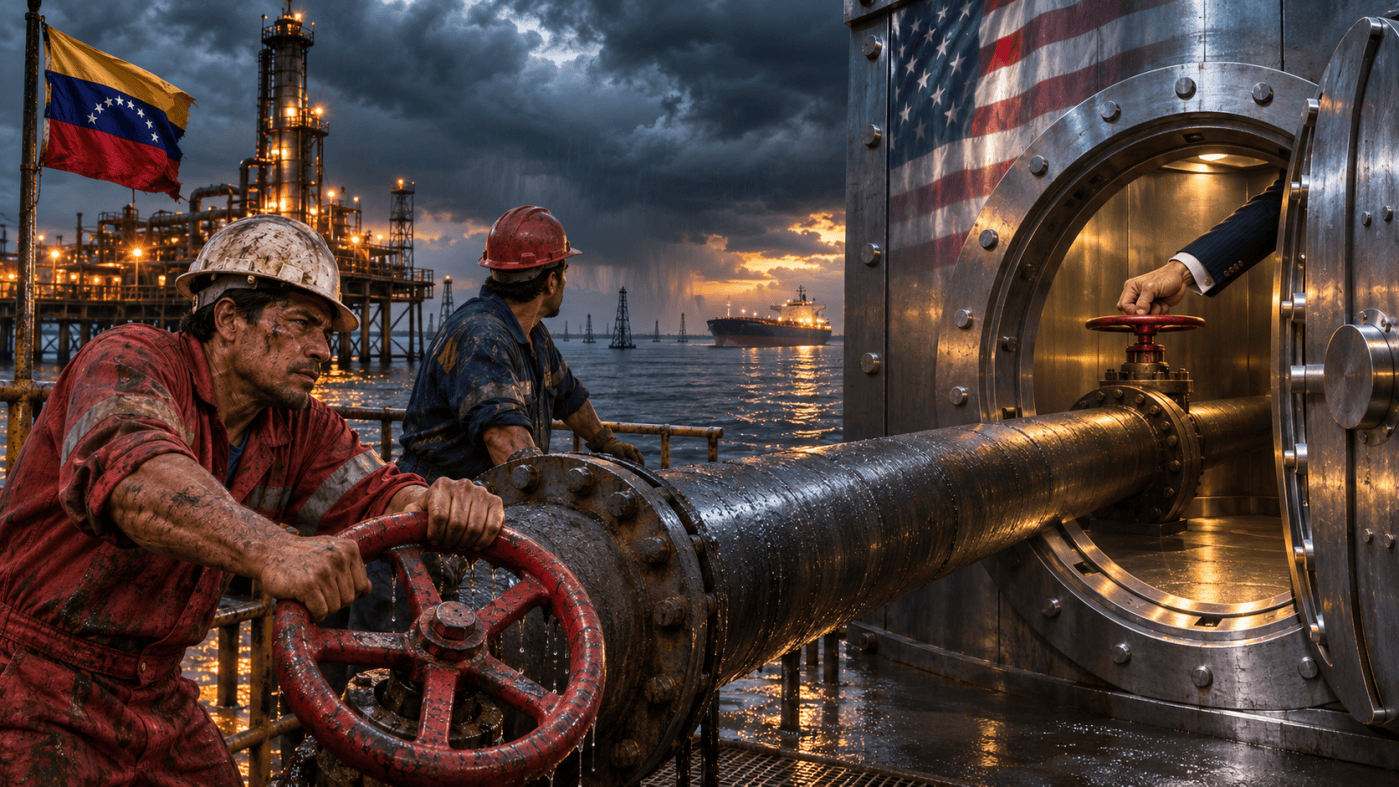
The New York Times calls it “handling” when Venezuela has to ask Washington to release its own oil money. After U.S. forces kidnapped Nicolás Maduro and Cilia Flores, Washington used the threat of another attack to dictate payment terms and open Venezuela’s oilfields to favored firms. The money can come back while the power to release it stays abroad, and a barrel can still reach China on terms Caracas has less power to set. Free Maduro and Flores, end U.S. custody, open the books, and back the oil workers fighting for a say in what recovery yields.
Prince Kapone | Weaponized Information | November 11, 2026
The Times Calls It Handling
Washington kidnapped Venezuela’s president in January. By November, the verb was handled. In their November 10 report for The New York Times, Tyler Pager and Anatoly Kurmanaev draw on a confidential KPMG report to follow more than $12 billion in Venezuelan export earnings through a U.S.-controlled account. The paper names the military intervention, calls the interim government pliant, and tells us who had the final say over the money. Then the headline gives us a verb fit for a bank clerk counting the day’s receipts.
Here’s what handled covers. Venezuela’s central bank requests the proceeds from the sale of Venezuela’s resources. Officials from the U.S. State and Treasury departments have to sign off. The paper reports that most of the money went back quickly, then suggests that the speed of those transfers lends credence to Washington’s claim that it’s merely a custodian. A prompt signature tells you the request went through. The requirement for a signature tells you who could hold it up. Since when did a quick yes settle who had the damn right to say no?
The paper’s account of KPMG’s work makes that reassurance hard to swallow. KPMG helped administer the account and trace transactions. The Times says its report falls short of the formal audit U.S. officials had promised and gives little basis for judging whether Venezuela got fair prices. The paper follows much of the money into foreign-currency auctions and cites its own earlier reporting that large agribusinesses and consumer corporations had an advantage in getting dollars. That’s a lead about who stood to gain. The KPMG report, as the paper describes it, leaves the ultimate recipients unidentified. The reader can see where much of the money entered the banking system. Who got to use it remains open.
Then Democratic congressional aides tell the Times that lawmakers will press the Trump administration to explain what it’s doing to prevent corruption in Venezuela. Look where that puts the burden of explanation. Venezuelan banks and businesses are the objects of scrutiny, while Washington gets called on to explain how carefully it’s watching them. The paper has already reported that the central bank had to ask for its country’s earnings and that U.S. officials could decide whether to release them. By the time Congress enters the story, the authority behind that decision has become the starting point for oversight.
The Times has shown us whose signatures the money needed. Its ledger story begins after Washington acquired the power to make Venezuela ask.
From the Kidnapping to the Payment Order
Venezuela had fought over who could give orders in its oil industry long before a U.S. official signed off on a dollar. Chávez’s hydrocarbons overhaul secured PDVSA’s majority position in joint ventures and raised the public share of oil income. As Washington tightened restrictions on financing and trade, Caracas used the 2020 Anti-Blockade Law to bring in operators that could recover their investment in barrels. That kept projects going when banks and buyers were hard to reach. By late 2025, Washington was seizing Venezuelan oil tankers, tightening the squeeze on the country’s main source of foreign currency.
On January 3, U.S. forces bombed Venezuela and kidnapped President Nicolás Maduro and Cilia Flores. At his January 3 press conference, Trump said Washington was ready to launch a larger second attack. The next day he warned Delcy Rodríguez that she could pay a greater price than Maduro if she failed to do what he wanted. Article 2(4) of the UN Charter prohibits the threat or use of force against another state’s territorial integrity or political independence. A U.S. criminal indictment supplied no Charter authority for the raid.
Two days after the kidnapping, Energy Secretary Chris Wright called John Addison, a Vitol gasoline trader. Reuters traced Addison’s $300,000 contribution to a PAC backing JD Vance’s Senate bid and reported that Vance had vouched for Addison to Wright well before the call. Energy confirmed the call and says it chose Vitol for its commercial scale. Reuters reports that Vitol and Trafigura got special licenses within days. At the January 9 White House meeting, Addison pitched Vitol’s ability to sell the crude as a way to give Trump leverage over Venezuelans. By July, he was Wright’s advisory board co-chair. The record shows who got the call. The files that could show whether political access changed the licensing decision are still out of public view.
The January 9 executive order recognized the covered proceeds as Venezuelan government property and shielded them from creditor attachment. It also gave the U.S. secretary of state authority to decide where the money would go on Venezuela’s behalf. By May, a PDVSA payment letter directed airline and shipping customers buying fuel to follow U.S. Treasury banking instructions. If a customer wanted fuel, PDVSA wanted the damn receipt.
Caracas’s January hydrocarbons reform widened the scope for private operation while preserving public ownership of the deposits. As Venezuela drew up the implementing rules, White House energy adviser Jarrod Agen described frequent contact with Rodríguez’s team about regulations and contract models. The July decree let operators seek reductions in fiscal charges to maintain what the rules call economic and financial equilibrium. In August, Washington dropped its U.S.-law requirement from several waivers while keeping specified foreign venues for disputes and Treasury-directed payment conditions where applicable. Chevron gained acreage through its existing PDVSA ventures, while Eni took over operations at Junín-5 under a productive participation contract.
Then there’s NABEP. Under the announced NABEP terms, the Pentagon’s Office of Strategic Capital would take a 35 percent stake in the operator’s parent company. State would get the right to buy 20 percent of output at production cost and first refusal on the rest, and Washington would have a veto over board appointments. The White House invoked the Monroe Doctrine in announcing the deal. Several of the fields slated for transfer had Chinese operating partners. Treasury had already excluded certain China-linked entities from its original general license while allowing eligible U.S. firms to resell crude to China. NABEP’s first million barrels reached Texas in October. The company initially linked the shipment to the at-cost purchase right, then said it came at no cost to U.S. taxpayers. The cargo arrived. How the parties settled the bill remains unclear.
Treasury authorized debt advisory services in May. By October the IDB’s Caracas office had reopened, and Venezuela was pursuing financing to clear arrears and regain access to lending.
Through September, the Times’ account of KPMG puts deposits from covered resource sales at $12.26 billion. Vitol and Trafigura supplied 61 percent of deposits into that account, and about $11.7 billion went toward foreign-exchange auctions. In January, four Venezuelan private banks received the first reported $300 million for distribution. The broader figures for central-bank currency intervention include dollars from other sources. The reporting gets us as far as the banks. The records showing which firms actually bought the auction dollars are still missing.
The State Survives, and Empire Makes It Carry the Load
Washington could kidnap a president in a night. It still needed Venezuelans to run the oil industry the next morning. Somebody had to keep the wells producing, get the crude to port, honor orders for fuel and keep the banks working. The people who knew how to do that work were still there, and so were the institutions through which they did it. That gave Caracas room to bargain. It also gave Washington a way to make the kidnapping count long after the troops left. The threat of another attack hung over a government that still had to make payroll, finance imports and get the damn machinery running.
That’s the contradiction at the heart of coercive reconstruction. Venezuela needs to repair productive capacity that years of sanctions helped cripple. Washington can condition access to some of the means of repair on changes in how the restored industry will be run. But it needs agreements that Venezuelan institutions can actually carry out. The August license revision shows what that dependence means in practice. Washington could drop its demand that contracts be governed by U.S. law while keeping a grip on where disputes could be heard and where covered payments had to go. Caracas retained authority that mattered to the business. Washington adjusted the terms so the business could proceed under the controls it kept. That’s how bargaining under pressure can change the form of imperial command and help it endure.
The pressure reaches into production before a barrel ever earns a dollar. An operator that asks for fiscal relief is making a claim on the income the field will produce. It wants the government to accept that the project needs a certain return and that the public should give up part of its share to make the numbers work. The fucking audacity is to dress that demand up as simple arithmetic, as though the operator’s return were a fact of nature and the public share were whatever happened to be left over. Caracas can get a field working again and commit part of its future income in the same bargain. That income is what the country will have to draw on when workers demand better wages and the public needs services it can actually use.
Several fractions of capital can lay claim to the wealth that comes out of the same well. The operator bargains over the split at production. The trader looks for a margin between what it pays and what the buyer will give. The creditor seeks a claim on income the country hasn’t earned yet. The importer wants access to the dollars once they’re offered for sale. These interests can pull against one another, and each has its own point of leverage. Where domestic capital profits by helping reproduce the terms of external command, that’s comprador mediation. The Vitol reporting exposes a different relation within the same order. Once U.S. officials can decide which firms get a commercial opening, access to a cabinet secretary has a business value of its own. The call shows who could get through. Whether that connection changed the choice of licensee remains open.
NABEP brings the security apparatus into the business itself. Under the announced terms, equity gives the Pentagon’s Office of Strategic Capital an interest in the returns of the operator’s parent company. The board veto gives Washington a say in who directs the business. State’s purchase right gives it a privileged claim on the crude. That’s where technofascist consolidation at home and hyper-imperialism abroad meet in this case. A U.S. security institution takes a position inside a private business whose opportunities U.S. coercion helped create. The American Pole gains a claim on the oil supply and a stake in the company’s accumulation. Fortress America takes shape in who gets to run the enterprise, who can buy its output on preferential terms, and who can profit as production expands.
The New Cold War runs through those same decisions. A Chinese firm operating a field has a position inside production. A Chinese buyer taking a cargo has a relationship with whoever can sell it. A Chinese lender expecting repayment out of oil income depends on how the oil or the money can move. Washington can go after one of those positions while finding another commercially useful and leaving a third unsettled. A barrel can still reach a Chinese refinery after Caracas has lost some of its freedom to choose who sells it and how payment is made. From the refinery gate, the trade might look familiar. From the Venezuelan side, somebody else has acquired a say over a relationship Caracas built to widen its room to maneuver.
And then there’s the money that came back. Those dollars can pay for imports Venezuelans need. That relief gives the arrangement a practical reason to keep going, even while Washington retains authority over the next release. Inside Venezuela, access to the auction can matter as much as the exchange rate. A firm that can reliably buy dollars can order goods while another firm has to wait or look elsewhere. The account tells us how much went toward the auctions. It leaves open which firms got that advantage. For a worker, goods on the shelf can ease a shortage, while wages still determine what can be brought home. The Times finds its reassurance in a transfer that went through. The power behind the transfer survives in the terms under which the next one can go through.
That’s the reach of imperial piracy. It extends from the proceeds already earned to the power to direct wealth that Venezuelan workers have yet to produce. Venezuela is owed the money and the authority to decide where future earnings go. Getting both back would reopen a struggle that runs through every part of this story. An operator can bargain over its return before a well yields a barrel. The people who do the work need the organized power to bargain over what that barrel yields for them.
Return the Proceeds, Open the Books
Free Nicolás Maduro and Cilia Flores and return them to Venezuela. Unión del Barrio’s campaign makes that demand and opposes sanctions, asset piracy and further military aggression. The United Electrical, Radio and Machine Workers of America has issued an antiwar action alert urging members and allies to join protests and press elected officials to condemn the attack. Carry those calls into union meetings and neighborhood assemblies. WI’s demand is to bring the fight over oil custody into that organizing. Get local organizations on record against another U.S. strike and send delegations to congressional offices to demand that Washington return the proceeds and give up its authority over future earnings.
Bring those delegations a list of records to demand. The House inquiry asked Vitol and Trafigura about their agreements. Press Congress to make public the January licenses, the records of who recommended and approved them, and the companies’ responses. Demand the marketing terms, including how prices and fees were set, along with the resale and settlement records that show who got paid. Use the Senate custody inquiry to press State and Treasury for the rules they used to approve transfers and an accounting that reconciles deposits, interest, disbursements and balances. Where officials delayed, changed or refused a request, demand the decision and the grounds for it. If Washington wants credit for keeping the books, let’s see the damn books. Those records would give organizers something concrete to challenge when officials defend the licenses, the sale terms or their power to hold up a payment.
Venezuelan petroleum workers have already named what they want from recovery. CAIT, Sinutapetrol and Movimiento 21 de Enero have called for collective bargaining, better pay, health care and reinstatement. Put their statement before union locals and use union-to-union exchanges to ask how workers abroad can back their demand for PDVSA and the Venezuelan authorities to reopen bargaining with direct participation from the rank and file. Press for that demand in solidarity statements and labor delegations. A bargaining table gives the people who keep the wells running a place to turn promises about recovery into obligations PDVSA has to honor.
Venezuela’s people should be able to inspect the agreements made in their name. And when the industry earns more from the oil their labor brings out of the ground, its workers should have the organized power to bargain for wages they can live on, health care they can use and reinstatement for those still fighting to get back to work.


Leave a Reply