Prince Kapone | Weaponized Information | November 10, 2026
I. The Siege Gets a Feasibility Study
Washington announces that it intends to choke a country’s trade, and the experts gather to discuss whether its hands are big enough. That’s the central problem in Urooba Jamal’s November 9, 2026, Al Jazeera analysis, “Trump says Iran is sealed off. But can new US task force stop weapons flow?” The article examines Task Force Iron Gate, CENTCOM’s new operation against Iran’s land routes and Caspian connections, and dismantles Trump’s claim of near-total isolation. But Washington’s presumed right to impose that strangulation never receives the scrutiny given to its ability to finish the job.
Jamal doesn’t simply swallow the White House line. Andreas Krieg calls the operation desperate and warns that it could carry America’s economic war into neighbouring countries’ sovereign territory. Other analysts explain why Iran’s borders and regional relationships frustrate complete isolation. Those criticisms matter. Yet the debate remains arranged around the siege commander’s problem: insufficient access, reluctant neighbours, too much frontier and too few personnel. The country under siege becomes a difficult assignment.
CENTCOM’s vocabulary helps establish that arrangement. Advanced weapons sit beside dual-use technologies, sanctioned materials and “illegal revenue streams.” The article attributes those categories, but never adequately separates them. Illegal under whose authority? An American designation and an international prohibition enter the discussion without their different reach being explained. Washington declares a restriction, and commerce starts appearing in the language of contraband. Apparently an American blacklist comes with a world government attached. That’s a hell of a promotion for paperwork.
The discussion then reaches satellite imagery, intercepted communications and possible strikes or ground operations to seize components. These appear as prospective enforcement methods before the authority to enforce has been established. The article warns that such actions could expand the war, but the reader has already been seated inside the operations room. The argument concerns how far the machinery might reach and what trouble it might cause.
Iran’s connections receive a different treatment. Rami Khouri invokes thousands of years of trading relationships, giving the account a useful sense of historical depth. But modern infrastructure and the political work of building it dissolve into an ancient web of contacts. Washington gets an operation; Iran gets a tradition. Former officials and defence specialists explain how supplies might be interrupted, while the producers, transport workers and households depending on those supplies remain outside the conversation.
The article punctures Trump’s bullshit without digging far enough beneath his claim to command. Iran’s continued commerce becomes the obstacle. What Iran and its partners have built—and what that construction allows them to sustain—remains largely beyond the frame.
II. Iran Didn’t Wait for the Gate to Close
The United Nations’ definition of aggression expressly includes an armed blockade of another state’s ports or coasts. The UN Charter provides for Security Council enforcement and self-defence under defined conditions; a president’s announcement supplies neither. Even the published Iran sanctions framework distinguishes prohibited cargo, territorial jurisdiction and high-seas inspections requiring flag-state consent. Iran, China and Russia have also contested the sanctions’ restoration, arguing that the European states lacked standing to trigger it. Neither a disputed restriction nor an American blacklist supplies a general licence to seal Iran’s economy.
Iron Gate’s announced reach extends beyond finished weapons. CENTCOM’s November 7 release, preserved in an archived reproduction, describes approximately twenty civilian and military staff coordinating action against weapons systems, dual-use technologies, sanctioned materials and revenue streams across Iran’s land borders and the Caspian. An October 1 determination had already brought Iran’s automotive and railway sectors within Executive Order 13902. Treasury’s designation announcement identified railway revenue and logistical capacity as targets, naming passenger services alongside public and private freight operators. That reaches a damn sight beyond a crate of missiles.
The pursuit of foreign intermediaries predates Iron Gate. In his March 2025 speech, Treasury Secretary Scott Bessent described maximum pressure as a campaign designed to collapse Iran’s economy and oil exports. He identified regional parties transferring Iranian revenues as targets. The mechanism was explicit: pressure the institutions handling Iran’s earnings so the country can’t freely use what it sells. Bessent also acknowledged that sanctions create new markets, which Washington then seeks to sanction.
Iran’s continental cooperation has its own history. In January 2016, China and Iran signed a Belt and Road memorandum alongside agreements covering finance, investment, customs and productive capacity. Their stated cooperation included railways, roads, ports and industrial equipment. In February 2023, they again committed to connectivity and industrial cooperation. The present land connections draw on years of agreements and construction, with individual projects at different stages of completion.
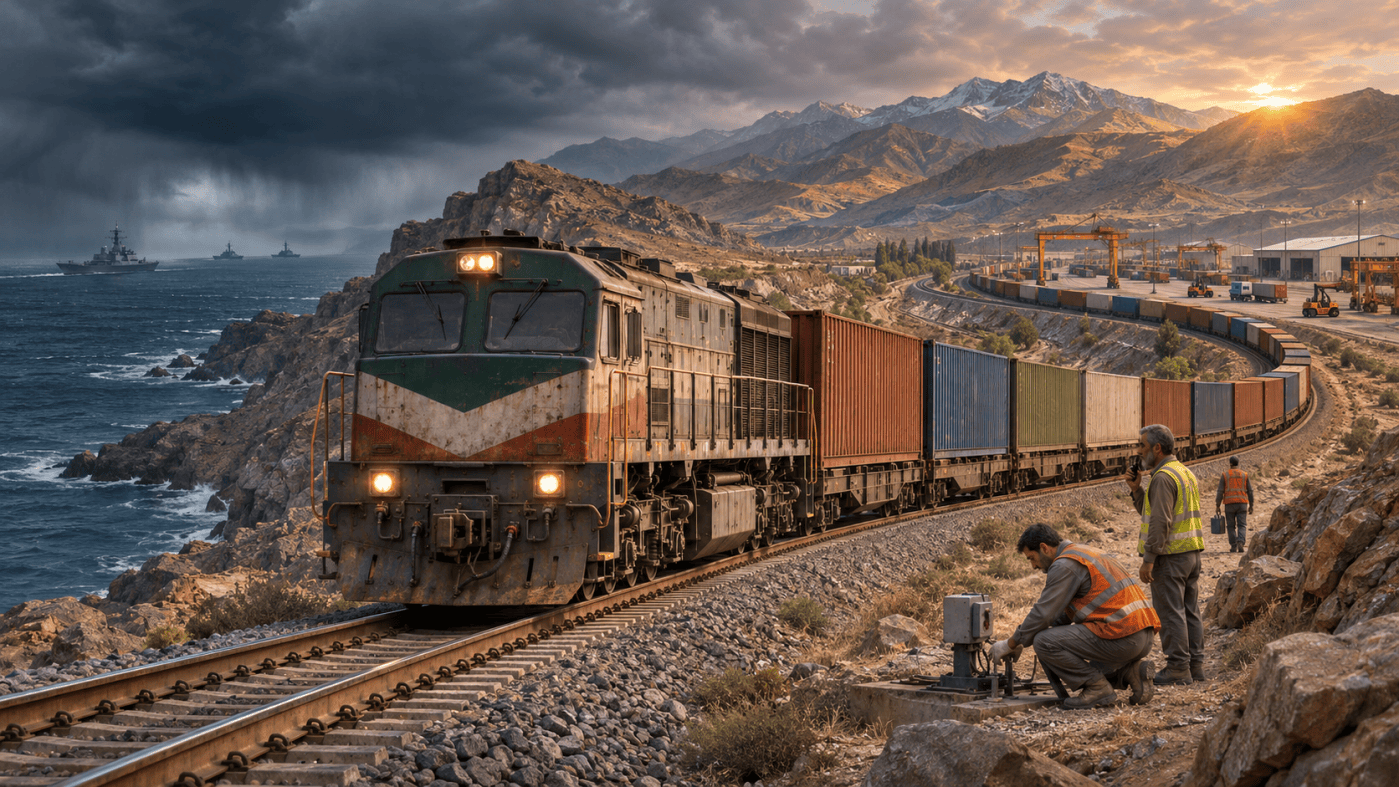
An October Iranian transport report quotes Peyman Sanandaji, chair of the Tehran Chamber’s transport commission, describing freight through Kazakhstan and Turkmenistan into Iran, including through Incheh Borun. He reported roughly daily service carrying fifty-four forty-foot containers and journeys of twenty-one to thirty days. His account acknowledged a Chinese holiday pause and planned resumption on October 14. Recurring services give importers an overland connection, though their capacity falls short of replacing the full volume previously moved by sea.
Outbound services have developed too. An ISNA account reproduced in Iranian provincial reporting records Qom’s first container export train to China. Governor Akbar Behnamjoo connected export development directly to earning foreign exchange for raw-material imports. He also described completed and planned connections between industrial areas and the railway network. Exporters need customers, and manufacturers need supplies; the provincial account joins those requirements to transport investment.
The North–South corridor supplies another set of connections, through western, eastern and trans-Caspian routes. On November 5, Russian reporting described engineering access along Rasht–Astara. Three days later, Deputy Roads Minister Hooshang Bazvand reported that Iran’s Supreme National Security Council had approved the railway agreement and the entire route was available for studies. That missing railway section remains unfinished, while the wider corridor combines different transport routes.
Goods also need payment. In 2024, Iran’s deputy central-bank governor described direct banking communications with Russia and transactions in rials or rubles. Linked messaging allows banks to communicate without SWIFT; completing a purchase still requires usable accounts, funds and settlement. June 2026 talks produced agreement to activate a permanent banking committee to advance cooperation and address obstacles. The countries are building financial channels alongside transport links, rather than relying on tracks alone.
Iran’s defence also rests on domestic manufacturing. A November 7 IRGC production statement described moving missile and drone production underground and continuing manufacturing during bombardment. Domestic production and foreign supplies can operate together; the statement doesn’t establish that every component is made inside Iran.
The Pakistani border shows how administrative obstruction affects regional trade. An October report from the crossings records resumed movement after a week-long suspension: food entering Iran and LPG entering Pakistan. Traders described Pakistani shortages and rising fuel prices. Iran’s ambassador blamed changes in payment-related documentation; the report also recorded security concerns and attacks on trucks. Reopening varied by crossing and direction. Clearance and paperwork can obstruct goods even where a road exists, and the resulting costs reach people on both sides.
III. The Siege Is a War on Iran’s Right to Develop
A shipment reaches its destination, but its journey doesn’t end at the unloading platform. An industrial input enters production. A finished product reaches a buyer. Export earnings help purchase what the next round of work requires. Workers return to their jobs, households obtain supplies, and another part of the country’s economic life continues. Washington’s siege attacks those connections. Behind the language of prohibited materials stands an attempt to make the ordinary work of sustaining a country depend on the permission of a government thousands of miles away.
That’s why the question of authority can’t be separated from the machinery of enforcement. A state can possess its territory, maintain its institutions and raise its flag while foreign power obstructs the relationships through which its people live. Ownership of a factory means less when somebody else can prevent its supplies from arriving or its payments from clearing. Washington seeks that power over Iran: the ability to turn economic dependence into political obedience. The country may retain its name, provided its future arrives with an American signature.
The distinction between weapons and economic life becomes especially useful to the siege commander because production connects them. Machines, materials, transport and technical knowledge sustain different activities across a society. Washington can invoke a military purpose while reaching into the productive foundations that make defence possible. The target expands from a shipment toward the capacity to manufacture, replenish and endure. Keeping a country functioning becomes grounds for further punishment. The accusation follows the supply chain until the economy itself appears in the dock.
This is how economic punishment reaches the working class. A delayed input can interrupt work well beyond the value of the missing item. Lost earnings can obstruct another purchase. A blocked payment can leave usable goods stranded while people wait for them. The pressure travels through wages, prices, production and access to necessities. Its consequences don’t stop at the office bearing a government seal. Workers encounter the siege through the conditions of daily life, while its architects describe the damage in the clean vocabulary of enforcement.
Iran’s preparation changes what Washington can accomplish through that pressure. Connections built over years give the country additional ways to obtain supplies, sell output and continue production. Domestic knowledge and manufacturing capacity help turn those supplies into further output. The political importance of a railway therefore exceeds the cargo counted on it. A route carrying a limited share of total freight can still help keep an indispensable part of the economy working. The decisive question concerns what its cargo allows people to continue doing.
That’s the material content of sovereignty in this struggle. Iran’s right to choose its path gains strength when the country possesses the means to continue along it under attack. Political refusal needs supplies, institutions and productive capacity behind it. Cooperation with China, Russia and neighbouring countries widens the ground on which that refusal can stand. A producer who obtains an input through another route, or an exporter who can receive payment through another channel, has more room to continue working despite Washington’s orders.
The difference lies in who can set the conditions of exchange. Every country needs goods it doesn’t produce, and obtaining them needn’t place its future under foreign supervision. The vulnerability deepens when indispensable purchases must pass through institutions an enemy can close. Building other connections reduces that enemy’s command. Multipolar development matters here because it widens the practical choices available to countries under siege. Its strength has to be measured in working arrangements: supplies delivered, payments completed and production sustained. Political declarations acquire weight through that work.
Washington pursues the alternatives because they frustrate its attempt to make submission compulsory. Banks, suppliers, transit authorities and neighbouring governments enter the field of pressure when they help preserve what the siege seeks to destroy. Hyper-imperialism operates through this combination of economic exclusion and armed force. The blacklist and the military operation press toward the same demand: submit, or face further obstruction. Functioning alternatives create pressure for a wider attack, although resistance, competing interests and diplomacy can constrain its reach. Expansion remains a danger to confront, rather than a fate already settled.
That pressure encounters other people’s interests. Trade sustains buyers as well as sellers. A restriction imposed against Iran can deprive a neighbouring household of supplies or a neighbouring producer of a market. The siege commander sees an enforcement partner; people across the border may see stranded goods, lost work and higher costs. Those interests help explain why cooperation with Washington must be secured through pressure and political decisions. The region contains governments, businesses and working people whose economic lives have purposes beyond carrying out American orders.
For Iranian workers, defending production and exchange means defending the possibility of continued social life against imperial destruction. The distribution of income, access to supplies and control over production remain matters of struggle within Iran. Foreign strangulation makes those struggles harder by attacking the capacities on which people depend. Washington acquires no right to starve a country because that country contains class divisions. Workers don’t gain power when an imperial navy decides whether their economy can function. The promise to punish their rulers arrives through machinery that reaches their own lives.
Iran can frustrate isolation while suffering serious damage. That possibility exposes the cruelty of the undertaking: Washington can fail to secure obedience and continue imposing pain. Its destructive capacity remains enormous, but destruction and command are different achievements. Iran’s accumulated capabilities and external connections contest the conversion of one into the other. They help keep the country’s future open against a power demanding the right to close it. For people living inside the state imposing this siege, that leaves a responsibility sharper than applauding Iranian endurance. Building organized opposition to the machinery threatening Iran is our work.
IV. Organize Against the Siege at Home
Treating Washington’s economic war as ordinary government business lowers its political cost. When a blacklist passes for law and the strangulation of trade passes for security, officials face less opposition to maintaining the siege. Our work begins by exposing that machinery and organizing people against it. The demands should be unmistakable: end the blockade, lift the economic siege, stop the attacks on Iran and end the punishment of countries that continue trading with it.
Bring those demands into a union meeting, a community organization or an existing political study group. Hold a focused discussion that follows the machinery: who orders the restrictions, how payments and supplies get obstructed, and whose lives bear the consequences. Use the documents behind the policy rather than another afternoon of trading opinions about Trump. Leave with people responsible for outreach, a date for the next meeting and a proposal for collective action. Political education earns its name when people become better equipped to organize.
The United National Antiwar Coalition offers an established route into that work. Its principles oppose sanctions and blockades, emphasize continuing education and mass mobilization, and invite organizations to affiliate. Its Iran action call urges groups to issue statements, rally their forces and organize against American aggression. Members can propose an anti-siege resolution in their own organizations, choose people to carry it forward and connect that commitment to wider coalition work. A resolution should establish responsibilities and participation, rather than decorate the minutes.
The Black Alliance for Peace’s Solidarity Network provides another route, including for non-Black individuals and organizations. Its work includes political education, public materials, meetings and participation in mobilizations. Take that work into the organizations you already belong to: prepare an explanation of the siege, arrange a discussion, recruit participants and help build coordinated turnout. Connecting these tasks gives a meeting consequences beyond the room and gives a demonstration organizers who’ll still be working after the signs come down.
Direct public pressure toward Treasury’s economic warfare and the officials defending the blockade. Name the attack on rail services and the punishment of trading partners instead of letting officials bury them beneath enforcement jargon. Carry demands to end those measures through demonstrations, speak-outs and organizational statements. The aim is to build a force that raises the political cost of this aggression and can sustain opposition when Washington widens it. Iran’s people are already carrying the burden of resistance. Here, ending the siege must become regular work in our unions, communities and political organizations. Take responsibility for that work, recruit others and keep the fight organized.


Leave a Reply