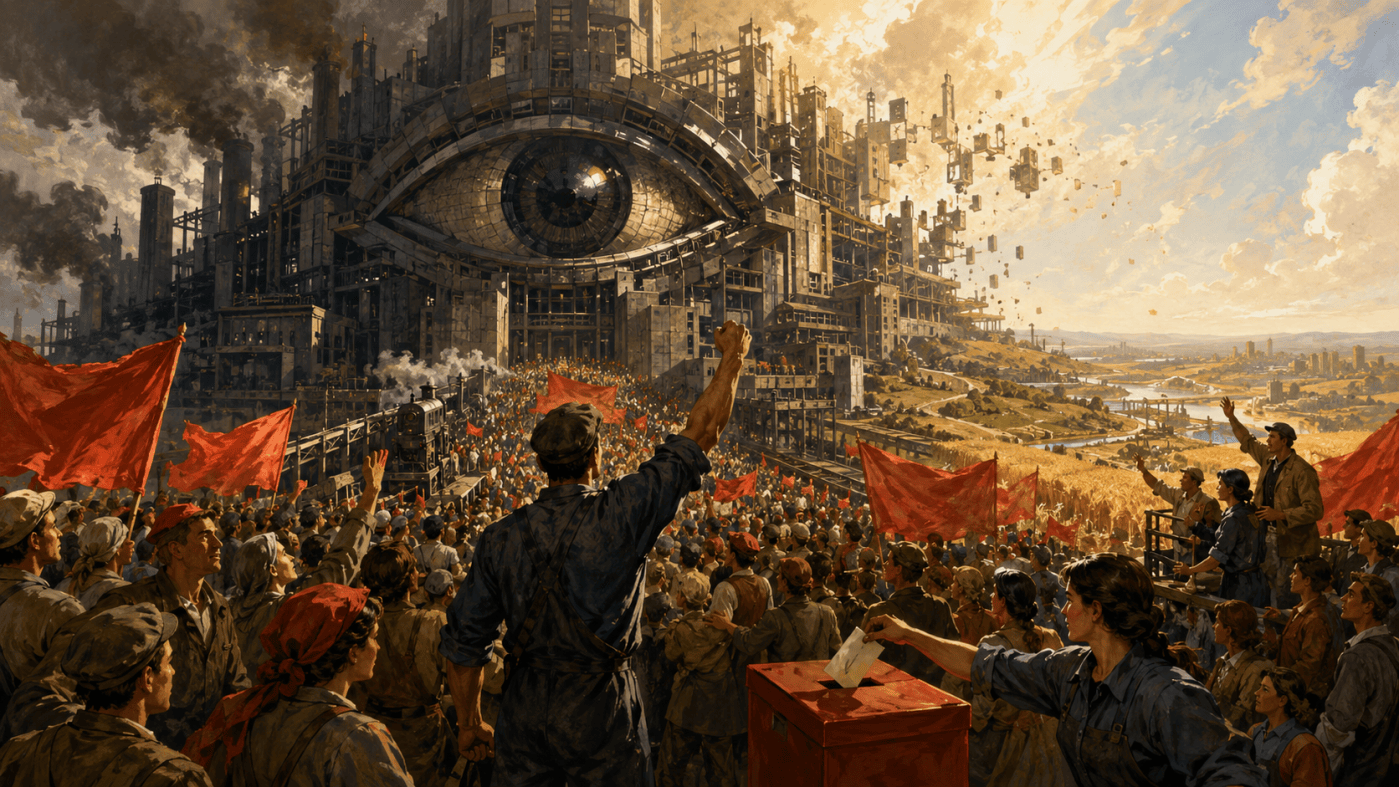
Capitalist democracy gives workers a vote while private property keeps vast fields of economic life under capitalist command; proletarian dictatorship begins when working people take political power to break that class rule. Socialist history then reveals a harder contradiction: revolution must concentrate enough power, knowledge, planning, and administration to transform society without turning those capacities into permanent powers standing over the producers themselves. From the Soviet worker-state problem through Yugoslav self-management, Maoist mass politics, Chávez’s communes, and the living experiments of China, Cuba, and Vietnam, the struggle becomes one of transferring effective governing power into the hands of associated producers at every necessary scale. Communism is not the disappearance of planning, expertise, or coordination, but the disappearance of their monopoly by a separate ruling power as society becomes increasingly capable of governing itself.
Prince Kapone | Weaponized Information
October 10, 2026
Democracy for a Class: The Lie Hidden Inside the Word “Dictatorship”
“Socialism always leads to dictatorship” sounds decisive because the accusation smuggles two different meanings into one word. In ordinary political language, dictatorship describes a form of government: political power concentrated in rulers who aren’t meaningfully subject to popular electoral removal, organized opposition, or protected political competition. Marxists use class dictatorship to identify something deeper: which class holds political supremacy and which property relations the state ultimately protects and reproduces. A parliament can be democratic in political form and bourgeois in class content. Collapse those two levels into one and the argument is rigged before socialism even enters the room.
Elections, civil liberties, unions, representative institutions, and rights of political opposition are real democratic gains. Working people fought for them precisely because they enlarge the terrain on which ordinary people can organize, contest power, and force concessions. Political equality changes how class struggle is fought. What it doesn’t automatically change is the ownership structure that keeps society divided into classes with radically unequal command over productive wealth. Universal citizenship can transform the political form of a society while leaving its underlying property relations intact.
Engels located the state inside that contradiction. In The Origin of the Family, he traced the state to societies divided by class antagonisms that could no longer be contained through older communal institutions. A specialized public power emerges from that conflict and presents itself as standing above society, administering a universal “order.” Yet the order has material foundations. Property has owners. Production places classes in different relations to one another. Law, taxation, courts, administration, and organized force operate inside that social structure rather than floating outside history as neutral institutions.
Engels was also more precise than the cartoon Marxism in which a handful of billionaires supposedly gathers in a smoke-filled room every morning to fax instructions to the government. He wrote that the state is “normally” the state of the economically dominant class while explicitly recognizing exceptional periods when contending classes can give political power greater room to maneuver between them. A bourgeois state can tax capitalists, regulate corporations, recognize unions, expand social provision, and adopt measures individual capitalists furiously oppose. Its class character lies deeper: the political order develops within, regulates, and reproduces a society organized around capitalist property, accumulation, and wage labor even while real struggles move through its institutions.
Class rule can’t be read backward from a constitutional label. A monarchy can defend capitalist property. A republic can defend capitalist property. Parliamentary institutions can widen popular participation while leaving ownership of productive wealth untouched. Different political forms mediate the same underlying class relations differently, and those differences can mean prison or liberty, exclusion or suffrage, illegal unions or protected organization. Political form matters enormously. It simply doesn’t exhaust the question of who rules socially.
The reverse is just as important. The phrase dictatorship of the proletariat never logically meant that socialism requires what contemporary political language calls a dictatorship. Engels made the difference almost impossible to miss. In his 1891 critique of the Erfurt Programme, he described the democratic republic as the specific political form through which proletarian class rule could emerge. Marxism’s term names the class content of political power. It doesn’t contain a secret constitutional instruction ordering one-party government, the abolition of elections, or any single timeless institutional shell.
History later produced a harder record. Communist Party predominance became recurrent across durable socialist revolutions, but it wasn’t produced everywhere by one universal mechanism. Revolutionary struggle repeatedly concentrated extraordinary organizational capacity in Communist movements; war and counterrevolution often strengthened pressures for political cohesion, while underground organization, armed struggle, coalition relations, rival parties, inherited institutions, constitutional choices, and post-revolutionary state-building shaped the resulting forms differently. Those political systems have to be explained from the concrete histories that produced them. Smuggling their later institutional forms backward into Marx’s use of the word dictatorship explains nothing.
The same material discipline applies to capitalism. Calling a country democratic tells us something real about elections, political rights, representation, and the possibilities available for popular struggle. It doesn’t tell us who owns the productive wealth, who commands investment, who controls the workplace, or how economic power enters political life. Bourgeois democracy is a real political achievement developing inside a society that remains divided between classes possessing radically unequal material powers.
That is the lie hidden inside the familiar comparison. “Capitalism is democracy; socialism is dictatorship” compares the political form of one system to the class content of another, then congratulates itself for winning the argument. Put both systems on the same level and the easy opposition collapses. Democracy has to be followed beyond the ballot itself—into the social institutions where people produce their lives, where property distributes authority, and where formal political equality meets the private power it hasn’t yet touched.
The Republic Doesn’t Enter the Factory: Where Capitalist Democracy Stops
The boundary Section I uncovered isn’t theoretical. It’s written into property law. Under Delaware corporate law, the business and affairs of a corporation are managed by or under the direction of its board. The worker may vote for president, governor, mayor, senator, school board, and ballot initiatives, then clock into an institution where no equivalent principle gives the workforce a vote over who directs production. Workers manufacture the goods, move the freight, maintain the machines, write the software, clean the buildings, and keep the enterprise alive. Ownership determines who possesses the governing authority. Political citizenship stops at the property line.
That authority reaches far beyond the supervisor assigning shifts. Corporate management decides what gets produced, where investment goes, which facilities expand, which close, when production moves, how work is reorganized, and whether new technology replaces labor. Some capitalist countries constrain managerial power more heavily than others, but American law makes the underlying property relation unusually clear. In First National Maintenance, the Supreme Court held that an economically motivated decision to terminate part of a business wasn’t automatically subject to mandatory bargaining with workers. A decision capable of eliminating jobs and reorganizing people’s lives can remain, in law, an entrepreneurial decision belonging to management rather than a democratic decision belonging to those who depend upon the enterprise.
Capitalism distributes more than income unequally. It distributes governing authority unequally. The worker enters public life as a formally equal citizen and production as somebody dependent upon access to property owned by somebody else. The factory, warehouse, mine, railroad, bank, hospital chain, logistics network, and corporate office become governments of a peculiar kind: institutions exercising command over labor and productive resources without deriving that authority from equal citizenship. Capital doesn’t need to abolish the ballot box to rule the working day.
Workers have never accepted this private government quietly. The labor upheavals of 1934 brought enormous strikes in Toledo, Minneapolis, San Francisco, the textile industry, and elsewhere, sharpening a crisis over union recognition and collective bargaining. The Department of Labor’s own history notes that those conflicts strengthened Senator Robert Wagner’s conviction that the country required a new labor policy. The resulting National Labor Relations Act explicitly recognized the unequal bargaining power between workers acting individually and employers organized through corporate ownership. Collective bargaining didn’t democratize capitalist property, but organized workers forced part of management’s unilateral authority onto contested terrain.
That’s important because bourgeois class rule doesn’t mean capitalists win every fight. Workers have won unions, wage protections, shorter hours, social insurance, safety regulations, public services, and legal restraints that individual employers fought bitterly. Popular organization can push a capitalist state into concessions, reforms, and institutional changes that materially improve working-class life. Yet those victories occur inside a property order that continually reproduces a class owning productive assets and another class that must gain access to those assets to work for a wage. The struggle can change the terms of command without automatically abolishing its property basis.
The political franchise itself was built through the same kind of struggle. American capitalism didn’t arrive carrying universal democracy under its arm. The Fifteenth Amendment formally prohibited racial discrimination in voting after the Civil War, but Southern ruling classes constructed poll taxes, literacy tests, intimidation, violence, and other means of stripping Black people of political power. The mass Black freedom struggle had to force federal intervention again, culminating in the Voting Rights Act of 1965. Capitalist development didn’t simply mature into Black political citizenship. Black people fought their way into a democracy that had denied them.
Indigenous history cuts still deeper because the republic expanded through the seizure of Native land while defining who could belong to the political community erected upon it. Congress didn’t broadly extend U.S. citizenship to Native Americans until the Indian Citizenship Act of 1924. This isn’t an identity footnote to a class argument. Land, property, conquest, racial classification, and citizenship developed together in the construction of the American republic. “The people” whose sovereignty liberal democracy celebrated was itself historically bounded, and excluded peoples had to struggle to widen it.
Even universal suffrage doesn’t equalize the material capacity to make political preferences effective. Martin Gilens’ study of policy responsiveness found that when lower- and higher-income Americans held different preferences, government policy responded much more strongly to affluent citizens. That doesn’t mean rich people mechanically dictate every law. It means one person, one vote coexists with profoundly unequal resources for turning wants into organized political pressure. Economic inequality doesn’t remain politely outside politics after Election Day.
Chile pushed the problem directly into the ownership of productive wealth. In September 1970, Salvador Allende won a 36.2 percent plurality in the presidential election. Because no candidate held an absolute majority, Chile’s Congress constitutionally chose between the two leading candidates and confirmed Allende on October 24. His Unidad Popular government pursued its declared constitutional road toward socialism, and in 1971 Congress unanimously approved the nationalization of copper, transferring the great copper enterprises into national ownership. Whatever strategic judgments one makes about the Chilean road, socialism had entered government through the existing electoral and constitutional order—and then began reaching into property.
Washington understood exactly what was at stake. Before Congress had even confirmed Allende, an October 1970 CIA instruction declared it a “firm and continuing policy” that he be overthrown by a coup while the American role remained concealed. That document doesn’t make the United States the mechanical author of every Chilean conflict or every force behind the 1973 coup. It establishes something devastating enough without exaggeration: a constitutionally operating socialist project threatened interests the leading capitalist power was prepared to defend outside the democratic rules it publicly celebrated.
Follow democracy from the polling station into property and bourgeois class power becomes concrete. The board controls the corporation. Management commands labor. Owners decide investment. Wealth enters politics with unequal force. Even the boundaries of citizenship were enlarged through struggle against people already holding property and political power. Workers and oppressed peoples have used bourgeois-democratic institutions to win enormous advances, but ownership continues to reserve vast fields of social decision-making for private command.
Cross that property line and the struggle changes character. Workers are no longer demanding only a better bargain from those who govern production. They are contesting who has the right to govern it at all. Once the class dependent upon wages moves to dispossess the class whose property gives it command over society’s productive life, political power can no longer remain bourgeois. Marx gave the power required to carry that transformation through a name bourgeois ideology has spent generations teaching people to fear: the dictatorship of the proletariat.
When the Working Class Takes Power: What the Dictatorship of the Proletariat Actually Means
Once workers move from bargaining with capitalist power to breaking the property relations that create it, class struggle enters a different stage. The factories can be expropriated. Banks can be socialized. Landlord power can be broken. The old ruling class can lose control of the state. None of this happens by politely persuading the dispossessed bourgeoisie that history has moved on. The working class needs political power capable of defending the new relations, suppressing attempts at restoration, reorganizing production, and carrying the transformation beyond the moment of seizure. Marx called that transition the dictatorship of the proletariat.
In the Critique of the Gotha Programme, Marx located it specifically between capitalist and communist society, during the revolutionary transformation of one into the other. The proletariat rules because the bourgeoisie hasn’t disappeared simply because its government has fallen. Property, wealth, social connections, managerial knowledge, international allies, old officials, and habits formed under the previous order don’t evaporate at midnight after a revolution. Political supremacy gives the working class the means to destroy the social relations through which capitalist power reproduces itself.
But Marx gave this transitional state an unusual destination. In the very discussion where he defended proletarian dictatorship, he insisted that freedom required converting the state from an organ standing over society into one subordinate to society. The point wasn’t to replace capitalist masters with an eternal government of professional rulers wearing red insignia. Working-class political power was supposed to transform the conditions that made specialized class domination necessary in the first place.
The Paris Commune had already given Marx and Engels a glimpse of what that could mean institutionally. Commune officials were elected, recallable, and paid workers’ wages. Engels later emphasized that these measures were meant to prevent public servants from becoming masters of society. Here proletarian power contains its own internal demand from the beginning: the working class needs institutions strong enough to defeat its class enemies, while those institutions must increasingly become answerable to the people whose power they exercise.
That political power wasn’t tied in Marxist theory to one permanent constitutional design. Lenin wrote in State and Revolution that the transition would produce a “tremendous abundance and variety of political forms” while retaining the same class essence: proletarian rule. What those forms looked like depended upon the revolution that actually occurred—its class composition, inherited institutions, level of development, alliances, enemies, and historical conditions. The dictatorship of the proletariat tells us which class must hold political supremacy during the transition. History still has to produce the institutions through which that supremacy becomes real.
Russia immediately made the problem more complicated than the slogan “majority rules.” The 1918 Soviet Constitution explicitly organized political power around workers, soldiers, peasants, and the poorest rural population while disenfranchising categories identified with exploitation and the old order. It also wasn’t ordinary one-person-one-vote democracy. Urban Soviets received representation at the All-Russian Congress at one delegate per 25,000 voters, while provincial congresses were represented at one delegate per 125,000 inhabitants. Political rights and representation were consciously weighted by class.
That form reflected a real social problem. Russia was overwhelmingly peasant. The peasantry couldn’t simply be renamed proletarian because it labored. Peasants could be exploited by landlords, creditors, and merchants while also possessing small property, producing commodities, hiring labor in some strata, and differentiating internally between poor, middle, and wealthy producers. Proletarian dictatorship in such a society depended upon political alliance, especially with poor and working peasants, rather than demographic arithmetic in which everyone who wasn’t a capitalist magically became the same class.
The Chinese Revolution confronted the problem on an even larger agrarian foundation. Mao’s 1949 On the People’s Democratic Dictatorship described the new political order as working-class leadership of a broad popular alliance, above all the worker-peasant alliance. Democracy operated among the people; coercive power was directed against forces attempting to overturn the revolutionary order and restore exploitation. The formula arose from China’s actual revolutionary bloc, not from pretending hundreds of millions of peasants were industrial workers.
Mao also refused to make the Communist Party or the revolutionary state eternal. In that same 1949 text, he argued that once classes disappeared, the instruments produced by class struggle would lose their function: state power would no longer be needed as an organ of class coercion, and political parties would disappear with the social antagonisms that had made them necessary. The Party’s historical justification was bound to a transition whose communist success would eventually abolish the conditions requiring a ruling Party at all.
This is the peculiar direction of proletarian dictatorship. Bourgeois power reproduces the property relations that continually recreate bourgeois and proletarian classes. Proletarian power is supposed to destroy those relations. It rules in order to eliminate exploitation, socialize the decisive means of production, prevent capitalist restoration, and create a society in which no separate exploiting class remains to be suppressed. It is class rule aimed at abolishing the conditions of class rule.
Political victory, however, solves only the first problem. A working class can overthrow owners faster than it can erase inherited divisions of knowledge and labor. Railways still have to run. Grain has to move. Factories require coordination. Hospitals need administration. Engineers possess skills that can’t be distributed by decree. Budgets have to be written, armies commanded, records kept, plans calculated, and millions of decisions connected across an entire society. A class can seize political power faster than it can acquire all the capacities needed to administer society.
The Revolution Wins—and the Contradiction Moves Inside
Political victory doesn’t erase the society capitalism left behind. Marx warned that the first phase of communist society emerges still stamped by the birthmarks of the old order, and among the hardest of those inheritances is the division between people who possess specialized knowledge and people whose labor has historically been organized by others. The capitalist can lose legal title to a socialized factory overnight. The workers can’t acquire every engineering skill, accounting system, logistical network, administrative routine, and body of accumulated technical knowledge overnight with it. The revolution has conquered political power. Governing an entire society is another material problem.
That problem concentrates capacities because production is already social. Railways don’t coordinate themselves factory by factory. Power grids connect regions. Steel becomes machinery somewhere else. Hospitals require national supplies, public health requires information beyond one neighborhood, and industrialization requires society to decide which investments happen first. Lin Chun’s reconstruction of Chinese socialism places this problem inside socialist modernization itself: national development, accumulation, redistribution, and large-scale social provision required institutions capable of coordinating resources across an enormous and uneven country. Bureaucratic expansion can’t be explained only as old officials surviving the revolution. Socialist construction generates administrative work of its own.
Scarcity gives that administration leverage. When machinery, housing, investment funds, skilled labor, consumer goods, and public resources are limited, somebody has to allocate them. Lin’s account of people’s democracy and bureaucracy makes the material relation concrete: administrative institutions acquired enormous influence through their role in distributing jobs, goods, services, rewards, and penalties. Scarcity doesn’t mechanically create bureaucratic domination. It does make control over allocation a form of social power. The ministry has the investment budget. The planner has the production figures. The cadre influences appointments. The people waiting for the allocation don’t possess the same power merely because the property being allocated is publicly owned.
Knowledge concentrates differently. The engineer understands a chemical process the shop floor hasn’t yet mastered. The statistician can compare output across hundreds of enterprises. The planning office has information no individual factory possesses. The manager knows where inputs are coming from and which orders can’t be delayed. Technical specialization is indispensable; abolishing expertise would cripple the very working class socialism is supposed to empower. The danger appears when specialization becomes a permanent social division—when one group repeatedly knows, calculates, interprets, and decides while another repeatedly receives instructions and executes them. Marx’s communist horizon required overcoming precisely the entrenched division between mental and physical labor, not pretending technical differences could be wished away.
Organizational continuity adds another layer. Revolutionary institutions can’t begin from zero every morning. Ministries need institutional memory. Industrial systems need experienced administrators. Parties need cadres who remember defeats, victories, alliances, errors, and strategic lessons. Yet the people who accumulate experience can also acquire control over who gains access to experience. Administrative ranking, appointment systems, differential access to information, and professional careers can make necessary continuity reproduce a durable hierarchy. Lin’s account of socialist administrative differentiation is valuable precisely because she doesn’t reduce the problem to corrupt personalities. The contradiction grows out of institutions performing socially necessary functions.
Bureaucracy, then, is more than an official with a bad attitude and a desk full of stamps. Engels had already identified the political danger when he warned that public organs created as servants of society could become masters over society. Under socialism, the problem acquires a new material form. The manager controls the labor process. The planner sees information workers don’t. The cadre influences who receives responsibility. The ministry decides whether money moves. Administrative separation develops when those necessary functions become powers that the producers can’t effectively penetrate, supervise, correct, or increasingly learn to exercise themselves.
None of this makes the administrator automatically bourgeois. A state-enterprise manager who can’t sell the plant, bequeath it as private property, or legally appropriate its profits as an owner occupies a different property relation from the capitalist. A planner allocating public investment isn’t a banker lending privately owned capital for profit. Bureaucratic privilege can deepen, administrative power can become socially entrenched, and under some conditions public authority can help open paths toward private appropriation. But collapsing administrator, bureaucrat, technocrat, and bourgeois into one word hides the transformation we actually need to understand.
The sharper measure is what relationship the producers have to the property already socialized. Minqi Li’s account of Mao-era socialism places the disposition of the social surplus directly inside the class relation. Workers and peasants could accept substantial sacrifices for accumulation when they believed the surplus they produced served their collective long-term interests. That political identification depended on more than state title. Li emphasizes the Maoist claim that workers should participate in managing enterprises, the state, education, and cultural life. Public ownership answers who no longer privately owns the factory. It doesn’t by itself answer who can understand the plan, challenge the director, supervise the administrator, or shape the use of society’s surplus.
This is also where Party leadership can either deepen proletarian power or begin substituting for it. A revolutionary Party concentrates theory, political memory, organization, and strategic experience because capitalism doesn’t spontaneously equip an exploited class with everything required to defeat a ruling order and reorganize society. That concentration serves a proletarian purpose when it multiplies governing capacity outside the professional cadre layer—training new organizers, circulating information, drawing workers into administration, investigating conditions among the masses, and creating institutions through which policy can be corrected. A Party that permanently monopolizes initiative produces a different relation. A vanguard that teaches the masses to rule strengthens proletarian power. A vanguard that makes itself permanently indispensable reproduces the distance communism is supposed to abolish.
The stakes aren’t merely philosophical. Zhun Xu’s study of the contradictions of rural collectives found that cadre-peasant and manager-worker stratification could weaken peasants’ identification with collective institutions, contributing to passivity when those institutions later came under attack. Xu doesn’t claim bureaucratic stratification mechanically caused decollectivization; the dismantling itself was overwhelmingly driven through political decisions from above. His narrower finding is more useful here: social property becomes politically vulnerable when the people who supposedly own it collectively experience its administration as something increasingly separate from them.
A socialist state can consequently become extraordinarily capable while producer sovereignty develops much more unevenly. It can industrialize, defend the revolution, coordinate investment, expand education, redistribute resources, and transform productive property on an immense scale. Those capacities are real achievements. They don’t tell us by themselves whether workers can obtain the information behind a decision, alter a plan, remove a director, challenge an appointment, supervise officials, or acquire the technical knowledge required to govern without permanent tutelage.
The revolution has moved the contradiction inside its own institutions. The very capacities concentrated because working people don’t yet possess them evenly—technical knowledge, planning information, administrative continuity, appointments, allocation, political organization—can become harder for working people to acquire because they remain concentrated. The workers’ state can remain proletarian in class direction while workers still confront officials and institutions acting in their name. Once that possibility exists, declaring the proletariat the ruling class isn’t enough. History has to show what happens when workers meet their own state across the desk.
When the Workers’ State Stands Across from the Workers: The Soviet Warning
The Russian Revolution was where the contradiction stopped being theoretical. Workers didn’t overthrow the old state merely to exchange one cabinet for another and wait for socialism to descend through ministerial orders. Factory committees, Soviets, unions, soldiers’ committees, and other organs of mass action had grown through the revolutionary struggle itself. The November 1917 Decree on Workers’ Control gave elected worker bodies substantial powers inside enterprises: they could inspect production and finances, examine company books and correspondence, supervise owners, and issue decisions binding upon them. Workers who had spent their lives receiving orders were beginning to acquire institutional power over production.
The political order surrounding them wasn’t born as the finished one-party system later associated with Soviet history. The Bolsheviks sought cooperation with the Left Socialist-Revolutionaries, whose strength lay especially among the peasantry, and Lenin publicly argued in November 1917 for an “honest coalition” linking the proletarian revolution to the working and exploited peasantry. The Left SRs entered Soviet government in December, taking several commissariats, then resigned from the Council of People’s Commissars over the Brest-Litovsk peace in March 1918 while remaining active in Soviet institutions. Coalition, Party strategy, peasant representation, and the direction of the revolution were still being fought out inside the new order. Communist Party predominance wasn’t sitting fully formed inside the phrase dictatorship of the proletariat.
Another collision came through the Constituent Assembly. Elected before the full political consequences of October had worked themselves through the country, it met in January 1918 with a majority unwilling to recognize Soviet power as the supreme state authority. After the Bolsheviks and Left SRs departed, the Soviet government moved to dissolve the Assembly. Lenin defended that decision in class terms: Soviet power represented a revolutionary transformation in property and state authority that couldn’t simply be subordinated again to an institution elected under the preceding political alignment. Competing institutions were claiming democratic legitimacy while pointing toward incompatible forms of class power. Soviet political narrowing emerged through struggles like these, not through a constitutional commandment requiring socialism to abolish every rival political organization.
Then political conflict became a war for survival. Anti-Bolshevik armies fought across the former empire while foreign powers intervened materially against Soviet rule. The United States’ own 1918 diplomatic record documents Allied military intervention, support for anti-Bolshevik forces, the occupation of Archangel, and the deployment of American troops. The revolution wasn’t designing its political institutions in a seminar room. It was trying to keep cities fed, armies supplied, trains moving, and factories operating while armed enemies attempted to destroy the new state.
War pushed authority toward concentration, but war can’t carry the whole explanation. Russian industry was devastated. Transport had broken down. Skilled technicians and experienced administrators were scarce. The working class had inherited an economy in which generations of producers had been deliberately excluded from much of the knowledge required to coordinate complex enterprises. Lenin’s own record blocks the convenient excuse that managerial centralization was simply imposed by the Civil War. In April 1920 he defended one-man management, strict labor discipline, and concentrated authority inside production—and explicitly recalled that the dispute over individual management had already arisen in 1918, before the Civil War had fully developed.
That matters because the pressure toward administrative command came from two directions at once. The revolutionary state needed emergency cohesion against enemies trying to kill it. It also needed engineers who could operate industrial systems, accountants who could reconstruct finances, managers who could coordinate factories, and administrators who could connect individual workplaces to an economy in collapse. Worker control had opened the owner’s books and broken the capitalist’s unquestioned authority. Reconstruction now exposed how much governing knowledge the old society had monopolized outside the working class. The revolution needed expertise precisely when workers were trying to become masters of production themselves.
Communists fought over how to resolve that contradiction. The Workers’ Opposition, associated especially with Alexandra Kollontai and Alexander Shlyapnikov, attacked bureaucratic suppression of workers’ initiative and demanded much greater authority for organized producers, particularly the trade unions, in economic administration. Kollontai’s argument wasn’t a call to restore capitalist ownership or surrender Soviet power to bourgeois parliamentarism. It came from inside the communist project: if this was the dictatorship of the proletariat, then the proletariat had to become increasingly capable of administering the economy rather than remaining permanently subordinate to specialists appointed in its name.
The Bolshevik leadership rejected that institutional answer while acknowledging much of the disease the Workers’ Opposition had identified. The March 1921 Tenth Party Congress met amid economic collapse, peasant crisis, the Kronstadt revolt, bitter internal factional struggle, and the turn toward the New Economic Policy. Its formal resolution “On Party Unity” ordered the immediate dissolution of organized factions, explicitly naming the Workers’ Opposition and Democratic Centralists. The leadership feared that factional organization under those conditions could be exploited by forces seeking to overthrow Soviet rule. Yet the very same resolution ordered continuing struggle against bureaucratic practices and called for the extension of democracy and workers’ initiative. Political contestation inside the ruling Party was narrowed while the Party itself admitted that bureaucratic command was becoming a danger.
Nothing in that sequence was mechanically inevitable. Civil war and foreign intervention created extraordinary pressures. Economic ruin and technical scarcity created others. The Bolshevik leadership made political choices about how to respond, and those choices altered the institutions through which later disagreement could be organized. Temporary emergency, administrative necessity, revolutionary strategy, and institutional consolidation became tangled together. Explaining the pressures doesn’t require pretending every resulting restriction was the only possible response to them.
Lenin himself refused to hide the outcome behind the label “workers’ state.” During the trade-union controversy at the end of 1920, he described Soviet Russia as a workers’ and peasants’ state suffering from “bureaucratic distortion”. He then insisted that organized workers still required protection against abuses arising through their own state power. That formulation only appears paradoxical if a proletarian state is imagined as the proletariat magically personified. For Lenin, workers could politically own the revolutionary state and still confront administrators exercising authority over them inside it.
By 1923 the problem looked even uglier. In How We Should Reorganise, Lenin described the administrative system as inherited substantially from the old order and only inadequately remade, while calling for far greater worker and peasant participation in supervising and renovating it. Capitalists and landlords had been stripped of political supremacy. Tsarist routines, trained personnel, administrative habits, and unequal access to governing knowledge had proved much harder to uproot. Political expropriation had moved faster than the socialization of administrative capacity.
This is the Soviet warning in its sharpest form. The workers’ state could stand across the desk from workers without ceasing, by that fact alone, to be a workers’ state. Its class character couldn’t make bureaucratic conflict imaginary, while bureaucratic conflict couldn’t by itself prove that bourgeois rule had already been restored. What Lenin left behind was something more difficult: a revolutionary state that had survived invasion and civil war, socialized decisive property, and accumulated growing administrative powers while its own leaders openly admitted that those powers weren’t yet adequately subordinate to the workers and peasants in whose name they operated.
And that was still the state of scarcity and wreckage. The unresolved contradiction was about to enter a radically different environment. The Soviet Union would build factories, collectivize agriculture, train millions of specialists, construct planning institutions, and acquire a capacity to reorganize social life on a scale the exhausted revolutionary state of 1921 could barely imagine. The bureaucracy Lenin confronted as weakness, inheritance, and distortion wouldn’t remain weak. Socialist construction itself was about to make the state enormously more powerful.
Power From Above, Judgment From Below: Stalin Between Collectivization, Constitution, and Terror
Lenin died confronting a workers’ state weakened by economic ruin, inherited administration, and scarce technical capacity. The Stalin period transformed that problem. Beginning at the end of the 1920s, the Soviet leadership used concentrated state power to collectivize agriculture, redirect resources toward industrial accumulation, expand heavy industry, train specialists, build planning institutions, and reorganize the material foundations of the country. The result was an enormous increase in productive and defensive capacity—but also in the number and reach of planners, managers, collective-farm administrators, Party secretaries, economic ministries, and security institutions required to carry the transformation through. The bureaucracy Lenin had feared was no longer simply debris inherited from tsarism. Socialist transformation itself was producing new layers of administration.
The countryside revealed the violence and instability inside that process. Collectivization transformed agrarian property while peasants responded differently according to class position, local conditions, and their relation to procurement and collective farming. Resistance, livestock slaughter, concealment, administrative coercion, deportation, policy errors, and disruption of production all entered the struggle. The famine of 1931–33 can’t responsibly be reduced to one cause. Stephen Wheatcroft’s multicausal reconstruction identifies harvest failures and agro-environmental problems alongside harsh grain procurement, collectivization’s disruption, depleted reserves, rapid industrial demands, and the leadership’s inadequate response as the crisis deepened. The catastrophe wasn’t an incidental backdrop to the administrative order that followed. It was one of the experiences that made the problem of regularizing that order unavoidable.
The Soviet system didn’t simply continue the most convulsive methods of 1929–33 unchanged. The years immediately afterward brought a partial stabilization. Davies, Khlevniuk, and Wheatcroft document economic recovery and greater regularity during the years 1934–36, while bread rationing ended and agricultural institutions became more settled. The 1935 collective-farm charter fixed the kolkhoz more firmly as an institution while preserving bounded household plots and personally held livestock within collective agriculture. None of this erased the violence through which collectivization had been accomplished. It meant the leadership was now administering a transformed social structure that could no longer be governed indefinitely as though every day were the emergency of 1930.
The 1936 Constitution emerged inside that attempted normalization. Its electoral provisions were a substantial break with the earlier Soviet system: universal, equal and direct suffrage by secret ballot replaced class-weighted, multistage voting; previous restrictions based on social origin, property status, or past activity were removed except where a court sentence deprived an individual of electoral rights. Party organizations, trade unions, cooperatives, youth organizations, and cultural societies could nominate candidates, while deputies remained recallable by electors. The same Constitution explicitly named the Communist Party the leading core of working people’s organizations and conditioned political liberties upon the interests of the working people and the strengthening of socialism. This wasn’t a conversion to bourgeois multiparty parliamentarism. It was an attempt to widen socialist citizenship inside continued Communist political supremacy.
People didn’t merely receive the draft from Moscow and applaud on cue. Samantha Lomb’s archival reconstruction estimates that more than 42 million people participated in constitutional discussions and that over 43,000 proposed amendments were submitted. The discussion didn’t substantially rewrite the constitutional structure, which remained centrally authored. But in the local and regional records Lomb studied, citizens used the language of the draft to raise questions about voting, pensions, education, working conditions, collective-farmer rights, and the accountability of deputies. A constitutional opening created political claims the center couldn’t completely script once ordinary people began speaking through it.
Stalin himself gave the electoral reform an explicitly anti-bureaucratic meaning. Asked by Roy Howard in March 1936 how meaningful elections could exist without rival political parties, Stalin rejected multiparty competition but insisted that non-Party organizations could nominate candidates and predicted lively contests in which voters would judge officials by schools, housing, working conditions, and the practical quality of administration. His most revealing formulation was that universal and secret voting would become a “whip” in the population’s hands against government organs that worked badly. The secret ballot mattered because a local official could no longer know with certainty whether the people dependent upon him had voted to keep him.
The pressure then moved inside the Communist Party itself. At the February–March 1937 Central Committee plenum, Andrei Zhdanov attacked cooptation, prearranged candidate lists, open voting, stale committees, and procedures designed to insulate officials from criticism. His proposed reforms required secret individual ballots, election rather than cooptation of Party bodies, free criticism of nominees, and the right to reject candidates. Stalin subsequently reiterated the order personally when Ukrainian Party leader Stanislav Kosior asked whether the requirement really applied: “Conduct all elections by means of secret voting.”
These rules weren’t completely decorative. J. Arch Getty’s archival work on the 1937 Party elections found substantial turnover in lower Party organizations as secret ballots and contested internal candidacies displaced large numbers of incumbents. That doesn’t prove that rank-and-file Party voting transferred control of Soviet political line to workers. It proves something narrower and still powerful: officials who had previously protected themselves through cooptation, list voting, and visible ballots could now lose office when members were allowed to vote against them without announcing the fact publicly. Socialist democracy was capable of making a bureaucrat lose his chair.
The reform also reached the relationship between Party leadership and administration. In his March 5 reply to the plenum, Stalin criticized Party organizations for superseding economic and state bodies, especially agricultural organs, and insisted that Communist leadership should operate by strengthening those institutions and guiding economic work through them rather than over their heads. He wasn’t proposing that the Party abandon leadership of the economy. He was attacking a form of substitution in which the Party secretary’s office became the actual headquarters of administration and the formally responsible Soviet or economic body lost both authority and responsibility.
How far the leadership intended to push electoral competition outside the Party remains contested. Getty argues from archival preparations that the Stalin leadership seriously prepared for contested candidacies and saw the new electoral system partly as a weapon against entrenched regional leadership networks. Khlevniuk’s archival interpretation is more skeptical that the evidence establishes a settled program for genuinely alternative national candidacies and rejects efforts to make regional bureaucrats the hidden masters who forced Stalin into Terror. The secure historical ground lies between the heroic and demonic caricatures: an anti-bureaucratic constitutional and electoral campaign was real; Stalin supported it; internal Party reforms had concrete effects; none of that removed the political center’s command over the institutions of repression.
And there the contradiction became brutal. Article 127 declared the person of every Soviet citizen inviolable and specified that nobody could be arrested except by decision of a court or with the sanction of a procurator. Less than a year after the Constitution was adopted, NKVD Order 00447 initiated a mass operation against broad categories of former kulaks, former Whites, alleged anti-Soviet elements, clergy, criminals, and others. Its procedure classified people into categories for execution or imprisonment and routed cases through extraordinary troikas rather than ordinary judicial proceedings. The collision doesn’t need rhetorical enhancement: a Constitution promising legally regulated arrest and a security order organizing mass extrajudicial repression operated under the same socialist state.
Security fears weren’t imaginary inventions floating outside history. The USSR faced an increasingly hostile international environment, the rise of Nazi Germany, Japanese expansion, espionage fears, internal conspiracy allegations, and a political leadership convinced that war was approaching. Those pressures help explain why security acquired such enormous weight. They don’t prove that every arrest, deportation, imprisonment, or execution flowing from them was necessary, nor do they transfer responsibility from the center to some abstract “bureaucracy.” The central leadership authorized the mass operations. The state that was trying to make administrators more answerable through ballots was simultaneously empowering security organs to bypass the legal restraints those ballots were supposed to reinforce.
The December 1937 Supreme Soviet election revealed which tendency had prevailed institutionally. The constitutional provisions for universal, equal, direct, secret voting remained. But the actual national contest became effectively uncontested, with one approved candidate per seat rather than the competitive candidacies Stalin had publicly described in 1936. A contemporary U.S. Embassy assessment likewise reported that single-candidate nominations kept the election firmly under existing political control even while acknowledging that the introduction of the secret ballot had significance. The democratic reform had been neither imaginary nor victorious. It had been contained.
Stalin belongs inside both sides of this history. He supported broader suffrage, secret voting, electoral accountability, internal Party elections, and attacks on administrative substitution. He also led the political center that sanctioned mass repression and maintained the concentrated institutions capable of overriding the legality his government had just constitutionalized. Turning him into bureaucracy personified explains away the democratizing record. Turning him into a democrat defeated by an alien bureaucracy explains away central responsibility for repression. A revolutionary leadership can fight bureaucratic insulation through one set of institutions while reproducing administrative separation through another.
The limit reached here was deeper than a badly designed ballot. Constitutional rights, recall, Party elections, and secret voting could discipline officials, but their continued operation still depended heavily upon institutions concentrated at the center. The people could be given more power to judge administrators without yet possessing equivalent power over the conditions under which that judgment remained possible. What remained unresolved was whether administration itself—not merely the officials occupying it—could be reorganized so that workers became ordinary participants in directing production rather than periodic judges of a specialized hierarchy.
The Council Isn’t Enough: Yugoslavia and the Limits of Self-Management
The Soviet experience had shown how difficult it was to discipline an enlarged socialist administration once decisive capacities had become concentrated inside it. Yugoslavia attacked the problem from another direction. Its revolutionary state had itself emerged through a mass Partisan war rather than simply being installed after liberation. The Second Session of AVNOJ in 1943 declared the bodies created through the liberation struggle the foundation of a new federal Yugoslav state and constituted AVNOJ as the supreme legislative and executive representative authority. By victory in 1945, the Communist-led movement had accumulated its own army, territorial institutions, political legitimacy, and administrative experience. The Party’s predominance had been forged through the revolutionary struggle before it became the settled political structure of the postwar state.
Then came the 1948 rupture with the Soviet bloc. The Cominform resolution denounced Tito, Kardelj, Djilas, and Ranković and effectively expelled the Yugoslav leadership from the Communist camp organized around Moscow. The split brought economic isolation, political pressure, and fear of Soviet military intervention. Yet Yugoslavia’s response is precisely why insecurity can’t be made into a universal explanation for socialist centralization. Under severe external pressure, the Yugoslav leadership moved toward a major decentralization of economic administration. Security pressure created constraints. It didn’t dictate one institutional answer.
The decisive move came in June 1950. The Basic Law on Management declared that factories, mines, transport systems, commercial enterprises, and other state economic property were to be managed by workers’ collectives “in the name of the community.” Workers elected councils by direct secret ballot and could recall them. Councils elected and removed management boards, approved enterprise plans and final accounts, reviewed management, and decided how to distribute the portion of accumulation left at the enterprise’s disposal. At least three-quarters of management-board members were to be workers directly engaged in production. This wasn’t consultation dressed up as socialism. Governing authority had moved materially into the workplace.
But the original law also shows how incomplete the transfer was. The enterprise remained inside the state economic plan. Directors initially could be appointed by higher economic associations or competent state organs, and they retained direct authority over production, employment, and implementation of state directives. Workers’ councils could recommend removal of directors and exercise important supervisory power, but the director remained connected upward to institutions outside the enterprise. Self-management began as a real redistribution of administrative authority inside a still much more centrally coordinated economy.
Yugoslav leaders understood the experiment as a process of making workers capable of governing rather than merely turning formal ownership over to them. At the first national congress of workers’ councils in 1957, Tito described the reform as a “democratisation in the economy” intended to expand worker participation in management, development, and distribution. He directly addressed the earlier skepticism that a young working class, much of it recently drawn from the countryside and lacking inherited technical experience, could administer complex enterprises. The wager of self-management was that governing competence grows through governing. Workers weren’t supposed to wait until some administrator certified them as ready.
That institutional order changed repeatedly over the following decades. Yugoslavia didn’t operate one frozen “self-management model” from 1950 onward. Direct state allocation weakened, enterprises gained greater autonomy, social ownership displaced the simpler idea that every productive asset was merely property of the central state, and markets and financial institutions acquired larger coordinating roles. A contemporary IMF reconstruction of Yugoslav banking recorded both sides of that transformation: elected workers’ councils exercised substantial enterprise authority, while regulations governing taxation, social contributions, amortization, credit, and reserve funds continued to limit what any one council could do with the income its enterprise produced.
That is where the Yugoslav breakthrough produced a harder problem. Imagine a steel plant governed by its workers. Its council can debate production, scrutinize management, choose representatives, decide how part of its net income should be divided between personal incomes and reinvestment, and force administrators to answer for enterprise decisions. That is a profound break with capitalist workplace government. But the steelworkers can’t, through their factory council alone, decide how much of society’s total investment should go to steel rather than railways, housing, hospitals, agriculture, or electrical generation. They can’t determine by themselves whether scarce resources should develop an already industrialized region or be transferred toward a poorer republic. The worker council had broken one wall of administrative separation. Behind it stood the larger economy.
Decentralization didn’t abolish whoever stood behind that wall. It changed them. Ministries lost some direct command while banks, enterprise managers, republic-level institutions, market competition, and financial mechanisms acquired greater weight. The same banking record shows how Yugoslav reforms shifted investment away from direct budgetary grants and toward investment funds, bank credit, and increasingly decentralized financial decisions. A factory could be self-managed and still depend upon credit controlled elsewhere. Workers could remove a management board yet remain unable to command the financial relations deciding whether a major expansion was possible in the first place.
Managers and specialists also didn’t disappear when councils appeared. Retrospective research on the Yugoslav factory found workplaces where directors retained considerable practical authority, sometimes building strong support among workers precisely because managerial expertise could secure investment, contracts, employment, and enterprise success. Workers possessed institutional rights while professional managers possessed information, networks, and technical competence that could give them disproportionate influence over how those rights were exercised. Democratizing the organization chart didn’t automatically socialize the knowledge accumulated inside it.
Market reform created another pressure. Greater enterprise autonomy meant workers could capture more of the benefits of successful production, but enterprises also faced each other more intensely as competing economic units. Profitable firms acquired different possibilities from weaker ones. Richer regions possessed advantages poorer regions lacked. A contemporary assessment of Yugoslav self-management credited the system with substantial democratizing effects while finding that it hadn’t eliminated major economic differences among the republics. Enterprise self-government could deepen worker power locally while market success and inherited regional development pulled resources unevenly across the federation.
Yugoslavia tried to solve precisely these limits rather than simply accepting them. The 1974 Constitution carried self-management far beyond the original factory council. Basic organizations of associated labor became building blocks of the economic system. Delegations originating in workplaces, local communities, and other self-managing organizations were connected upward into assemblies. The Constitution sought to coordinate common economic and political decisions through self-management agreements, social compacts, associated labor, republics, provinces, communes, and federal institutions. Its architects explicitly described socialist self-managing democracy as the historical form of the dictatorship of the proletariat appropriate to Yugoslavia’s stage of development.
This was an attempt to solve the problem of scale without surrendering either pole. Workers weren’t supposed to retreat into autonomous factory islands. Society still needed planning and coordination. Research on Yugoslav self-management planning describes the later system as an effort to reconcile decentralized decision-making with macroeconomic coordination through participatory planning rather than simply restoring the old command hierarchy. The ambition had become much larger than industrial democracy: producers organized in separate workplaces were supposed to associate their decisions across the economy itself.
Political power remained more concentrated than that constitutional ambition might suggest. The 1974 constitutional materials continued to assign a decisive strategic role to the League of Communists, even while rejecting direct Party administration as the ideal form of socialist leadership. Yugoslav Marxists associated with Praxis attacked precisely this gap from inside the socialist project. One Praxis critique argued that self-management had penetrated production and distribution far more deeply than political decision-making, where the established political organizations and their leadership still retained decisive authority. Another warned that bureaucracy survived alongside self-management because social power had not yet been fully reconstructed through self-governing institutions.
Yugoslavia proved something enormous without proving everything its defenders hoped. Workers could manage complex modern enterprises. Councils could exercise real authority, elect and recall governing bodies, scrutinize management, and learn administration through practice. The answer to bureaucracy wasn’t condemned to be periodic correction from the summit of the state.
But workplace sovereignty wasn’t yet social sovereignty. The producer who governs the steel plant still lives inside relations of credit, investment, regional redistribution, market exchange, technical expertise, federal planning, and political leadership that no isolated council commands. Associated producers can’t simply mean separate groups of workers governing separate enterprises. They have to acquire effective power over the relations connecting those enterprises into a society—and over the institutions deciding who possesses the knowledge and political authority required to make those decisions. The factory council had taught workers that they could govern production. It hadn’t yet settled who would govern the powers beyond the factory gate.
Bombard the Headquarters: Mao and the Attempt to Revolutionize Proletarian Power
Yugoslav self-management had pushed worker power into ordinary enterprise administration. Its limits exposed another layer of the problem. Workers could elect councils and scrutinize management while banks still shaped investment, specialists still monopolized knowledge, and political authority remained concentrated elsewhere. Maoist China attacked that division at a different point. The issue wasn’t simply whether workers could manage a factory. It was whether ordinary producers could challenge the political and intellectual structures that kept deciding who was qualified to govern in the first place.
China arrived at that struggle through its own revolutionary history. Communist leadership wasn’t produced by copying a Soviet constitutional template after 1949. The CPC had accumulated exceptional organizational authority through land revolution, base-area government, armed struggle, mass organization, and civil-war victory before the People’s Republic existed. Yet the political settlement established at liberation wasn’t the simple abolition of every non-Communist political force. The 1949 Common Program defined the new state as a people’s democratic united front led by the working class and organized the CPPCC through the Communist Party, democratic parties, people’s organizations, the People’s Liberation Army, national minorities, and other political forces. Communist predominance had been historically forged before it was constitutionally institutionalized.
That history also produced the mass line. Mao’s 1943 discussion of methods of leadership described correct leadership as a repeated movement “from the masses, to the masses”: gather dispersed experience, concentrate it politically, return it in systematic form, test it in practice, and correct it again. The Party’s claim to leadership rested here on something more demanding than command. It had to learn from people whose experience no committee could manufacture from inside an office. Political leadership became an epistemic relation: the Party could lead correctly only by continually drawing knowledge from the people it claimed to lead.
Mao carried that problem directly into the socialist state. In 1957’s Contradictions Among the People, he explicitly included contradictions between leaders and led and those arising from the bureaucratic conduct of state personnel. He also warned that disturbances could result from poor work by officials and insisted that such conflicts among the people be handled through democratic methods, persuasion, criticism, and self-criticism rather than by mechanically treating every challenge to authority as counterrevolution. A socialist official couldn’t settle an argument with a worker simply by declaring himself the representative of socialism.
The factory made the limits of that principle concrete. Joel Andreas’ study of participatory paternalism documents a system in which workers possessed substantial social protections and meaningful participatory institutions, including workers’ congresses, production teams, political study, and forms of participation in management. Yet factory Party committees and managers retained powerful authority over appointments, political evaluation, production, and the permissible boundaries of worker organization. Workers could participate inside the enterprise without possessing durable independent organizations capable of overruling the officials who organized that participation. They were politically proclaimed masters while important means of acting as masters remained institutionally concentrated elsewhere.
By the mid-1960s Mao had come to treat that gap as more than administrative imperfection. Socialist ownership had transformed the dominant property relation, but hierarchy between leaders and led, specialists and ordinary workers, intellectual and manual labor, city and countryside, and managers and producers persisted. Those relations shaped political interests and ideas inside socialist institutions themselves. The danger of restoration consequently couldn’t be reduced to an expropriated capitalist hiding outside the gates. Mao’s Bombard the Headquarters directed the attack inward, against leading authorities he believed were suppressing mass revolutionary initiative and pushing the revolution toward a different social direction.
The August 1966 Sixteen Points made the intended relation unusually explicit. The document declared that the masses had to liberate themselves and couldn’t have revolution performed on their behalf. It defended open debate, warned against labeling people counterrevolutionary merely because they criticized officials, and called for Cultural Revolutionary groups, committees, and congresses in factories, mines, schools, government bodies, neighborhoods, and villages. Their members were to be elected, subjected to mass criticism, and replaceable through principles consciously modeled on the Paris Commune.
That was more ambitious than periodically unleashing righteous anger and then telling everybody to go home. The proposed mass organizations were supposed to become durable forms through which ordinary people could supervise socialist authority. The Cultural Revolution’s governing aspiration was institutional as well as insurgent: the people who had previously been investigated by cadres were to gain organizations capable of investigating cadres.
Once political authorization opened that space, workers pushed beyond the ordinary limits of factory participation. Andreas’ research on Cultural Revolution factories shows worker rebel organizations developing outside established Party committees, investigating managers, exposing privileges, attacking established hierarchies, and competing over the right to speak for the working class. For a period, administrators who had monopolized political organization inside the enterprise lost that monopoly. Participation crossed into autonomy.
Autonomy didn’t automatically become sovereignty. Rebel organizations fragmented, developed competing political lines, fought over representation and legitimacy, and in some places descended into violent factional conflict. Yiching Wu’s critical reconstruction of grassroots Cultural Revolution politics stresses precisely this unstable opening: popular insurgency could escape the limits originally intended for it, but the resulting crisis of authority also generated pressures for containment and demobilization. The ability to overthrow an official didn’t yet supply an agreed mechanism for administering a city, coordinating production, resolving competing claims, or deciding which rebel organization actually represented whom.
Shanghai pushed the problem furthest. During the January Storm of 1967, revolutionary worker organizations and allied rebels displaced the existing municipal Party and government leadership and attempted to reorganize political authority through the Shanghai People’s Commune. For a brief moment the Paris Commune ceased to be merely a historical reference and became a live institutional proposal for socialist China. The political monopoly of the old municipal administration had been ruptured by mass organization from below.
Then all the material functions of government arrived at once. Electricity still had to flow. Rail transport had to operate. Food had to enter the city. Factories required coordination. Public security, communications, finance, and relations with the national government couldn’t be suspended until factional arguments reached theoretical clarity. Within weeks the Commune form gave way to the Shanghai Revolutionary Committee, combining representatives of revolutionary mass organizations, revolutionary cadres, and the People’s Liberation Army in the celebrated “three-in-one” structure.
The Revolutionary Committee was an attempt to hold together powers the mass uprising had torn apart. Rebel workers brought political initiative from below. Experienced cadres brought administrative knowledge. The PLA brought organization, nationwide coherence, and armed institutional force. But each contribution also reproduced an inequality. Cadres knew how the offices worked because they had occupied them. Specialists controlled knowledge accumulated through years of training. The army possessed disciplined force that mass organizations didn’t. Worker representatives could enter government without thereby acquiring every capacity concentrated in the people sitting beside them.
This is why the Maoist attack on bureaucracy spread far beyond political offices. If experts permanently monopolized knowledge, ordinary producers would remain dependent upon experts even after private property disappeared. If higher education continued sorting society into those trained to conceptualize and those expected to execute, hierarchy would regenerate through education itself. Cultural Revolution policies consequently attacked the inherited division between intellectual and manual labor through combinations of study and productive labor, expanded worker and peasant access to education, altered admissions practices, local involvement in schooling, and efforts to make technical knowledge serve production rather than form a separate social estate.
Maurice Meisner, whose account of the Cultural Revolution is frequently sharply critical, nevertheless documents major educational changes during the period: rapid expansion of rural schooling, decentralization of educational administration, attempts to give communes and production brigades greater influence over local schools, and reforms intended to reduce the cultural gulf separating educated specialists from workers and peasants. Their political meaning went beyond expanding enrollment. A population permanently denied technical and intellectual formation can’t become the governing subject of a technologically sophisticated socialist society.
Dongping Han’s work in Jimo County offers a local microscope on that process. His research on rural educational reform found dramatic expansion of village schooling during the Cultural Revolution, greater local involvement in education, and deliberate efforts to combine academic instruction with agricultural and industrial knowledge useful to rural communities. Jimo isn’t China in miniature, and one county can’t establish a national verdict. It does show what “socializing knowledge” could mean materially: children of peasants gaining access to schooling, communities supporting schools, and technical learning becoming less socially remote from production.
The campaign against the mental/manual divide reached cadres too. Officials were sent into productive labor, students and intellectuals into factories and countryside, and workers into political and educational roles that challenged the assumption that expertise naturally belonged to one stratum. But the cure was never complete. Meisner notes that cadres sent through May Seventh schools generally retained their official rank and often returned to administrative positions afterward. Temporary manual labor could unsettle bureaucratic habits without abolishing the social structure that reproduced administrators as administrators.
Later Mao-era institutions tried to preserve pieces of the anti-bureaucratic breakthrough. The 1975 Constitution required state personnel to maintain close ties with the people and participate in collective productive labor. It formally guaranteed citizens the right to speak out freely, air views fully, hold great debates, write big-character posters, and strike; deputies were subject to supervision and replacement. Yet the same constitutional order explicitly affirmed Communist Party leadership of the state. Mass criticism had been institutionalized in law without creating an autonomous political structure standing outside Party leadership.
Nor had ten years of anti-bureaucratic struggle erased stratification within collective institutions. Zhun Xu’s later field research on rural collective China found that cadre-peasant and manager-worker divisions remained capable of generating resentment and weakening people’s identification with collective institutions. He doesn’t claim that those divisions mechanically produced later decollectivization; his evidence instead shows why changing formal property and periodically attacking privilege didn’t automatically dissolve the social relations between people administering a collective and people working inside it.
The Cultural Revolution carried the inherited socialist problem into a deeper field: who possessed knowledge, political initiative, organizational autonomy, and recognized competence to govern had itself become a matter of struggle.
The breakthrough was real but temporary and uneven. Mass organizations could rupture bureaucratic monopoly. Workers could organize outside ordinary factory hierarchies. Students could challenge educational authorities. Peasants could gain greater influence over institutions that had once treated them mainly as recipients of policy. But the Cultural Revolution couldn’t make extraordinary insurgency the permanent operating form of a complex society. Bureaucratic separation → mass revolt → shattered administrative monopoly → fragmented authority → recentralization. The movement could break open institutions faster than it could build a stable social order in which the political, technical, and administrative capacities uncovered by that rupture were permanently possessed by the producers themselves.
Workers had now managed factories, rebelled against Party committees, entered revolutionary governments, challenged experts, and pushed education toward the countryside. Yet property, workplace power, territorial administration, political authority, planning, and the social surplus still hadn’t been drawn together into one durable form of popular government. The unresolved problem was no longer simply how to let workers into administration. It was how to build a socialist order in which production, community, political decision, and social need could begin governing one another through the organized activity of the people themselves.
From the Factory to the Commune: Chávez and the Search for Popular Power
The Cultural Revolution had pushed socialist politics into the factory, the school, the Party committee, and the division between expert and worker. Its unresolved problem was how those eruptions of popular initiative could become durable governing relations rather than extraordinary campaigns followed by administrative reconcentration. Venezuela entered that history from somewhere very different. Hugo Chávez didn’t inherit a socialist state, a nationalized economy, or a Communist Party already governing society. The Bolivarian process began inside an elected constitutional government, a capitalist market economy, a deeply oil-dependent state, and an old administrative structure it hadn’t destroyed. Its radical experiment was to ask whether people could begin building institutions of another kind of power inside that contradiction.
The constitutional opening came before Chávez’s mature turn toward socialism and before István Mészáros became one of his major theoretical reference points. The original 1999 Constitution defined the new republic as democratic, participatory, and protagonistic. Article 62 declared popular participation in the formation, execution, and control of public management necessary to collective and individual development. Article 70 recognized referenda, recall, constituent initiative, open councils, and citizen assemblies whose decisions could be binding, then carried participation into economic life through self-management, co-management, cooperatives, and community enterprises. Article 72 made every popularly elected office recallable. Article 184 provided for transferring services and participation in investment planning toward organized communities. The constitutional citizen wasn’t supposed to remain somebody who voted and then disappeared for another election cycle.
But this was not yet a socialist constitution disguised under another name. The same constitutional order protected private initiative, commercial activity, and private property. The Bolivarian state was constitutionally opening channels for popular sovereignty while continuing to operate within a mixed economy whose capitalist property relations remained substantial. That starting point matters. Chávez’s later socialism didn’t descend complete into 1999. It developed through the struggles, defeats, experiments, and theoretical encounters that followed.
One of those encounters had actually begun before Chávez became president. While finishing Beyond Capital, Mészáros discussed Chávez’s 1993 prison text Pueblo, Sufragio y Democracia, in which Chávez argued that the sovereign people had to become both subject and object of power and proposed shifting effective decision-making toward communities and municipalities. Mészáros immediately recognized in that already-existing Bolivarian current something far more radical than normal parliamentary reform. The chronology is important: Chávez didn’t need Mészáros to teach him that representative government could separate the people from sovereignty. Mészáros encountered a Venezuelan revolutionary already wrestling with that problem.
Jorge Giordani became the human bridge between them. He had known Mészáros in England and later served as Chávez’s political-science thesis adviser during Chávez’s imprisonment, meeting with him to discuss Marx, Gramsci, political economy, and Mészáros. Giordani later described himself as a kind of “conveyor belt” between the two men during the 1990s. He also helped initiate the effort that produced Eduardo Gasca’s Spanish translation of Beyond Capital, published in Caracas by Vadell Hermanos in 2001. Chávez’s Bolivarian politics and Mészáros’s critique of twentieth-century socialist transition were converging before they became a conscious political synthesis.
When they finally met personally in Caracas in 2001, Mészáros later recalled that Chávez had already read much of Beyond Capital, heavily underlining and annotating the Spanish edition. Their relationship then became direct and sustained. Mészáros’s contribution wasn’t a new vocabulary for participation so much as a harsher theory of what participation would have to accomplish. In Beyond Capital, capitalism is only one historical form of a wider system in which the producers are separated from effective control over the reproduction of society. Abolishing the private capitalist is decisive, but state title by itself doesn’t settle who commands production, surplus, planning, labor, or investment. A socialist transition that only changes the legal owner can leave workers still receiving decisions made elsewhere.
Mészáros gave systematic theoretical form to problems socialist history had already exposed. The Soviet state had shown that socialized property could coexist with administrative command over producers. Yugoslavia had shown that workers could govern an enterprise while banks, markets, investment, and society-wide surplus remained partly beyond them. Mao had attacked the division of knowledge and authority that continually reproduced people qualified to decide and people expected to execute. Mészáros pulled those fragments into one demand: socialism had to go beyond capital, not merely beyond the private capitalist. The whole relation through which people reproduced society had to be brought increasingly under the conscious control of the associated producers.
Chávez made the connection publicly explicit in 2005. Drawing directly upon Mészáros, he identified an “Archimedean point” for the transition: the construction of a communal system of production and consumption. The image was powerful because it moved the socialist problem beyond ownership taken one enterprise at a time. Production had to connect with consumption through communal purpose. The worker wasn’t simply to control a workplace that still sold into a social order organized elsewhere. Communities themselves had to become part of deciding what production was for.
Michael Lebowitz helped translate that systemic problem into a much more concrete transitional formulation. Working in Venezuela and discussing socialist strategy with the leadership, Lebowitz emphasized that socialism had to be built as an organic combination rather than as isolated reforms. In January 2007 Chávez gave the idea a mass political form as the elementary triangle of socialism: social ownership of the means of production, social production organized by workers, and production directed toward communal needs and purposes. The genealogy is specific: Mészáros’s critique of partial transformation helped frame the problem; Lebowitz developed a concrete transitional articulation; Chávez turned it into political strategy. None of them invented the aspiration for worker power or communal life. What emerged was a sharper synthesis of problems socialist history had repeatedly encountered separately.
Each side of that triangle was aimed at a different failure. Social ownership without worker power could leave a ministry commanding a state enterprise while workers remained executors. Worker control without social coordination could leave a self-managed enterprise pursuing its own income against other enterprises and communities. Community participation without command over productive property could produce assemblies deciding needs while somebody else still controlled the factories, credit, and investment. Socialism had to bring the three together: social property + producer control + social command over need and surplus.
The Bolivarian process began giving that conception institutions before the triangle itself had been fully formulated. The 2006 Law of Communal Councils established citizen assemblies as the primary locus of popular power inside the council and made their decisions binding upon it. Assemblies approved community development plans, selected and revoked spokespeople, supervised finances, exercised social control, and decided projects around concrete local needs. The 2009 organic law went further, defining communal councils as institutions through which organized people could exercise community government directly and participate in the formulation, execution, evaluation, and control of public policy.
This wasn’t merely the state asking citizens what color they wanted the new playground painted. Communal councils handled budgets, projects, social auditing, local planning, infrastructure, public services, and community organization. People who had previously confronted municipal or ministerial administration as petitioners could begin administering resources themselves. That shift is politically important because capacity develops through use. You learn how to evaluate a budget by evaluating one. You learn how to plan a water project by fighting over priorities, costs, labor, and implementation. Protagonism becomes something more than attendance when people acquire powers they previously had to ask somebody else to exercise for them.
But Chávez increasingly concluded that the scale of the communal council was too small. Marta Harnecker later captured the institutional problem clearly: the territory best suited to immediate participation isn’t necessarily large enough to exercise meaningful self-government. A neighborhood can decide local priorities; it can’t independently operate a regional transportation system, integrate agricultural supply, coordinate multiple workplaces, or plan major infrastructure. The commune was supposed to associate councils across a larger territory without simply replacing them with another distant municipal bureaucracy.
The 2010 Organic Law of Communes defined the commune as a space of popular self-government oriented toward construction of a communal state. Its architecture included citizen assemblies, communal parliament, planning, social control, and forms of communal economic organization. In the same legislative package, the Communal Economic System Law tried to connect political power directly with material reproduction: organizations under communal social property were to produce, distribute, exchange, and consume goods and services according to collective needs, reinvesting surplus socially through democratic and participatory planning.
Here the commune becomes more than territorial democracy. A community identifies needs. Workers organize production. Social property provides the productive base. Planning connects enterprises and territories. Surplus is supposed to return to collective purposes instead of becoming either private profit or an administrative resource nobody below can control. The old separation between politics and economics begins to blur because the same organized people are supposed to participate in deciding both what society needs and how labor and resources will meet those needs.
Worker control was the other indispensable half of that project. Chávez encouraged workers’ councils and experiments in co-management and worker control, especially in recovered and state enterprises. But Dario Azzellini’s research shows how quickly the old problem reappeared. In some workplaces, state institutions supported expropriation while new managers then resisted surrendering authority to workers; in others, officials tried to turn workers’ councils into consultative bodies concerned mainly with wages and labor grievances rather than real control of production. The state could create the legal and material opening through which worker power grew while its own managers fought to keep the command those workers were supposed to acquire.
That isn’t reducible to a morality play in which virtuous grassroots organizations confront an evil state. Without the Bolivarian government there would have been no comparable legal architecture, public financing, strategic expropriations, or political sponsorship for communal councils and workers’ control. Yet the ministry that funds a popular institution also has power over it. The official who releases the money can delay it. The public enterprise can recognize a workers’ council while withholding decisive managerial information. The municipality can praise popular power until a commune begins performing functions the mayor’s office considers its own. Azzellini’s later fieldwork repeatedly found precisely this struggle between participatory and representative-administrative logics inside the Bolivarian process itself.
The economy made the problem harder. Private capital never disappeared. The 1999 constitutional order protected private economic activity, and even during the great expansion of the Chávez years the private sector grew faster than the public sector through much of the period studied by CEPR. At the same time, the government moved after 2005 toward nationalization and greater public control in strategic sectors while cooperatives, state enterprises, private firms, social-production enterprises, and communal property coexisted. Venezuela wasn’t a consolidated dictatorship of the proletariat operating upon a completed socialist economic base. It was a contested transitional project whose institutions were pulling in different class directions at the same time.
Oil made the transfer of power materially dependent upon the very state it was supposed to transform. ECLAC calculated that hydrocarbon fiscal revenue accounted for roughly 44.9 percent of total government revenue in Venezuela during 2004–09. Centrally captured oil revenue helped finance social programs, infrastructure, public investment, communal projects, and much of the material expansion that made popular participation possible. But a commune receiving resources generated by PDVSA and allocated through national institutions didn’t thereby acquire control over the oil industry, national investment priorities, foreign exchange, or the wider disposition of the social surplus. Local governing capacity could grow while macroeconomic command remained centralized.
This is exactly why Mészáros resisted the fantasy that decentralization by itself equals associated-producer power. In his communal-system argument, producer control had to expand through the whole structure of social decision-making rather than stop at politically convenient local levels. A thousand powerful communes still can’t govern national accumulation if investment, major infrastructure, industrial strategy, banking, and the decisive surplus remain beyond their effective reach. Association has to scale without reproducing a hierarchy that strips the associated producers of the powers they were supposedly associating to exercise.
Chávez understood increasingly that his own government was part of the obstacle. His October 2012 Golpe de Timón was brutal precisely because it wasn’t addressed to abstract enemies. He attacked ministers and state institutions for treating communes as somebody else’s departmental responsibility, complained that PDVSA had failed to build communal structures around its operations, and demanded that the entire government orient itself toward communal power. “Commune or nothing” wasn’t a declaration that communes had already triumphed. It was an admission from the head of the constituted state that the state he commanded was failing to transfer power fast enough.
That admission exposes the Bolivarian contradiction in its mature form: constituent popular power confronting constituted state power inside a rentier, mixed transitional economy. Communal assemblies could make binding local decisions while ministries still controlled transfers. Workers could organize councils while appointed managers retained information and authority. Social property could expand while private capital remained large. Communities could plan production for need while national accumulation depended heavily on centrally managed oil revenue. Chávez could use presidential authority to open political space for popular institutions while those institutions remained materially dependent upon a presidency, ministries, and public enterprises they were supposed eventually to surpass.
The experiment established something historically important: popular institutions can acquire genuine governing capacity before they acquire command over the total system that reproduces their dependence. People could learn how to plan, budget, supervise, produce, audit, and administer collectively during the transition without first waiting for every capitalist relation or inherited state institution to disappear. Their power was real precisely because it transferred actual functions into organized communities and workplaces. Its limit was equally real because ministries, national investment, private capital, oil revenues, and higher-level planning still governed conditions those institutions couldn’t command alone.
By the time Chávez demanded “commune or nothing,” socialist democracy had moved beyond the old choice between administration from the center and rebellion against it. The unfinished task was to make planning, production, knowledge, budgets, social surplus, and political authority increasingly belong to organized producers at the scales where each actually had to be exercised. Venezuela had built fragments of that power inside a society still governed through contradictory property relations and a powerful national state. The problem was no longer whether socialist institutions could invite people to participate. It was how far popular power could travel before it reached the institutions that decided what the entire society could do.
The Contradiction Lives: China, Cuba, and Vietnam in the Twenty-First Century
Venezuela exposed the limit of treating participation as though the word itself settled anything. A commune could govern real resources while depending on a ministry for money. Workers could organize inside a public enterprise while management retained decisive information. Popular institutions could become stronger without yet controlling the larger relations on which their power depended. China, Cuba, and Vietnam confront that problem from the other side of history: not as insurgent projects struggling to build socialist institutions inside an inherited capitalist state, but as mature Party-led socialist systems combining public ownership, planning, markets, private capital, mass organizations, and institutions through which working people enter political and economic decisions.
The useful measure is concrete. Participation matters insofar as it transfers effective decision-making power. Can workers get the information behind a decision? Can they change it? Can citizens compel an institution to respond? Can people supervise the officials speaking in their name? And once the dispute leaves the workplace or neighborhood, how far does their power travel toward investment, planning, and the social surplus?
China’s workers’ congress system puts those questions directly inside the enterprise. A 2024 Party-state directive again identified workers’ congresses as a basic form of democratic enterprise management, called for strengthening employee directors and supervisors, and required important matters directly affecting industrial workers’ interests to pass through congress deliberation and approval. Local regulations can give that language concrete teeth. Shanghai’s employee-congress rules provide for deliberation of development and operating plans, approval of important workplace rules, supervision of implementation, evaluation of senior management, and election of employee representatives to corporate governing bodies.
The existence of those powers shouldn’t be inflated into a national claim that Chinese workers already exercise sovereignty over every enterprise. Yi Long, Chris Nyland, and Xin Fan found meaningful worker influence over performance-pay rules and workplace grievances in the school cases they studied. The same research also shows how participation can remain bounded by the institutions through which it is organized. China’s Trade Union Law places workplace union activity inside a nationally unified trade-union structure rather than a plural system of independently competing labor organizations. Workers can possess consequential rights inside sanctioned institutions while lacking equivalent freedom to invent whatever organizational form they choose when those institutions fail them.
Cuba shows mass participation operating at a different scale. During the 2018 constitutional process, official Cuban figures recorded 133,681 consultation meetings, nearly nine million recorded attendances, and 783,174 proposals. The resulting draft underwent hundreds of changes, with modifications proposed to a majority of the articles that had been submitted for discussion. Those numbers come from the Cuban state itself, but their institutional significance doesn’t depend on pretending they were independently audited statistics: the government publicly documented which proposals were accepted, rejected, consolidated, and used to rewrite the constitutional text.
The 2022 Family Code pushed the mechanism further. Cuban authorities reported roughly six million participants in nearly 79,000 consultation meetings before the legislation was redrafted and submitted to a national referendum. Consultation here had consequences. But six million people didn’t simultaneously sit around one table writing statutory language. Proposals moved through aggregation, legal drafting, political review, the National Assembly, and finally a popular vote. Mass initiative entered a chain of institutions that interpreted and transformed it.
That mediation becomes easier to see when people propose something the political system doesn’t adopt. During the constitutional consultation, more than 12,000 proposals called for direct popular election of the president, yet the final system retained indirect election through the National Assembly. National representation is similarly more mediated than municipal nomination. Cuba’s own national nomination procedure allows municipal assemblies to reject names advanced through candidacy commissions and demand replacements, but voters don’t choose between competing candidates for each National Assembly seat. The people can originate demands, modify proposals, reject particular representatives, and ratify major decisions without possessing an unmediated right to determine every stage of national political selection.
Vietnam supplies the sharpest reminder that formal representation and working-class initiative can come apart. Labor scholar Do Quynh Chi found that after Đổi Mới, enterprise unions, bargaining institutions, and workers’ congress mechanisms often failed to carry grievances effectively. Workers responded through unauthorized strikes over wages and working conditions. Her ILO research found that those struggles could then push enterprises and official representative bodies toward more responsive mechanisms. A later study with Diane van den Broek similarly found that wildcat industrial action pressured official unions toward greater responsiveness even while management dependence and the existing political structure constrained how far reform went.
Vietnam has tried to institutionalize part of that pressure. The 2022 grassroots-democracy law establishes mechanisms through which employees in state enterprises can inspect, supervise, report violations, and operate representative inspection bodies. The 2024 Trade Union Law, effective in 2025, preserves the Vietnam Trade Union inside the Party-led political system while legally recognizing the existence of enterprise employee organizations outside the traditional union structure and procedures by which they may affiliate with it. Yet law can run well ahead of practice. Human Rights Watch—an adversarial source whose political framing doesn’t define this essay’s analysis—reported in May 2024 that the enterprise organizations anticipated under the preceding Labor Code had still not become operational because implementing regulations were absent. The newer legislation changes the legal terrain. Whether it gives workers durable organizational power has to be demonstrated in practice.
These cases make disagreement more revealing than participation statistics. A workers’ congress matters when management has to alter what it was going to do. A consultation matters when proposals change law—and its limit becomes visible when institutions reject demands that substantial numbers of people advance. A union’s representational weakness becomes unmistakable when workers walk around it and strike anyway. Socialist democracy lives not only in the channels through which people are invited to speak, but in the material consequences their speech can produce.
Then the problem moves into accumulation. China’s constitutional economic order defines socialist public ownership as the foundation of the system and the state sector as the leading force while also recognizing private and other non-public sectors as important components of the socialist market economy. This creates a social structure far more complicated than “state versus workers.” Public enterprises, private owners, managers, wage workers, farmers, collectives, foreign investors, Party committees, banks, and planning bodies all enter the reproduction of the economy. A workers’ congress can influence an enterprise while larger decisions over finance, industrial policy, regional development, and long-term investment operate through institutions far beyond that congress.
Cuba states the property relation with unusual clarity. Its 2019 Constitution defines fundamental means of production as socialist property of the people while the state acts as their representative, and it simultaneously recognizes cooperative, mixed, and private property. Workers are guaranteed participation in planning and management. Those are different layers of power: the people own, the state represents that ownership, enterprise managers administer, and workers participate. In 2021, Díaz-Canel himself attacked weak worker protagonism, poor transparency, inadequate spaces for debate, and old bureaucratic methods inside the socialist state enterprise. Public ownership establishes a different class foundation from capitalist ownership. It doesn’t make the actual exercise of producer power automatic.
Cuban market reform complicates that structure further. Camila Piñeiro Harnecker documents expanding private enterprise and private wage labor alongside new inequalities in income, working conditions, rights, gender, and skin color. Her study of reform-era labor makes the class differentiation impossible to hide inside the generic category “the people.” A worker employed by the state, a cooperative member, a self-employed producer, a privately employed wage worker, and a private employer don’t occupy identical relations to production merely because all are Cuban.
Those struggles unfold under a material constraint no serious comparison can delete. The United States continues to administer the Cuba sanctions system through blocked-property rules, licensing restrictions, statutory prohibitions, and financial controls. The blockade doesn’t explain every Cuban shortage, administrative failure, or inequality. It does restrict trade, finance, investment, and access to external resources while Cuba simultaneously attempts to reorganize its own economy. Socialist contradictions under siege remain socialist contradictions; siege simply changes the material conditions in which they have to be solved.
Vietnam makes the mixed character explicit in constitutional language. Its 2013 Constitution defines a socialist-oriented market economy with multiple forms of ownership and economic sectors while assigning the state economy the leading role. Here too, the decisive contemporary issue can’t be answered by asking only whether markets or private firms exist. It is who directs accumulation, how public and private powers interact, where workers can intervene, and whether the institutions coordinating development enlarge or narrow the producers’ effective command over the society their labor reproduces.
China, Cuba, and Vietnam provide no completed institutional solution. They provide something more useful than a clean verdict. Worker congresses can carry real authority while autonomous organization remains bounded. Mass consultations can rewrite law while national decision-making remains heavily mediated. Workers can force institutions to respond through unsanctioned action while the legal system struggles to absorb that pressure. Public ownership and national planning can coexist with private capital and differentiated wage relations whose political effects have to be fought out rather than assumed away.
The unresolved issue now sits exactly where the entire history has driven it: who possesses effective command when decisions become large enough to govern everybody’s reproduction at once? Workers can enter the meeting. Citizens can alter the draft. A strike can force an official institution to listen. But investment still has to be allocated, surplus distributed, technical knowledge organized, managers supervised, and national priorities decided. The living socialist question is whether the institutions performing those functions remain powers exercised mainly for working people—or become capacities working people increasingly exercise themselves.
A State Powerful Enough to Disappear
By now the easy bourgeois slogan has collapsed under the weight of the history it was supposed to explain. The communist problem isn’t how to build a state that rules working people more efficiently. Nor is it how to weaken proletarian power until capital can walk back through the door carrying the deed. The problem is stranger and harder: the working class needs enough organized power to destroy bourgeois rule, defend socialized property, coordinate a complex economy, and defeat restoration while progressively making the specialized possession of that power unnecessary.
Capital rules so capital can continue ruling. Its political power defends property relations that continually recreate capitalist ownership on one side and dependence upon wage labor on the other. Proletarian power points in the opposite historical direction: Marx located it within the revolutionary transition whose success abolishes the class relations that made such rule necessary. It is class rule aimed at abolishing the conditions of class rule.
That changes what socialist state strength means. A weak workers’ state that can’t defend social property, restrain capital, organize investment, or prevent an exploiting class from reconsolidating isn’t advancing toward communism by virtue of its weakness. It is simply vulnerable. But an immensely capable state whose ministries, Party bodies, managers, planners, and specialists permanently monopolize the knowledge and authority required to run society hasn’t completed the transition either. One side loses the means to transform society. The other risks making the instruments of transformation into permanent governors over it.
The answer isn’t to choose between capacity and democracy. It is to socialize capacity. A revolutionary Party possesses theory, memory, organization, and strategic experience because somebody had to concentrate those capacities to defeat an organized ruling class. Its communist measure lies in what happens to them afterward. Political leadership advances when it produces more people capable of investigation, judgment, organization, administration, and correction. It stagnates when the mass of people remain dependent upon a permanent layer to think, coordinate, and decide for them. The highest form of revolutionary leadership isn’t a population eternally impressed by the brilliance of its leaders. It is a population becoming progressively harder to govern from above precisely because it is becoming increasingly capable of governing itself.
The same movement has to reach property. Social ownership breaks the private capitalist’s legal command over productive wealth, but the meaning of that ownership deepens only as working people gain increasing power over what society does with it. Who develops the production plan? Who sees the information behind it? Who determines investment priorities? Who decides whether additional surplus goes toward expanded production, shorter working time, housing, transportation, health care, ecological repair, or some other collective need? If those remain permanently questions for administrators alone, the producers possess social property juridically while confronting its reproduction politically as somebody else’s work.
Production has to change with ownership. Workers can’t remain the human end of an instruction chain whose first link has merely changed from a private boardroom to a public office. Governing production means acquiring the practical capacity to understand the labor process, challenge management, reshape work, supervise specialists, and participate in deciding what production is for. That doesn’t abolish engineers or managers. It abolishes the assumption that engineering knowledge entitles the engineer to social command and that managerial competence requires workers to remain politically subordinate.
Knowledge may be the most stubborn property of all. Machinery can be nationalized by law. Expertise can’t. A population excluded for generations from advanced education, administration, statistics, science, planning, and political leadership can’t simply vote those capacities into existence. Socialist education consequently has a political task deeper than producing more credentialed specialists. Knowledge concentrated because specialization is technically necessary must become knowledge that society can increasingly understand, reproduce, supervise, and place under collective direction. The specialist remains specialized. The monopoly of specialists over socially consequential judgment doesn’t have to.
Planning faces the same problem at the scale of an entire society. Associated producers can’t mean every workplace or neighborhood retreating into its own little republic and hoping the pieces somehow add up. Rail systems cross cities. Watersheds cross administrative boundaries. Energy grids connect regions. Advanced industry depends upon supply chains no single council can command. Hospitals, universities, scientific research, ecological restoration, housing, transportation, and social care all require decisions extending far beyond the immediate producer or local community. Communist development doesn’t abolish scale. It changes who possesses the effective power to coordinate it.
Planning doesn’t vanish. Administration doesn’t vanish. Technical knowledge doesn’t vanish. Coordination sure as hell doesn’t vanish. What withers is their existence as powers monopolized by strata standing politically apart from the people whose common activity they organize. Engels’ formulation that the state becomes unnecessary as class antagonisms disappear was never a prophecy that society eventually stops keeping records or coordinating trains. In Anti-Dühring, the disappearance of political class domination is precisely what allows social administration to shed its character as government over persons. Necessary coordination survives. Its social relation changes.
This gives the “withering away of the state” a much more concrete meaning than counting ministries and celebrating when the number gets smaller. A state can privatize half the economy, abolish public institutions, and become administratively weaker while capitalist class domination grows stronger. That isn’t communist withering. The decisive movement is whether political and material decisions progressively cease confronting working people as commands issued by institutions they can’t effectively govern.
That means the socialization of governing power has to travel through the whole reproduction of society. Producers need not personally make every decision; no complex society could function that way. Delegation remains. Specialization remains. Representative bodies remain where useful. The communist direction lies in whether delegated power remains penetrable from below: whether people possess the information to judge it, institutions through which to initiate alternatives, the capacity to deliberate, actual authority over decisions, the means to supervise implementation, and enforceable power to correct or replace those entrusted with specialized responsibility.
Participation begins becoming sovereignty when organized people acquire enforceable power over decisions rather than merely the opportunity to comment on them, and when that power can reach the scale at which those decisions are actually made. A neighborhood assembly that governs a local budget has acquired something real. Communist development requires that the same principle travel toward the institutions commanding investment, planning, administration, and society’s surplus.
And this is why socializing political rule without socializing material reproduction stops halfway. A population may exercise extensive political rights while banks, owners, and corporations still command investment. A socialized economy may abolish the capitalist owner while planners and managers retain effective control over production and surplus. Worker management may democratize production while wider accumulation remains beyond the workers’ reach. The communist movement has to unite what class society continually separates: ownership from labor, knowledge from execution, politics from production, decision from consequence.
Marx’s insistence that freedom required transforming the state from an organism standing over society into one subordinate to society lands differently after this history. Subordination isn’t accomplished by ordering officials to be humble. Society becomes capable of subordinating specialized institutions only by acquiring the material powers those institutions have concentrated: knowledge, organization, information, administrative competence, control over resources, and enforceable political authority. The state doesn’t wither because working people need less capacity. It withers as a separate class power because they possess more of that capacity themselves.
The dictatorship of the proletariat reaches its highest development at exactly that point. Not when the revolutionary state can command everything. Not when the Party can decide everything. Not when every factory becomes an island of self-management or every commune governs only what lies inside its borders. Its peculiar historical victory arrives when the organized producers can increasingly own, plan, produce, distribute, know, administer, and decide collectively at every scale their common life requires—until the special political power once needed to rule in the name of a class has surrendered its governing capacities to a society increasingly capable of governing itself.
A capitalist state succeeds by reproducing capitalist rule. The proletarian state succeeds by making specialized class rule itself unnecessary.


Leave a Reply